


Marie Lorenz and Jeff Williams: "Roll, Pitch, and Yaw" at International Waters
Review
The more I penetrate the other, the more I lose myself in his abysses. But such description falsifies the essence of the process. In reality, the other opens himself to me as long as I open myself to him. The abysmal mystery of the other is revealed by mutual suction (“attraction”), which is the essence of the dialogue between friends.
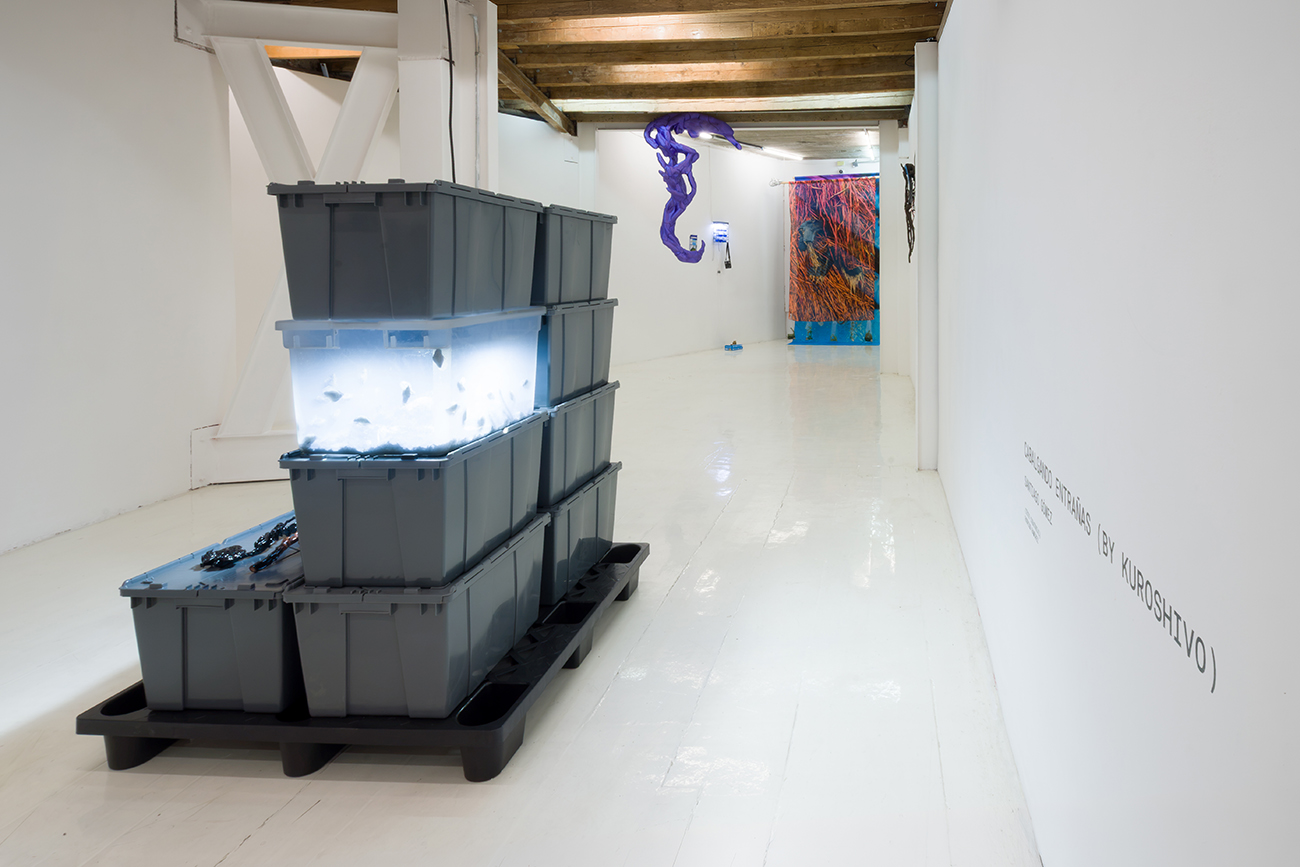
The more we allow ourselves to be devoured by the abysmal, the more our body appears as a viscous magma. At artist Santiago Gómez’s solo exhibition at Plaga, we suddenly find ourselves on a sensitive surface, where limits are lost and the boundaries between interior and exterior dissolve. Unable to signify, categorize, or organize everything that affects us, intensity causes our organs to mutate and reconfigure themselves to the point of dissolution. This collapsed body collides with the technical development of capital, imbricated with the technical advance of accelerated forces.
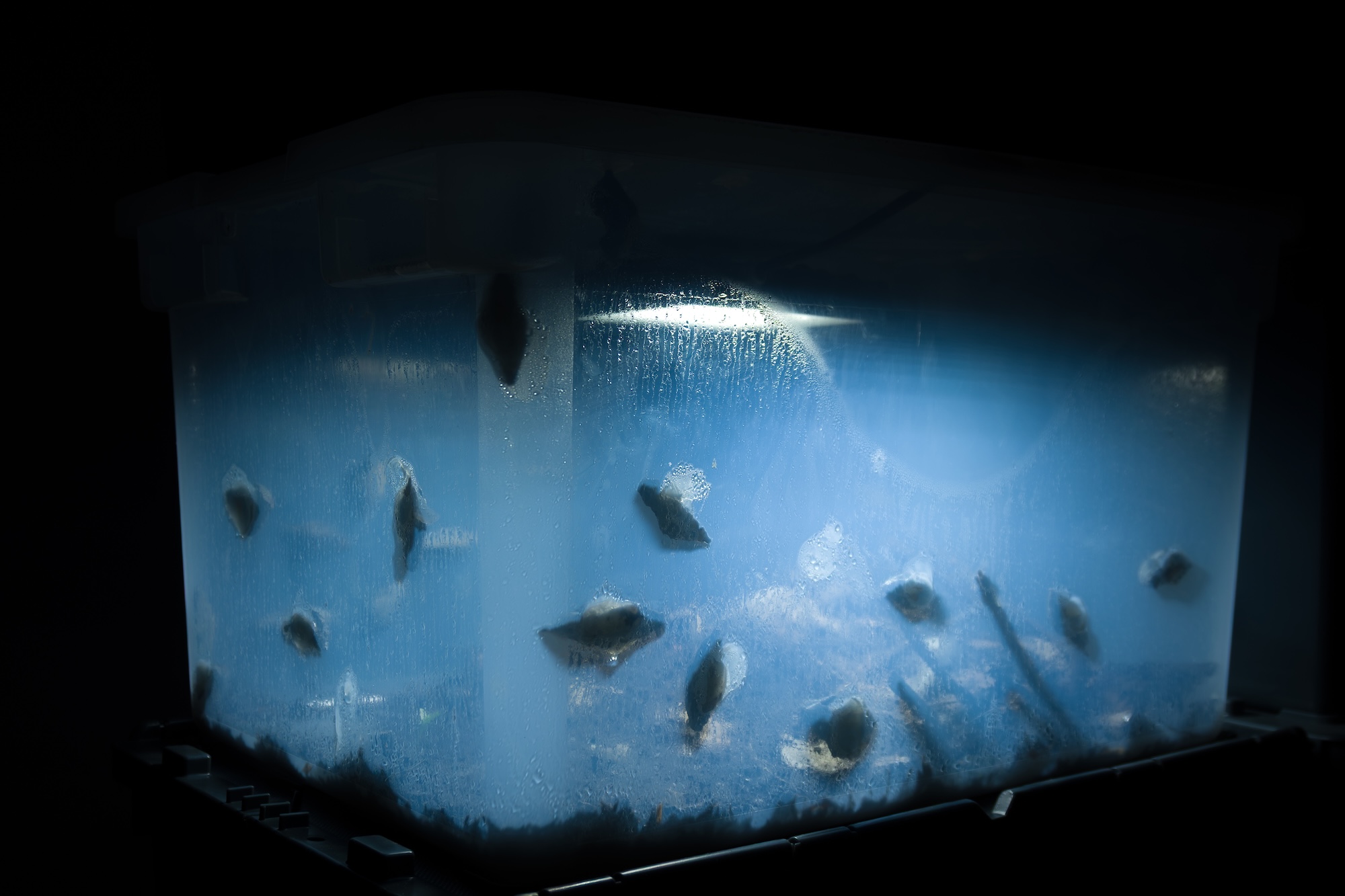
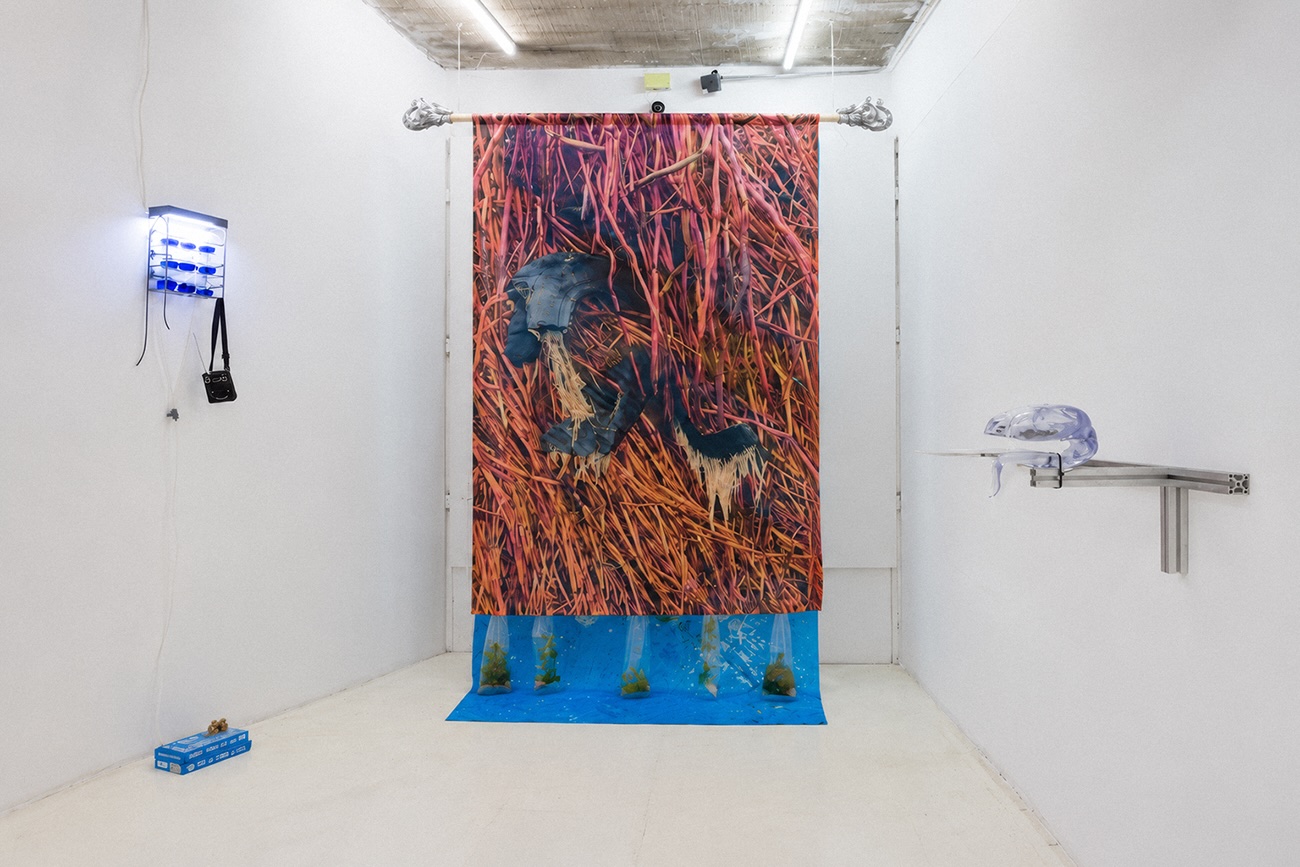
The figure of the modern explorer that Santiago Gómez rescues is not only the one who leaves home in search of the unknown, as if affected by a passion for the storm. In this case, it is the explorer who has fallen or thrown himself into the sea. He has been possessed by unleashed forces, both of capital and of the storm. Un barco ebrio nos arrastra por los corredores subterráneos del huracán / A Drunken Boat Drags Us Through the Underground Corridors of the Hurricane (2026) shows us the explorer’s view after the shipwreck. It appears as a tangle of algae and tire fragments decomposing in full sun. The piece shows us the enterprise after the shipwreck and its merchandise flowing through the underground corridors of the Mixuca fish market in Mexico City.
Kuroshivo Minorista (the project from which the exhibition emerges) is a journey at constant risk of death, yet awaiting a reward for conquering, capturing, and ordering the world. This romantic effervescence runs through the search for an unexplored place, a treasure island, the new continent that could hurl us into the wholly other. His journey (our journey) is not only that of Ahab, the self-destructive captain of the Pequod in search of Moby Dick, the mythical abstract monster, as the fatal destiny of the capitalist enterprise, but a journey expressed as a movement that sustains itself as intensity. We are already living the end of the world, yet we have neither the language nor the concepts to describe it.
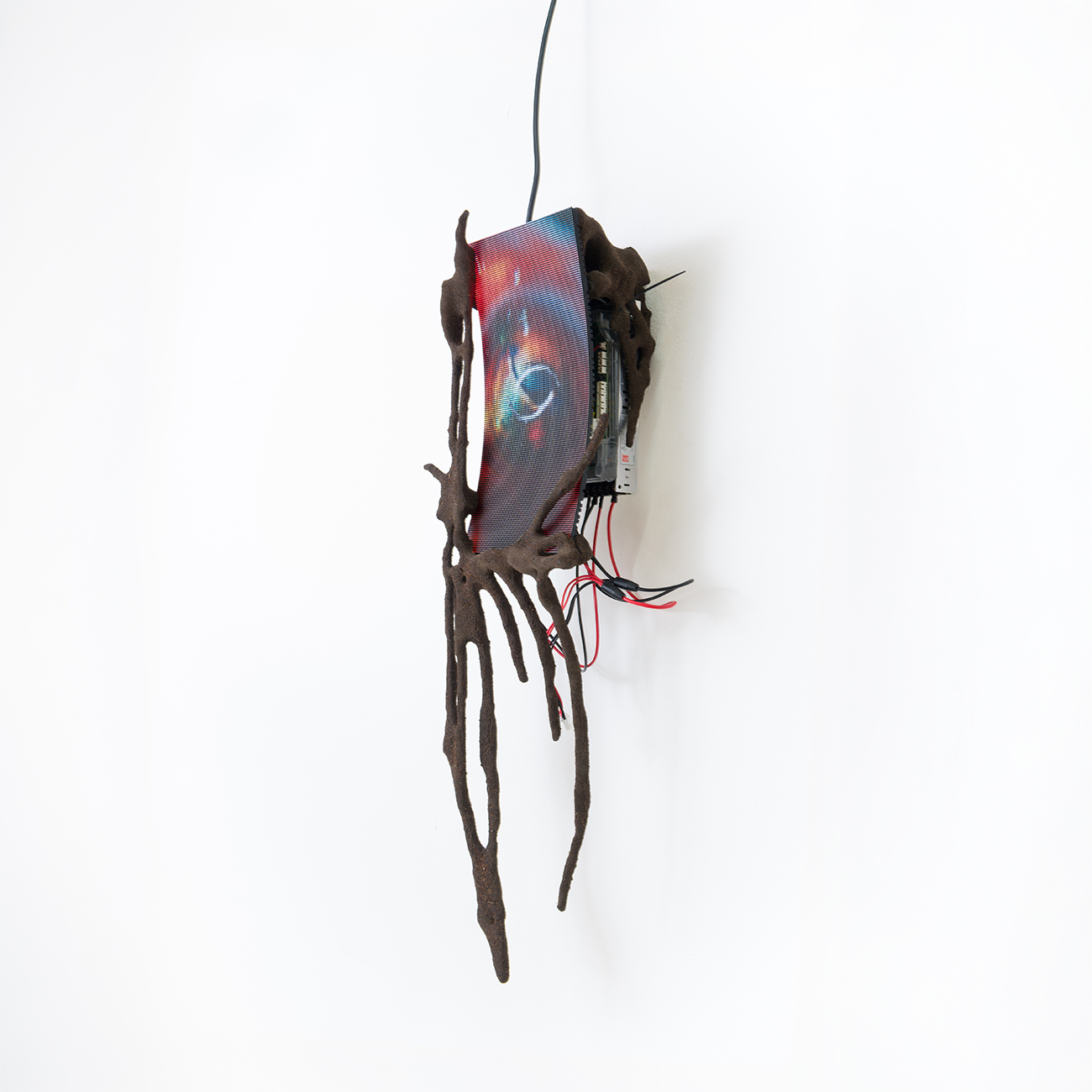
On the one hand, the pieces are made from the apparent perfection of hyper-efficient machine production; on the other, they emerge from the incorporation of the unknown, the monstrous, or the mutant, outlining a capitalism in which environmental hells and toxic residues are now combined with the ideal product of the virtual image of the spectacle, embodying this principle of viscosity that Morton writes about so extensively in Hyperobjects. It reveals that as explorers we no longer need to embark on a long journey; the ship has been wrecked “in the midst of senseless voices” (Michel Serres, Hermes IV). We are in the middle of the cloud or the storm. There is no longer any point of reference to cling to. But it also shows us how capitalism has penetrated every filament, every molecule and particle. By disorganizing our organs, it has become the very force of the hurricane.
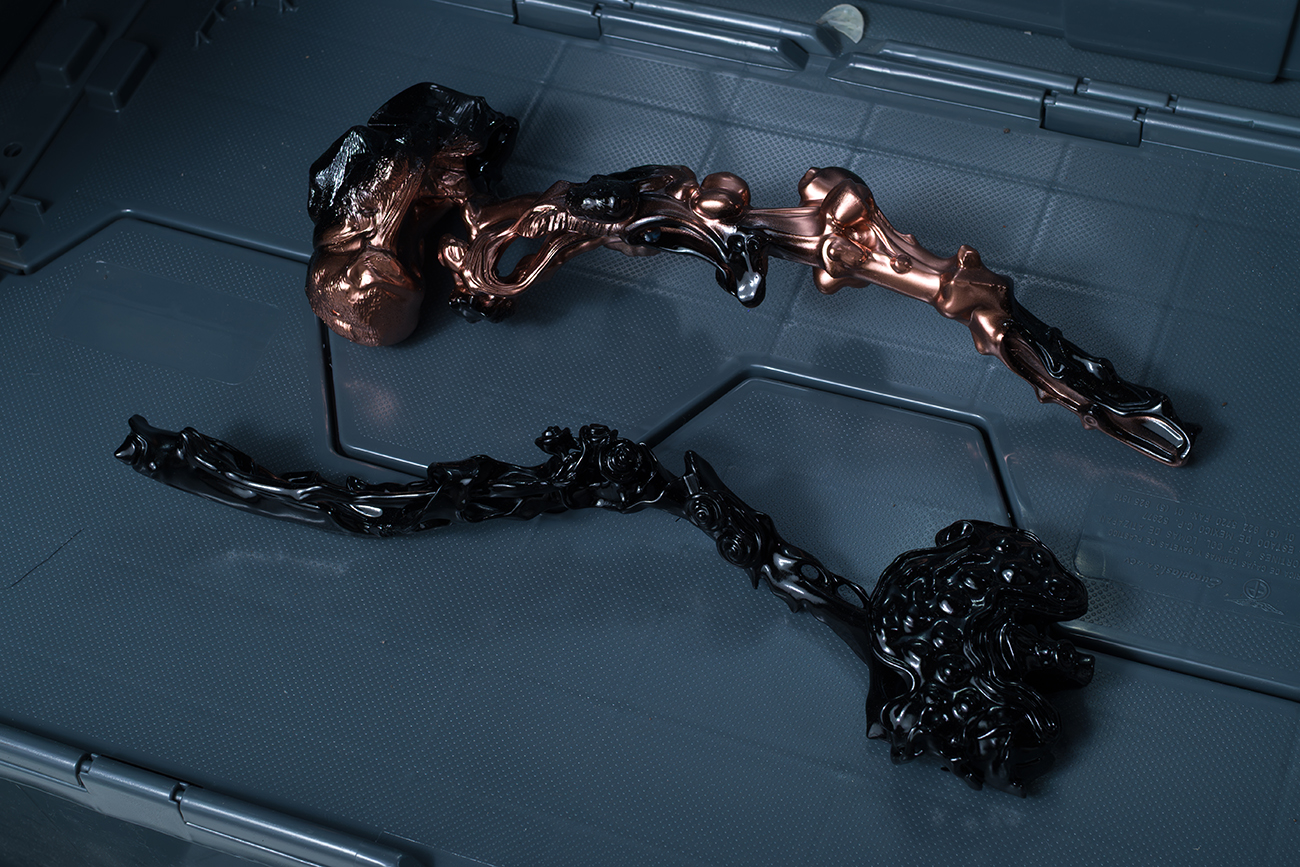
Cabalgando Entrañas / Riding Entrails presents this failed enterprise as an infected, waste-filled, and strange body, blended into the virtual flows in which a new flesh is constructed. Flusser says that viscous bodies (Vampyroteuthis Infernalis, Vilém Flusser) repel us because they are more alien to our own structure, yet this alienness is also a common evolutionary principle of our skin, overlooked and distanced in the corners of time. But this viscosity is what drives our yearning; it is also the humid space that proliferates in erotic illusion. The exhibition posits this eroticism as the decomposition of the structures that sustain us, and as the moment when bodies dissolve into one another. But in its indiscernibility with capital, it stages a rendered sexuality produced by the program.
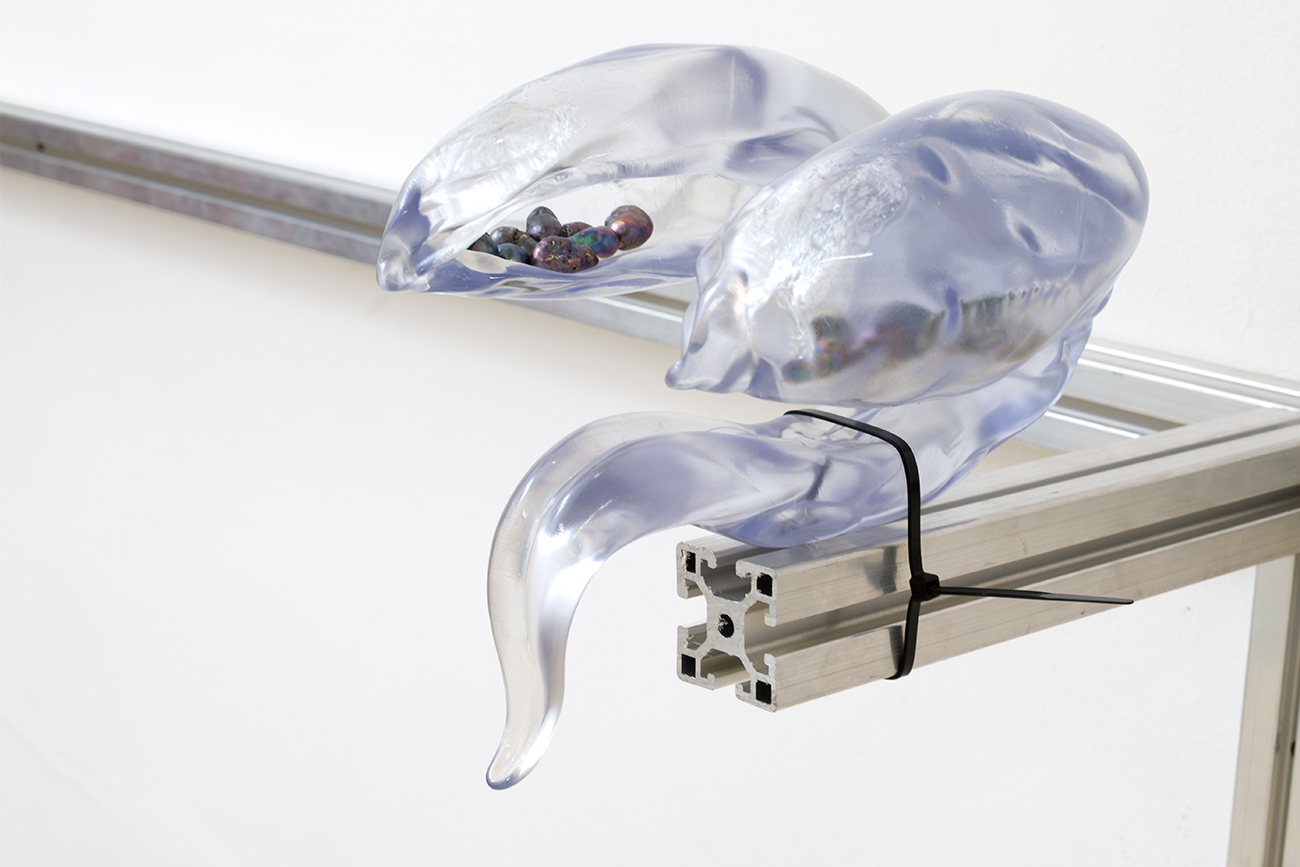
In the exhibition, the sexed organ has become mutant proliferation. Órgano Multong (lóbulo genital) / Multong Organ (genital lobe), 2026, is a translucent, degenerated organ that ejaculates pearls, grown in the sewers of black markets, in the waste of virtual devices, in machines fed by waste materials. This hinge principle in Gómez’s work confronts the possibility/impossibility of desire in the accelerated life of capitalism. A set of aberrant connections that emerge in the liminal spaces that the capitalist death machine leaves behind. We ride the entrails, clinging tooth and nail to the hope for a space of possibility, in the midst of an apparent general collapse. Holding the helm or the reins, whipped by the winds, eager and still awaiting a vital sliver of desire and longing. We still long to see our paradise, our supposed destination beach, as promised.
As intercessors of the virtual/actual domain, these 3D impressions play with a force of indifferentiation: a power that makes the artificial appear, or rather, the simulation that potentiates the erosion between the real and the false. In the piece Raíz de Kuroshivo. Crítica a la razón umbilical / Root of Kuroshivo. Critique of Umbilical Reason, 2026, the projection of the interior of the body is a virtual reconstruction, an exploration that becomes a simulation of the folds, of the fluids of an interior that exists only virtually.
Captured by the time of the human in Gómez’s work, the program continues programming itself, but the swallowing of the entire exterior produces an implosion that catalyzes, in the midst of the devices, a crack, a sewer, a fissure, or a wound through which the synthetic entrails emerge.
Santiago Gómez: Cabalgando Entrañas / RIDING ENTRAILS was on view from September 17 to October 17, 2026. The exhibition was presented by PLAGA, Galería Divergente.