

.webp)


Wenfei Quan: “Contemporary Hominin” at TaThaTa
Review
“We want justice… We want it now… Queremos justicia… La queremos ya.”
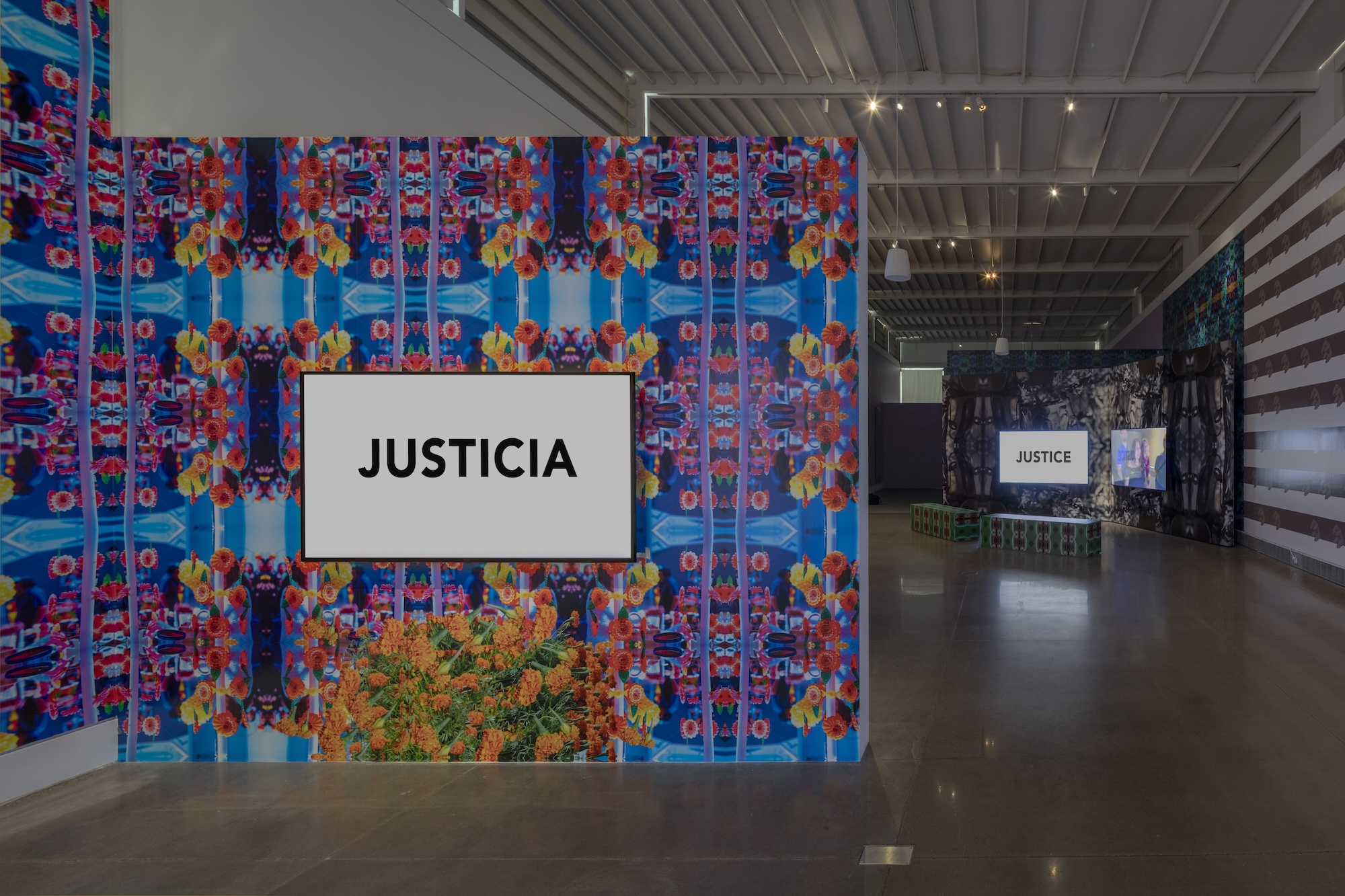
Voices in English and Spanish resonate through the lower-level galleries of the Queens Museum. The sung slogans hail from Sonia Boyce’s What We Want (with Resistance Revival Chorus) (2026). This seven-channel video documents an activist performance in the museum—and repeatedly returns it to the site for subsequent publics. Boyce employed multiple cameras to capture distinct sections of the line of people participating in a chain of call and response. Recalling the musical video installations of Candice Breitz or Ragnar Kjartansson, the performance was spatialized and hence had an undeniable immediacy.
.jpg)
What We Want is central in Demonstrate, Boyce’s solo exhibition on view at the Queens Museum until January 31, 2027. Five other videos by the artist simultaneously appear on the same set of screens, punctuating What We Want every eight minutes. They all reveal alternative functions of the museum, showing interviews with museum educators and community members and recording other ceremonial and performance activities there. For example, in the two-channel We Make Our World (2026), participants in the New New Yorkers bilingual printmaking program reflect on their experiences. An animated, geometric polyhedron alluding to pyrite or “fool’s gold”—a motif Boyce employs to interrogate received social valuations—oscillated between the two screens, linking them together. The monitors were mounted on a wall covered with digital prints on vinyl of dynamic interlocking sections of red, yellow, and black (a separate artwork, entitled Red Card wallpaper, 2026). A salon-style array of photos of participants’ hands at work also appeared over the brightly hued ground, bringing the content of the workshop into the exhibition.

Boyce is less known in the United States; however, especially in the twenty-first century, she has loomed large in the United Kingdom's art scene. She represented Great Britain at the Venice Biennale in 2022. Hauser & Wirth began representing her in 2023, which coincided with her work increasingly appearing in museums and non-profit spaces in North America. Her career began to take off in the 1980s, as she emerged alongside a generation of Black British artists whose practices engaged with questions of race, identity, and representation. Although her medium and style have shifted over the decades, female subjects and racial politics remain key themes in Boyce’s work.

Decorative patterns, which resemble wallpaper, appear in her early works such as Lay Back, Keep Quiet and Think of What Made Britain So Great (1986), which is a poignant reflection on colonialism. Wallpaper itself began appearing more frequently in her installations from c. 2007 onwards. An early example is Clapping Wallpaper (1994), which makes a performance “echo” across a space in a manner similar to what is seen in Demonstrate. Here, all the walls and benches are covered with colorful vinyl prints, creating an incredible sense of visual density. By lifting a domestic element to the museum's high ceilings, Boyce suggests that more intimate, personal activities, such as the memorial service for a trans woman in Testimony (2026), can have a place in public. Marigolds featured in that work repeat as patterns on the wall. Moreover, as other multiplied motifs dominate the space of the galleries, Boyce effectively claims the walls—further legitimating the extra-artistic actions.
The show’s title illuminates the contents that comprise it: “to demonstrate,” of course, means to protest publicly. Indeed, for What We Want, singers processed through the museum. The Resistance Revival Chorus, whose members led the song, is a collective of women and non-binary singers that was founded in 2017 to resist the policies of President Donald Trump and helped Boyce transform the museum. Their singing took the form of calls for justice, freedom, peace, honor, love, power, hope, care, healthcare, and land to be returned. These words were, in some cases, translated into Spanish, and Boyce undertook further amplification of the messages by transcribing the text in bold black capital letters onto white ground on some of the screens. Viewers thus encountered the chorus both aurally and visually, hearing its rousing calls while reading the shifting demands projected across the screens, articulated through the collective voices of “we” and “queremos.” Beyond witnessing the act, this piece prompts an imagining of collective, joyous political procession through the museum.

Additionally, a significant number of the participants were people of color, including members of the Latinx community, who represent a significant portion of the users of the parks that surround the museum. Participants circled the iconic Panorama of the City of New York, a meticulously crafted model of Greater New York commissioned by Robert Moses for the 1964–65 World’s Fair. Moses is a now-infamous urban planner whose initiatives left an indelible mark on infrastructure policy all over the US. Robert Caro’s Power Broker (1974) importantly brought to light many of the more dismal aspects of Moses’s development projects, which often disproportionately displaced (or negatively impacted) low-income or minority New Yorkers. Thus, the confrontation with technocratic authority and the reclaiming of the city come to the fore through site-specific investigation and staging.
Demonstrate fulfills its titular mandate with artworks that show the Queens Museum can be a hub for all kinds of social action. It becomes clear that the museum does not just serve the traditional function as a space for viewing or quiet contemplation, but also empowers the local community. This does have a longer history here, and we might think about Tania Bruguera’s transformation of the Queens Museum in 2011. Boyce’s works importantly deviate from straight documentary, blurring representation and presentation. Audiences almost feel like they witness the actions and thus have access to the memory of an event they did not directly attend. This heightened sense of having seen the museum’s transformation sparks and facilitates new imaginings for its use.
Sonia Boyce: Demonstrate is curated by Lindsey Berfond with Isa López and will be on view at the Queens Museum through January 31, 2027.