

.webp)

Taryn Simon: "Father Country I Do Love You" at the Guggenheim
Review
Born in Culiacán and trained as a forensic pathologist, Teresa Margolles worked as a mortician in Mexico City during the 1990s, where her encounter with drug-trafficking-related deaths sparked the beginning of her artistic practice. Connecting the bodies in the morgue to the criminal activities spanning the US-Mexico border, Margolles’s minimalist sculptures, videos, and installations expose the social and political forces that propel and mask violence. The artist is ruthless in her use of materials, which include glass from crime scenes, rubble and soil from contested sites, and residue from dead bodies. Her work forces a confrontation with unsettling and unsavory topics that are typically driven underground, while simultaneously memorializing lives that have been lost or upended.
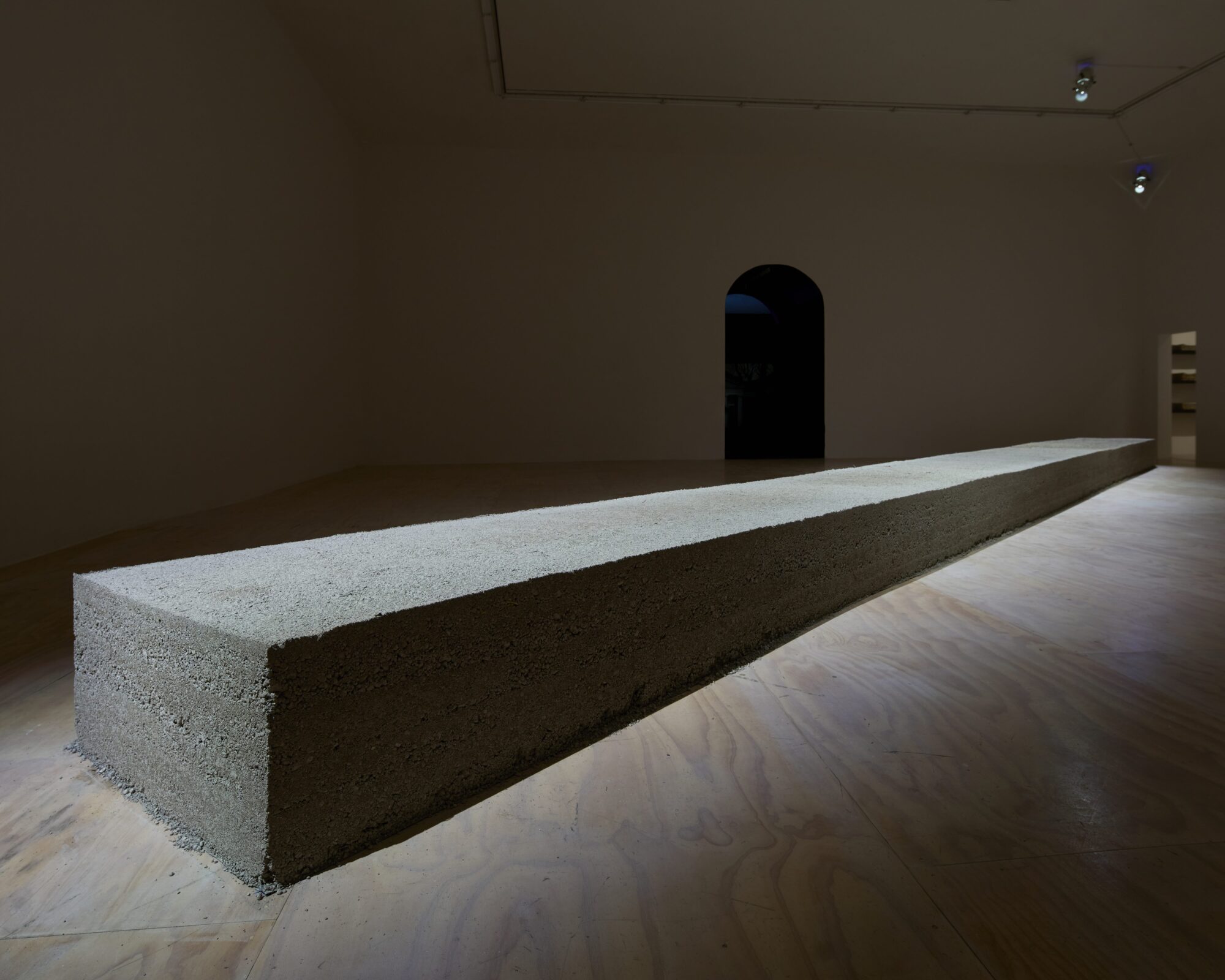
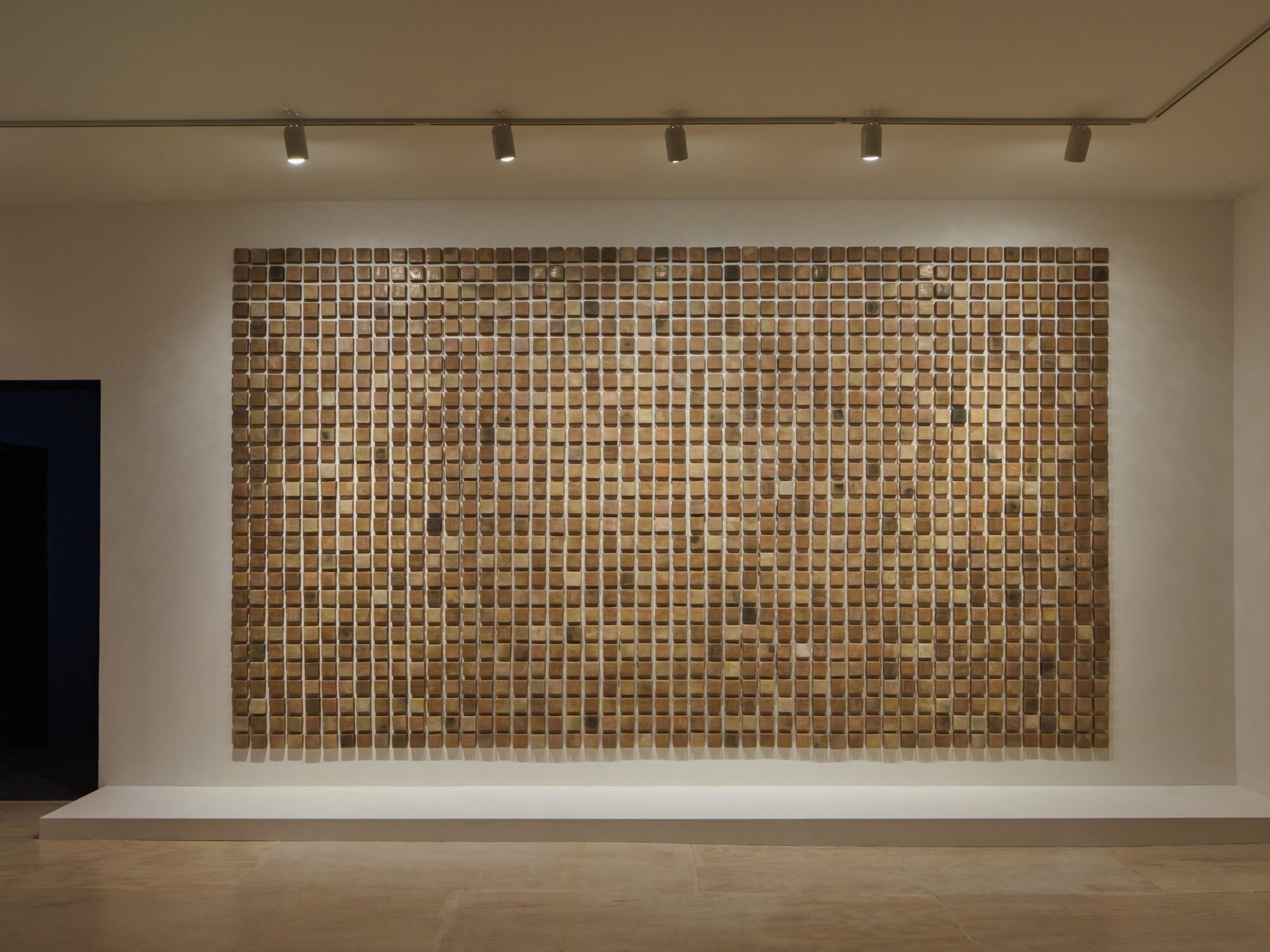
En el lugar de los hechos (At the Scene), organized by MoMA PS1, is the first large-scale museum presentation of Margolles’s work in the US. The exhibition spans the early 2000s to the present, with the installation La promesa (fragmento) (The Promise) (fragment) (2012), a colossal horizontal column of thirteen tons of pressed rubble from a demolished house in Juárez, Mexico, as the centerpiece. Located near the Mexico-U.S. border, Juárez underwent rapid and uneven urban expansion as its manufacturing sector grew, following the implementation of NAFTA (North American Free Trade Agreement) in 1994, which led to overdevelopment, exacerbating existing infrastructural and socioeconomic inequalities that, alongside organized crime, gender inequality, and institutional failures, formed the backdrop to rising drug-related violence and femicide. As the exhibition title suggests, contested sites and their relationship to the gallery space are central to Margolles’s work. Another large piece, La gran América (The Grand America) (2014), consists of a grid of 1,400 wall-mounted clay tiles made from the soil from both sides of the Rio Grande riverbed.
The exhibition opens with the videos La nieve (The Snow) (2015) and El agua de la ciudad, Dallas (The Water of the City, Dallas) (2016), both of which commemorate infamous, unknown murder sites. In La nieve, a neighbor shovels snow off the sidewalk where Eric Garner was arrested and killed. This location at 202 Bay Street (now renamed Eric Garner Way) in Tompkinsville, Staten Island, is recognizable from the video of the incident that went viral. In contrast, El agua de la ciudad, Dallas depicts obscure sites where people have been shot. Each site is methodically scrubbed with water reclaimed from morgues or crime scenes. In some cases, the surrounding scenery, such as a tree-lined suburban street scattered with rustling leaves, is so serene it is jarring to imagine a murder took place there. Margolles provocatively teases the line between tranquility and violence.
The following gallery is pitch black with the exception of two illuminated cases holding pieces of jewelry created from shards of glass taken from the wreckage of crime scenes in Culiacán. Margolles commissioned a local jeweler to create Joya (Cadena) (Jewel [ Necklace]) (2007), which inlays glass shards in place of precious gems in a ten-carat gold necklace. The spot-lit installation mimics the display of jewelry or antiques in museums, evoking the often-complicated histories behind artifacts, often involving empires, oppression, and theft. At the same time, it recalls cinematic representations of jewel heists, drawing a parallel between institutional and illicit forms of acquisition and reinforcing the work’s broader connections with capitalism, violence, and art.
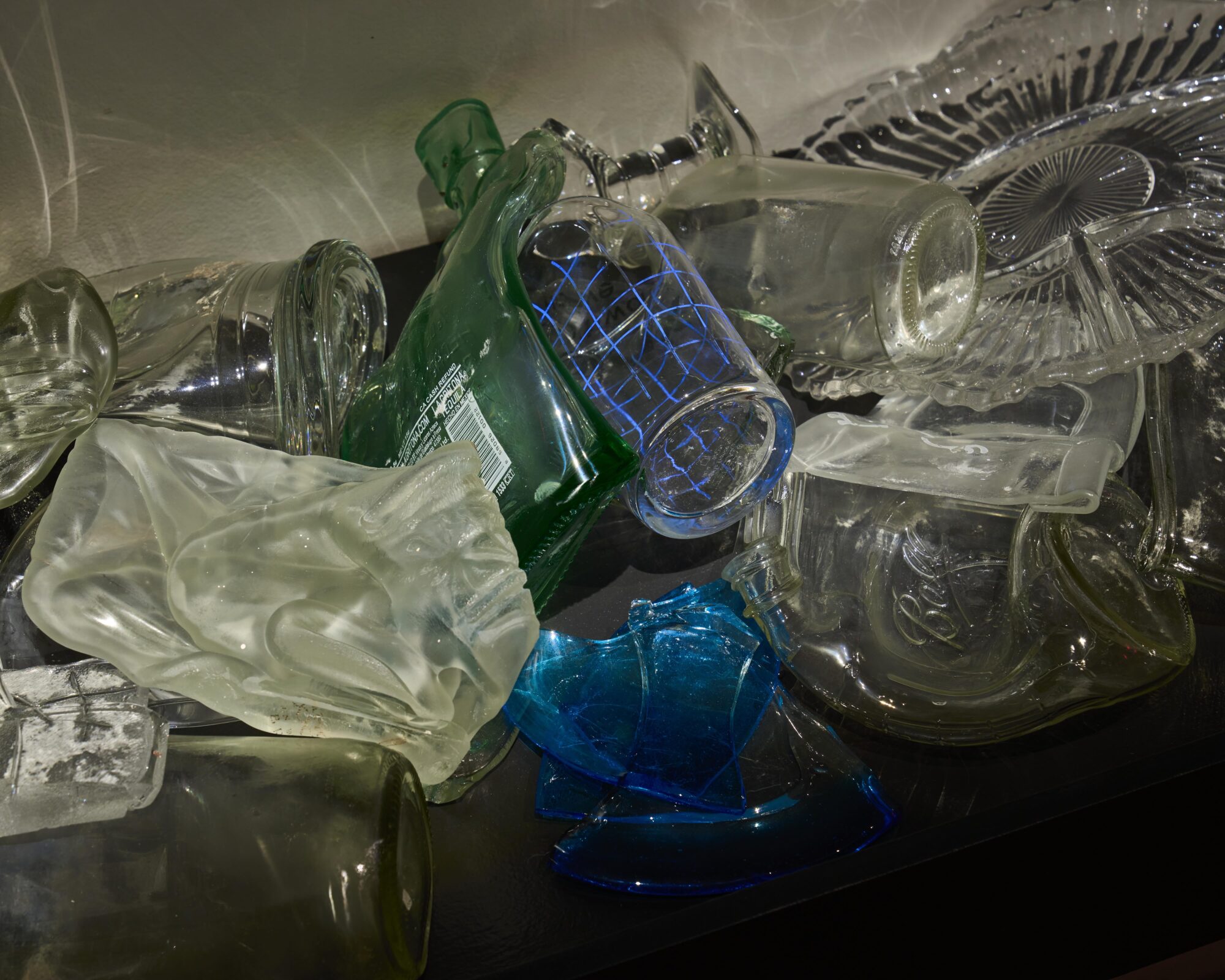
In Vestigios de la Ira (Vestiges of Wrath) (2026), glass as a material plays a symbolic role. It is melted and fused together, representing lives that were upended or destroyed. The installation also features two horizontal strips of everyday glass objects—goblets, vases, serving plates, and soda bottles salvaged from homes of people who have been deported. In the artist’s words, the sculpture “mourns the broken dreams and shattered illusions of immigrant communities in the US” as a result of the current immigrant enforcement efforts.
The most unsettling works in the exhibition, Periferia de la agonia (Periphery of Agony) (2003) and Aire (2026), employ minimalist forms to bring the viewer into an encounter with death. Upon first glance, Periphery of Agony appears to be an almost tranquil room-sized tapestry featuring a subtle repeating print that evokes a horizon line. The pattern is, in fact, an imprint left by a dead body. Stepping closer to the residue-coated fabric, the experience becomes unnerving. A largely empty space with two industrial air conditioning units, Aire, too, initially appears innocuous. The wall text at the entrance explains that the two humidifiers are infused with residue collected from sites of violence. Although it also assures visitors that the elements are at a safe level and pose no risk, with every breath the viewer is made conscious of what they are inhaling. Margolles makes the point that it is really not possible to completely distance ourselves from the brutality around us.
The discomfort Margolles elicits in these two installations connects her work to a history of feminist performance art employing the methodology of re-staging sites of violence, particularly rape scenes. The most famous and contested example is Ana Mendieta’s performance Rape Scene (1973), in which she reconstructed the sexual assault and murder of Sarah Ann Otterness, a fellow student at the University of Iowa. Mendieta invited her classmates to a performance at her apartment, where they found her bent over her kitchen table naked from the waist down, hands and feet bound, and covered in blood. The reaction of the students, who sat down in the apartment and had an extended discussion about the gruesome artwork, has been the source of debate. In a 2023 article, art historian Bryony White suggests: “Mendieta might be seen as highlighting the audience’s complicity in such an event, the way in which their attention to the scene is also productive of the very unsound political affects of scenes of sexual violence. That is, we might be drawn to stare and point, to disbelieve, to feel morbidly intrigued… Are we excited voyeurs? Are we complicit bystanders?”1 Other feminist performance pieces that have re-staged violence and grappled with these questions include Yoko Ono’s Cut Piece (1964) and, more recently, Emma Sulkowicz’s Mattress Performance/Carry that Weight (2014).2
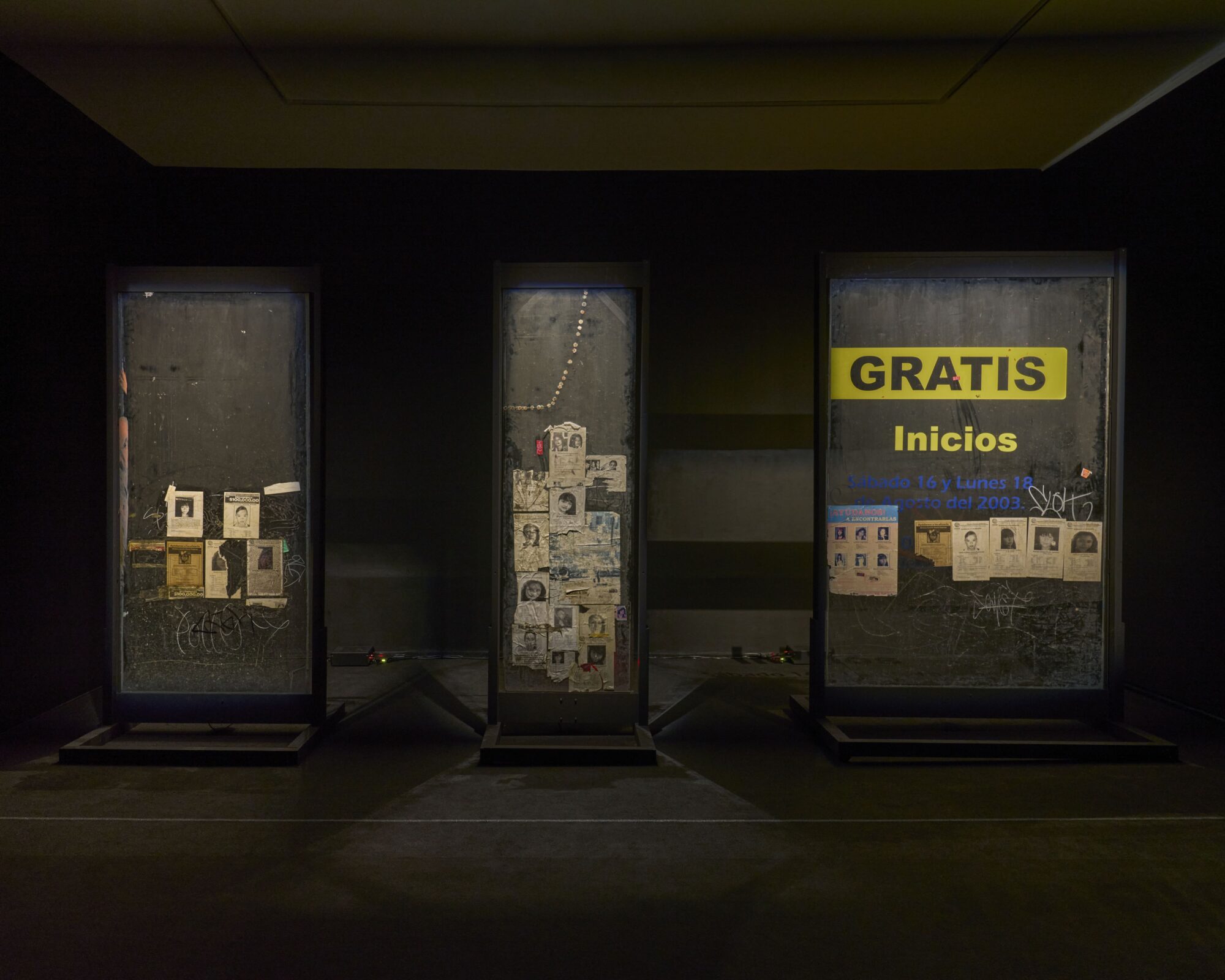
The closest Margolles comes to the explicit recreation of a rape scene is La búsquedo (1) (The Search [1]) (2014), a monumental wall sculpture created from window panes removed from an abandoned store in Juárez and covered with pasted photographs of missing women. The broadsides refer to rampant femicides and violence against women experienced in Mexican communities and particularly in Juárez since the 1990s. These incidents were frequently documented through posters and newspapers, a practice that has spurred the development of femicide photography, as feminist collectives and photographers collaborate to stage and record re-enactments of murder scenes to prevent the deaths from being concealed and forgotten.3
Despite a few uncomfortable moments, En el lugar de los hechos manages to address taboo and often sensationalized topics while maintaining an atmosphere of reflection and quietude. Returning to La Promesa, which crumbles and dissolves at the edges, the artist arranged for the work to be dismantled by people who have experienced broken promises and unfilled dreams. Segments will be removed for one hour each day. By the end of the exhibition, the entire sculpture will vanish.
Teresa Margolles: En el lugar de los hechos (At the Scene) is on view at MoMA PS1 from September 24, 2026 to February 8, 2027.
References:
1 Bryony White, Returning to The Scene of the Crime: Gendered and Racialized Violence in Ana Mendieta’s Rape Scene, Art Journal, 82:2, 68-81.
2 Ana Fazekas, (Auto)Biography of Hurt: Representation and Representability of Rape in Feminist Performance Art, Journal of Literature, Culture and Literary Translation 8:1, 12, 2017. https://www.sic-journal.org/Article/Index/465.
3 Aline Hernández, "Doubling Down on the Spectacle: The Performative (After) Lives of Femicide Photography in Mexico," Contemporary Theater Review, 2022.