.jpg)

.webp)
Matthew Ronay at Casey Kaplan Gallery
Review
Chia-Yun Wu’s practice is shaped by the movement between places. Born and trained in filmmaking in Taipei, Wu studied in London and now lives in New York, where her first US solo exhibition, Elsewhere, is on view at Nunu Fine Art. The artist negotiates the difficulties of locating a stable sense of self within and between these distant geographies.
Elsewhere presents new works developed from two previous series: A Song for Loss (2020) and No Home to Land (2025), both of which debuted in Taipei, with the latter commissioned by the Taipei Fine Art Museum for the 2025 Taipei Biennial. The two series, combining theatrical installation, photography, and mixed media, connect personal histories to unresolved questions of Taiwanese nationhood. Rather than foregrounding explicit markers of national identity, however, the works in Elsewhere center more on the subjective experience of relocation. The works evoke the difficulty of establishing a stable sense of identity or belonging without a single geographic location as a fixed point of reference.
Drawing on her training in filmmaking, Wu integrates cinematic strategies with digital photography. For example, she incorporates text reminiscent of film subtitles. Additionally, her compositions and subject matter evoke pillow shots, cinematic cutaways to still life or landscape as transitions between scenes. Wu does not consider herself a photographer due to her belief that the medium requires particular interest in the photographed subject. Instead, she focuses more on the physical properties of imagery, exploring how formal interventions affect viewing conditions.
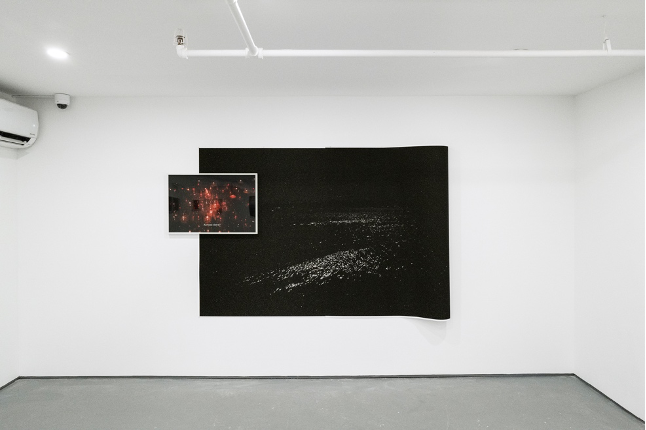
For these new works, she re-photographed photographs shot years ago and then made new prints from those images. This meta-approach of photographing photographs introduces an additional stage of production, which complicates distinctions between image and object. Elsewhere (v) (2026) and Elsewhere (vi) (2026), for example, capture transparent vinyl that was wrinkled or partially peeled from the physical prints before the photographs were taken. The resulting images foreground the photographs as physical objects while also exposing the successive physical interventions underlying their production.
Layers produce distance between viewer and image—a point Wu reiterates in formal terms throughout the exhibition. Elsewhere (ii) (2026), a photograph of church candles, partially overlaps with Elsewhere (iv) (2026), a sizable print with one end rolled up against the wall. Wu similarly plays with visual access through layering in two diptychs: Elsewhere (x) (2026), which pairs a framed piece of white clay with a landscape photograph, and Elsewhere (ix) (2026), which consists of two photographs of vegetation printed on dark gray mirrors. Each visual is partially obscured by translucent plastic, while the use of darkened reflective surfaces further complicates visibility.
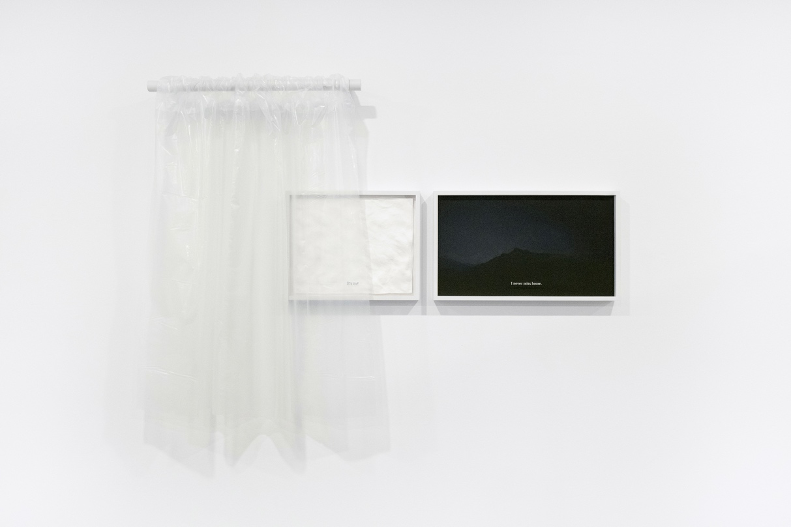
Similar logic of layering extends to the subtitle-like text, which Wu adheres to the protective glass instead of digitally integrating the phrases within the images. Elsewhere (x) reads “It’s not” and “I never miss home,” while Elsewhere (ix) includes “Hope, Despair” and “Despair, Hope.” The phrases are doubled and rendered ambiguous: the conviction of “I never miss home” is cast in doubt by “It’s not”; the reversed order of hope and despair forms a loop in which the two sentiments feed into each other.
The exhibition repeatedly resists a sense of closure or culmination. Wu channels her experience of migration through her art, without resolving questions of belonging. The framed white clay from Elsewhere (x)—an unadorned surface, a literal blank slate—is open to associations of incompletion, while perhaps serving as a placeholder for what is yet to come. A similar sense of suspension appears in the circular white clay at the center of a photograph of a tree in the middle of a prairie in Elsewhere (xi), as well as an adjacent crimson circular drawing.
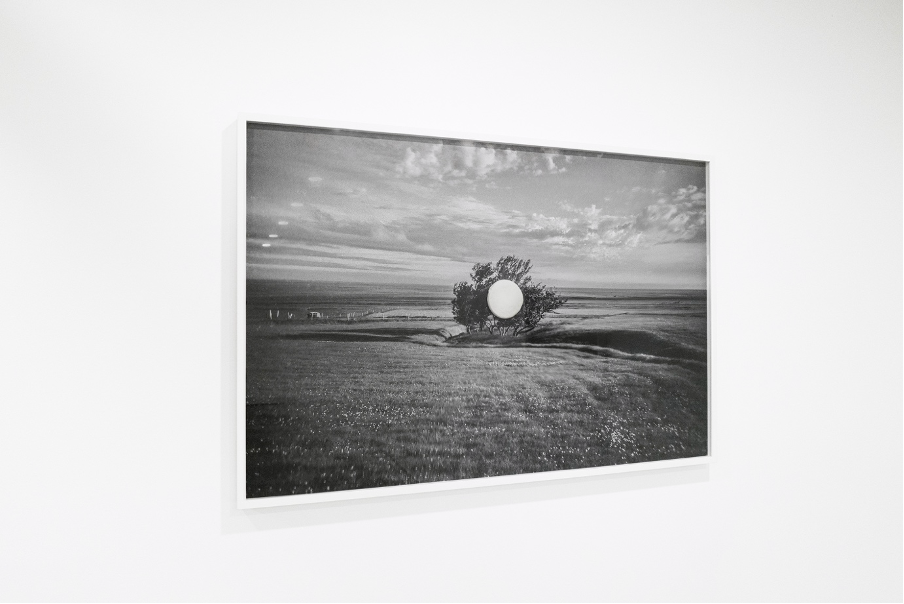
Wu’s interest in displacement also emerges through her emphasis on transitions in this exhibition, fabricated in both Taiwan and the US. Through pillow shots, she locates viewers between scenes without a clear sense of direction. A Song for Loss (iii-i) (2026), meanwhile, consists of two strands of hair collected from Wu’s parents back in Taiwan, accompanied by a dark printed line symbolizing Wu’s own hair, evoking a sense of distanced presence rendered through representation rather than material remnant.
To add one final layer, Wu affixes text to the exit stair risers that is visible only as viewers leave the show: “My luggage was light, yet my heart was heavy. My dream is near, yet my home is far. My body will dissipate, yet my soul will keep wandering.” Directly beside this text is Elsewhere (iii) (2026), a portrait of Wu and her family printed on a darkened mirror that was unintentionally smudged during production. Rather than arriving at a destination, Elsewhere leaves Wu—and the viewer—in a state of suspension.
Chia-Yun Wu’s Elsewhere is on view at Nunu Fine Art in New York through October 31, 2026.