


In Conversation with Steve Locke
Interview
Danny Fox's recent solo exhibition at Alexander Berggruen centers on Fata Morgana, a peculiar optical phenomenon in which refracted light lifts distant ships above the horizon and holds them in midair. Fata Morgana gathers Fox's recent seascapes and interiors rendered in loose, layered brushwork that produces surfaces veined with traces of earlier strokes that seep through like faint tide lines. Through the consistent use of pentimenti, which leaves earlier brushwork and moments of doubt visible on the canvas, Fox positions himself as an unreliable narrator of his own pictorial space, presenting visual truth as something provisional and to be continually revised.
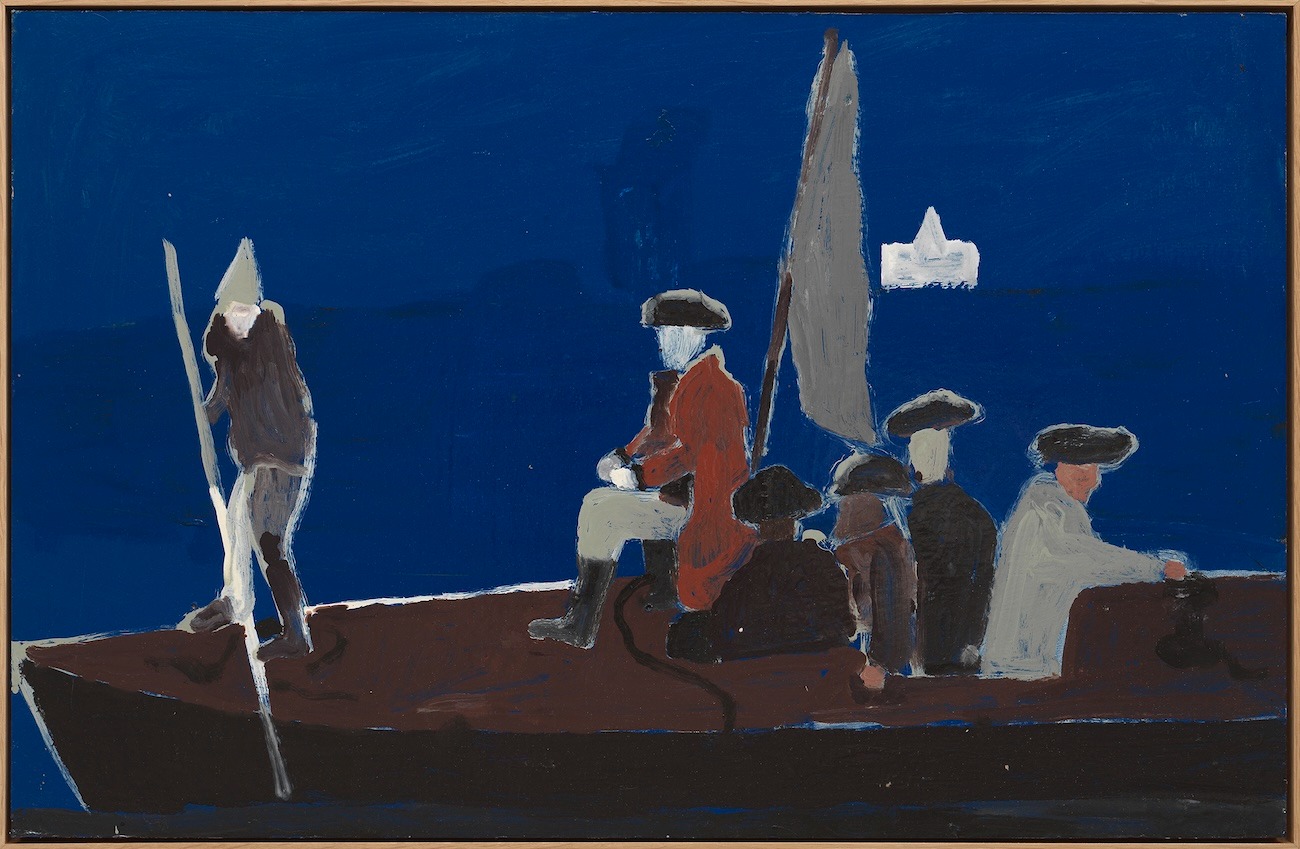
Drawing on the Fata Morgana mirage witnessed along the Cornish coast, Fox paints boats, animals, and figures on a journey caught between sea and sky. The departure (2026) depicts a group of sailors crossing a blue seascape, its faint horizon dissolving in Fox’s restless brushwork. A second glance reveals a white, iceberg-like form hovering in the distance, unmoored from the ocean below. A similar sense of ungrounding appears in the title painting Fata Morgana (2026), where a small boat is suspended amidst a turbulent grey backdrop. The pentimenti carve darker passages into the seascape, giving his compositions a mercurial quality; like his wandering subjects, Fox’s compositions induce a peculiar vertigo as viewers search for their bearings in his unstable seascapes.
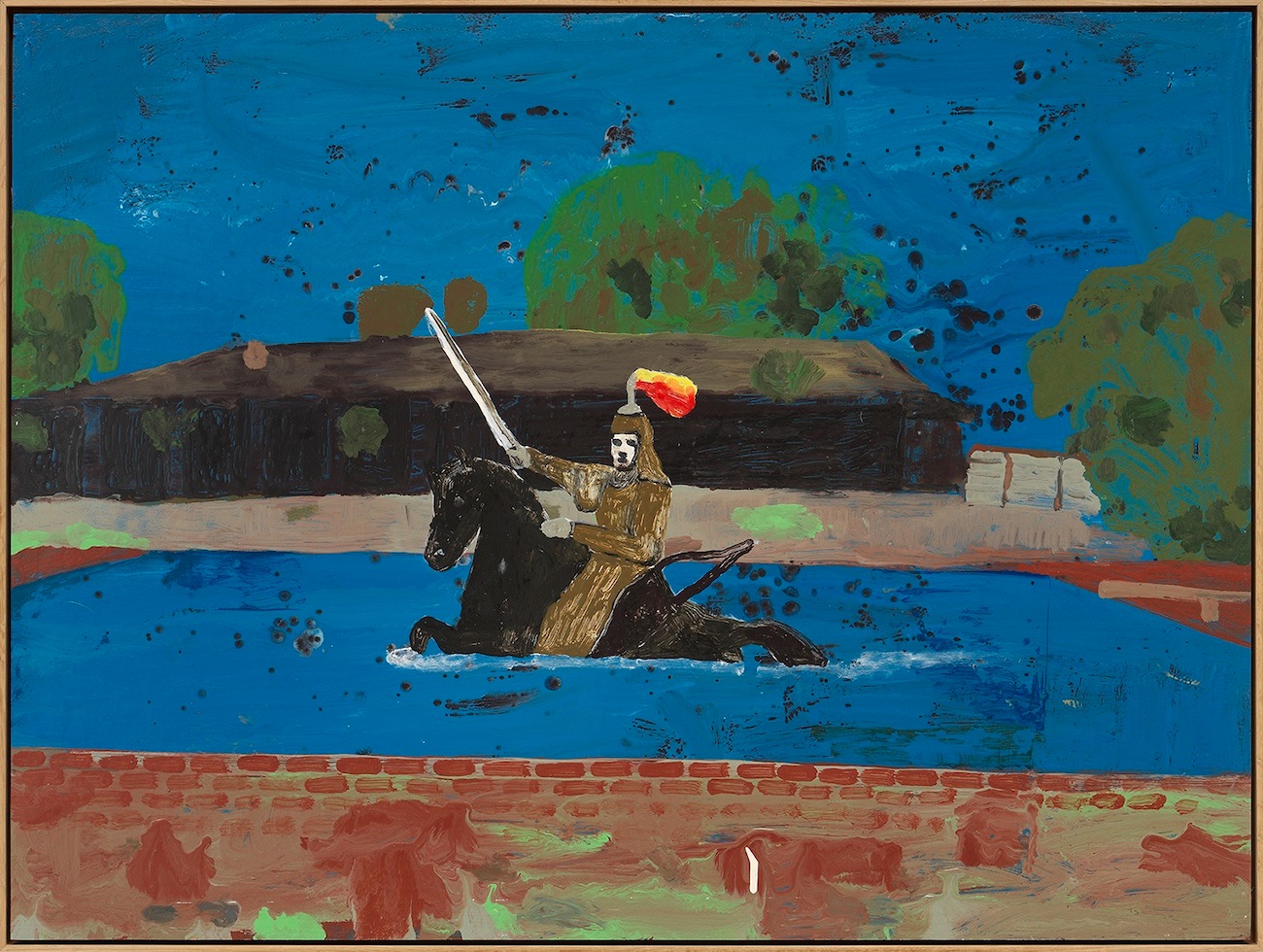
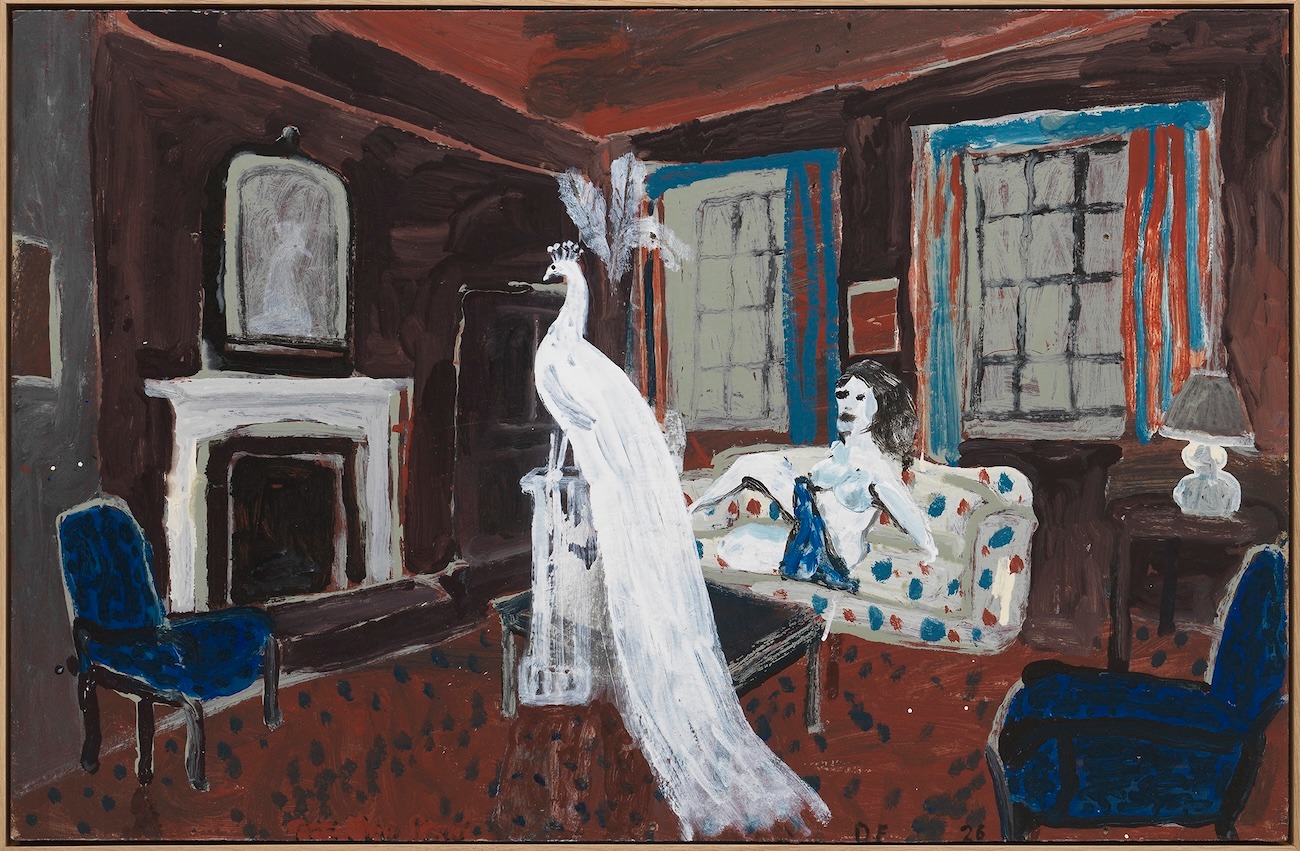
Rather than reproducing the Fata Morgana as a recurring motif, Fox takes its perceptual disorientation as a governing principle. Beyond his seascapes, the mirage assumes a different register within Fox’s interiors, where the distinction between the domestic space and the natural world is repeatedly destabilized. In black motel (2026), a knight in armor charges through a motel swimming pool on a black horse. His raised sword and charging posture suggest conflict, yet the motel pool relegates his gesture to a mere pose. In The Mad King (2026), a white-feathered peacock looks back at itself through a mirror in a dark living room. It hovers above a nude woman, who reclines on a couch nearby. Its dominant pose seems to overpower the woman's presence, claiming the domestic space as its own. On the other side of the gallery, a zebra emerges among decorated tableware in High Tea (2026). The stained plates and used butter knives bear the evidence of human occupation, yet its most conspicuous inhabitant belongs elsewhere. Fox displaces the characters in unconventional settings to make their existence absurdly incongruous, leaving viewers to reconcile the same discrepancy between appearance and expectation that governs the rationale of Fata Morgana.
This unsettled condition is perhaps most pronounced in what Fox calls “the humble journey,” where the distance between departure and destination becomes a condition of perpetual estrangement. On the other side of the gallery, a group of bundled-up figures gathers amid a landscape of bruised purples and muddy grays. The title, The Negotiator After Vernet (2026), relegates the gathering’s temporary nature, and Fox’s barren winter landscape makes even this brief huddle seem all the more fleeting. In rider and moss (2026), a figure in black and a tricorn hat rides a white horse along a narrow strip of ground. Arrested mid-gallop, horse and rider seem condemned to perpetual transit. The liminal quality of Fox’s compositions evokes a palpable sense of estrangement that echoes the instability of his pentimenti, which resist any form of resolution or belonging.
Animals appear within domestic interiors, ships float in the sky, a knight on a horse finds himself stationed in a swimming pool. The absurdity of repeated estrangement disorients viewers, as familiar forms no longer convey their apparent meanings. Yet in Fox’s textured surfaces, the pentimenti produce a form of perceptual truth. Rather than resolving perceptual uncertainty, Fox leaves it embedded in the image, suggesting that seeing is only the first stage of perception; reality is not simply apprehended but constructed through the mind’s ongoing acts of interpretation.
Danny Fox: Fata Morgana was on view at Alexander Berggruen through October 7, 2026.