
Santiago Gómez: “Cabalgando Entrañas / Riding Entrails” at Plaga
Review
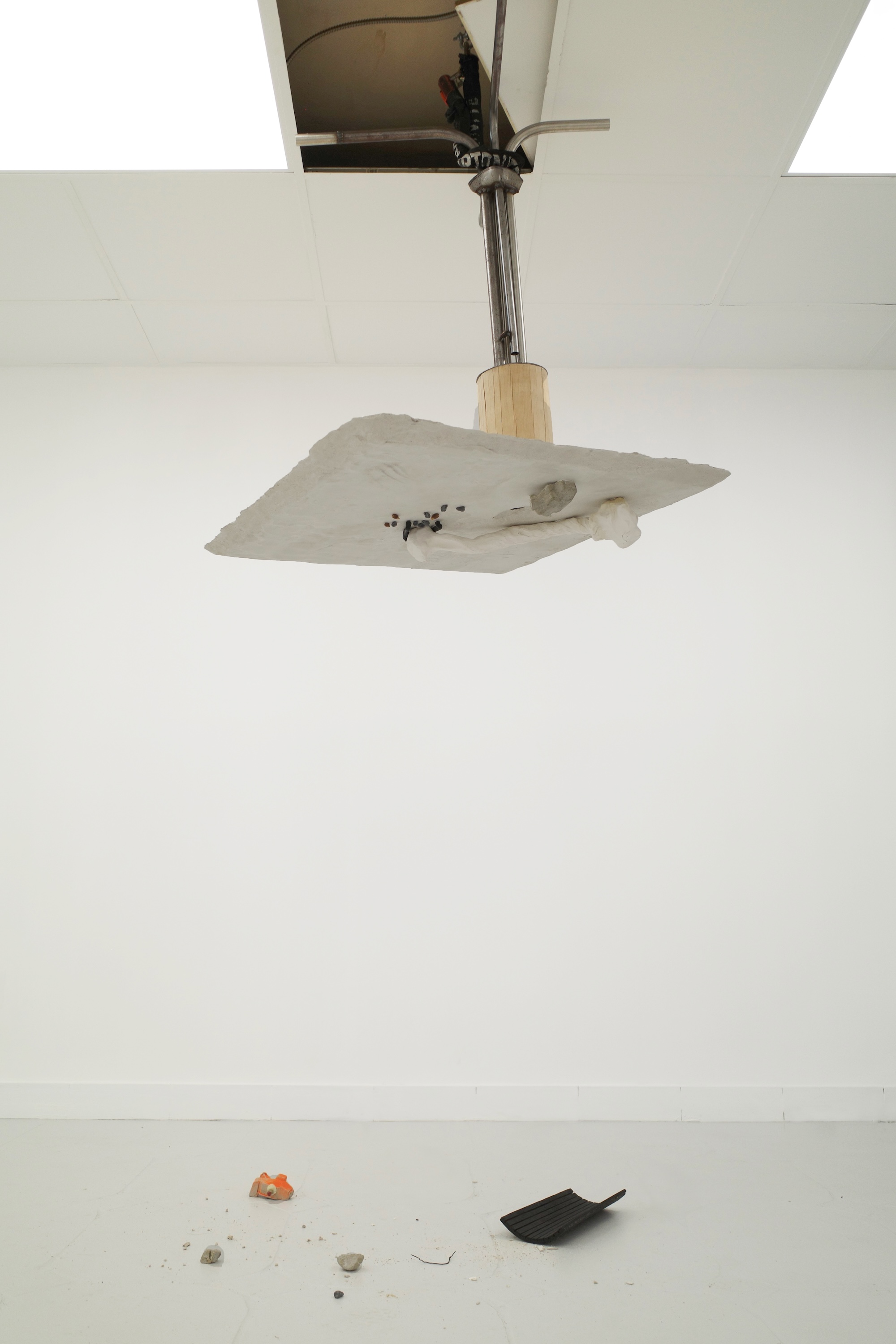
There is a particular pleasure in entering an exhibition and realizing that someone has been willing to hammer into the white walls of the gallery itself. Dumb Luck is a show that does exactly that: a large section of drywall has been broken out of the wall and suspended in front of the resulting hole, while heavy metal sculptures hang from the exposed ceiling. In the show, artist Paz Sher, working with curator Fanfan Yuxuan Fan, presents a madly compiled space that is in constant tension with the
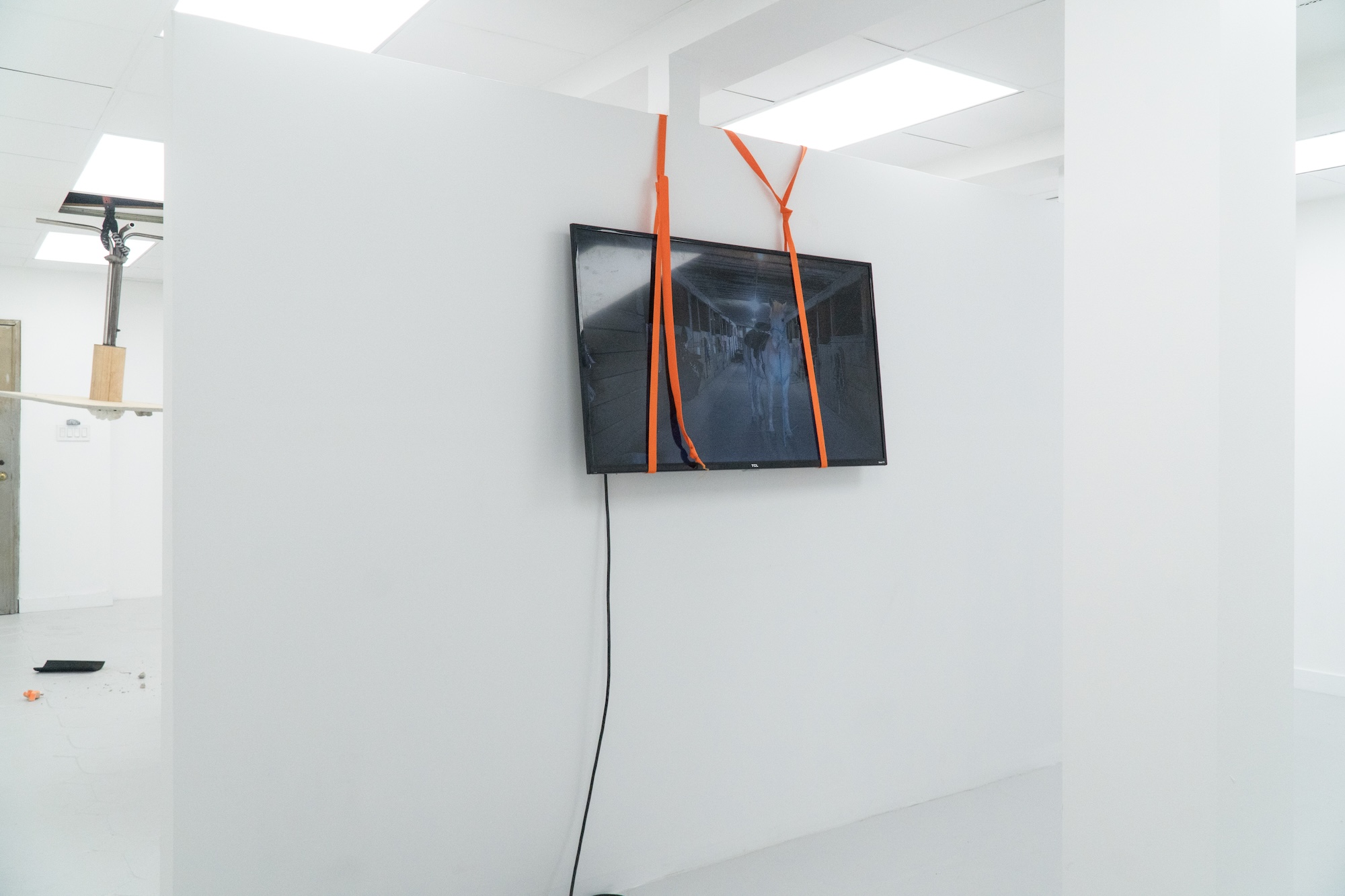
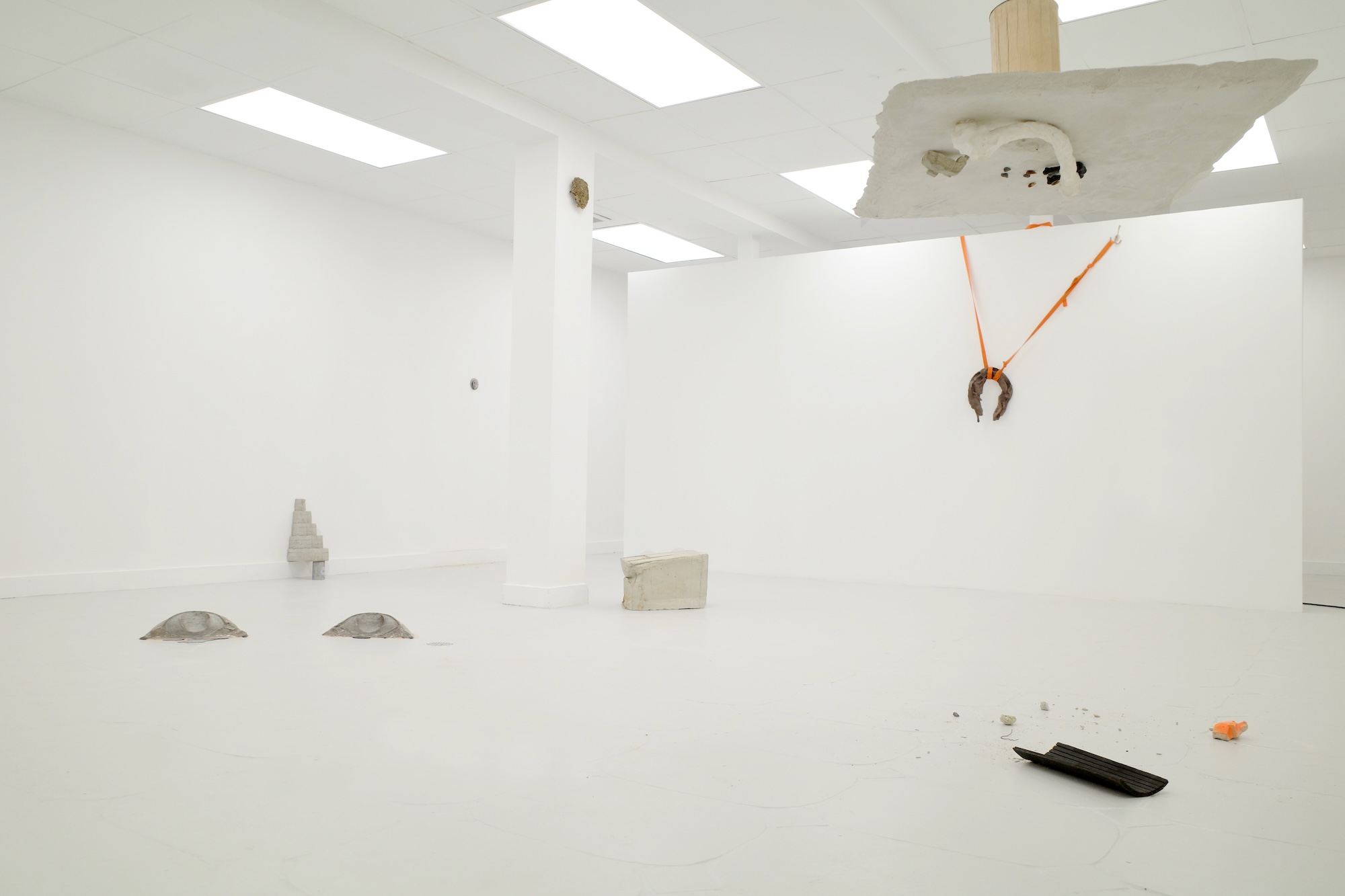
The show sits in the basement of 29 Henry Street in Manhattan’s Chinatown. From the street level, the pristine white cube gallery glow at the bottom of a flight of burgundy granite stairs appears deceptively inviting. Descending into it, however, means entering a space whose apparent neutrality will soon be broken (and quite literally). Other than the two strikingly obvious deconstructions previously mentioned, the space is decorated with other subtle but deranged instability and roughness. Crumbs of breakage remain near the wounds of the space, reminding the audience of the process alongside the jagged wall edge and the overflow of aluminum cast. The sculpture piece Cross Tied consists of a horseshoe-shaped cast bronze and a large TV display, suspended and counterbalanced on the two sides of an added wall. Both the bronze end and the TV end are loosely tied with neon orange nylon webbing straps.
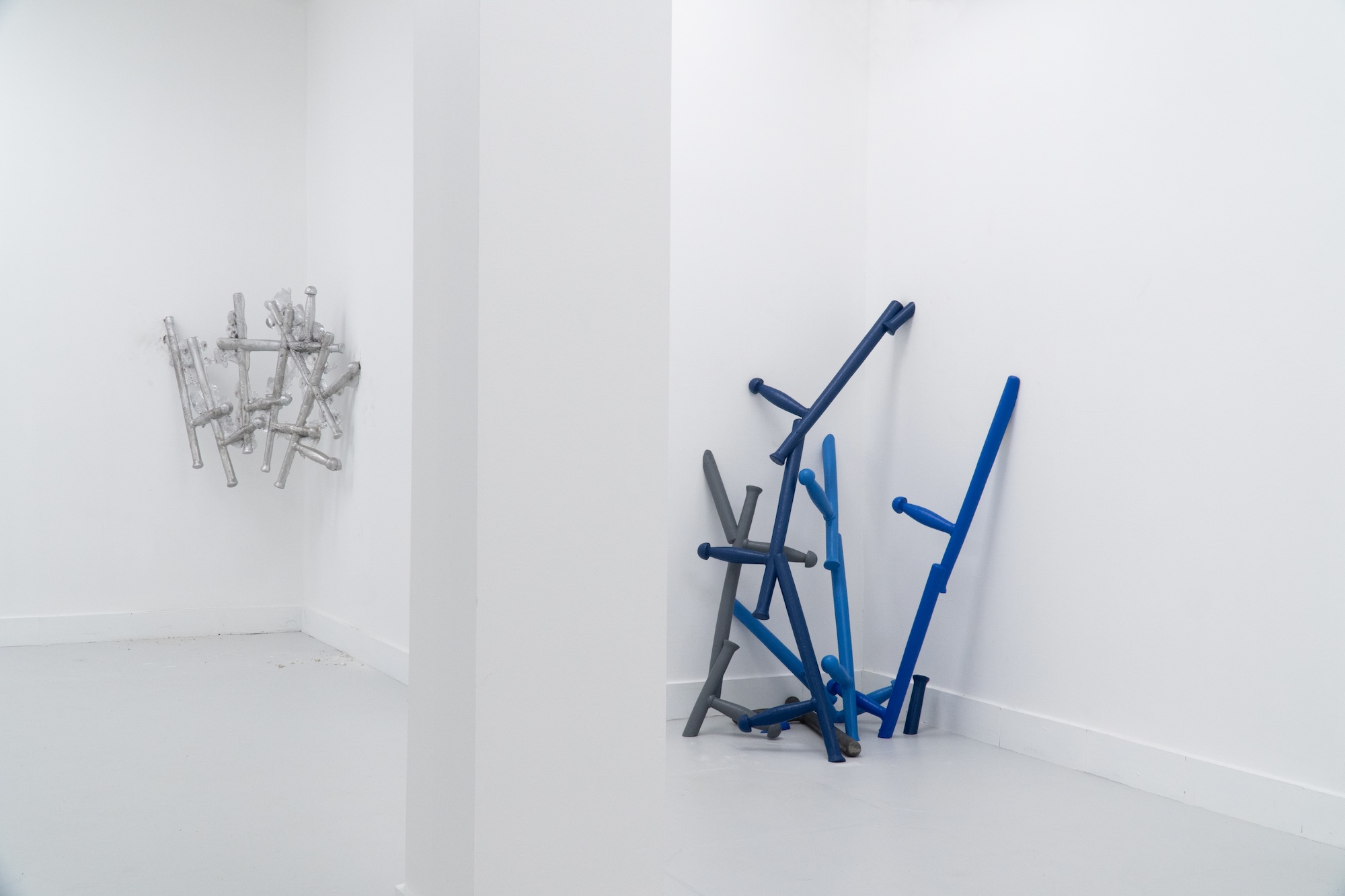
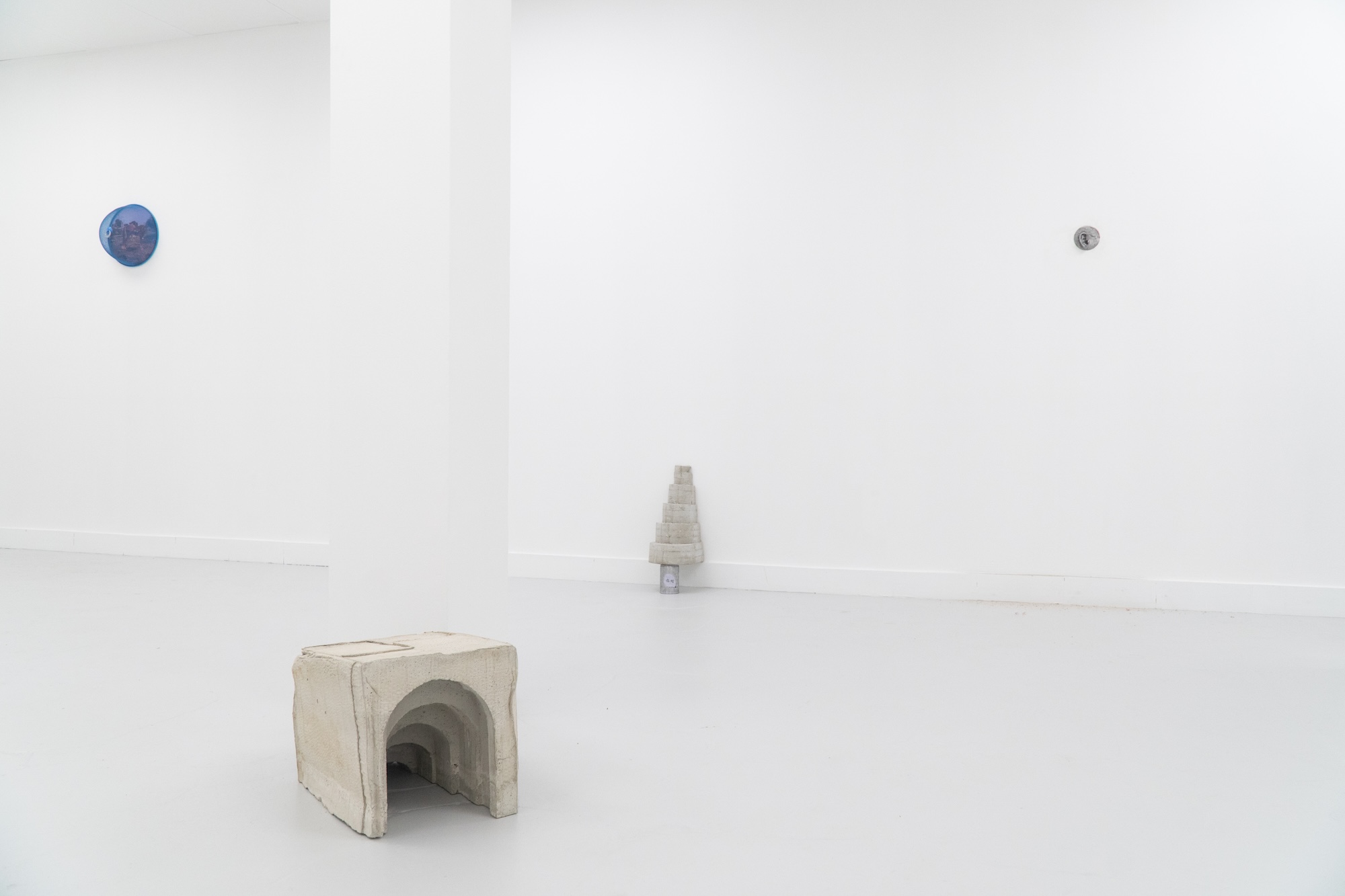
For all the overwhelming chaos my description so far might appear, Dumb Luck does not feel chaotic. If anything, as Cross Tied already suggests, the exhibition is preoccupied with balance: between accident and intention, instability and control, things falling apart and things that still hold together. Two piles of cast police batons, made in different materials, occupy two adjacent inside corners. The negative space of the exposed wall cavity, together with this architectural division, gives the arrangement an unexpected sense of structural stability. Nearby, the two concrete works, Temporariness and Descending Order of Permanence, sit reliably and solidly against the wall and pillar, their weight almost reassuring. My favorite, though, is still Antihelix: an aluminum ear embedded neatly into the wall—which, according to the curator, was fitted so precisely and deeply into the opening that the violence of cutting into the wall is almost concealed by the neatness of its fit.
The curator Fan describes the word “dumb” as a failure of speech—where language becomes inadequate for capturing the operations of chance. There is certainly anxiety in the destruction throughout Dumb Luck: things break, walls fall, structures might fail, and decisions are irreversible. When I asked Fan about how it was to cut so extensively into the gallery, she laughed: “They still have my deposit. Sher will restore it back to its original state.”
The trust is why Dumb Luck never quite becomes a show about surrendering to randomness. Chance requires commitment and control, and the exhibition’s precariousness is painstakingly and collaboratively constructed, sometimes through the most practical forms of problem-solving. All the cutting and hammering creates a condition that the subsequent decision has to respond to; every unstable arrangement requires a gestural counterweight to keep it standing.
Such a view feels particularly relevant when the reality around us seems simultaneously rigid and unreliable. Political orders, armed conflicts, visas, even the walls we live between can appear permanent until suddenly they are not. Dumb Luck offers no fantasy that these conditions can be brought entirely under our control, but states that the conditions are a reality that can be responded to. And the particular form this response takes is what I can only call handiness: knowing how to repair something after it breaks and having enough confidence to trust that you can work with whatever follows. Seen this way, handiness begins to resemble what we more commonly call resilience.
Yet the analogy is imperfect. For all the violence of its interventions, the exhibition operates within a carefully negotiated framework of permissions, obligations, and material constraints. The holes will be patched, the sculptures removed, and the white cube returned to its customary neutrality. This does not make the destruction any less consequential as an artistic gesture, but it complicates the fantasy of unbridled spontaneity that such gestures might otherwise invite.
This inherent paradox brings me back to what struck me about Dumb Luck in the first place: how, by mediating and controlling chance operations, the artist reveals an architecture that’s neither immutable nor merely incidental to the artworks it contains. The temporary and unusually productive disfigurement of the space itself ultimately becomes an inquiry into the conditions that make such an intervention possible, and the limits within which chance can be allowed to operate.
Paz Sher: Dumb Luck was on view at 29 Henry Street, New York, from August 13 to September 1, 2026. The exhibition was curated by Fanfan Yuxuan Fan.