
Santiago Gómez: “Cabalgando Entrañas / Riding Entrails” at Plaga
Review
In The Pulse and the Pause, presented as part of He Art Museum’s Young Artist Project in Shunde, Foshan, fifteen mixed-media paintings made between 2023 and 2026 occupy the museum’s basement gallery. Working with acrylic, charcoal, and pastel on canvas, Hou Yijie layers thin, wavering contours over broad passages of muted color, punctuated by flashes of brighter pigment.
The paintings range from individual portraits and self-portraits to crowded group scenes. Echoes of history, myth, and popular culture surface in a hairstyle, a costume, or the tilt of a body. These passing resemblances lend romance and heroism to intimate gestures, but they rarely hold still: in Hou’s paintings, recognizing a figure is an unfinished process.
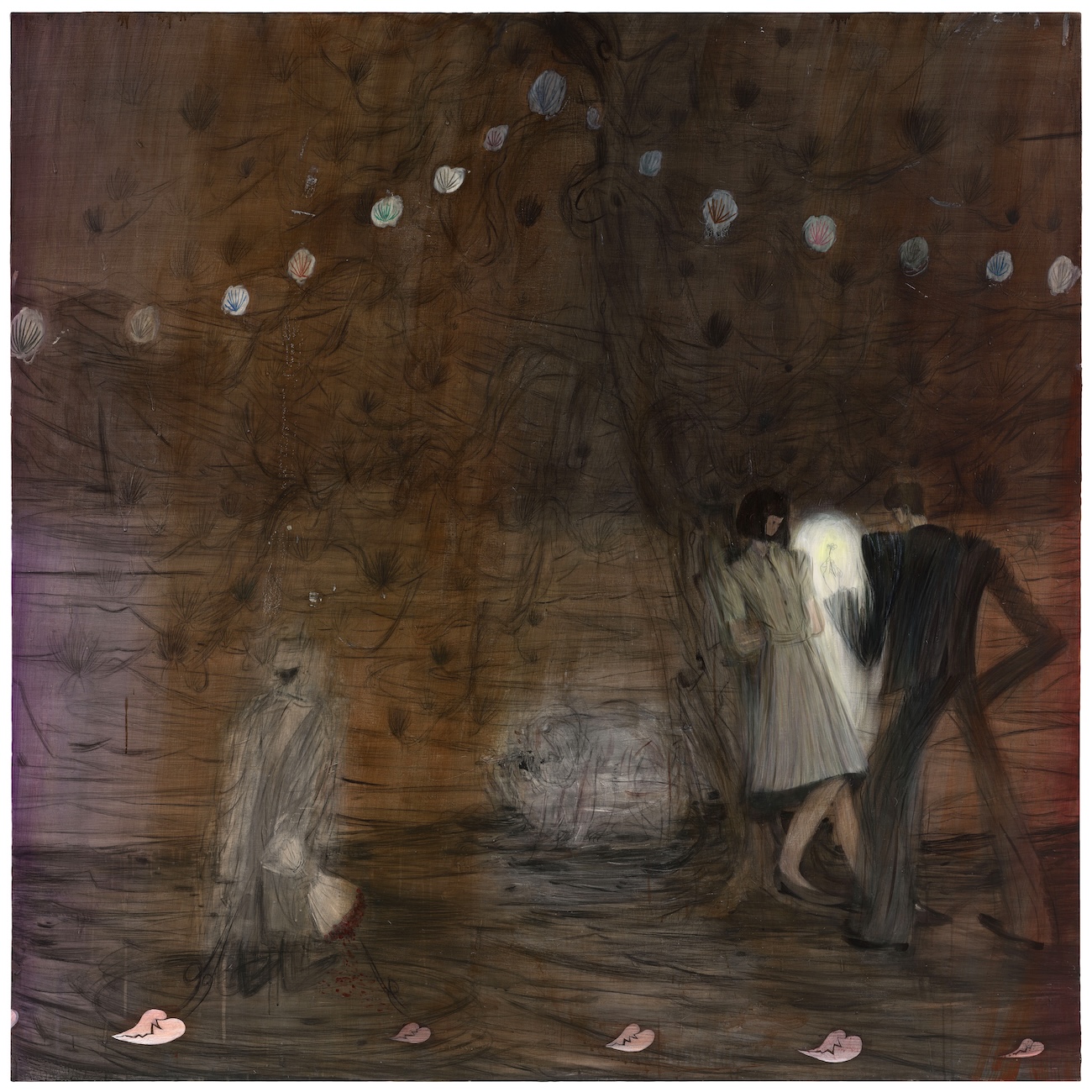
Our understanding of the relationships between Hou’s figures shifts as overlooked details come into view. In The Casanova under the Pine Tree (2025), a boy offers a girl a tiny flower beside a river, their encounter illuminated by a patch of yellow-white light. A second look reveals a nearby figure in a traditional Chinese scholar’s hat, moving to the left while turning his head back toward the couple. He carries a bouquet of roses that seem to drip blood onto the ground. Broken hearts form his shoes and mark his footsteps. The contrast between the small flower being offered and the abundant roses carried away gives the scene its emotional tension. The scholar’s body performs a departure that his gaze refuses to complete.
Recognition remains unsettled even overhead, where what first resembles festive lights resolves into clusters of pine needles. The title adds another uncertainty. The Chinese term qingsheng, rendered here as “Casanova,” can suggest both a master of romance and someone exceptionally devoted to love. Does it name the boy offering his flower or the scholar departing with his roses? The broken-heart footsteps make the latter’s retreat both poignant and faintly comic, leaving the viewer unsure whether his devotion is being honored or gently mocked.
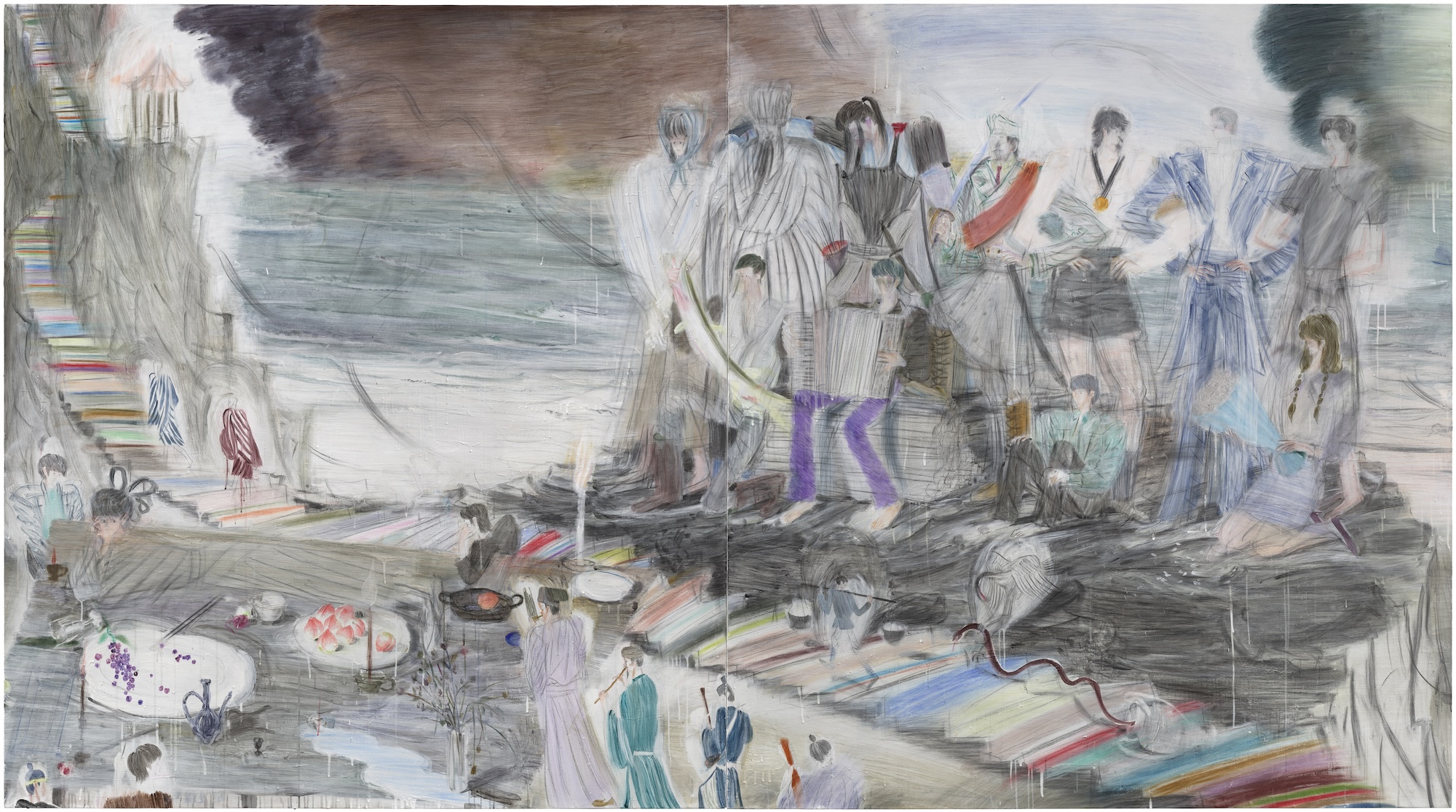
The question of how figures belong together takes on a collective dimension in The Internationale (2026). A group of towering figures stands on a dark ledge beside the sea, arms bent as if linked. Robes, swords, a medal, and an accordion suggest an unlikely assembly of immortals, champions, and musicians, their stylized faces recalling the 1990s Japanese manga Yu Yu Hakusho, which Hou, in conversation, mentioned having read as a child. Below them, much smaller figures play the pipa, erhu, bamboo flute, and sheng. At the lower left, a woman reclines beside a table of wine and fruit, her pose evoking the reclining Venus, her looped coiffure the goddess in The Nymph of the Luo River, the handscroll traditionally attributed to Gu Kaizhi.
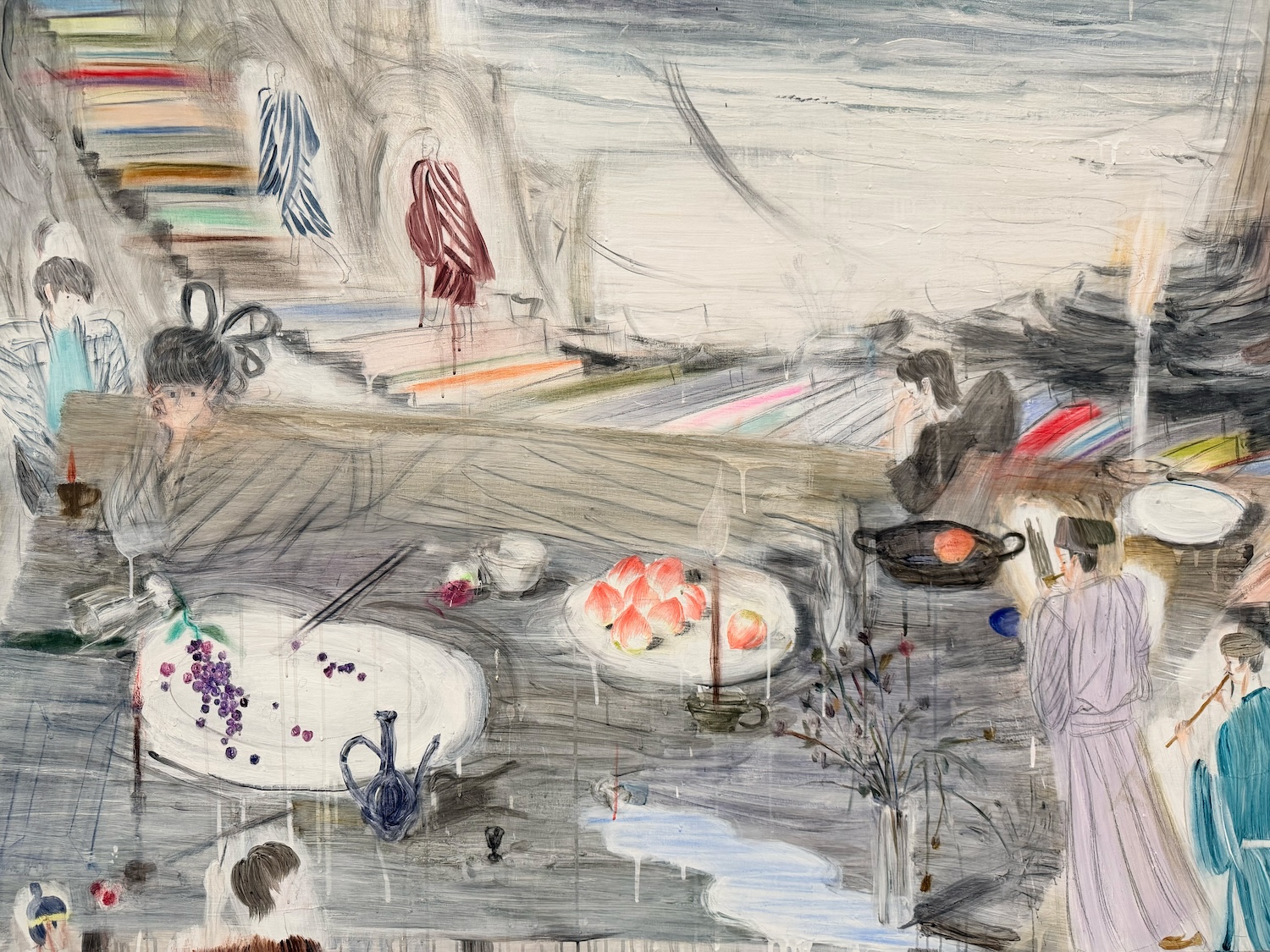
Music offers these disparate figures a possible common activity, though whether they are playing in concert remains uncertain. The title The Internationale invokes a song of collective emancipation, yet the gathering gives some participants the stature of gods while others appear as miniature musicians. The accumulation of familiar motifs risks making identification an end in itself. Recognizing their sources, however, does little to explain what holds this unequal assembly together. Even the authority implied by the larger figures’ scale is unsettled by Hou’s handling of paint: fine, repeated strokes overlap and pass through translucent washes, making their bodies seem insubstantial. They command the scene without quite solidifying within it.
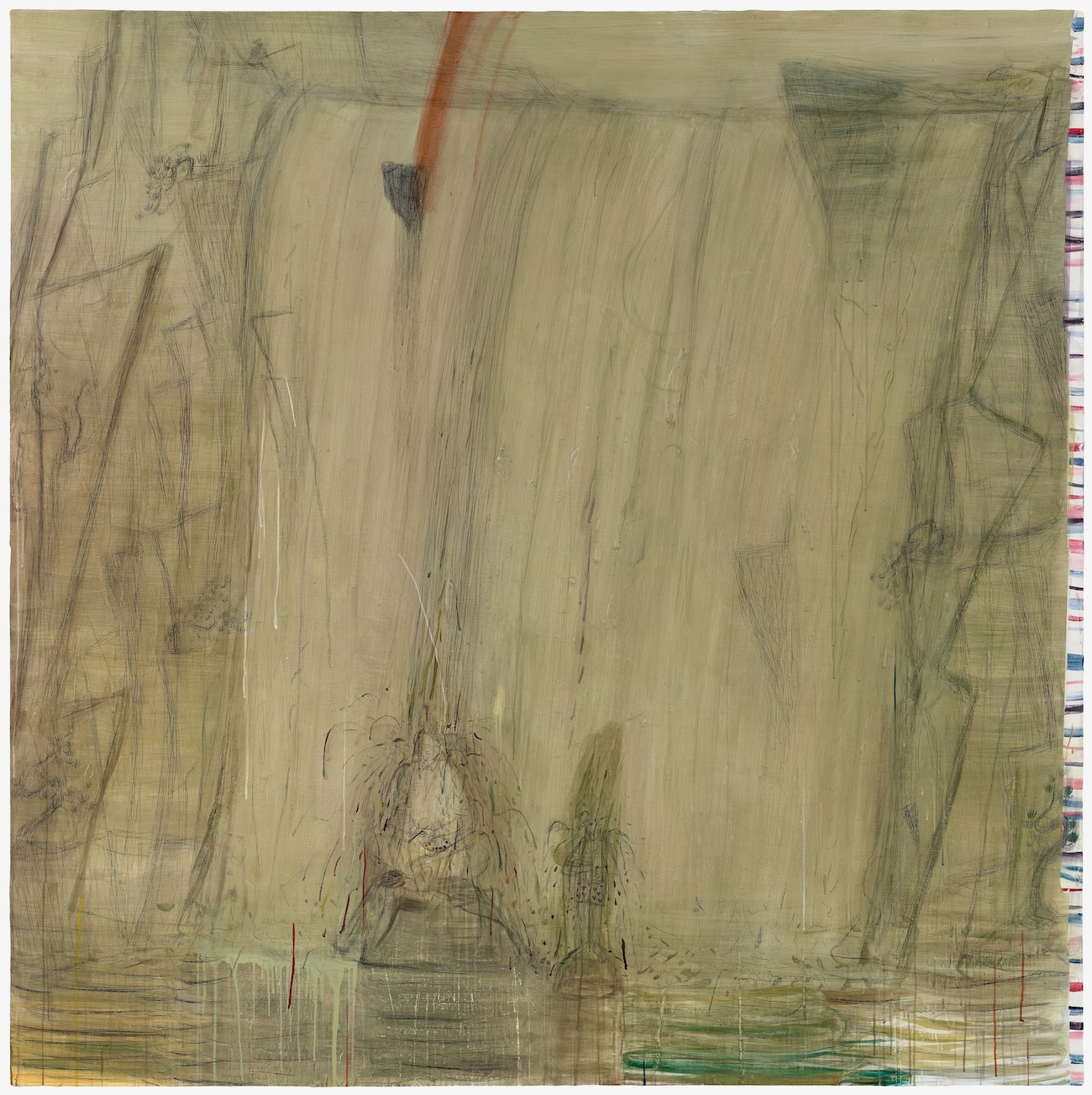
Recognizing Hou’s figures requires not only sustained attention but also a change in viewing distance. From afar, gray-green strokes resemble tangled vegetation. Only on approaching do two figures emerge beneath a waterfall. In Path to Immortality I (2023), artistic apprenticeship takes the form of martial arts training. Meditating under a waterfall is a stock trial in wuxia, China’s genre of martial arts fiction, where the endurance of a disciple’s body is also a test of their inner resolve. On the left, a painter sits cross-legged on a rock, holding a brush and palette. His cap and the pipe between his lips recall Van Gogh’s Self-Portrait with Bandaged Ear and Pipe (1889). As the falling water touches his body, it breaks into colored rivulets. Beside him, a smaller figure in heart-patterned underwear presses his palms together in a gesture suggestive of a martial arts salute.
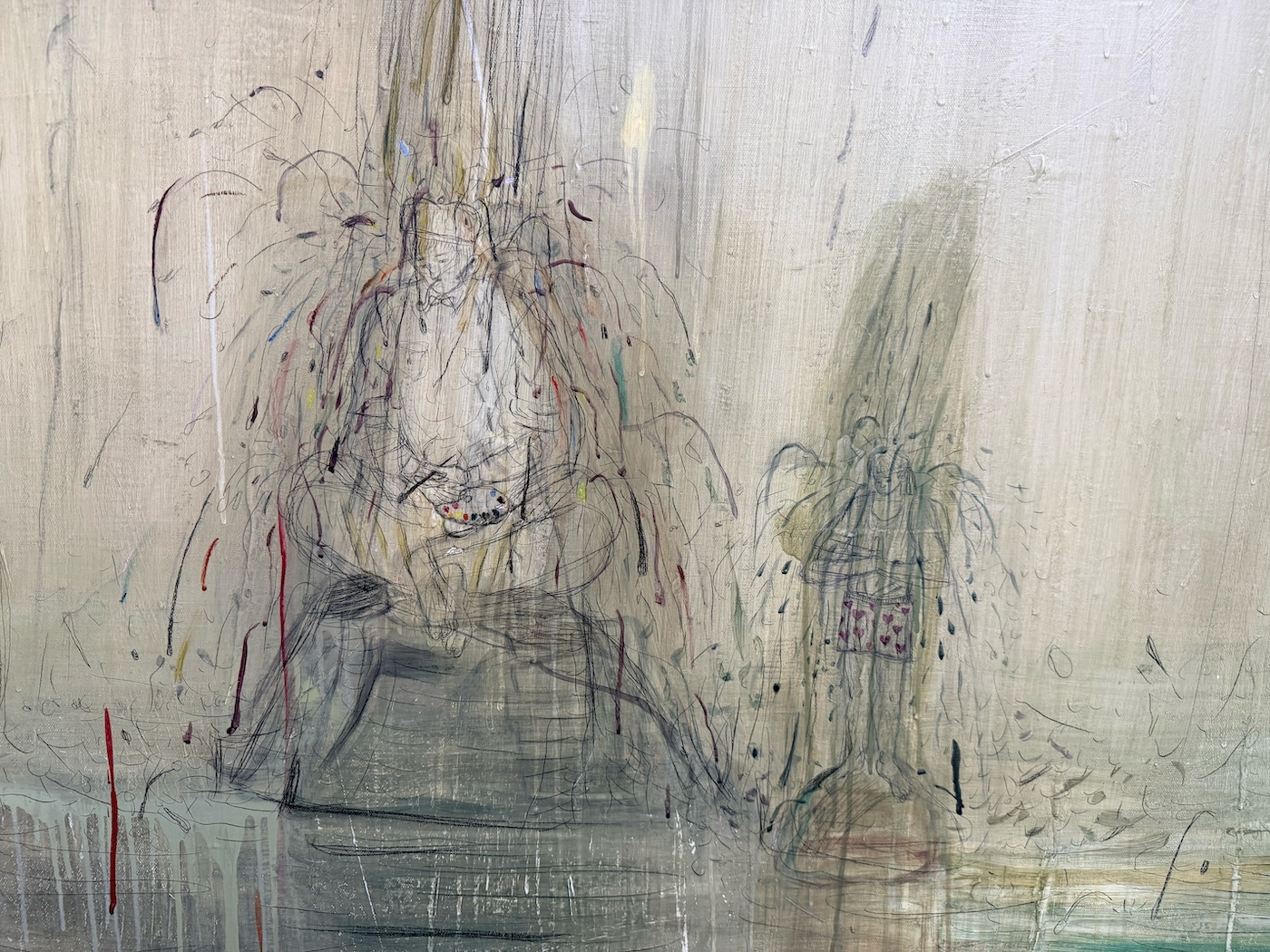
Hou identified this figure as himself and described his companion as his childhood idea of what an accomplished artist looked like. The aspiring painter trains beside the master as though hoping to acquire his powers. His underwear gives the solemn exercise a comic vulnerability. Hou stages artistic ambition as an act of imitation, leaving open whether performing the rituals of mastery can bring the apprentice any closer to becoming a master.
Across these paintings, variations in line, color, and paint thickness bring figures into focus and then draw them back into their surroundings. This instability gives pictorial form to the distance between the roles Hou’s figures assume and the feelings their gestures betray in their own psychological universe.
Hou Yijie: The Pulse and the Pause is on view at He Art Museum (HEM) in Foshan, China, from August 15 to November 15, 2026.