

Editors' Selects: October 2026
Review
The white cube has long been a sanitized vacuum that isolates art from the exigencies of the world, and continues to be the de facto mode of presentation in New York. International Waters stages a breaking of tradition through its current exhibition, Roll, Pitch, and Yaw. Bringing together Marie Lorenz’s kinetic sculptures assembled from debris collected from New York’s waterways alongside Jeff Williams’s drawings and assemblages, the exhibition considers a landscape so saturated by human production that nature and waste can no longer be disentangled. The exhibition’s ideological foundation asserts that the contemporary landscape cannot be experienced separately from the reach of material culture and industrial waste. International Waters’ peculiar architecture turns this premise physical, producing a show with three protagonists: Lorenz, Williams, and the gallery itself. By leveraging the venue’s idiosyncrasies, the installation transforms this critique into physical confrontation.
Tucked behind an inconspicuous door in the industrial borderlands of Bushwick, the journey into International Waters is a dream-like passage. One enters through a raw, graffitied, neon-lit space that is the recording studio of Newtown Radio, then crosses through into the main gallery, which is situated in the corner of the radio shack itself, and the conventions of art viewership dissolve. The gallery is a brutalist, raw concrete space with an exceptionally steep incline. Resembling more a parking garage ramp than an exhibition space, the ramp destabilizes the viewer’s balance and line of sight. One cannot passively stroll through this exhibition: the architecture demands continuous exertion.

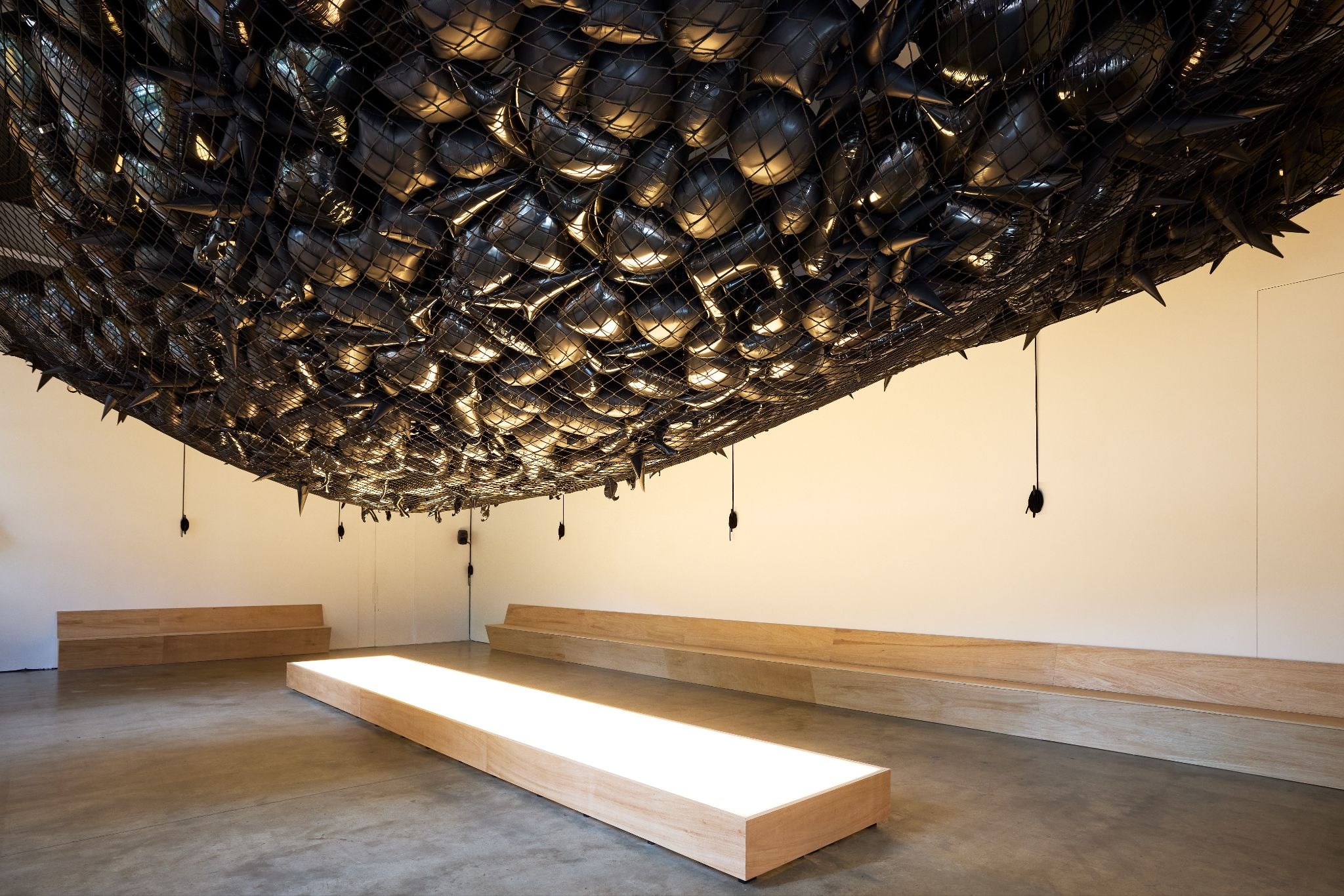
Lorenz’s practice involves a collaborative ritual of sorts: traveling New York’s waterways in a small wooden rowboat with other artists, she collects objects carried by tides along industrial creeks, configuring them into large, kinetic structures. In the gallery’s central installation, Tide Mill (2026), scrap wood, fragments of construction material, fabric, stones, and municipal debris are incorporated into imposing pendulums that take up most of the space. At International Waters, those pendulums become difficult to view as discrete sculptures: their frames rise through the room like waves, gesturing to the same waterways they were brought from, while salvaged panels, torn textiles, and heavy counterweights hover at different heights. Some components resemble clothes, rudders, or pieces of a vessel without resolving into any one thing.

The heavy, scavenged forms, positioned on International Waters’ asymmetrical slope, exploit the uneven architecture to generate a tense, erratic kind of dynamic energy. The artwork weaponizes the room, forcing one into a face-to-face negotiation with the imposing swinging debris in a tight, cramped space. The absurdity of the incline echoes the absurdity of the degraded environments documented by the artists. Without the incline, the sculptures lose their sense of urgency, shifting from threats into passive gallery objects in a static white cube.
Jeff Williams’s black-and-white drawings show those same landscapes consumed by refuse. Heaps of lumber, pipes, tires, and construction remnants spread across paper until they start to resemble a pattern. Dense linework collapses objects and terrain into a single plane, and urban structures are always visible in the background. Through the artist’s hand, the accumulation of municipal waste is reframed as a new geological layer of the Anthropocene.

The drawings are fairly direct; Williams’s sculptures, however, are the more ambiguous. A metaphor for the passage of time itself, assemblages of metal and ceramics that have accumulated outside kilns, over months into stalactite-like accretions, hang against the walls. Their surfaces resemble the gallery’s walls, not to camouflage or mimic, but with an effortless continuity and site-specificity. Here, Williams’s sculptures share the building’s material vocabulary.
The compelling nature of Roll, Pitch, and Yaw lies in the symbiosis of three protagonists: the gallery, Lorenz, and Williams. The same presentation displayed in a standard commercial gallery may have rendered the art object fully consumptive, yielding a less effective critique. Instead, the unique space of International Waters—its cramped walls, extremely oblique floors, combined with the immense size of its central piece—places the body into an active confrontation with the art. Together, the artists and the venue construct an environment where the viewer cannot look at the landscape from a safe distance but is forced to move through it, feeling the imposition of human production.

Marie Lorenz and Jeff Williams: Roll, Pitch, and Yaw is on view at International Waters from September 19 through November 1, 2026.