

Forms of Dependence: In Conversation with Yuna Cho
Interview
Emily Coan: My Alchemical Vessel
DIMIN | 406 Broadway, Fl. 2 New York
October 30 – December 5, 2026
When Simone de Beauvoir lost a tooth in a bicycle accident in the southwestern Alps in 1944, she decided not to replace it, reasoning, “What was the point? In any case I was old, I was thirty-six.” Emily Coan, now thirty-five, is approaching her mid-thirties with far less resignation. Best known for theatrical landscapes and ritualistic nightscapes populated by exceptionally attractive women, Coan turns indoors in My Alchemical Vessel, her latest show at DIMIN, where maidenhood gives way to midlife.
For Beauvoir, middle age came with a double standard: just as women reached greater sexual confidence, society doubled down on shunting them into restricted roles. At the gallery, these prescribed identities of a woman’s life cycle—the virgin, the temptress, the mother—encircle the viewer like a group of sentinels. But what initially appears to be a female artist’s personal interrogation of midlife gives way to a wider indictment of the viewer’s own expectations.
Coan’s earlier paintings have come under critical fire for their contribution to “hot girl feminism.” In a 2025 Art in America article, Emily Watlington criticized them as “trafficking in normative fantasy and absent any formal innovation.” Coan’s latest paintings, however, seem to answer these accusations of pastiche by complicating the act of looking itself. Deep art-historical references to Johannes Vermeer, Georges de La Tour, and Jan van Eyck expose how figurative painting has always relied on repetition and inherited ways of seeing.
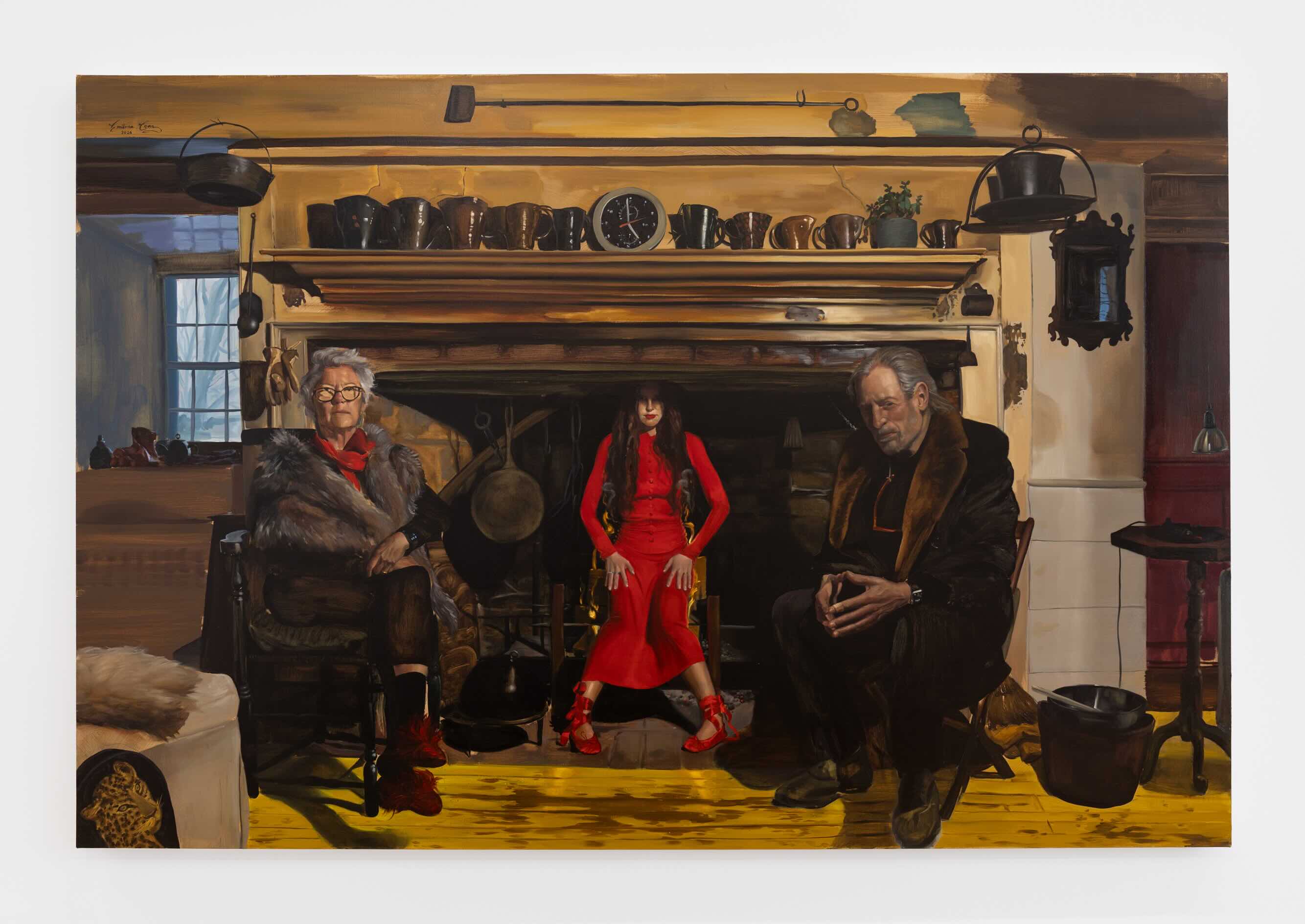
The centerpiece, Nigredo (2026), takes its title from the first stage of alchemical transformation and the Jungian term for confronting the repressed self. Coan, clad in a red dress, sits inside a fireplace between her two in-laws, oscillating between ember and flame (an image that will live rent-free in my mind during the holidays). The painting tackles anxieties about legacy on at least three levels: in relation to her in-laws, once fixtures of the New York art world; to portraiture; and to the artist as witness. Coan even models her signature after van Eyck’s in his Arnolfini Portrait.
In Sadie (2026), perhaps the most “hot girl feminist” painting of the lot, a blonde model in a black corset assumes the nonchalance of a Venus, more Titian than Manet. But drawing tools in the foreground complicate our perspective. We are not simply looking at this lithe model but at a woman being made into an image.
Coan’s interest in the construction of images extends to her process. She stages her compositions like film sets, with her in-laws’ eighteenth-century farmhouse in Ghent comprising center stage. The repetitive interior invokes dioramas and, by extension, the feminist philosopher Donna Haraway’s famous conception of “Teddy Bear Patriarchy,” which analyzed how Carl Akeley’s dioramas, just a few stops uptown at the American Museum of Natural History, painstakingly construct worlds that encode expectations and power relationships beneath a seemingly neutral, universal visual language. Coan’s carefully arranged props and costumed figures similarly expose how readily we project expectations onto women, reading their bodies and roles through assumptions we rarely impose on inanimate objects. For Beauvoir, ultimately, the perceived constraints of midlife also marked the arrival of greater sexual and erotic confidence. Perhaps that is what we are witnessing here, too: what appears to be confinement may instead be a form of liberation.
The Skin of the Earth is Seamless
The International Studio & Curatorial Program (ISCP) | 1040 Metropolitan Ave, Brooklyn
October 27, 2026 – February 12, 2027
The current group exhibition at the International Studio & Curatorial Program, The Skin of the Earth Is Seamless, brings together eight artists who treat borders less as map demarcations than as forces shaping how geopolitical identities are inherited, negotiated, and endured. Eschewing direct representation, the show traces their global effects through multimedia abstraction and formal experimentation, revealing the intimate ambiguities of dislocation and belonging.
“A borderland is a vague and undetermined place created by the emotional residue of an unnatural boundary,” writes scholar and poet Gloria Anzaldúa in her 1987 book Borderlands/La Frontera, the conceptual anchor for the show’s title. Indeed, that residue suffuses every work. In Verónica Gaona’s Metal Body (2026), it turns literal: a crumpled Chevrolet Silverado panel, studded with bolts like sutures, wraps family photographs printed on tarp. The pickup, a tool of labor and emblem of mobility, subsequently arrives as wreckage. Gi (Ginny) Huo’s 흙/soil (2024) mounts two plywood boxes on steel structures, joined by a slack rubber cord recalling telephone lines linking North and South Korea. Set into the wood is a photograph of burial soil, evoking the earth her grandfather saved to accompany him in death, a final tether to the North Korean land he left behind.
In Seba Calfuqueo’s Culpa (Guilt) (2023), the artist, sheathed in a saturated blue bodysuit, kneels in snow among araucaria trees, featureless yet quietly arresting, as captions recount Chile’s seizure of Mapuche land and the plunder of its forests and rivers. Nardeen Srouji’s Red Stitch I (2018) embroiders Palestinian tatreez in red wool across perforated metal typically used for barriers. Dense embroidery thins into single vertical threads, like the bars of a partition, then gives out to bare metal; at the base, a final band of stitches resumes, marking the persistence of cultural inheritance through violent displacement.
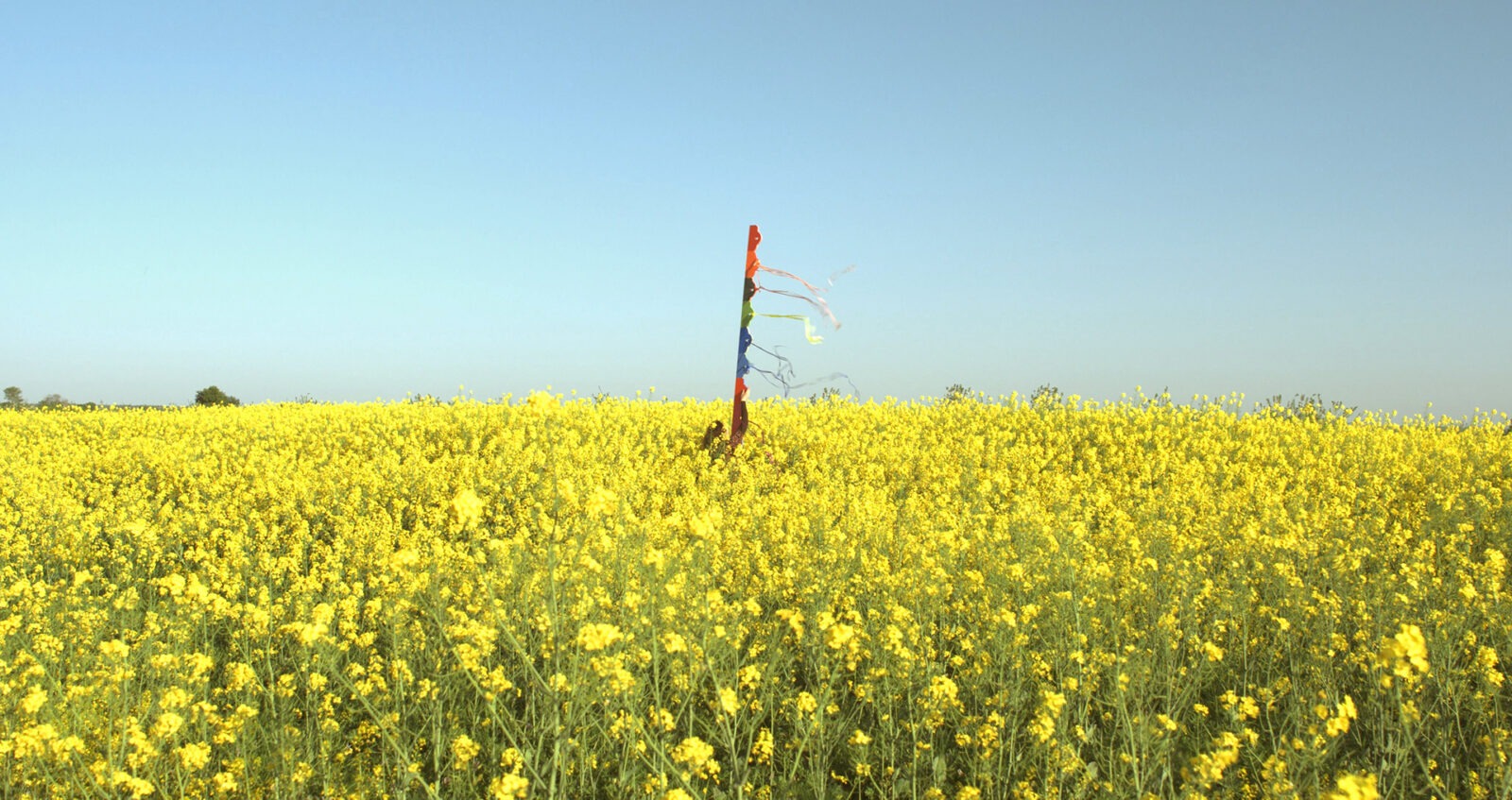
Magdalena Ciemierkiewicz’s Ghosts-Forms (2023–24) unsettles because of its uncanny loveliness: ribboned poles modeled on roadside shrines stand in blazing rapeseed fields near her Polish village, while subtitles recount how Nazi forces burned the bodies of those they executed there. Simon Liu’s Let’s Talk (2023) finds a similar false brightness in Hong Kong murals lettered “Rebuild” and “Reconnect,” which his handheld montage renders as wallpaper over the city’s underlying fissures. Brenda Mallory’s Partitioning (2017) sews collagraph prints of a pitted dartboard into a grid recalling Dawes-era allotment, which broke Cherokee and other Native land into private parcels. Its reassembled seams simultaneously divide and fasten the surface. In Kara Springer’s The Shape of Mountains (2023), rice paper prints of clay terrain drape over wooden armatures. The resulting form is at once architectural, geological, and anatomical, obscuring separations between land and body.
The exhibition resists folding disparate, suppressed histories into a singular narrative by attentively preserving material, symbolic particulars: a cord, a stitch, a bolt. The earth may look seamless, but nearly everything on it has been cut and sewn back together. Each artist offers not restored wholeness but an unflinching record of fracture, and of the tenuous, unrelenting ties that persist in its wake.
Richard Brintzenhofe, Darrel Ellis, Miguel Ferrando
STOREY GALLERY | 1 Rivington St, New York
October 29 – November 21, 2026
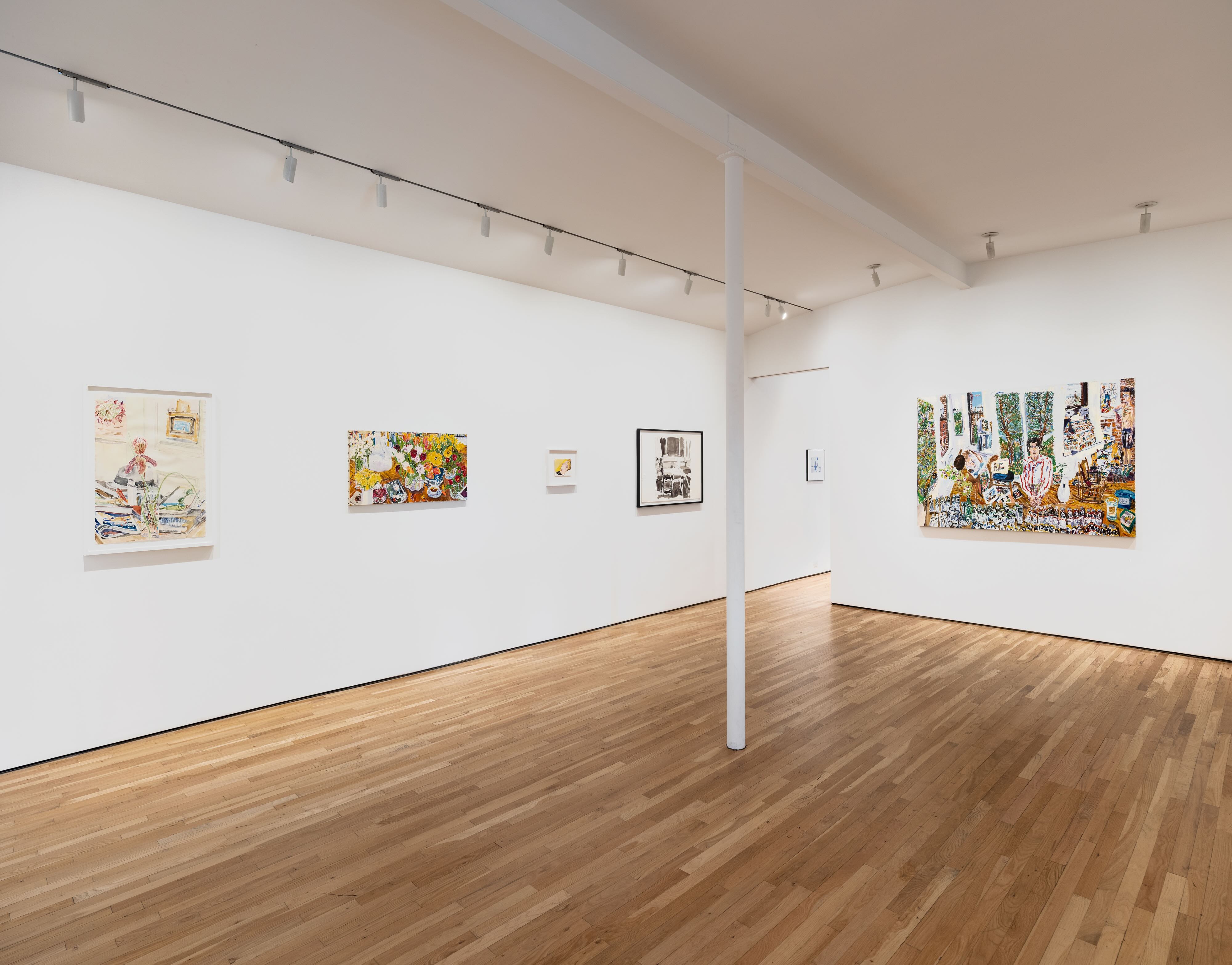
“The pleasure of seeing is intense. I watch and watch it transform in my eyes, the meaning is the looking and the making.” Such was the sensuous aesthetic vision expressed by Richard Brintzenhofe in 1993. 33 years later, STOREY GALLERY, an emerging queer space in the Lower East Side, has reified Brintzenhofe’s optical hedonism in the exhibition Richard Brintzenhofe, Darrel Ellis, Miguel Ferrando.
The show brings together the practices of three New York-based artists active during the 1970s and 1980s, whose relationships shifted fluidly between artistic peership, friendship, and love. Unfortunately, Brintzenhofe, Ellis, and Ferrando all died young due to the AIDS epidemic. While such loss permeates the exhibition, it does not forefront this tragedy. Rather, STOREY’s presentation embraces the intense pleasure of seeing, as described by Brintzenhofe, to showcase a variety of queer interiorities.
Untitled (Carroll Street, Brooklyn) (1983), an oil painting by Brintzenhofe, leads viewers into the gallery's central room. The large composition depicts Brintzenhofe’s studio, with its windows open to the surrounding city’s lush greenery and crisp sky. Brintzenhofe sits centrally in the foreground, dressed in a red-striped button-down, and his partner David stands shirtless in the background.
The image takes on a voluptuousness and vibrational quality through Brintzenhofe’s thick, beady application of paint. The interior jitters with each curvy brushstroke, as if microscopic life teems throughout the studio. At the composition’s bottom, the artist’s paint tubes sit in orderly rows, organized by color. These containers take up a similar energy as Brintzenhofe’s brushmarks by twisting and squirming into one another. Ultimately, Brintzenhofe foregrounds the materiality of his paint to show his hand: he revels in the vitality of color to squeeze his subjectivity into his studio. A joyful spirit emerges through vibrancy.
Contrasting the liveliness of Untitled (Carroll Street, Brooklyn), Darrel Ellis’ drawing Billy Lying Down (1981) uses ink and wash to present a softer image. As the title suggests, the composition portrays a man reclining on a sofa. Ellis’ washes, which fade between gray and brown, amplify the scene’s restful nature, picturing an interior environment that appears just out of focus, as if the viewer’s eyes are about to close. The ink strokes atop this wash clarify Billy’s form, outlining the arch of his back and his arms’ placement behind his head. His body appears to glow on the sofa’s darker surface.
Billy Lying Down offers a parallel queer interiority to Brintzenhofe’s studio, characterized by stillness and peace rather than color and energy. Ellis’ drawing is carefully layered to build up the moment’s gentle transience. The image’s small scale reinforces the intimacy of the scene, encouraging quiet introspection.
Placed near the gallery’s entrance, Miguel Ferrando’s watercolor drawing Untitled (Orange Tulips with Lotus Calendar) (c. 1992–93) represents an aesthetic intermediate between Ellis’s tranquility and Brintzenhofe’s vigor. The still life depicts a vase of yellow tulips, which sits before a Buddhist lotus calendar hanging on a yellow wall. The composition is bright and warm, endowing the image with a sense of radiating movement. At the same time, the fluid qualities of the picture’s watercolor marks and the simplicity of its image evoke a calm atmosphere.
Ferrando’s drawing offers yet another manifestation of a queer interior. He uses the tulip and the lotus to construct an environment that oscillates between dynamic growth and peaceful emptiness. The depicted space thus embodies a full spectrum of queer perception, balancing the intensity of outer vision with the placidity of inner vision.
ENERGY
Field of Play | 126 13th St, Brooklyn
October 17 – November 15, 2026
In a former factory building in Gowanus, tucked away between glass manufacturers and auto repair shops, ENERGY at Field of Play rejects the ease and immediacy of artistic overconsumption. The exhibition, curated by Mark Sengbusch, celebrates the slow, sustained thrum of creation: intention and intensity, breath and beating heart. The show features five artists working across time, space, and medium to translate the topography of their inner worlds into the physical realm, each piece a potent repository of energy that supercharges the creative impulses of viewers.
Energy takes different forms across these works. The serene yellow-green abstraction of Bernard Childs’s We have the whole wide world in our arms (1977–81) radiates with cosmic energy, evoking the image of a sun rising over a body of water. The lurid, densely populated canvases of Alicia Gibson’s Resistance to Reality, Still Life, and Soliloquy (all 2026) emit a frenetic energy, as words and patterns and colors strain against one another to overwhelm the senses. The energetic ethos of Gilda Snowden’s Chronicle (1994) is subtler: a sharp red triangle intersects with a dark silhouetted self-portrait, a spark of external energy penetrating the artist’s subjective internal experience. Physical body as body of water, quiet ripples far below the surface.
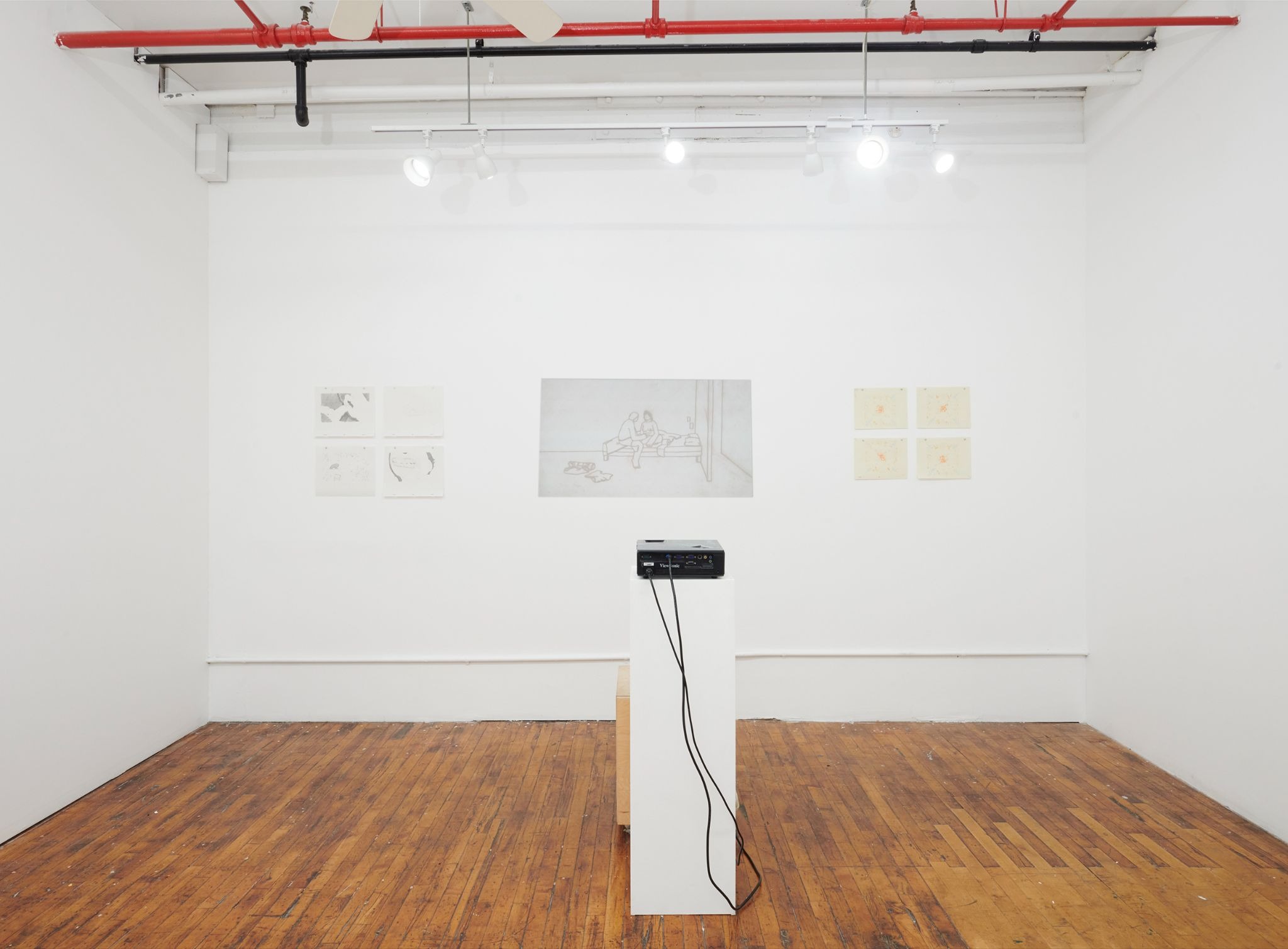
Although ENERGY as a whole is a strong and cohesive exhibition, the works of Kohana Wilson are the clear standout. A small black ViewSonic projector loops two hand-drawn animations, edith and the tall child (2024) and a home for lou (2026). The video projection is fuzzy and dreamlike, a small square flickering softly against a white wall. To its left and right, four frames from each animation offer a glimpse into Wilson’s diligent process. The edith illustrations are delicate gray graphite; in the lou illustrations, soft pastel patterns bloom and spiral, a synthesis of floral and geometric imagery. There is something at once nostalgic and unfamiliar about Wilson’s analog animations, memories of watching childhood cartoons refracted through the kaleidoscope of surrealist subjectivity.
ENERGY acts as a microcosm for the Field of Play’s broader gallery ethos: a cyclical relationship of artists uplifting one another, each individual acting as a force multiplier for the creative energy of the community. In physics, energy is divided into two categories: kinetic energy, possessed by an object in motion, and potential energy, stored within a still object. ENERGY, as an exhibition, pulsates with kineticism. Each artwork, complete and self-contained, is a repository of the energy, effort, and intention imbued by its creator. But the white walls on which this art hangs call to mind blank canvases longing to be filled, and viewers’ positional relationship to the art generates intense potential energy: gravitational, magnetic, not quite chemical but alchemical. In this industrial-turned-artistic space, listening to the ever-present thrum of the exposed HVAC system, the compulsion to create—to join the ranks of Field of Play’s artist-curator collective—is overpowering. To be human is to be small and large at the same time: a single stitch in a vast tapestry, one neuron firing among many, the cosmos collapsing and being reborn around you all the time.
Janet Olivia Henry: Retroactive
Gordon Robichaux | 41 Union Square West, #925 and #907, New York
November 8, 2026 – January 10, 2027

Along two walls of Gordon Robichaux’s gallery is a near re-creation of Janet Olivia Henry’s Retroactive, her 1982 exhibition at Just Above Midtown (JAM) gallery. Always working with autobiography, the seven works trace Henry’s personal development from birth (by stork) to becoming an artist and artworker at JAM itself. Should Henry continue this artwork through today, as a 79-year-old, how would she narrate the continuation of her trajectory?
By no means has Henry stopped being an artist, but then and even now, the art world and market were neither a secure nor final destination for her. This exhibition, also called Retroactive, is a small but much-needed presentation that traces over four decades of Henry’s practice while making sure to bring it up to the present day.
In those seven works from 1980 and 1981, Henry eschews formal frames for plastic vinyl that encloses tableaux of her progressive life stages: birth in New York; childhood schooling by a white teacher represented by the Daisy Duke Barbie doll; herself as a student represented by the Star Trek Lieutenant Uhura Barbie doll—one of the few black Barbies from that time; visits to her family’s homeplace of Antigua; and then herself as a fashion student, teacher, and finally as an artist and artworker. Each scene contains a handful of carefully selected, miniature plastic objects, evocative of childhood. The objects, such as shoes, paper umbrellas, black-painted globes, and brown paper bags, are loaded symbols that all participate in the construction of an identity. In the US particularly, we are what we own (and therefore buy). Henry uses herself and her own life to demonstrate and tease out these ideas. The personal becomes political as she lays open racial, gender, and power dynamics.
Fittingly, Henry directs much of her critique towards the art world, that same seemingly invisible system that, by choosing who to support and give attention to, is simultaneously choosing who not to. In Turnover, THE Downtown Survey Show of the 80–81 Season (1981; part of the JAM show), a plastic alligator with boxing gloves perches on Henry—again, as a Lieutenant Uhura Barbie—in a sleeping bag. Sleeping over often at the gallery was one way she navigated the familiar challenge of supporting herself as an artist and supporting other artists. By now, has the alligator finally stepped off her back?
The critique continues through the two most recent works from 2026, hanging sculptures that mine those miniature plastic symbols but this time in consideration of the male art gallerist persona. Cars, homes, Orientalist garb, and cigarettes are photographed, enlarged, and sealed in plastic pouches with slight padding. Dangling from a near-invisible string, this man (made up by his symbols) is raised up by those same invisible forces and yet just as precarious as anyone else in the arts. Forty-plus years of being an artist, and Henry still sees through the façade.
Brenda Goodman: Pieces of Time
JJ Murphy Gallery | 53 Stanton St, New York
October 15 – November 15, 2026
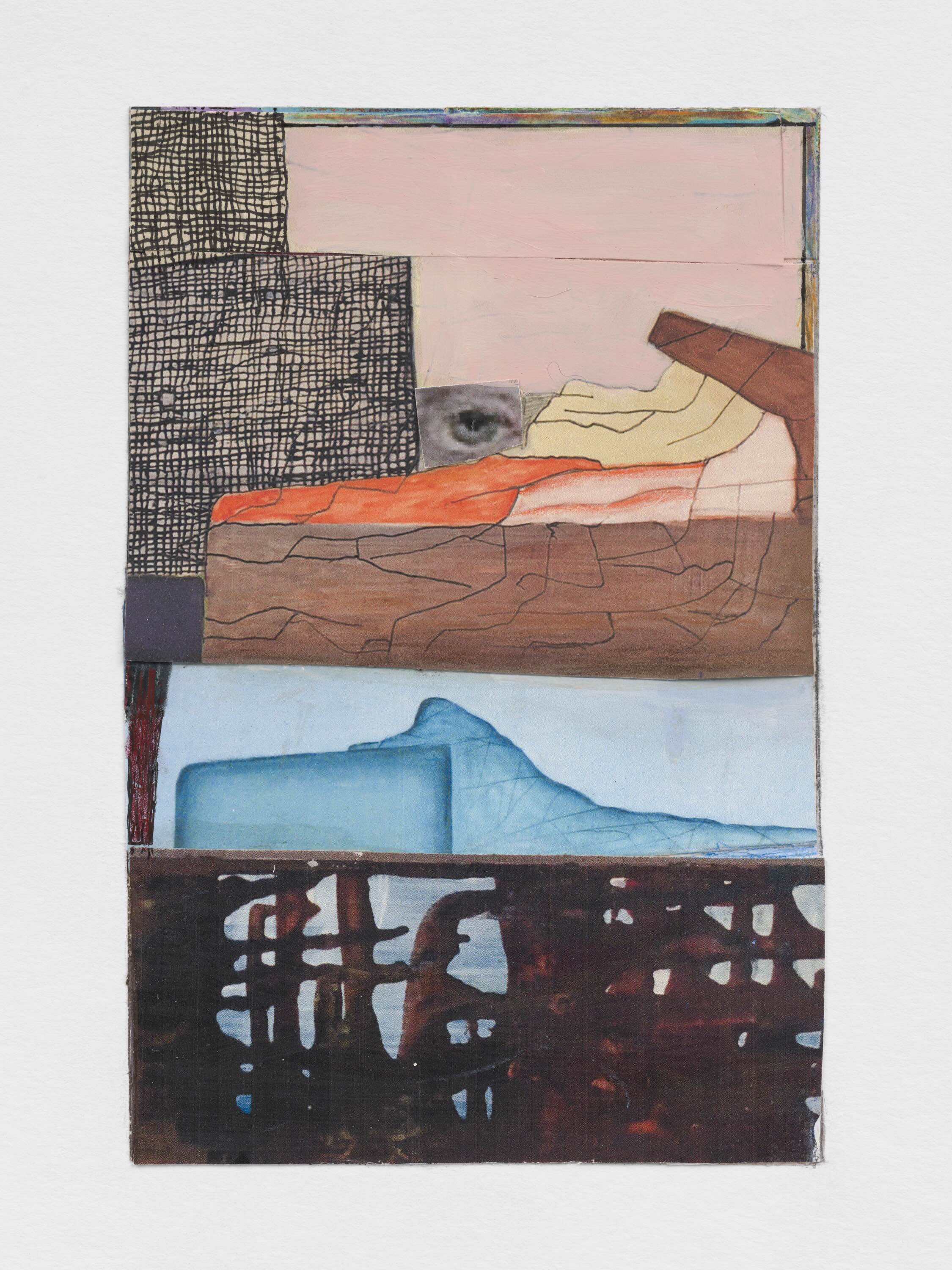
While eavesdropping at an opening earlier this year, I heard a gallerygoer remark to the artist Brenda Goodman that he could recognize one of her paintings from any given square inch of surface, so distinctive is her hand. It’s an interesting piece of praise to consider in relation to Pieces of Time, Goodman’s exhibition of 33 small collages at JJ Murphy Gallery. Each work is about four-by-six inches, displayed on a shelf inside a leaning mat, and composed of paper fragments, many of which are cut from low-quality prints of her own paintings. This is the first-ever collage show for Goodman, who has likened the process of making them to solving puzzles, one of her pandemic pastimes.
Would the same viewer recognize one of Goodman’s collages as readily as her paintings? That would depend on which square inch he was shown. To be sure, the new collages bear the hallmarks of a Goodman painting in their overall composition and content: pale and hairless figures express anguish, bewilderment, and fear. Disembodied eyes confront the viewer with harrowing vulnerability, each gaze as raw as an open wound. Whether entirely abstract or partly figurative, the surfaces appear scarred, splintered, smudged, or saturated with liquid. Geometric areas are carefully juxtaposed for their contrasting formal qualities or else for their discordant closeness (much like the bright sour peal of neighboring piano keys played at once).
At first blush and from afar, Goodman’s collages may even be mistaken for small paintings until the diminutive scale inevitably draws the viewer in close; only then is the surface, with all its abutting and overlapping shards of paper, truly legible. I inspect what looks like an area of sludgy media at the bottom of Collage #21 (2026)—a complex composition additionally containing dense black crosshatching, a single stolid eye, a glacial blue landscape, and fissured forms of brown, orange, and cream—and realize what I’m looking at is not really paint, but a print thereof. More printed pieces reveal themselves throughout the show, based on the pointillistic noise of their limited CMYK color profile and total flatness. These stand out against the areas featuring actual paint and pencil, which retain the complex surfaces and spectrum of color that Goodman is known for.
The printed matter functions less as a faithful reproduction of Goodman’s painting—for it lacks the very color and surface that defines the work—than as another formal device in the artist’s already sizable bag of tricks. In the abstract Collage #32 (2026), for instance, Goodman doesn’t even try to hide the pixelated rainbow at its center, and its digital haze plays brilliantly with the slashes of pencil above as well as the soft gradient of light blues below. A similar dynamic exists in Collage #23 (2026), in which a printed image at its center is continued by hand in the margins, an act that simultaneously expands on and contradicts the source.
Goodman offers yet another compelling display through Pieces of Time, not in the least because she has found a way to copy her previous work without repeating herself.
Sarah Sze: Images in Translation
Yale University Art Gallery | 1111 Chapel Street, New Haven
October 9 – February 14, 2026

Sarah Sze’s Images in Translation at the Yale University Art Gallery is a two-room, site-specific installation that presents assembled materiality in constant flux. The exhibit’s receiving room holds three new paintings with a sculptural quality, composed of several flush, uneven canvas panels, layered with thick radial brushstrokes atop a cosmos of torn photographs. The borders of these disparate images are tested, the white teeth of the paper’s tear treated as an additional line, bisected with strips of neon tape. Through this superimposition, Sze stacks images into a single accumulated body, bringing a deer’s backside to the same ruptured plane as the aerial view of a city, also woven into the rippling surface of an ocean.
The painted representation of this layered, dynamic world seeps into the gallery itself: a thin blue string traverses the three enclosing walls, weaving underneath the canvases in an assured and uninterrupted straightness, dripping streaks of blue paint to the floor. The single, taut line carries the paintings’ color throughout the space and links their layered surfaces.
The boundary between physical and pictorial worlds further disintegrates amidst the darkened enclosure housing Images in Translation (2019), the show’s namesake sculpture. A delicate skeleton of wooden sticks wears a bulging constellation of projected images. The flickering images, buzzing within a densely populated network, embody various registers of motion: the still image of a budding flower, a bird flapping its wings, the blurred view of a forest whipping past a car window. Sze “translates” these images twofold, beginning with the unobstructed image on the computer setup in the corner, subsequently projected outward to lay atop paper-thin pinky-length cells, the light attempting to pass through the other side—their backsides oblique— leaving only an amorphous collection of dug-out images.
These projected images pierce through, pressing shards of stray light into the gallery space, painting the immediate material—whether it be the white wall, a curved paper, or the faces of gallerygoers—with light, implicating the surroundings by dispersing the image into the physical space.
Sze imposes subtler translations, too: digitized natural imagery echoing across the space finds its living, corporeal form as a potted plant at the desk next to the computer. As the communicated images proliferate and metamorphose, Sze offers rooted reminders of origin points, tucking hints of their material histories into the network’s landscape: the disparate packaging for the assemblages’ tangle of cables rests upon cans of paint, the shells of the works’ constituents literally supporting the weight of the structure.
Across both rooms, images of hands engage in creation, either layering marks atop the canvas, or pressing deep grooves into green slime. These are emblematic representations of the exhibit’s function at large: the show seeks to record the locomotive and tactile processes of image creation, over a final finished object. Sze’s work flashes in a viscous pool of process, accentuating the contingency of mark and image formation across all surfaces.
The dog-eared Post-it note on the backside of the desktop computer reads “no files to retrieve.” Nothing is stored. Nothing is retrievable. The images exist as they are translated and passed through hands, surfaces, and materials.
Strata of Relations: Tales Across Asia and Beyond
Palmer Gallery at Vassar College | 124 Raymond Ave, Poughkeepsie
October 16 – November 22, 2026
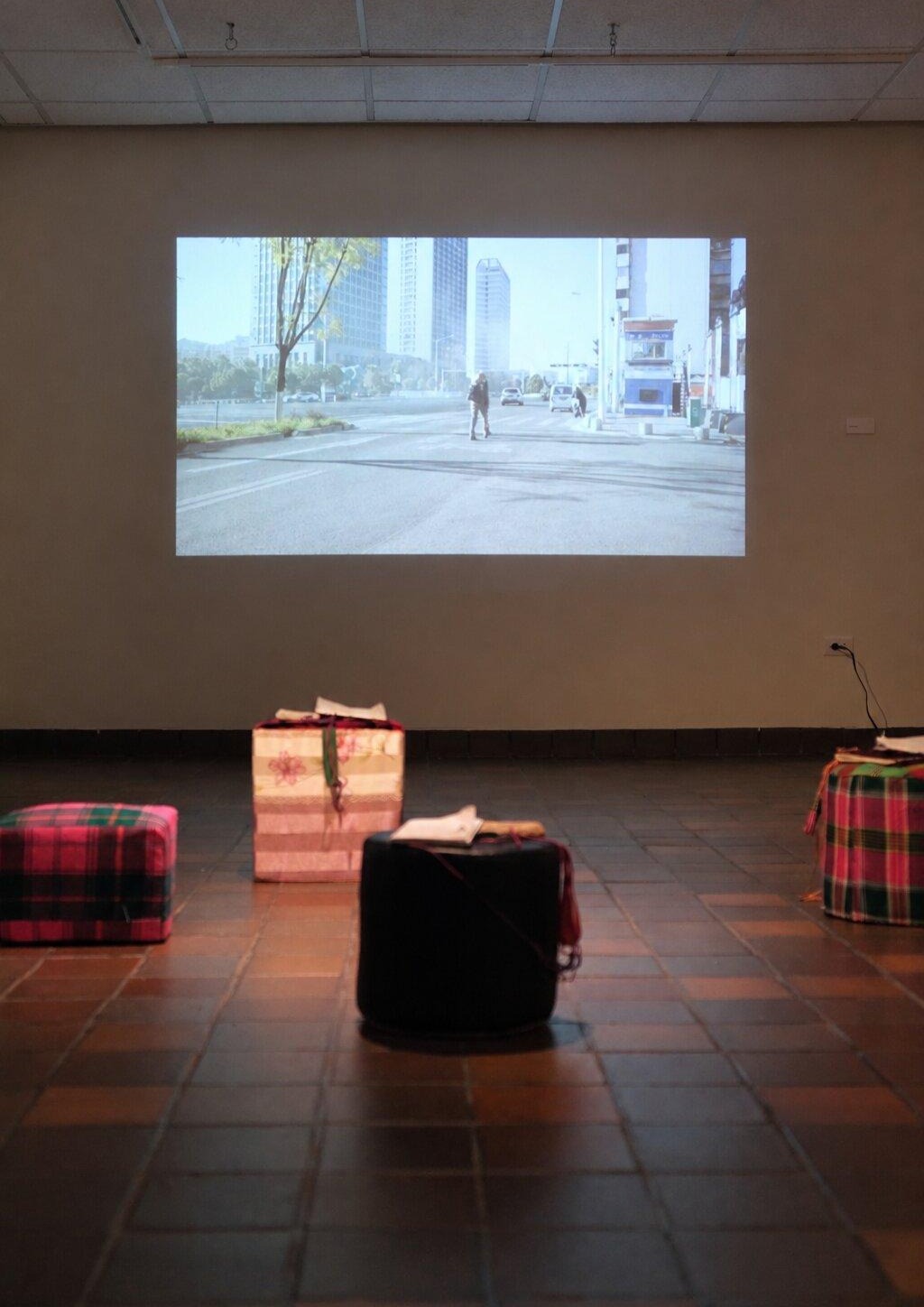
If each place contains its buried, secretive past within itself like geological strata, how can one access its layers? Strata of Relations, curated by Yixuan Wang on the occasion of the 2026 New York Conference on Asian Studies, takes up this question. Here, the teleology of history in its objective, sequential form is replaced by the opacity of archival fragments, field investigations, and speculative storytelling, spanning multiple locales across Asia and beyond.
Landscape exists in its expanded form within the exhibition: natural, as mountains to be wandered through, but also artificial, as water infrastructures in Central Asia; it is condensed to an index, as wrought-iron patterns found within residential neighborhoods in Lahore, but also dispersed across fragments, as narrated by cut-up letters of correspondence. Presenting landscape through its multiplicity, Strata of Relations makes clear that one cannot understand a site and its past as an abstracted, unmediated whole. Instead, one must identify its parts, devise one’s own method, and excavate. In the case of modern Asia, the excavation would yield layers haunted by displacement, imperialism, and militarism.
Xinhao Cheng, in his video A Time to Embrace (2019), approaches the landscape along the China-Myanmar border by walking 875 kilometers while kicking a stone, physically tracing a historical wartime caravan path that is now in part highways and railways. While Cheng isolated the elemental form of stone to play with, Huiqi He also initiated her field-work-based video The Quiksilver Flames (2026 - present)with the chemical element mercury, articulating the regional history of Guizhou, China through the threshold between industrial mining and alchemical mysticism. Landscape, under prolonged scrutiny, reluctantly reveals the contradictions it inhabits.
In thinking through the contradictory, Beihua Guo’s installation of uranotypes titled Designated Ground Zeroes (2023 - present) examines China’s changing urban surfaces by photographing former US-designated nuclear target sites, now shopping centers, neighborhoods, and cultural venues. The juxtaposition of then and now exposes lingering traces of nuclear violence, otherwise barely visible within the urban landscapes of today. Similarly uncovering the aftermaths of Cold War militarism within Asia, Christy Phimmasone’s sculpture Anatomy of the Secret War (2026) metaphorically excavates the buried, undetonated bomblets from the soils of Laos, presenting them as porcelain and clay objects on the gallery floor.
While many of the examined landscapes consist of depths of strata, some are marked by an absence of history: Siyang Dai and Zijun Zhao, in their installation Rehoming DunDun (2024–), locate the resettlement community of Dameng, China, to explore how its residents reestablish a sense of belonging after the demolition of their former homes. Absence, in fact, permeates Strata of Relations. Its location in upstate New York means that all the artworks are divorced from their sites of investigation. Just as the artworks do not claim to fully know or own their landscapes, the exhibition does not claim a root as well. Strata of Relations is a diasporic poem, in the sense that there never was one home, nation, or history—only the unstable, haunted landscapes of relations in its multiplicity.
Sagarika Sundaram: Reservoir
Henry Moore Institute | 74 The Headrow, Leeds, LS1 3AH
September 30, 2026 – January 10, 2027
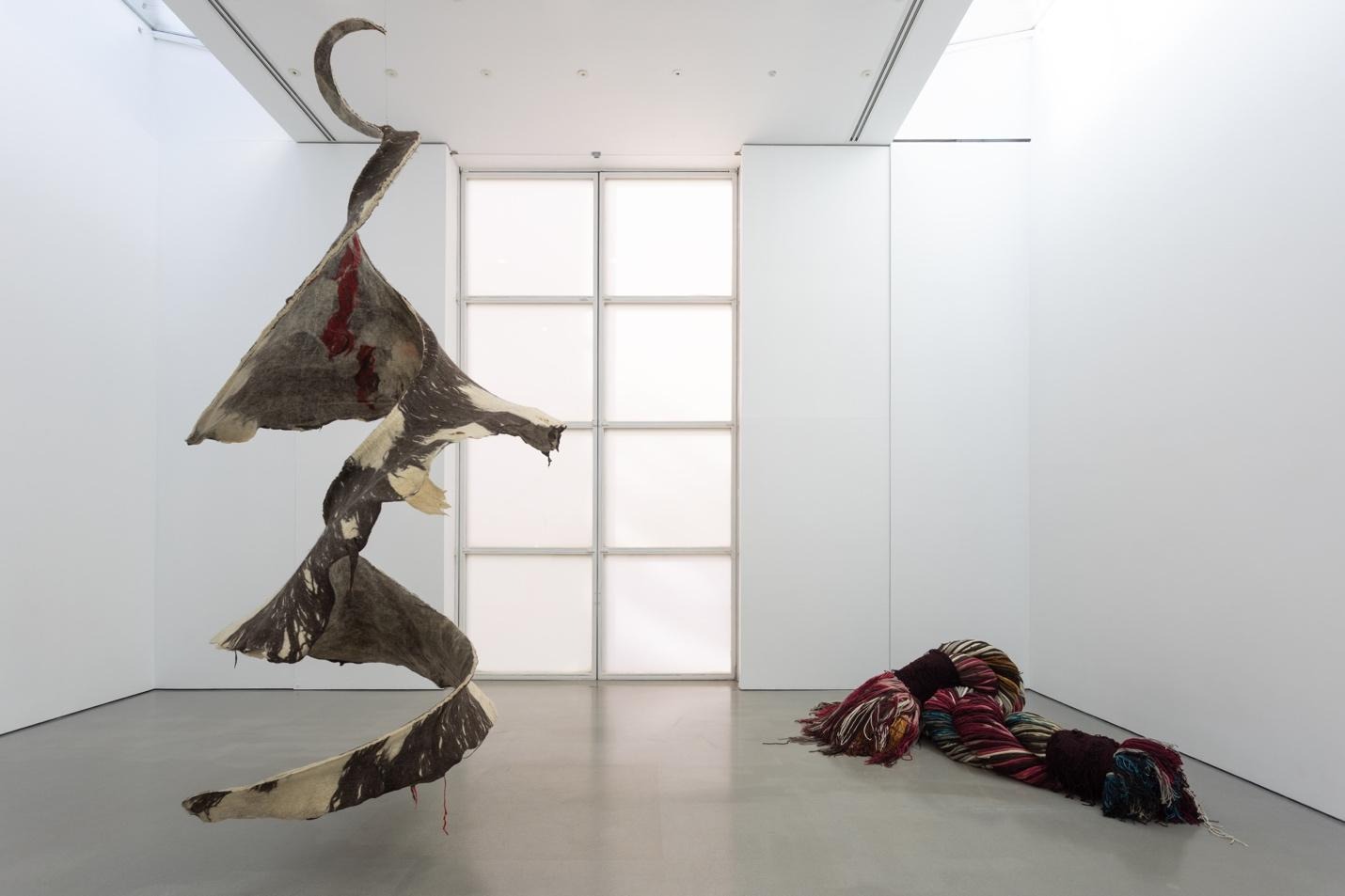
Sagarika Sundaram has created an immersive ecosystem entirely out of wool for Reservoir, her first museum exhibition at the Henry Moore Institute in Leeds. Merging saturated hues and muted tones, her large sculptural textiles tell a story of patience, resourcefulness, and legacy. Made from handmade felt, Sundaram’s sculptures have a pliable quality, yet appear sturdy and majestic. Installed sparsely, her forms twist, coil, and gather strength, establishing a tension between movement and stillness that draws in and holds the viewer. The resulting torsion gives each form a sense of turning energy; in Sundaram’s hands, this energy becomes palpable, as though the sculptures are caught in the act of becoming.
Transformation is at the crux of Sundaram's labor-intensive, process-based practice. Through repeated dyeing, layering, and compaction, Sundaram builds up the felt’s strata. Loose wool fibers bind under moisture, warmth, and pressure into a dense, continuous surface that can be cut without fraying. As though slicing through a layer cake, the artist cuts open the material to reveal buried colors and shapes within its plies, exposing its hidden pulse.
Felting is among the oldest processes for creating textiles, predating spinning and weaving. For millennia, the material has been used to clothe and shelter the body. Sundaram engages these associations, employing felt to investigate the materiality of wool and its relationship to human biology and psyche. “I treat textile like a body—rupturing the flat surface, revealing what lies beneath layers—the carnal, painful, ugly, beautiful—interrogating what it means to be both of and alien to this world," she explains.
Reservoir features a new body of work by Sundaram, created especially for the exhibition while in Kutch, western India. Its centerpiece, Blue Mountain (2026), measuring ten feet high and twenty-four feet long, is imposing and beckons viewers to take a closer look, almost inviting them to take shelter between its folds. Made with natural brown and cream wool, Blue Mountain contains painterly swaths of dyed blue wool that evoke the ice-capped peaks of Himalayan glaciers. Sundaram compares the sculpture’s coarse, pebbled texture to an elephant’s knee, rough and wrinkled.
Nearby, Dancer (2026) unfolds with kinetic force, extending from floor to ceiling. Cut from a single piece of felt, Dancer is animated by torque, recalling the spiral as a fundamental pattern of life and the universe, a symbol that is omnipresent and naturally recurring. Sacred geometry seems to inform Sundaram’s practice: a mountain morphs into a triangle, a fold becomes a seedpod, and a spiral evokes the logarithmic coil of a nautilus shell. Her monumental sculptures conjure the natural world, as Glossolalia (2026) recalls writhing, vine-covered tree branches emerging from primordial lakes. Reservoir is ultimately an exhibition about becoming: wool becomes felt, softness becomes mass, and stillness becomes charged with motion.