
Clare Koury: “The New Era of Manifestations Ascending the Bounds of Millennial Law” at lower_cavity
Review
Yuna Cho, a Korean-Canadian multimedia sculptor who received her MFA in Painting and Printmaking from Yale University, once described herself as a constant learner. As both a professor of drawing at Western Connecticut State University and an early-career artist, Cho’s students and experimental material approach bring her attention to ideas previously overlooked, creating an attitude of experimentation and radical curiosity. Her artworks carry this ethos, seeking to impart an expansive attention to the invisible, elusive qualities of the environment. By drawing on the aesthetic qualities and methods of post-minimalism, Cho addresses the malleability and porousness of the human body and identity.
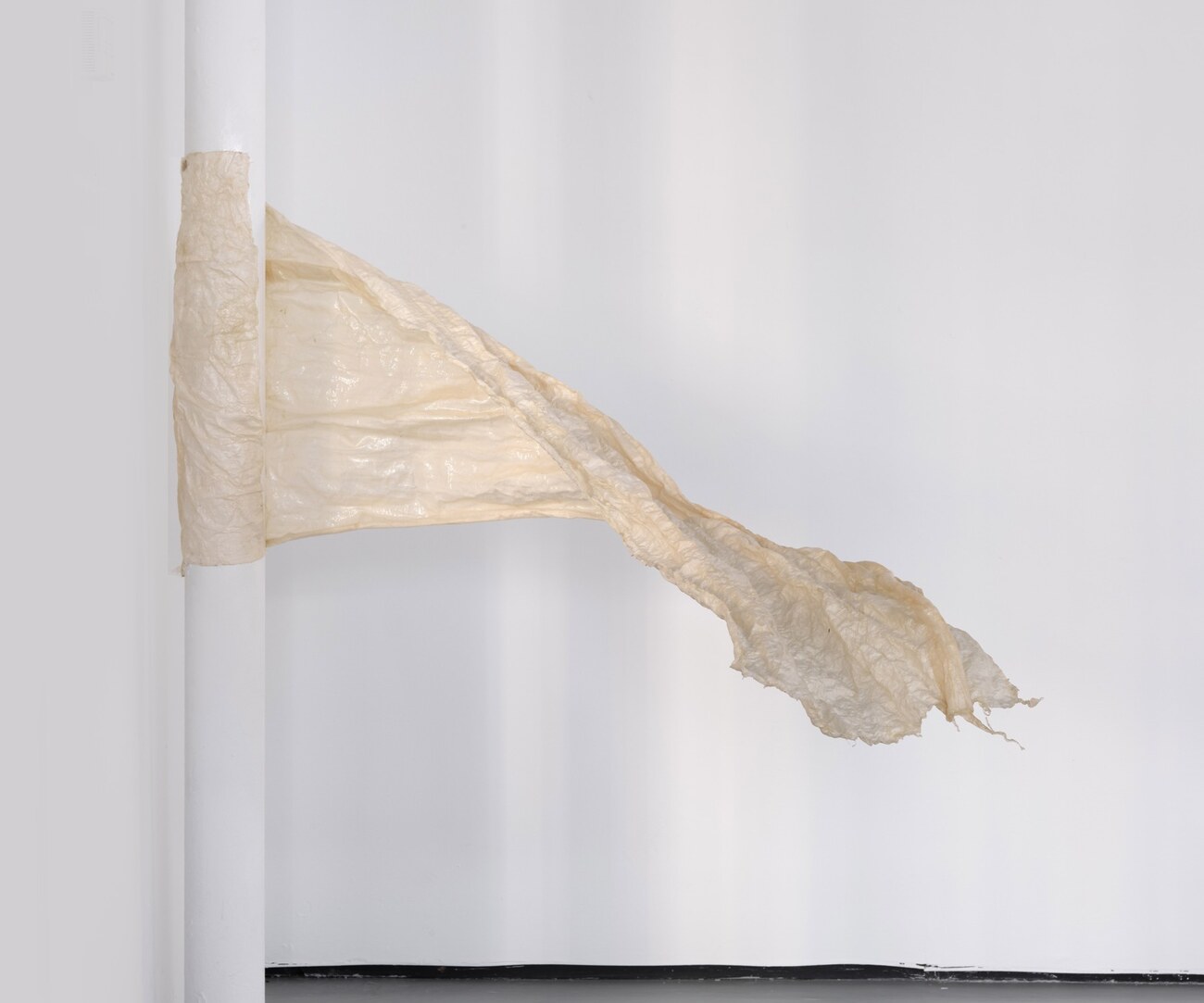
Growing up, Cho and her family frequently moved houses and across countries. Like many people drawn to creative practices, she occupied a hybrid identity formed by growing up in different parts of Korea, Canada, and eventually the United States. The immense changes that Cho repeatedly faced as a child find poetic resonances in the materiality of her work. Working primarily with handmade paper, Cho adds water and glycerin to give the paper hygroscopic properties. This allows the work to absorb moisture from the environment and take on new forms, which is also an artistic analogy for the process of adaptation that immigrant or itinerant populations often undergo. Still, holding 당연한건 없어 (2026) was made at her studio in New Haven. The handmade paper, which initially lay hanging like a drying towel, was positioned parallel to an open window. Its hygroscopic qualities allowed the sculptural body to absorb moisture from the air and retain the wind's shape, preserved in the work’s twisting form.
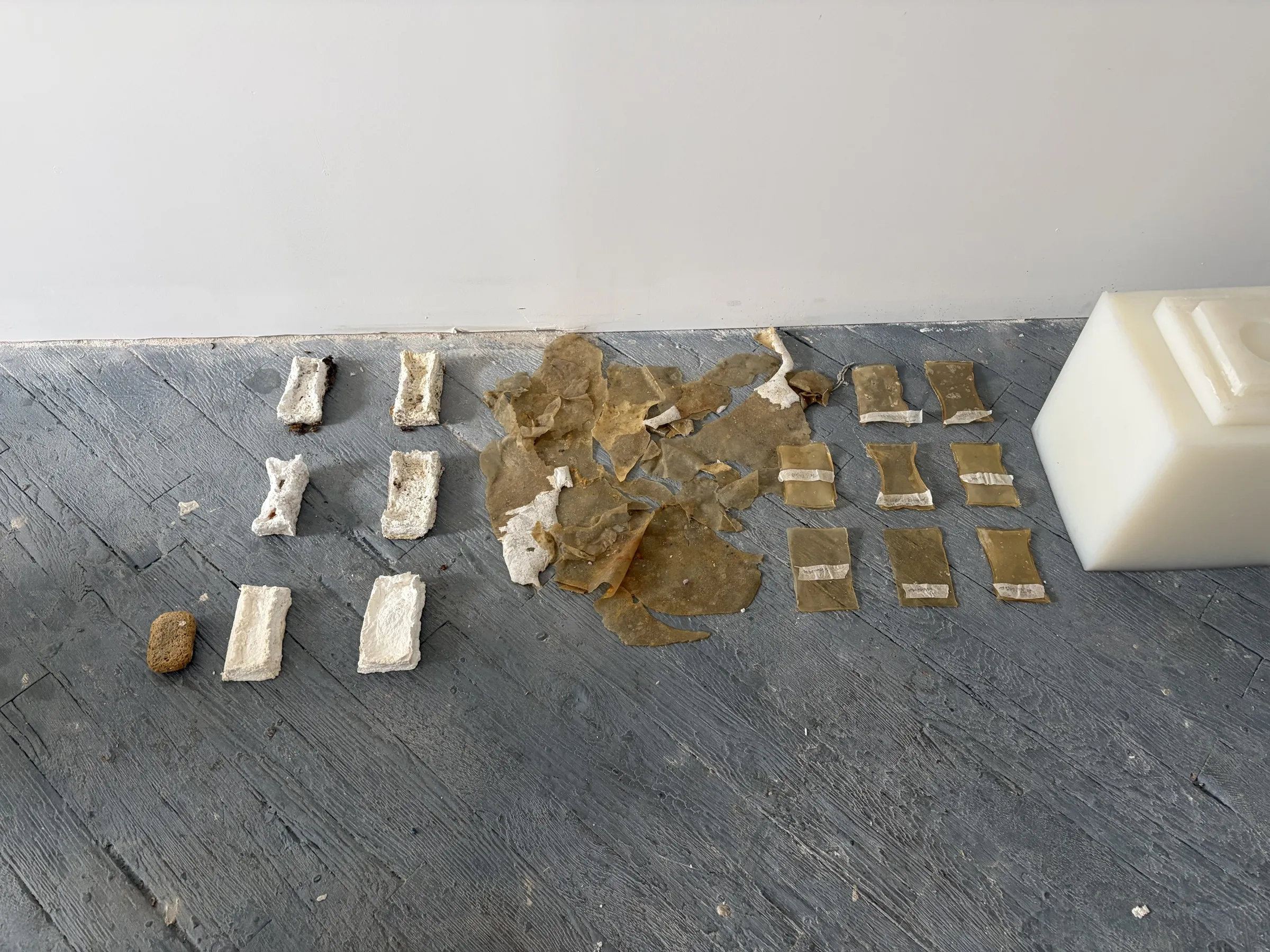
Despite their formal simplicity, Cho’s sculptures have a surprisingly intangible quality. Part of what contributes to their elusiveness is the shapes they take on, which are like ghosts of harder, more geometric forms. What Surrounds, Touches, and Holds 둘러싸고, 닿고, 지탱하는 것들 (2025) is a large composite of rectangles, displayed suspended, strong yet on the verge of collapse. Scattered across the piece’s yellowing body are remnants of its contact with previous surfaces and materials such as water, dust, hair, leaf, gelatin, and glycerin. What looks like a collection of attempts to fully peel off masking tape is an ode to porousness, fragility, and the idea that our bodies always carry remnants from previous encounters. When I asked Cho how she arrived at this visual language, she said, “They're all imaginary. They're not based on anything that exists in real life, because I think it goes back to that idea that things shaping us are not always tangible. They're mostly intangible things like the psychological, emotional, and social.” While not being representational, her paper pieces come from larger, wooden assemblage sculptures that she dubs “mother structures.” “The mother structure is giving birth to the skin,” Cho said, “but then in turn, the skin also leaves residues onto the original structure. They're both dependent on one another.”
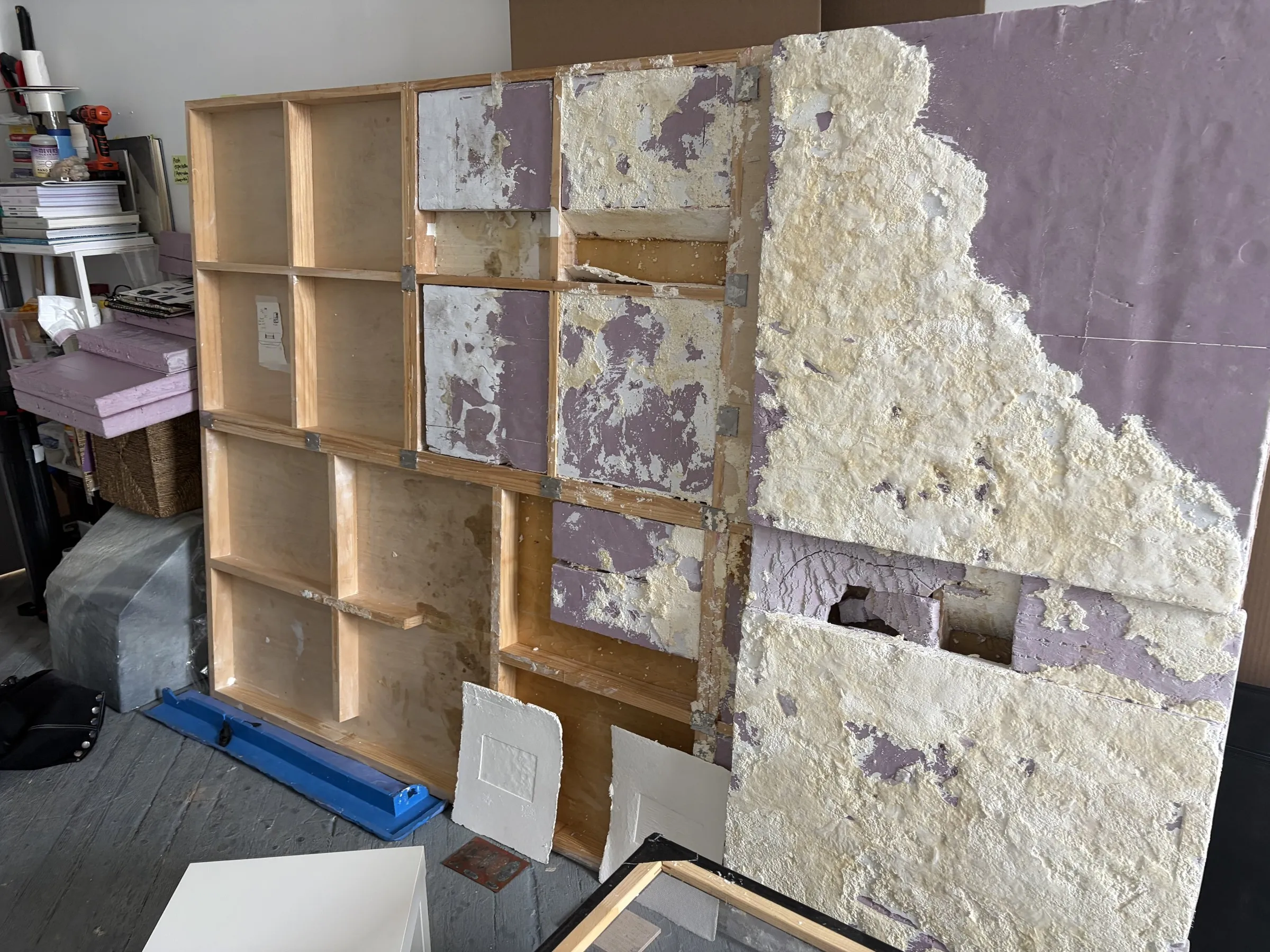
If the wooden assemblages are mothers, then Cho is like a midwife, facilitating the birth of the skins. She works entirely from the ground, sitting or crouching to ensure that she’s as close to the material as possible. When asked why she does this and if it doesn't hurt her back, Cho expressed an interest in the immediacy of mediums. “I really have to feel everything,” she said. “I have to be on the floor. And I think that's being carried on to the work that I'm making right now, where I'm trying to slow down all the processes, and I'm trying to spend most of my time observing how the material behaves.” Cho keeps a detailed notebook with time-stamped images of her material experiments. The level of care and precision taken is reminiscent of a photobook used to track a baby’s development.
The imaginary forms that structure works like What Surrounds, Touches, and Holds contain the traces of earlier, modernist ambitions. Their rigid, geometric construction stems from both an earlier period in Cho’s own art-making practice and a larger, cultural artistic obsession with the grid as an emblem and a myth. In her 1979 essay “Grids,”1 Rosalind Krauss writes that in the early twentieth century, “The grid announces, among other things, modern art's will to silence, its hostility to literature, to narrative, to discourse.” The serial, geometric patterning draws attention to the artificiality of image-making while also striving to represent infinity. Around the 1960s, process-based artists sought to subvert the implicit universalism of the grid by inserting handmade and chance-based processes into geometric works. Eva Hesse’s grid drawings or, more recently, Richard Tuttle’s Particles at Pace Gallery, are both examples of how a post-minimalist subversion of the grid can create an aesthetics of dependence: a rigid structure, made pliable by a tender hand.
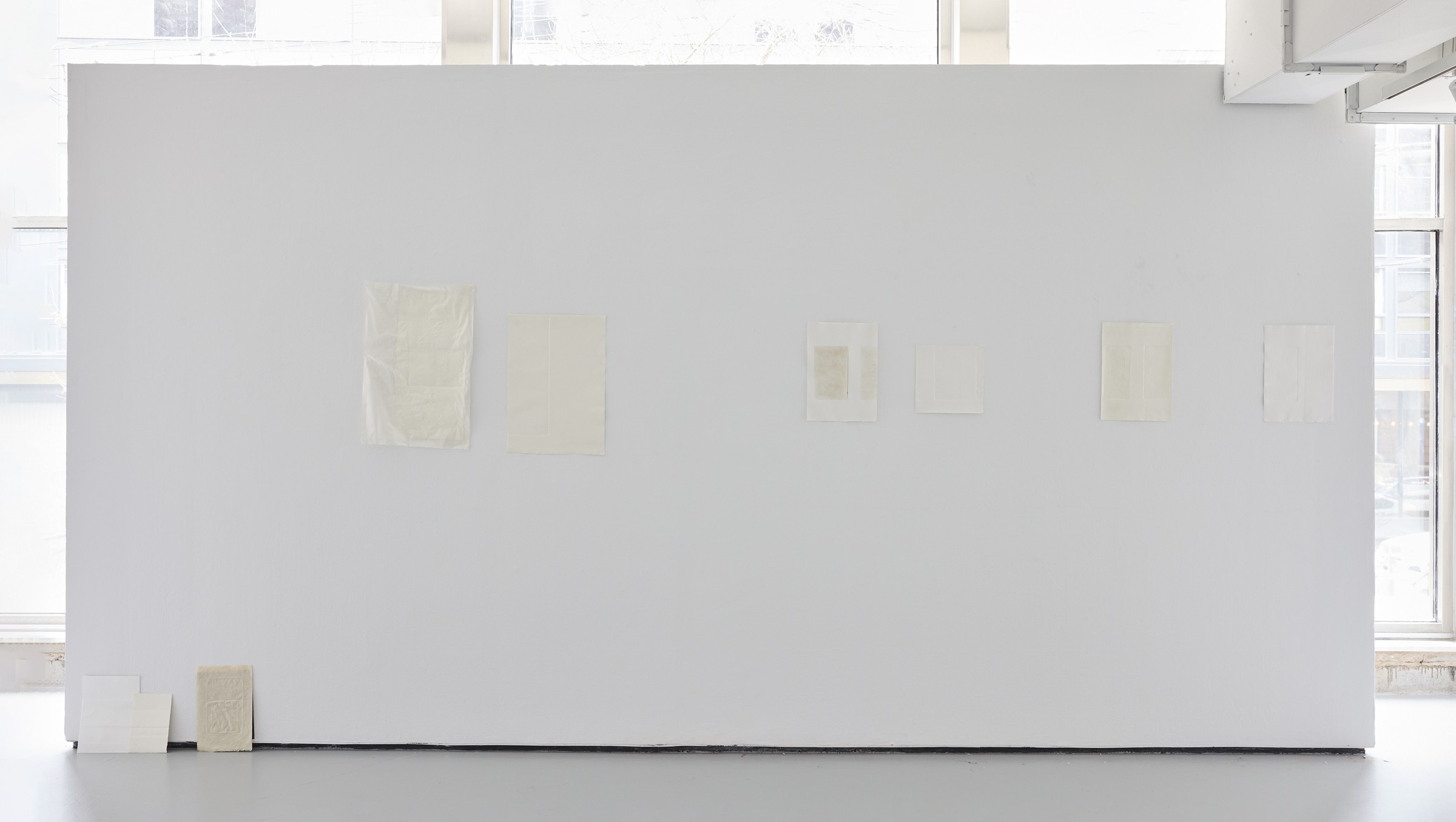
All of Cho’s work teeters on the line of imperceptibility while simultaneously maintaining a strong quietness. Comprised almost entirely of different shades of white, the absence of intentionally applied color creates a heightened presence of the less readily accessible characteristics such as texture and time, like the slight height variations that can only be viewed in person in Where It Softened 눈에 보이지 않는 (2025). By incorporating the often overlooked aspects of the environment, like the wind from a window or dust from a studio floor, into the foundation for a sculpture, Cho creates a vision of bodies blinking, awake, and porous to the world. How do our bodies carry and absorb past encounters? As the otherwise invisible ambient forces make the surfaces of Cho’s works records of the conditions that shaped them, these encounters also give material form to a sense of interdependence that runs through her practice, serving as an apt metaphor for the body’s continual adaptation to its surroundings.

1 Rosalind Krauss, “Grids,” JSTOR. October 9, 1979: 50.