


Heejung Kim: “Vestiges of Time” at the Asian and American Art Foundation
Review
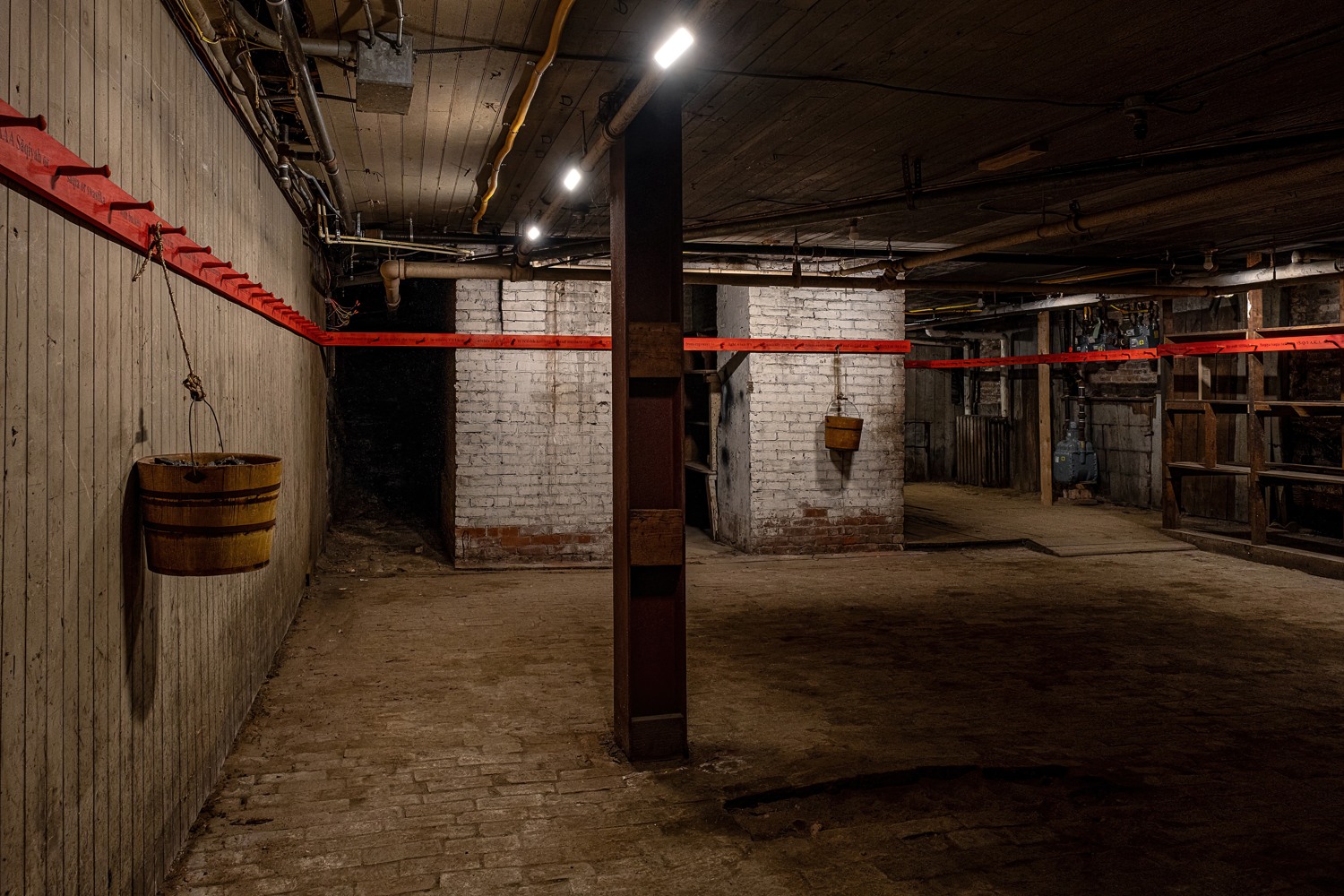
Entrance to Clare Koury’s site-specific installation The New Era of Manifestations Ascending the Bounds of Millennial Law (2026) is gained via an unassuming storefront in the small post-industrial town of Holyoke, Massachusetts. Inside, a descending set of stairs delivers the visitor to CHAMBER: lower_cavity’s project space. At the bottom of the steps, the viewer is confronted by a luminous red peg rail hung at eye level, encircling the perimeter of the dimly lit, rough-hewn space. The peg rail is embellished with text of a slightly darker tint that begins with: “Hold back your hand from the mill, you grinding girls; even if the cockcrow heralds the dawn, SLEEP ON!”1
Koury has long been interested in alternative epistemologies—from the electromagnetic frequencies of the earth, to the Phoenician alphabet, to alien life forms—and how they affect human behavior. This project is the latest expression of that inquiry, stemming from the artist’s research into Shaker communities. Perhaps known most widely for their design and craftsmanship, the religious sect has recently returned to public consciousness through The Testament of Ann Lee: the 2025 film starring Amanda Seyfried that dramatizes the movement’s founding. When I meet Koury at the exhibition, she tells me she has not seen the film. Instead, she became interested in the Shakers due to the concentration of their settlements both near the Connecticut River (on which lower_cavity is located) and in her home state of Kentucky. Indeed, this project takes on a different era of the Shakers’ history than is captured in the popular adaptation. After the death of founder Ann Lee, successive leadership altered (and eventually replaced) the foundational texts of the movement. In 1821, the “Millennial Laws” were instituted: a set of rules that controlled nearly every aspect of daily life in the community. While they claimed to maintain the egalitarian principles the movement was previously defined by, they in fact “perpetuated the values associated with Victorian androcentrism and favoured the traditional sex-based division of roles, thus subordinating women to men’s decisions.”2
These laws are adapted into text that appears on the peg rails of the installation. Some phrases take the laws as a starting point for free phonetic association (“flow must continue from A sea to A stream to A song sung in time to AAA SSSāqiyah or saqia or swastika”), while others offer a kind of late-capitalistic update to the text (“song of the lifeforce as flow TTTo Old McDonald’s meat farm E-I-E-I-O.”)3 Koury’s transformation of the laws parallels their departure from the sect’s original values, as well as their transformation over time.4
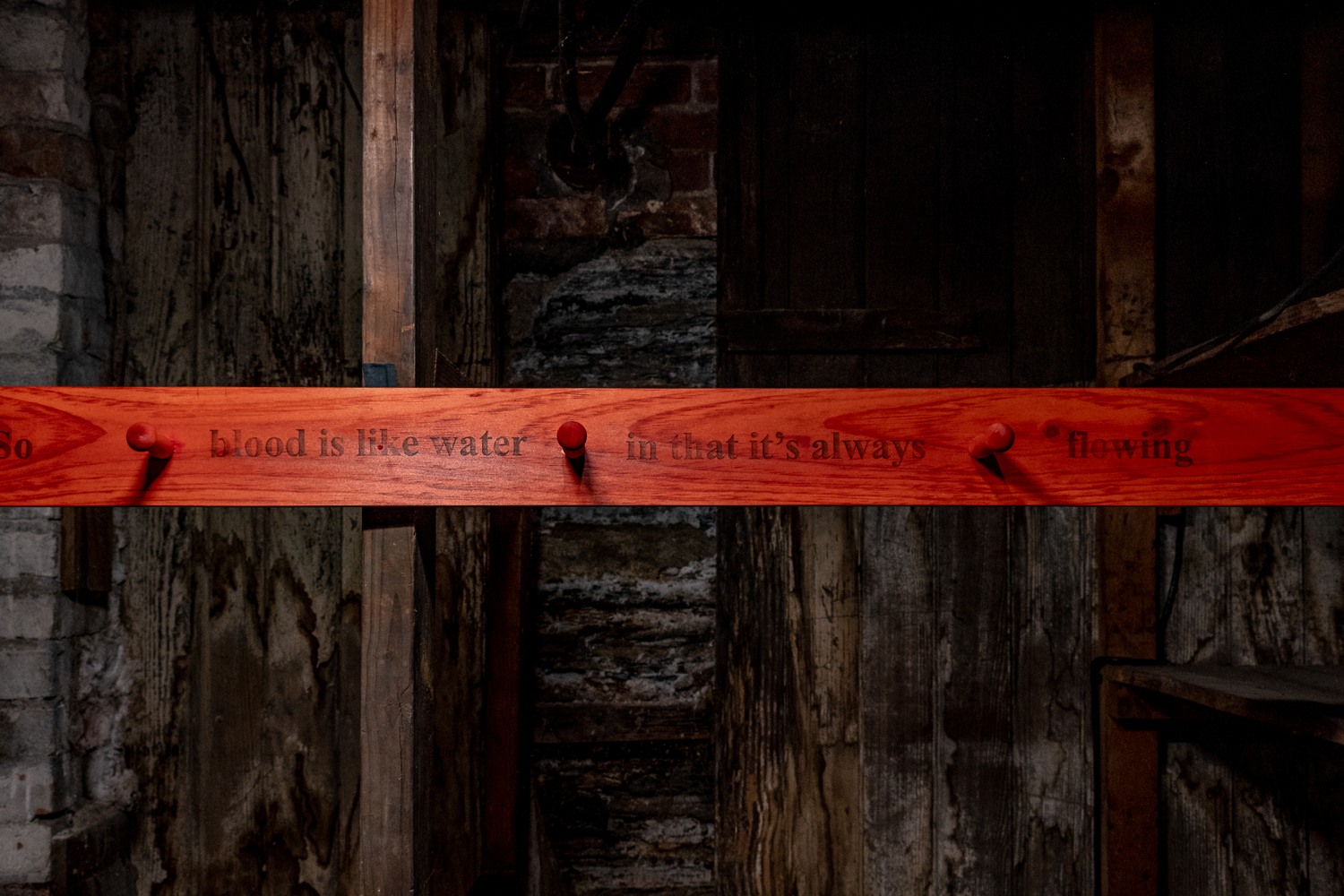
The peg rail itself is also transformed in this installation. It is dyed using Red 40, one of the few colors approved for use in design by the Millennial Laws. Here, the color is applied transparently, allowing the wood grain and the transferred text to emerge, just barely reaching the threshold of visibility. While a traditional Shaker peg rail would typically be hung about six feet off the ground and used to store furniture, cleaning supplies, and outdoor wear, Koury’s is hung at eye level, in direct confrontation with the viewer. Despite the artist’s reliance on historically accurate details, the rail’s snaking path around the dimly lit space summons a sense of conspiracy that feels distinctly contemporary. It conjures a chain reaction of associations: from a red-stringed corkboard constellation, to Red 40 maxxing, to MAHA moms.
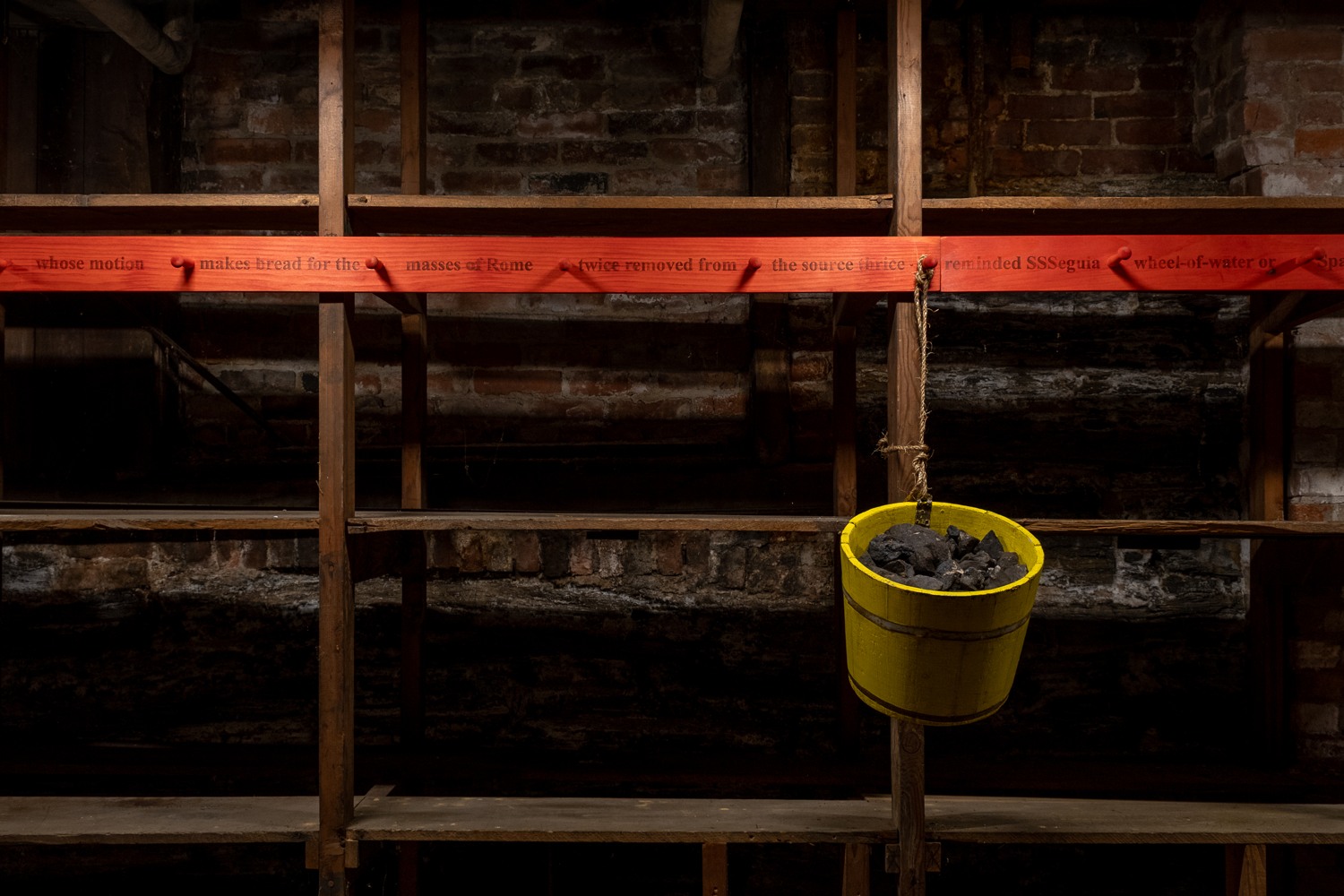
Only three objects occupy the length of the peg rail. Shaker-made buckets, painstakingly researched and obtained by the artist on eBay, hang from lengths of rope affixed to their handles. Each bucket is painted Chrome Yellow (another Shaker-approved pigment) and filled with mineral ore samples from Kentucky, the Adirondack Mountains, and the nearby Betts Manganese Mine. Recalling both the Shakers and Koury’s own connection to the natural world of the two locations, their residence on the pegboard feels tenuous, almost improbable, as the rope frays under the weight of the material. One wonders why they might be hung there, suggesting a significance to their shared resting place. The provenance of each sample is not indicated anywhere in the room, further gesturing towards—if not a sameness—a connectivity.
This dual sense of conspiracy and interconnectivity evoked in the installation is further implied by the title of the work. The New Era of Manifestations references a period of Shaker history during which young women in the community would enter ecstatic trances and return with messages from the spirit world—often from their deceased founder, Ann Lee.5 While they began in Watervliet, New York, these occurrences eventually spread to all the Shaker colonies across the country. As Koury’s title implies, these mediumistic attacks were antithetical to the order and discipline of the Shaker community, disrupting the tight control the Millennial Laws enforced on the sect. In fact, historians of the period suggest the Manifestations threatened the very fabric of the group’s new leadership, attacking the "patriarchal order that had held the sect in its grip since the death of its founder” and “seeking to restore the egalitarian nature of the movement.”6 Koury’s installation seems to act in concert with this claim, alluding to a wider relation that ascends the physical—whether it be spiritual or naturalistic in nature.

The artist’s continued fascination with the extremities of human behavior is explored here through language that relies on materials faithful to her research, yet offers little explanation to the viewer. In doing so, the work is simultaneously overdetermined and oblique: offering a plethora of deeply charged language and material, but without context to interpret it. This is not a bug, but a feature I find specific to Koury’s work. Deeply rooted in her own fascination and research, the work overflows with information, so much that it becomes auratic and evocative, whether or not it is clearly decipherable. The New Era of Manifestations Ascending the Bounds of Millennial Law presents this phenomenon in a serious, sobering light, suggesting we consider its potential and take a second look.
Clare Koury: The New Era of Manifestations Ascending the Bounds of Millennial Law is on view by appointment at lower_cavity’s CHAMBER through January 2027.
1 Clare Koury, The New Era Of Manifestations Ascending The Bounds Of Millennial Law, 2026.
2 Alexandra Midal, Witches of Design Ann Lee: Design, Trance and Feminism (Mudac, 2026), 26.
3 Koury.
4 The Millennial Laws were updated almost continuously until a final version was reached in 1845. Midal, 20.
5 Elizabeth Freeman, Beside You in Time: Sense Methods & Queer Sociabilities in the American 19th Century (Duke University Press, 2019), 49.
6 Midal, 33.