

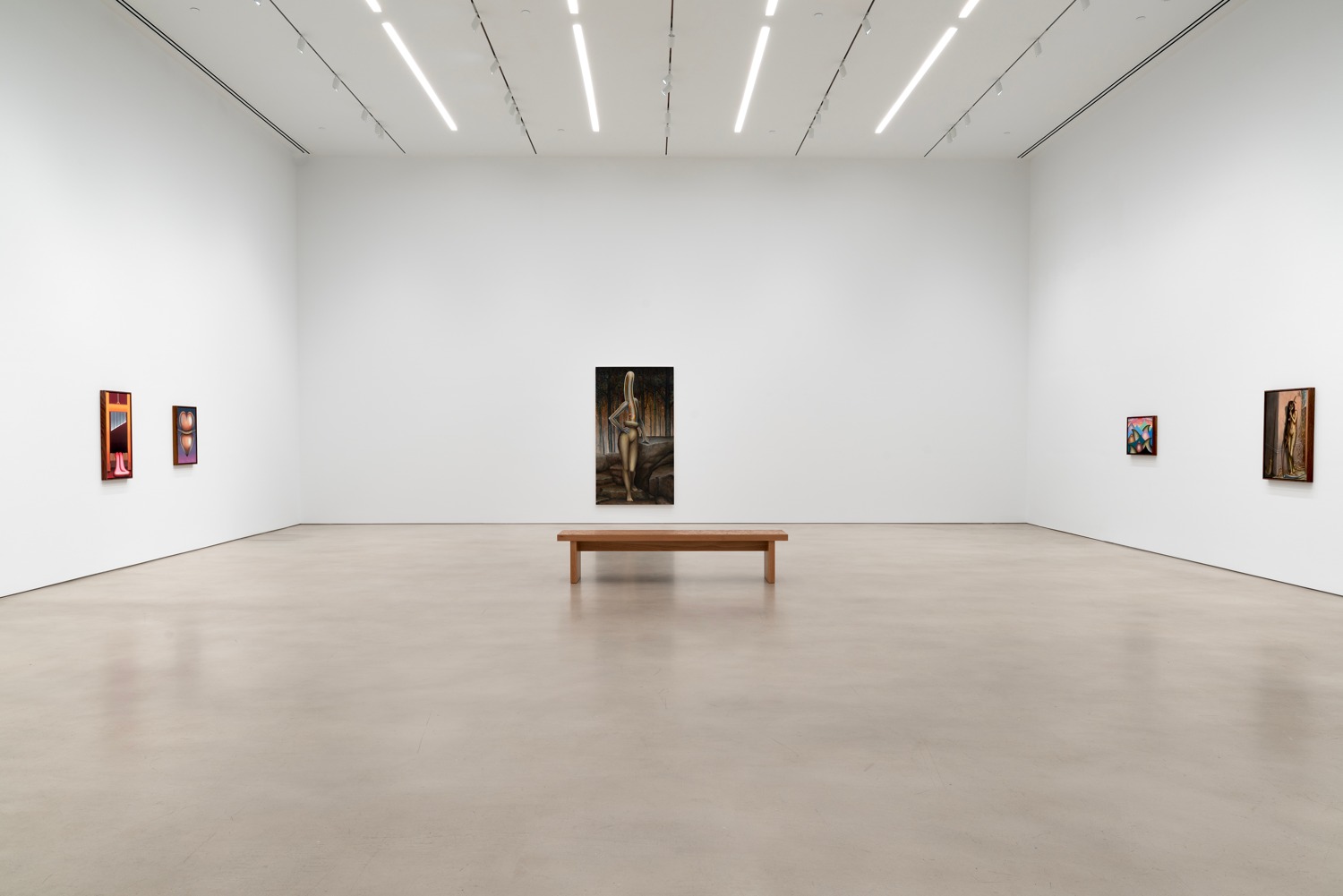
Emily Mae Smith: “Transit of Venus”
Review
Billed as a "semi-retrospective," this midcareer survey by Korean-American artist Heejung Kim, comprising 23 sculptures, artist books, and drawings produced over the last three decades, reminded viewers that formal beauty and thematic intrigue can spring united from obsessive facture. We often associate this lesson with Outsider artists—Judith Scott comes quickly to mind—but it is equally evident in the art of highly trained practitioners like China's Lin Tianmiao or Britain's Jill Townsley. Kim herself is a multi-faceted professional who holds an MA in art education along with her MFA, teaches studio practice at various colleges, and serves as a director of the nonprofit women's cultural organization Pen + Brush.
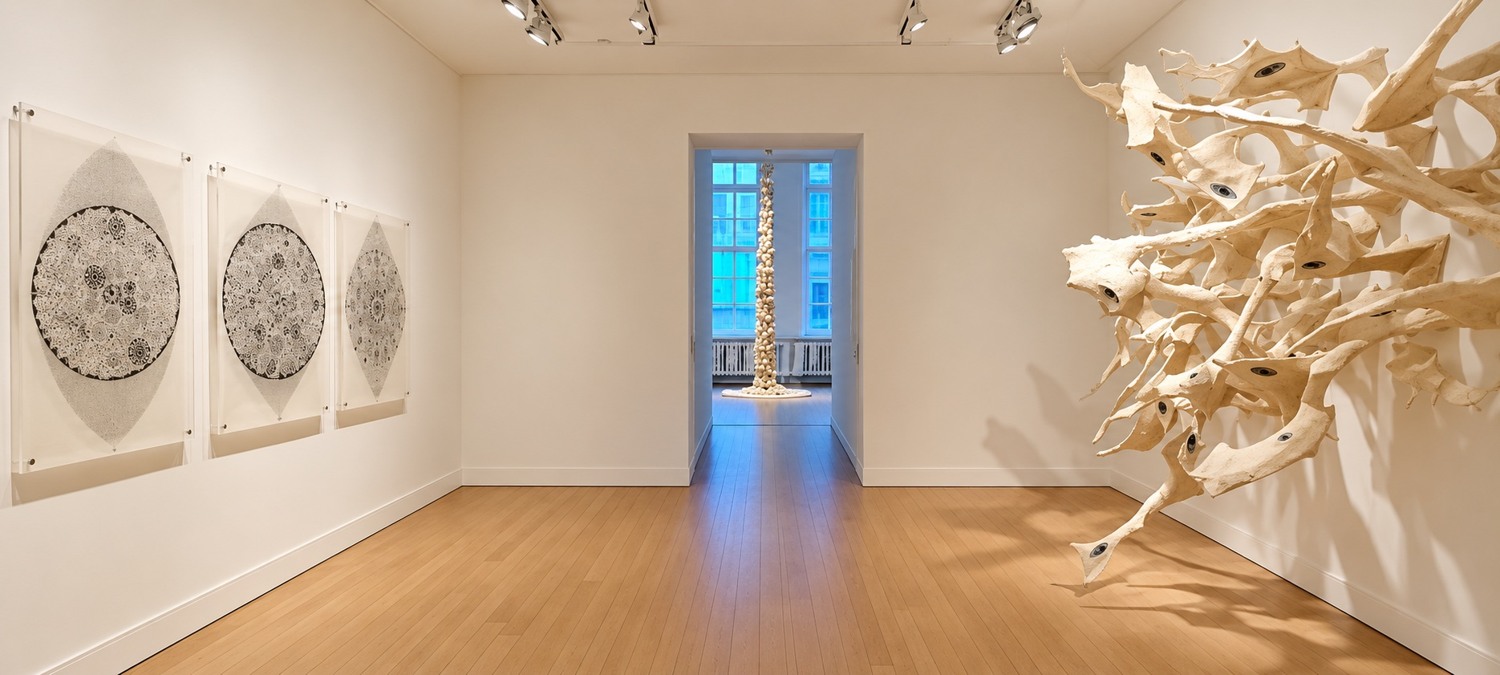
A hunger for space paired with a subdued monochromic cast gave this exhibition an unsettling initial impact—as though one had walked in on the extraterrestrial invasion of a Chelsea gallery. Strange light-tan-colored forms clambered along the walls, protruded into the viewing area, and rose up in columns. On small platforms, artist books sprouted alien tendrils or offered string, wire, and plastic eggs in place of words. Many of the pieces bore appliqué eyeballs, lending a you-are-being-watched eeriness to one's immersive stroll through the space.

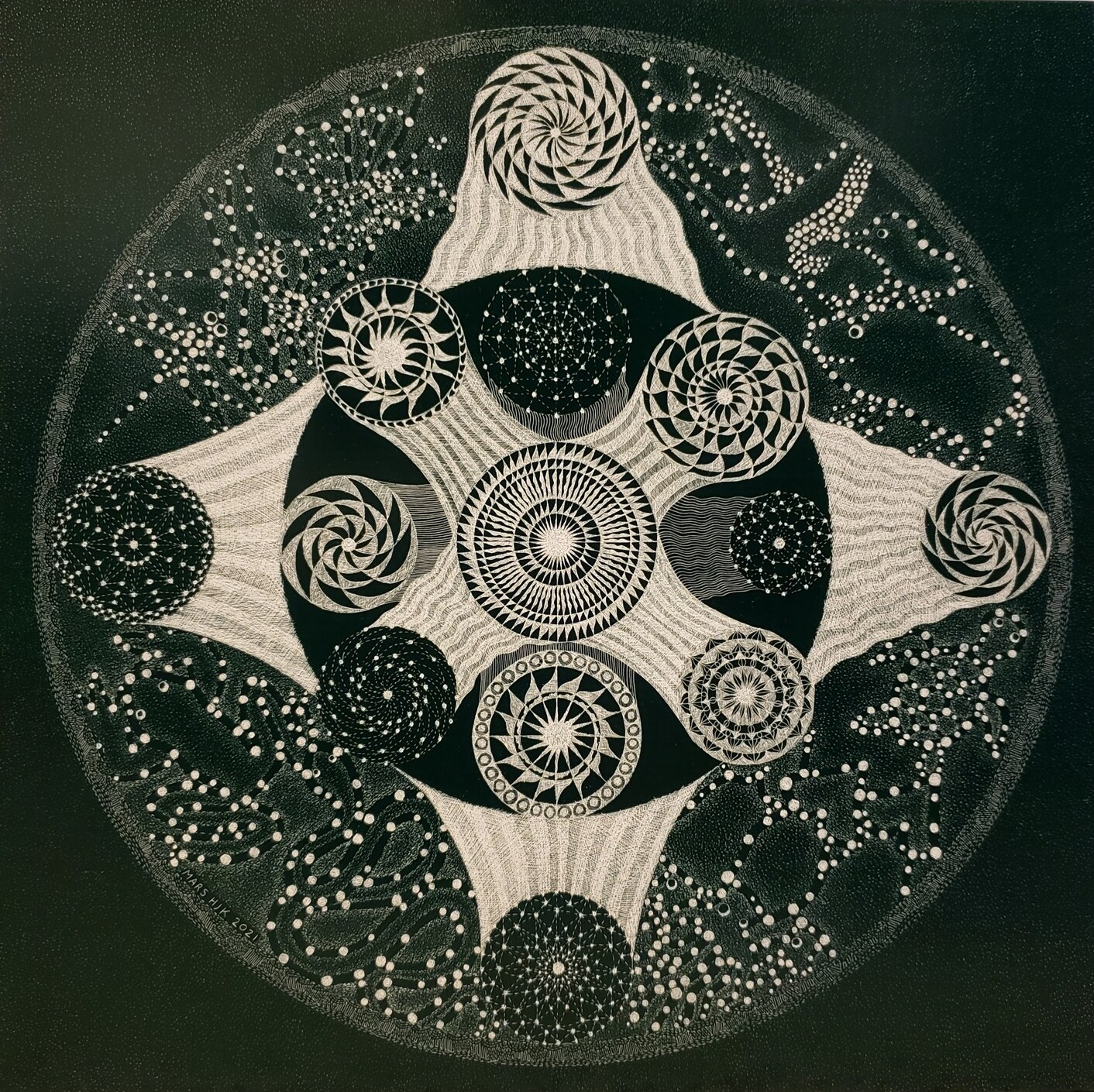
This sense of mysterious intrusion continued on a micro level as well. The artist, who has repeatedly expressed her enchantment with stars, uses a profusion of tiny dots to evoke the celestial lights, presenting their interplay as silent intimations of a spiritual domain. As seen most strikingly in A World of Dots (2025), a 10-foot-wide black panel bedazzled with variously sized disks painted with white circles and spirals and raised from the surface on small hand-carved wooden rods, the notion of cosmic patterning prevails at every scale. Not only do the dots, upon close inspection, reveal symmetrical designs but their allover distribution throbs with the rhythms of implicit shapes and spatial relationships.

Yayoi Kusama has repeatedly shown how myriad dots can break down the distinction of individual entities, including the self, and conjure up an infinite interrelatedness. But Kim's preoccupation also has a biographical origin. As a child, she watched her composer father handwrite his multipart scores and bind them into books. Today, the adult artist's work alludes repeatedly to the music of the spheres—the notion, originated by Pythagoras and echoed by Plato and Kepler, that the movements of cosmic bodies evince mathematical proportions, musical intervals, and an ultimate harmony.
In addition, Kim, who moved to the United States as a graduate student in 1989, expresses a fascination with the dialectic between multiplicity and fullness versus emptiness and the metaphysical void. This preoccupation first jelled for her when, in overpowering response to a work encountered at the Metropolitan Museum of Art, she elected to write a research paper on Tibetan mandalas. Those complex geometric designs, which represent the cosmos and simultaneously map the odyssey of a spiritually questing mind, spurred her later travel to the Himalayas and clearly influenced her many diagrammatic works such as Eye Mandala I (2018) and Cosmic Energy of Animal (2021).
For Kim, the search for enlightenment is inseparable from physical engagement with her materials. The intersecting lines in her drawings serve as emblems of karma. The sewn-on eyes suggest the "third eye" of intuitive wisdom that sees through illusory everyday appearances. The tedious stitching that holds together many of Kim's works requires, like the making of her innumerable dots, a deeply meditative repetition of gesture and thought—a process that eventually iterates into near-trance.
Yet Kim is well aware that even the most intricate Tibetan sand mandalas, once completed, are soon ritually wiped away to emphasize the transience—and thus the ultimate unreality—of all earthly phenomena. Appropriately, her exhibition was called Vestiges of Time, because in this mystical worldview time itself is transcended. Its accouterments—even these substantive artworks, created with devout patience and care—must be discarded without regret. They are mere handmade remnants, superseded like the flesh and all worldly concerns as the soul journeys elsewhere, beyond both chronology and matter, into dimensionless peace.
Heejung Kim: Vestiges of Time, a Semi-Retrospective was on view at the Asian and American Art Foundation, New York, September 2 to 25, 2026.