
Florian Krewer: “woven thin” at the Musée d’Art Moderne de Paris
Review
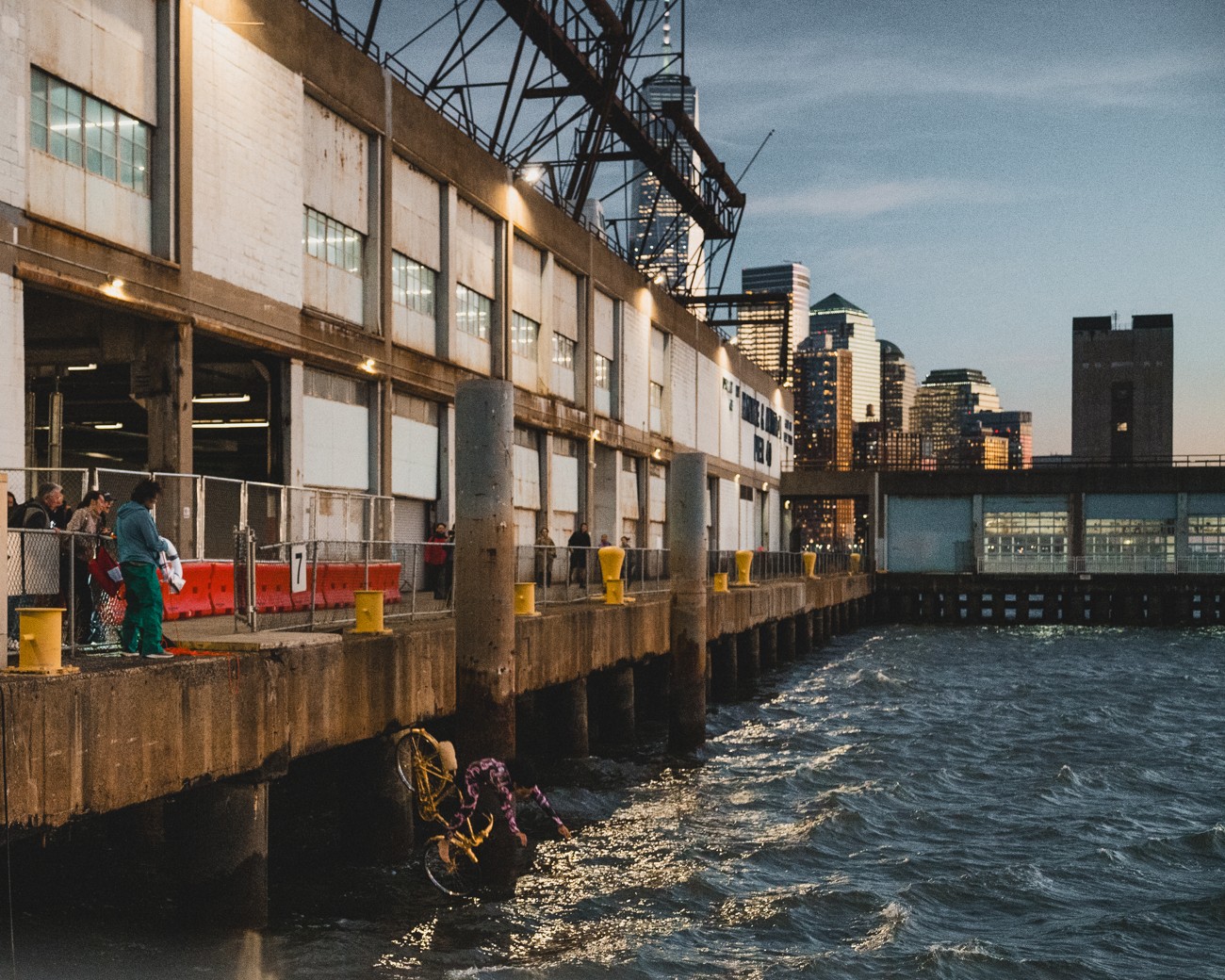
Low tide waves dissolved into each other, reflecting the warmth of Autumn sunset at their crests. I knew where to stop because a large crowd had already gathered in expectation, facing the Hudson River. The exact location for this performance—part of Identity Card, the third edition of The Immigrant Artist Biennial—was only revealed earlier that day. It was a charged day to be at a former commercial dock on the West Side piers: by sunset on October 30th, over two billion dollars of cargo sat idle that day, because of a united dockworkers' action across more than 100 ports across Europe, Asia, Africa, the Americas, and Australia, unified by the statement: “Dockworkers do not work for war.” A cargo ship glided south on the New Jersey side of the Hudson, and I wondered if New York City ports participated (they didn’t).
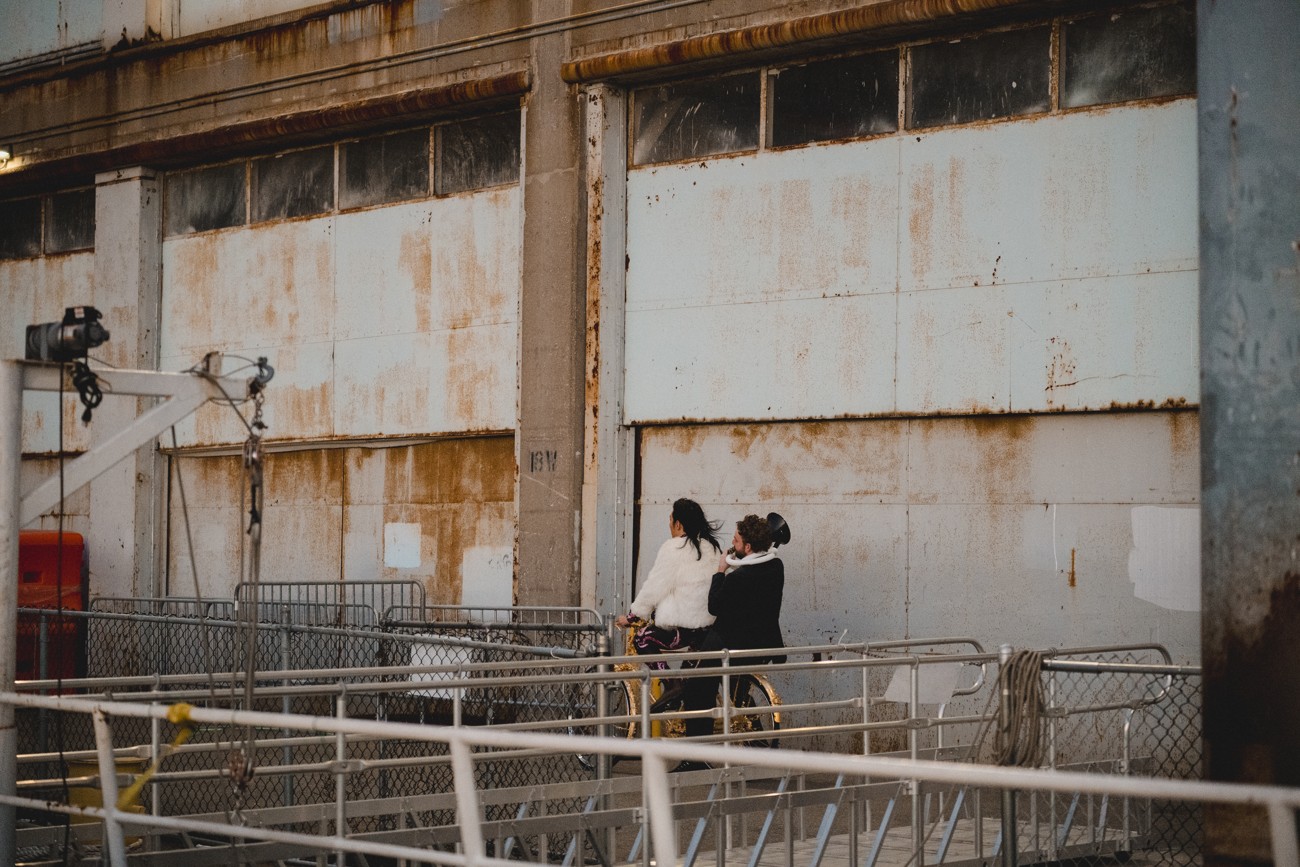
Anh Vo arrived riding a bicycle from the south corner of Pier 40 and pedaled past us with musician Erinn Buhyoff balancing on the rear rack. They turned around and cycled past us again. Wearing a Versace bodysuit topped with a white shaggy waist-length coat, Vo smiled and waved at a curious crowd who couldn’t stop cheering. The bicycle frame was fully gold-leafed. Buhyoff improvised drone sounds with a homemade woodwind instrument and projected sound with a megaphone from behind Vo’s right ear. After disappearing for several minutes, Vo appeared pedaling alone and fast, steering towards an open gate along the pier and riding that gold bicycle into the Hudson River. We heard a massive splash and rushed to the railing to see Vo emerge and catch breath. Swimming in place but holding a dry paper text in one hand and a wireless microphone in the other, Vo read to us from the waves:
THIS IS NOT A RE-DOING
THIS IS NOT A RE-PERFORMANCE
THIS IS NOT A RE-ENACTMENT
This is not an attempt to bring the past into the present, as if the present is ever not already burdened by the weight of history.
History needs not be re-presented.
The prefix re- is a redundancy.
THIS IS A DOING
THIS IS A PERFORMANCE
THIS IS A TRANSLATION
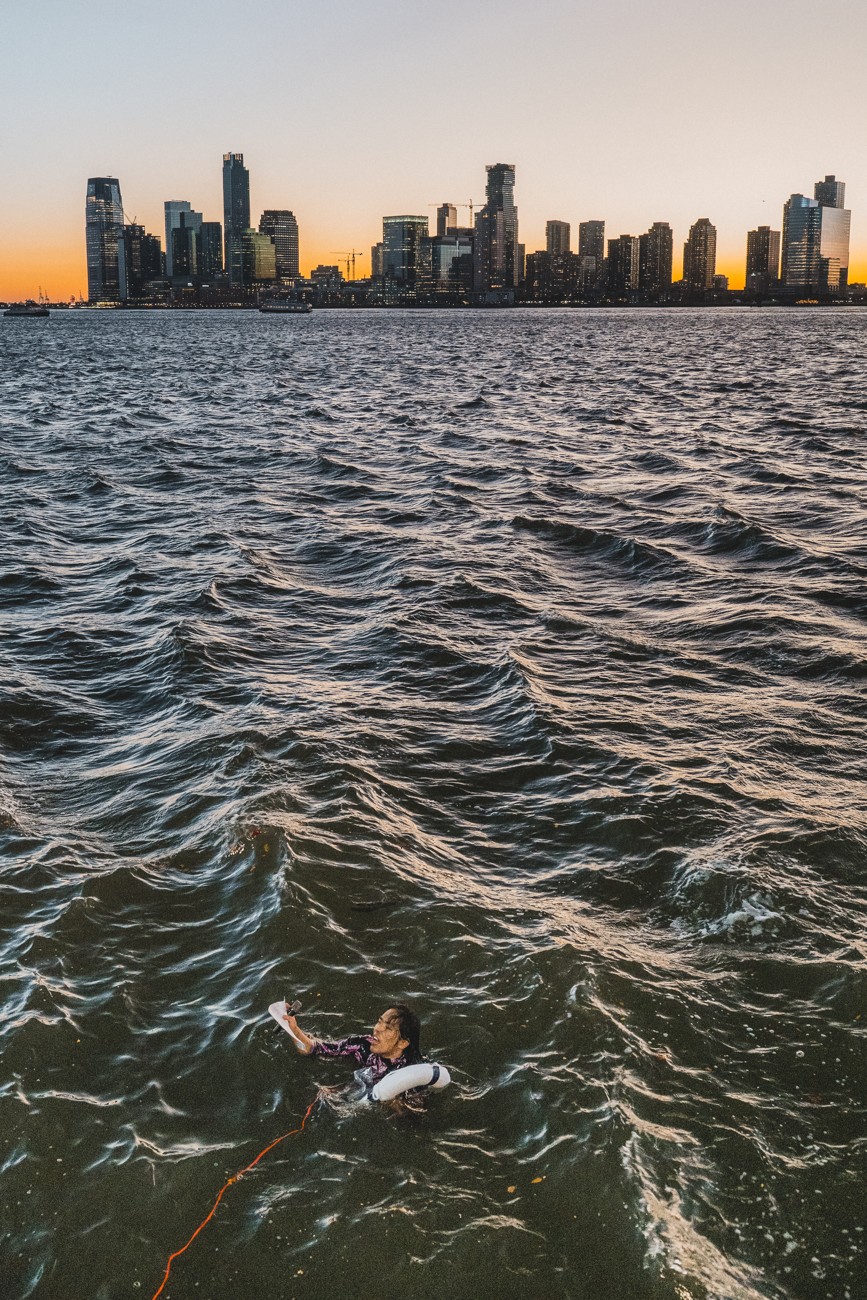
I could only partially hear between the agitated tide and the crowd cheering. A rope enabled Vo to climb up and out of the water. No sign of the bicycle. It was impossible not to think of Bas Jan Ader’s short 1970 performance piece, Fall 2, Amsterdam, in which Ader rides a Dutch roadster into the Reguliersgracht Canal. Manhattan’s Pier 40 was specifically built for Holland Airlines in the early ’60s; I couldn’t help but think about it. But Anh Vo had an entirely different context for this work, titled Phoenix Forever: “With this performance, I was mostly responding to, or translating, Vũ Đức Toàn's 2022 performance ‘Phượng Hoàng Vĩnh Cửu’ to evoke the transgressive spirit of Hanoi guerrilla performance that I thought Vũ Đức encapsulated so well.”
Vo is a Vietnamese performance artist, choreographer, and writer whose work blends urban experimental performance practices from New York and Hanoi alongside Vietnamese folk rituals. “In Vietnam, experimental performance mostly operates underground, guerrilla, with no resources other than occasional crumbs of funding from foreign entities. As the US is descending into this weird brand of fascism/authoritarianism, I thought it would be a great opportunity to turn to the artists in Vietnam who have been navigating a police state for generations now.”
By invoking the urgency of gathering and building collectively, Vo thoroughly cleansed a canonical Western performance art gesture from its romantic notions of surrender (to gravity, Ader) into a call for action, a call to immersion—the Hudson River is far deeper than the Reguliersgracht’s shallow sediment bed. Phoenix Forever had the visibly deconstructed help of a team, whereas Ader and Vũ Đức “were more centered around the single artist figure.” With such choices, Vo’s performance was more about connection with the audience than Ader and Vũ Đức, revealing a looser, associative practice. “Also,” Vo continued, “I love how much Vietnamese experimental performance is not built around the ‘show,’ the ‘production,’ precisely because of precarious socio-political conditions. Performance there mostly spreads through gossip and hearsay, which is such a different approach to performance that doesn't fetishize presence.”
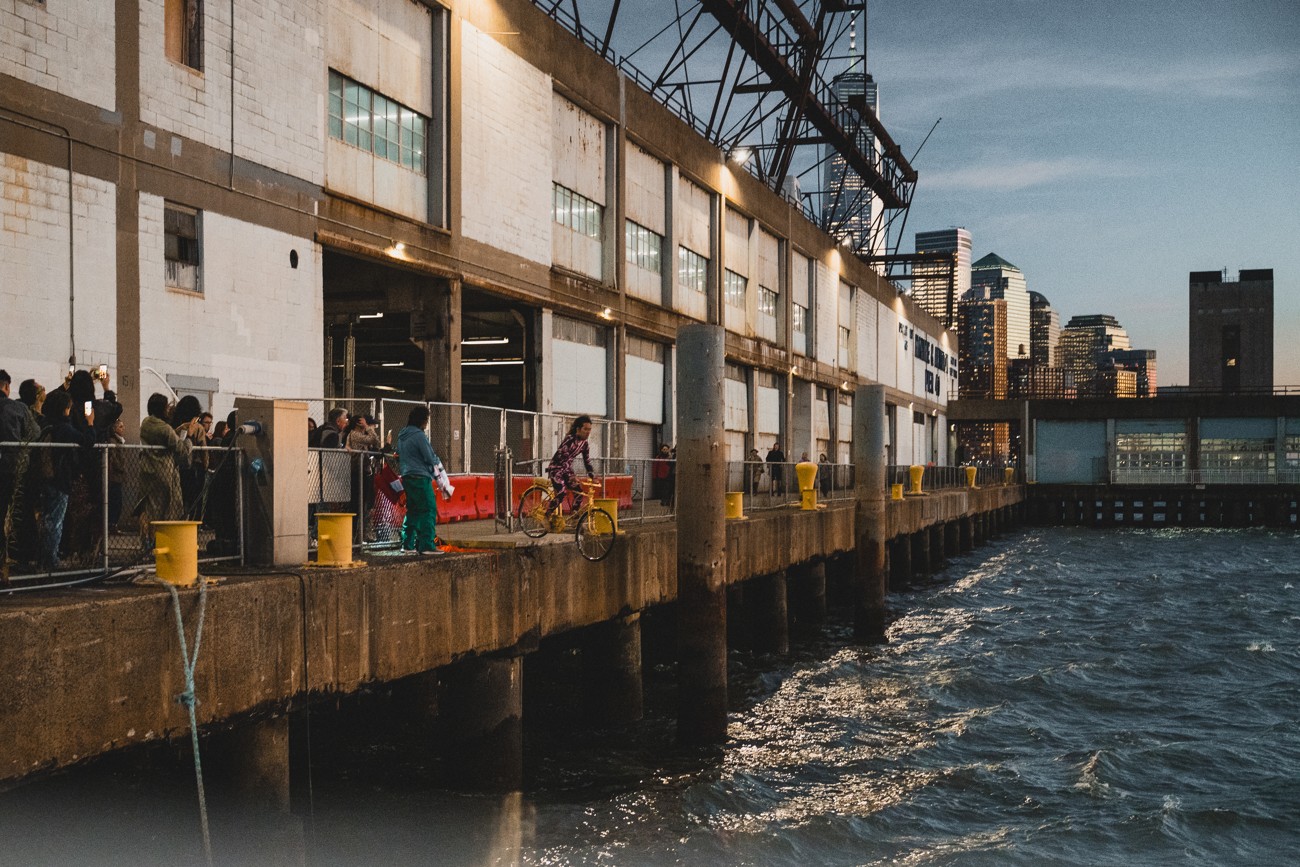
Vo finds more accuracy in translating Vũ Đức’s Hanoi performance to New York shores instead of a re-performance. “The prefix is a redundancy,” as Vo read from the river. The performance is an elongation of a gesture that begins in one artistic community but then travels to another and adapts, as immigrants do.
While Vo was warming up with a towel on the pier, we chatted briefly about the symbolism of the Phoenix bicycle, which was key to Vũ Đức’s and Vo’s performances. The Phoenix model is also a roadster, but in Vietnam the Chinese-made bike is associated with socialist ideals and movements. Later at home, I read about how under Mao Zedong’s economic policy, the Phoenix was part of the coveted “Three Great Items” (the other two being a Butterfly sewing machine and a Shanghai wristwatch) that signaled affluence and stability. By the time this mass-market bike reached other parts of Asia, the associations were more about political solidarity than owning a top-tier luxury product. By riding that gold-leafed steel tank of a bike into New York waters, Vo shows us that the vehicles we use to communicate solidarity (bicycles, social media, livestreaming) also carry a similar paradox to the Phoenix bike: can we sustain a resistance by utilizing elite/luxury goods that dominate consumer markets?
More than a dozen phones filmed Anh Vo’s performance, including my own. Bicycles were central to geographic mobility in the way that our mobile technologies provide informational/data mobility—commodities that, like the Phoenix bicycle, start out as economic patriotism but mass market access transforms them into mobile units of dissent. So, what are we actually steering? Vo expressed with much clarity that riding into the unknown requires translation and optimism. By drowning the object, Vo keeps the symbol alive in an auspicious aura of possibility we so badly need.
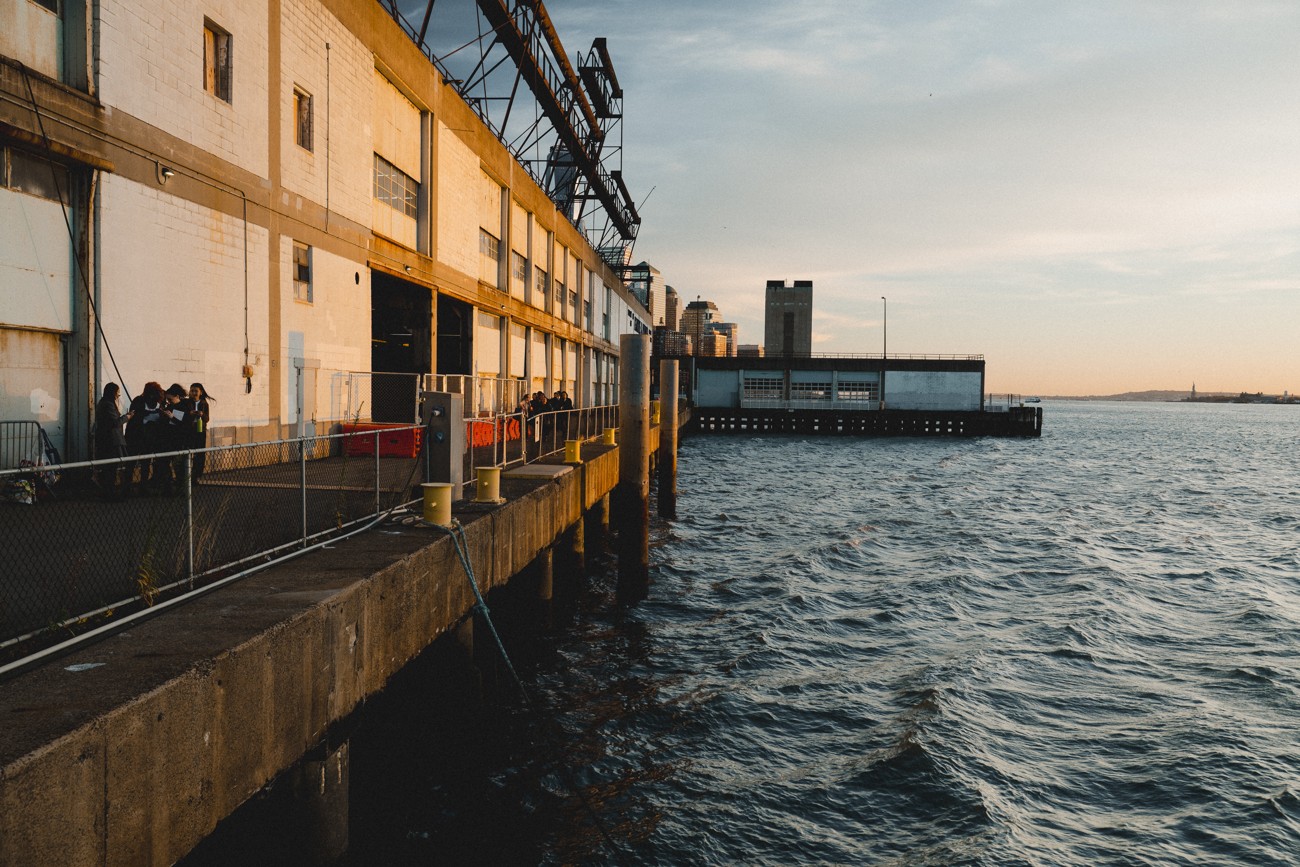
Anh Vo: Phoenix Forever took place at Pier 40 on October 30th, 2026, as part of the third edition of The Immigrant Artist Biennial, Identity Card. The performance was curated by Sofia Thieu D’Amico.