
Florian Krewer: “woven thin” at the Musée d’Art Moderne de Paris
Review
“You Must Change Your Life” stands, without context, as a command, an injunction. But why? How? And who is asking? On what grounds? Worn blunt by work and baby duties at home, I was instantly receptive to the proposition, though not without skepticism. When the entrance curtain fell behind me and the sun was blocked out, my attention narrowed to the first object in the exhibition: a glass frame with a Rilke poem that gives the exhibition its title. Enlisted by artistic director Ho Tzu Nyen as a curatorial statement, the poem follows the poet’s encounter with a headless Apollo statue, which holds an intense energy that leaps toward the viewer and demands a change of life. The leap from one to the other is hardly self-evident: that the intensity contained in a work of art should compel a transformation of life is itself an act of faith.
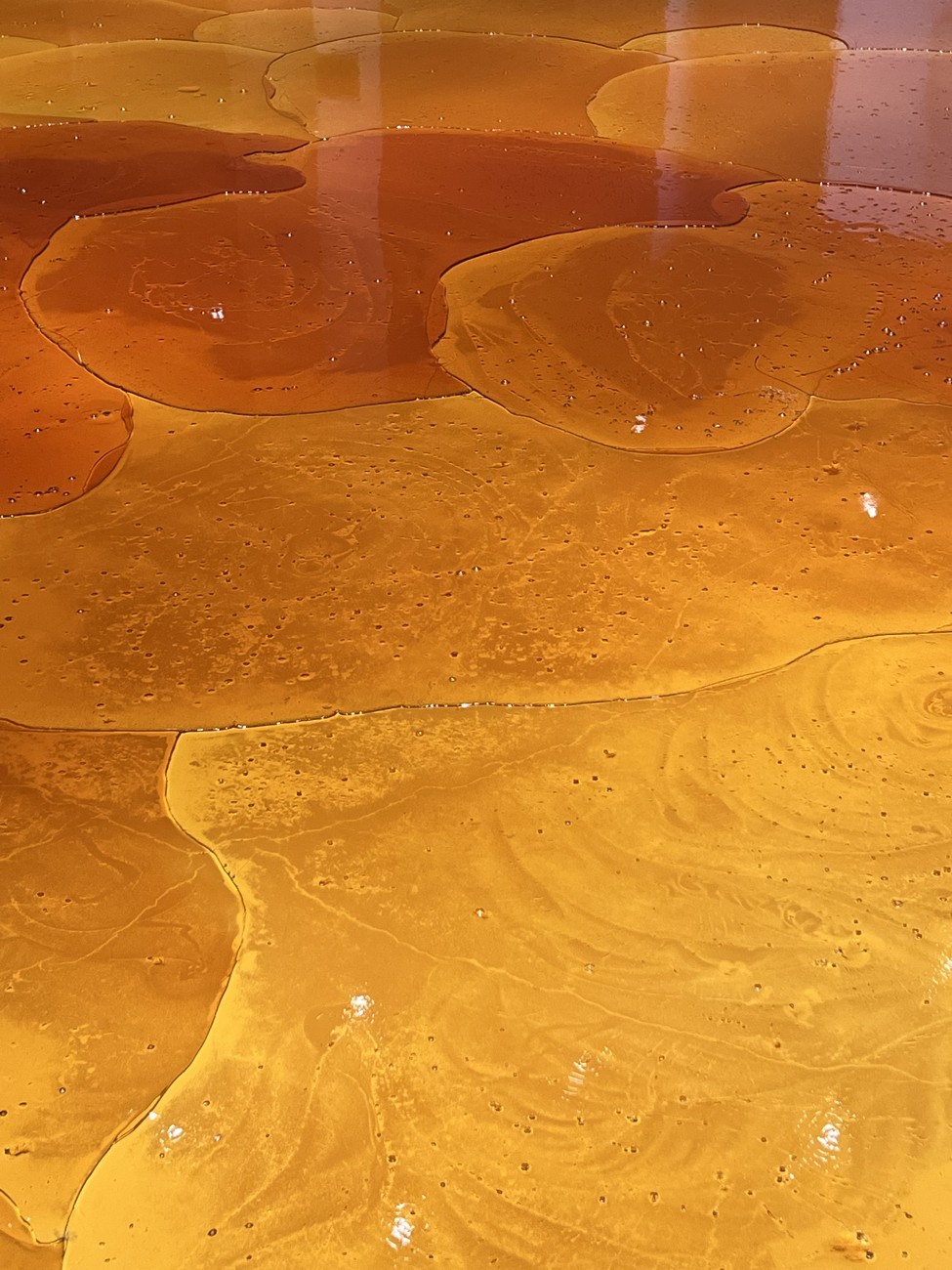
The abruptness of the command has its origins in the poem, then. The centerpiece of the biennale, Goldin+Senneby’s Resin Pond (2026), makes that leap momentarily convincing with an expanse of eye-catching gold. Spreading in an irregular shape that recalls a travertine pool or a semi-molten lava field, it was created by pouring nearly two tons of luminescent pine-tree resin directly on the gallery floor, likely patch by patch, with different shades of gold running into and overlapping with one another. Their sheer expanse and shared golden hue create a massive pool of pure, vital energy, seeming to enact Rilke’s premise that intensity itself can become an impetus for transformation.
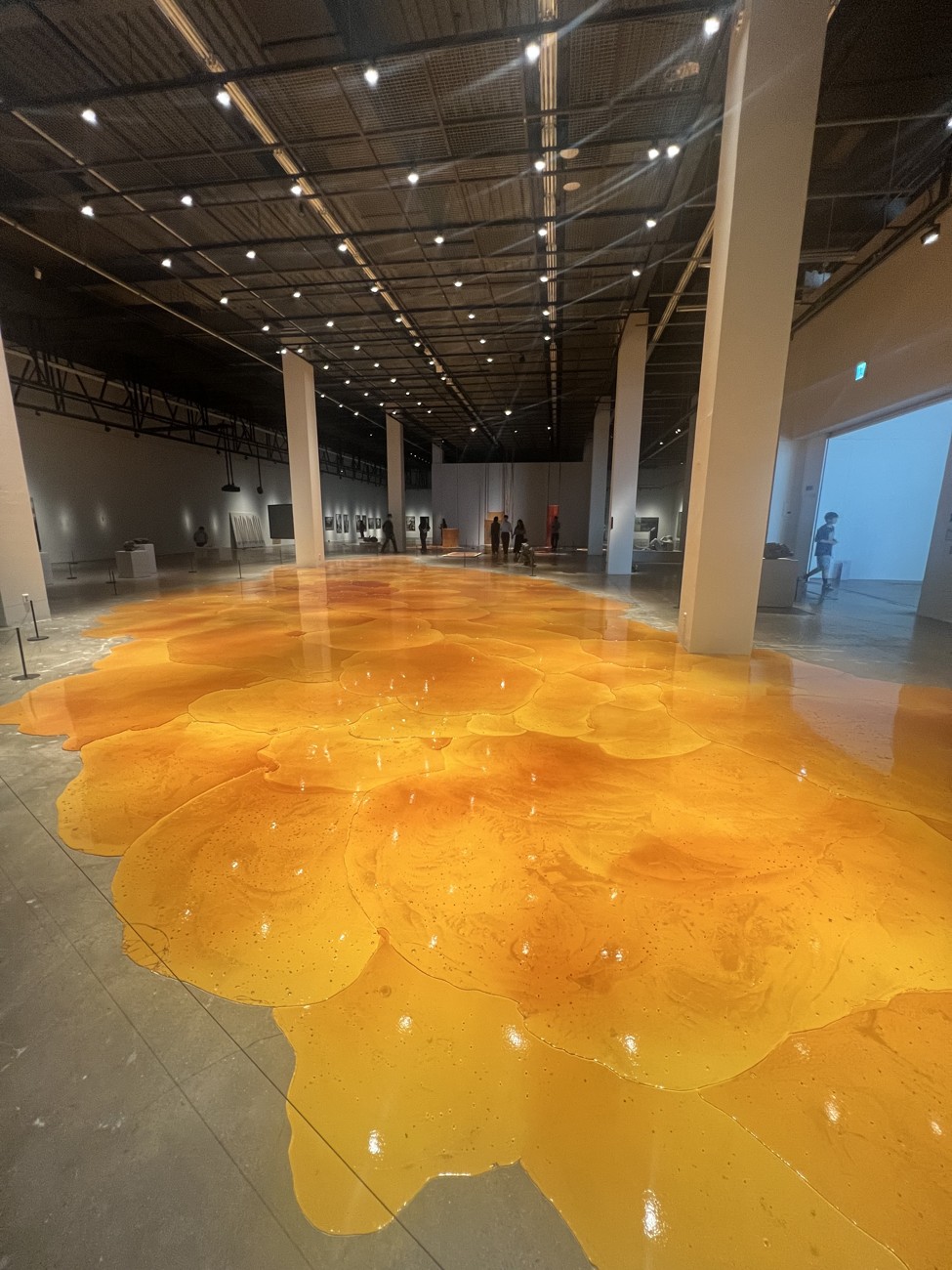
Two neighboring works strengthen this impression. Various volcanic stone formations on loan from Jeju Stone Park offer a natural resonance, each rock formed by a different mechanism that transformed liquid into solid form. These natural objects not only join an art biennale but also strengthen its argument, their inclusion itself a refreshing change in the curatorial playbook. Ahead, Nina Canell places a basin of water next to a sack of cement in Perpetuum Mobile (40 kg) (2009–2026), where the mist activated by an ultrasound device from the former continues to harden the latter. The premise is clearly that existence is relational and shaped by mutual influence. Here, transformation requires no intention but proceeds quietly, through the sustained interaction of two ordinary materials.
With a few more works demonstrating change against a backdrop of continuity, the biennale invites back the question of how. In a series of works that juxtapose photos and paintings, exemplified by Thoughts on the Baby Pine Tree—Wonsan Island (1998/2020), Rim Dong Sik posed naked among pine tree saplings on a sandy beach in 1998, then rendered the scene on canvas in 2020. As the painting is not photorealistic, one could trace the additions and deletions against the photos and infer the change in meaning through the revisit/replication that is also a dialogue between self, nature, and time. In Wang Jiahao’s To Youth (On the Way to Longjing Mountain) (2024), the socialist realism that was once the dominant visual language of high Maoism (think of Liu Chunhua’s famous depiction of Mao Zedong on his way to Anyuan) is recalled to portray a contemporary Chinese couple’s outing. Occupying the central position and gazing into the future, à la workers and farmers in the art of high socialism, the couple are well-dressed and lean on their car, likely taking a moment of rest before engaging in their planned hike for recreation. That the subject, which is supposedly more substantive, changes while the style, which is supposedly more surface-level, stays the same complicates any simple model of change as gradual or surface-first. Form and content do not necessarily transform in tandem; one may persist while the other is radically reassigned.
Violence often propels drastic changes, and the works that address politics and violence head-on constitute the biennale’s strongest moments. In Kiri Dalena’s Erased Slogans (2008–), over 130 photos depicting political gatherings are assembled, with all slogans in them digitally erased. The viewer thus does not know what the protests were about, and the photos consequently change status from witnesses to aspirations in action to witnesses to unrealized aspirations. In the same artist’s Life Masks series (2013–), political and environmental activists, cultural workers, and families affected by state violence are invited to pose for photos, all appearing in their daily clothing and photographed frontally and usually in their homes, but with their faces hidden behind white plaster masks. Far from an effort at de-individualization, the masks are meant to offer these volcanic individuals a moment of reprieve, a break from projects so deeply entangled with their sense of self.
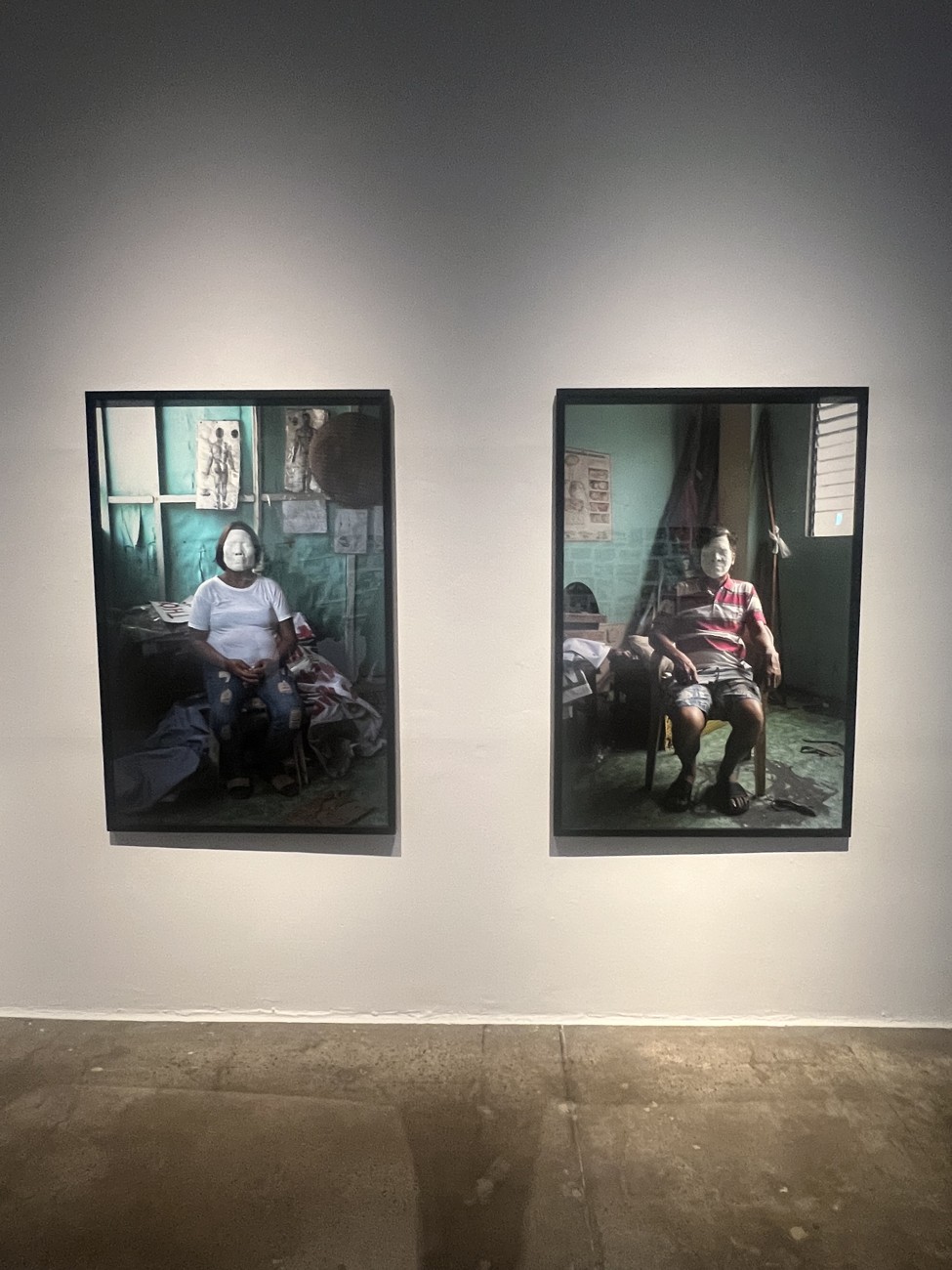
That the masks offer respite, a chosen pause from lives inseparable from political struggle, is where the question of why slides back in. If change is a given, there is no need for the special call of “You Must Change Your Life,” as there is no need to have an injunction ordering the sun to come out every morning. Rilke’s “must” asks for something more than change as a condition of existence: it turns change into an imperative, a matter of direction, agency, even obligation. Yet the freedom to choose can be a privilege. For those whose lives are shaped by violence, change might be the result of imposition rather than choice, and the pursuit of a different path might be risky. What, then, makes change an obligation, and who has the freedom to answer such a call?
This is also where the first gallery ends. The rest of the biennale explores tangential topics like “Bodies and Bonds,” “Landscapes and Learning,” “Cosmos and Change,” and “Air and Articulation” but rarely returns to the titular questions it raised. As I walked through these later galleries, I increasingly felt the weight of leaving the questions to hang, a sense compounded by the dissonance between the works: not far from the work of Amanda Heng’s Another Woman in Gwangju, 1996, 2014, 2023 (2026), which uses a series of photos showing the artist and her mother visibly aged over different editions of the Gwangju Biennale and thus evokes thoughts of fragility and mortality, kids were playing ping-pong on two tables installed by the exhibition organizers. Large sections of wall left empty invite speculation not of negative space but of a lack of participating work, and this speculation only grew stronger when I entered the “Cosmos” gallery and found the first object on view there to be yet another giant lava rock.
I left the biennale hall with a sense of hollowness. The initial visual impact of the resin pond and the works addressing violence still hold up, but the force of the opening premise was rarely invoked again, and by the final galleries, change has become too loose a theme that almost anything can fall within it. The biennale shows repeatedly that change happens; it is less successful at sustaining the harder proposition of its title, that you must change yours.
The 16th Gwangju Biennale: You Must Change Your Life is on view from September 5 to November 15, 2026.