
“Doll Dressing” at The Museum at FIT
Review
The closing line of Paul Chaat Smith’s (Comanche) incisive essay “Land of a Thousand Guilts” expresses a simple fact and directive: “We contain multitudes. Embrace it.”1 Indeed, the Indigenous Americas are vast—not only hemispherically, but as a complex reality extending across diverse territories, nations, clans, and persons with their own sets of beliefs, practices, histories, and cultures.
Radiant Geometries: Vectors of Knowledge from the Indigenous Americas, curated by Noor Alé at the Moody Center for the Arts at Rice University, seems to heed Smith’s imperative. The exhibition extols the multiverse that is the Indigenous Americas, celebrating its inherent plurality while coalescing around common efforts to preserve and pass on knowledge. Through painting, sculpture, textile, video, and site-specific installation, artists from varied geographies explore ancestral epistemes encompassing science, spirituality, mathematics, mythology, agriculture, architecture, and social systems such as ceremony and matriarchy. Radiant Geometries not only highlights lifeways that have existed since time immemorial—it illuminates a continuum of creation and reinvention across Indigenous communities. The result is a constellation of transcultural, transtemporal ways of knowing and relating to the world as an interconnected whole, where balance is contingent upon respect and reciprocity.

Radiant Geometries is expansive in breadth and scope. Jordan Ann Craig (Northern Cheyenne), Natalia Montoya Lecaros (Aymara), and Eamon Ore-Giron conduct extensive research into cultural belongings, ritual regalia, and ceremonial heirlooms—evoking objects as gateways between past and present through which the artists create portals of psychic reassembly. In Black Medallion XIV (Inti) (2022) and several paintings from his Talking Shit series (2017–ongoing), Ore-Giron communes with the Incan sun god, Inti; Mach-acuay, the Serpent of the Milky Way (2025) from Incan dark constellations; and divine creatures represented in Mayan ceramics (c. 300–900 CE / 2026) from Rice University’s collection. Together, the works amplify a matrix of ancient astronomy and interspecies kinship. In Tótems de emergencia (2021), Montoya Lecaros braids connections between Aymara and North American Indigenous cultures through La Fiesta de La Tirana, a syncretic religious festival in Chile with pre-Hispanic roots.2 Her sculptural installation avows aesthetic self-determination through ancestral celebrations of a sentient, participatory planet. Craig—in Not Popular Just Well Liked and Made Your Stories Whole (both 2026)—paints bold and jubilant compositions inspired by Cheyenne pouches, beaded leggings, and parfleches (rawhide containers) from the Panhandle-Plains Historical Museum and Denver Art Museum. Her symmetrical abstractions resist art history’s traditional devaluation of craft while remaining open to reflection and new possibilities.

In the groundbreaking essay “Making Kin with the Machines,” Noelani Arista (Kānaka maoli) describes time as “neither linear nor cyclical,” explaining that “both the past and present are resonant and relational.”3 This framework can lend insight into parallels and continuities between colonization and gentrification, territorial displacement and housing inequalities, forced assimilation and systemic racism, given the absence of reparations for historical harms. Melissa Cody (Navajo/Diné), Patrick Martinez, and Caroline Monnet (Anishinaabe/French) face these complexities head-on while revealing generative nuances and persistent ingenuities. In Battle of the City on Fire (2025), Martinez re-imagines ancient Cacaxtla murals painted by Olmeca-Xicalanca artists (c. 600–900 CE) in a contemporary urban landscape, Los Angeles in particular.4 The installation mobilizes a broken architecture of stucco and cinderblock, charred with references to a traumatized city in the wake of immigration raids and wildfires. The warriors reincarnated in Martinez’s mural recall the unbroken presence of brown people on this same land from which many are now being deported. Meanwhile, bougainvillea, native to tropical forests in Central and South America, blooms above a bright pink neon line. For our plant relatives, boundaries such as those between Mexico and the United States are invalid.
In A Quiet Place (2021) and The Room (2023), Monnet carves and prints Anishinaabe geometries onto raw construction materials such as Enermax insulation panels, industrial styrofoam, and wood. The works transform perceptions of the built environment while underscoring inequities in the living conditions of many Indigenous communities. Often engineering large-scale works and architectural installations, Monnet assertively reclaims space, affirming an inherent connection to the land. In Sunrise Rainbows (2025), Cody interweaves generational memories of the Long Walk—the violent removal of Navajo people from their homeland by the United States Army in the 1860s—with enduring icons of adaptability and resilience. Rainbows—crown jewels of the storm—are Navajo symbols of sovereignty. Cody animates an eccentric visual lexicon that merges pixelated, gridded structures inspired by ‘80s video games with spiritual iconographies such as the sacred number four and Na’ashjéii Asdzáá (Spider Woman), the deity who gifted the knowledge of weaving—a practice that bestows hózhó (balance, harmony, beauty, and order) upon the community.5
Nanibah Chacon (Diné/Navajo and Chicana), Sara Flores (Shipibo-Konibo), and Cisco Merel activate time-honored and cutting-edge technologies alike to convey stories and acts of social cohesion and ecological stewardship. In her three mesmerizing kené paintings (2020–2022), Flores crystallizes vibrant visions through sacred patterns passed down across generations from elders to emerging artists through matrilineal heritage. She uses wild cotton, plants, seeds, and clay gathered around her home in Yarinacocha near the Ucayali River to compose mystical pathways simultaneously angular and rhizomatic. These forms conjure the Amazon rainforest as a powerful life-force in a shared planetary consciousness.
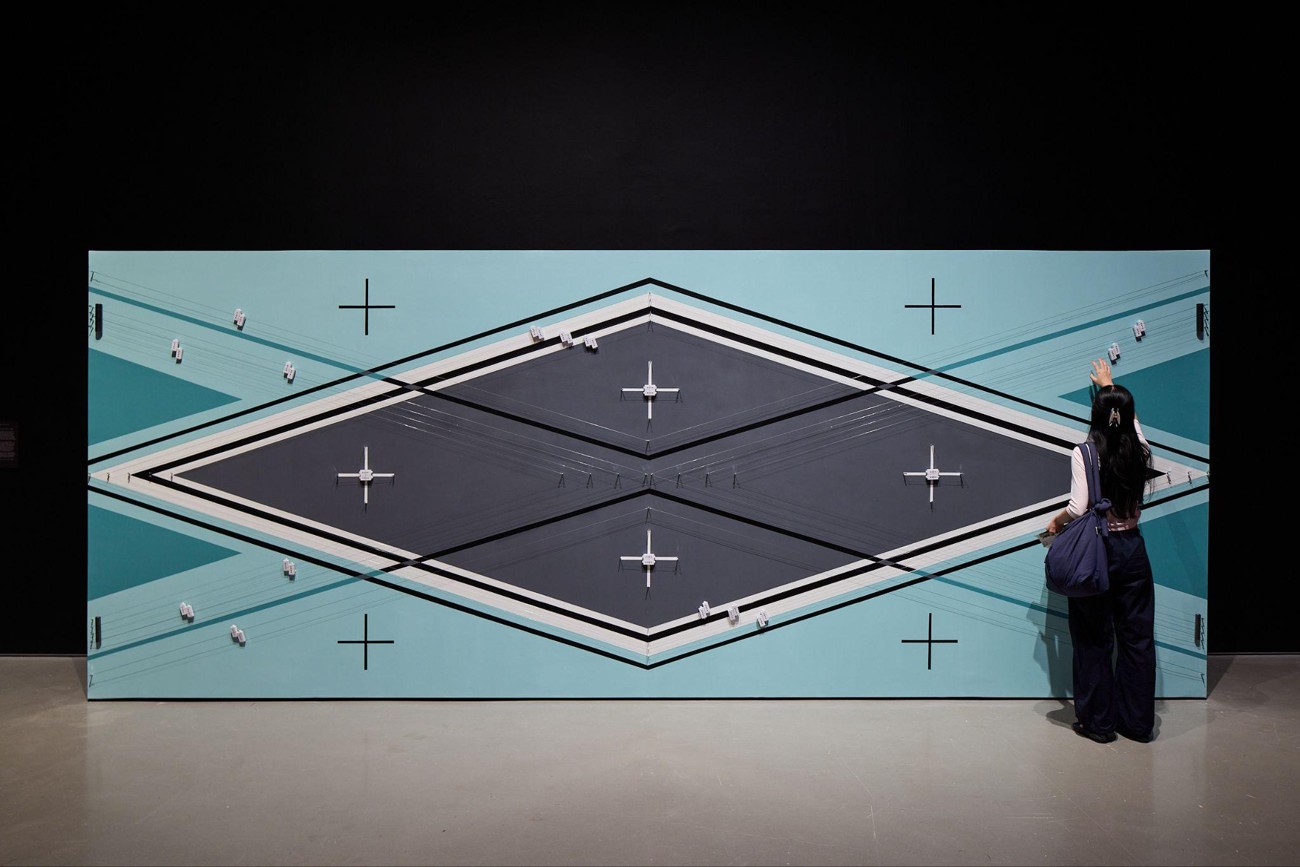
In her interactive audio installation Where Two Rivers Meet (2026), Chacon energizes electromagnetic exchanges, echoing the Navajo creation story of emergence from the first world of darkness and disorder to the fourth world of brilliance and structure through the endless passage of vibrational frequencies across physical fields. Akin to a monumental guitar, Chacon’s work consists of music wire tightly strung across triangular and diamond painted shapes. When touched, the wires emit a deep, resonant chord that fills the space with sound.
In Sigilantes (2025), Merel mounts a towering installation guarded by a large abstract painting inspirited by Guna cosmovision—a layered, interconnected universe where physical and spiritual worlds are inextricably intertwined.6 Elevated on a colossal easel-like structure, Merel’s sigil presides over a circular foundation of clay gesturing to casas de quincha, a form of vernacular architecture found across Panama, in which homes are built collectively using local materials. The cooperative construction process, called junta de embarre, combines joyous ceremony and rigorous skill, requiring an intimate understanding of the environment and building components: the types of wood used for each part of the house, the mixing techniques, and the precise ratios of earth, water, and natural fibers to form the thick, tacky paste that becomes the architectural substance for these earthen homes. Honoring the cultural heritage of his motherland, Merel imbues the work with totemic resonance, invoking its protective powers over this sacred communal practice, the ancestral knowledge and technical expertise it sustains.
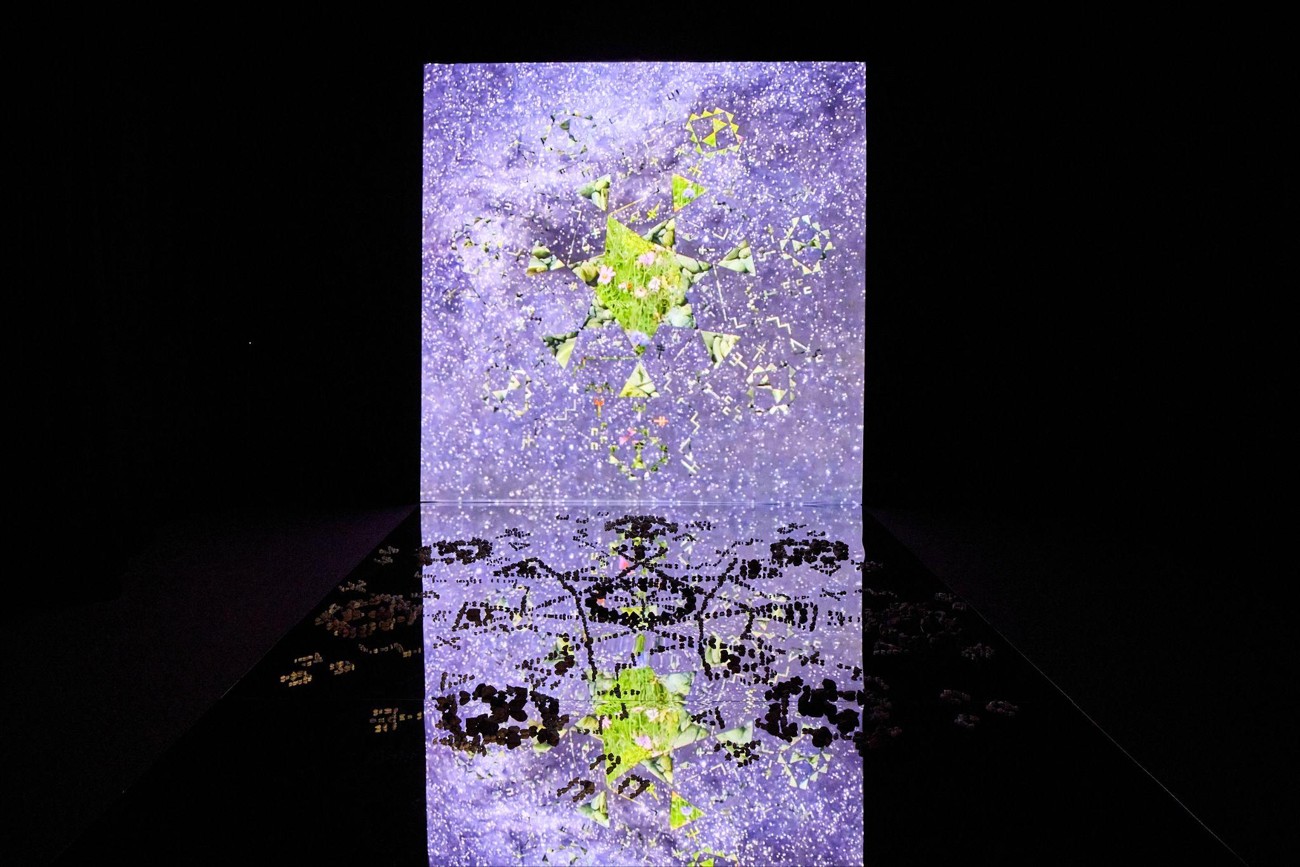
Visitors’ journey through the multiverse that is the exhibition culminates with two immersive multimedia installations by Patricia Domínguez and Kite (Oglála Lakȟóta). Kite’s Wičháȟpi Wóihaŋbleya [Dreamlike Star] (2024) is a meditative and oneiric “cosmologyscape”7: an audio-video installation that collapses any distinction between celestial and terrestrial realms. In Wičháȟpi Wóihaŋbleya, intricate geometries radiate from a seven-pointed star while moving images pulse between a starry night sky, stones submerged in rippling water, and flowers in a sunny meadow that softly respond to a breeze. Mirroring and inversion are both visual and technical mechanisms through which Wičháȟpi Wóihaŋbleya resists a sequential chronology. In Kite’s cosmos, poetry is read and repeated in reverse,8 while images gently oscillate forwards and backwards, inside and outside of the central mandala in potentially infinite loops—an “ancient and future dance.”9 The mandala—adapted from Lakȟóta textiles and a grammatical “shape kit” developed in collaboration with Sadie Red Wing (Lakȟóta/Dakȟóta)—was conceived as a musical score that aspires to sing. Mirrored across a reflective surface on the ground, a terrestrial mandala is composed of local stones gathered around the Moody. These stones will be returned to where they were originally found after the exhibition. Besides their role in Lakȟóta cosmology as living beings with agency,10 stones are significant in the context of Kite’s work with machine learning and artificial intelligence. In “Making Kin with the Machines,” which she co-authored, she writes: “AI is formed from not only code, but from materials of the earth […] Forming a relationship to AI, we form a relationship to the mines and the stones. Relations with AI are therefore relations with exploited resources.”11 Understanding AI as a new sedimentary layer in an ever-evolving geology, the artist’s approach is grounded in Lakȟóta knowledge and ethics, encouraging recognition of technological systems and nonhuman beings in wider circles of relations across our interconnected world.
Guided by green LED lights through a hallway painted black, visitors enter an immersive capsule blessed by an altar with medicinal plants and crystals. In this darkened space, Domínguez transports visitors into a parallel dimension where quantum physics, mythology, ethnobotany, technology, and healing rituals converge. She presents Tres Lunas más Abajo [Three Moons Below] (2024) and Matrix Vegetal (2022), two “video shrines”12 illuminating the energetic forces and more-than-human intelligence that intrinsically connect living and nonliving matter. Developed with support from Arts at CERN (European Organization for Nuclear Research), Tres Lunas más Abajo imagines quantum entanglement—famously dubbed “spooky action at a distance” by Albert Einstein—through the quest of a protagonist and her robotic falcon kin in search of their quantum pair. As physicist and philosopher Karen Barad writes, “Quantum entanglements are not the intertwining of two (or more) states/entities/events, but a calling into question of the very nature of two-ness, and ultimately one-ness as well.”13 In Tres Lunas más Abajo—described by the artist as “a video prayer to broaden my cosmological sensor”—quantum entanglement manifests as spatiotemporal leaps between CERN in Switzerland, astronomical observatories in Chile, and ancient petroglyphs in the Atacama Desert. It is entanglement between human beings, animals, robots, astronomical and geological phenomena; between ancestral Indigenous scientists, Erwin Schrödinger (who first coined the term in his pioneering 1935 paper which is largely, reductively, remembered only for that one paragraph about the cat), Domínguez, and you, the viewer. The artist reminds us that principles at the vanguard of science today—entanglement, interdependence, relativity—have long been known, cherished, and put into practice by Indigenous societies.
Summoning multiplicities of being in and knowing the world, Radiant Geometries offers ways of attending to contemporary complexities across social, ecological, and technological relations. Artists in the exhibition orient us towards planetary awareness, as the present becomes threshold into an ethical future.
Radiant Geometries: Vectors of Knowledge from the Indigenous Americas is on view at Rice University’s Moody Center for the Arts through December 19, 2026.
1 Paul Chaat Smith, “Land of A Thousand Guilts,” in Preoccupied: Indigenizing the Museum, ed. Colleen Kennedy (Baltimore Museum of Art, 2024), 59. Heartfelt thanks to Dare Turner (Yurok) and Leila Grothe whose wonderful initiative Preoccupied: Indigenizing the Museum at the Baltimore Museum of Art (co-curated by Turner and Grothe with the assistance of Elise Boulanger (Osage), April 21, 2024–February 16, 2025) was instrumental in expanding my consciousness and increasing my awareness of Indigenous cultures and art by Native artists.
2 “A través de ejercicios auto etnográficos doy forma de tótem a la identidad aymara mezclada con el imaginario del indio norteamericano, el cual se ha representado en el territorio nortino en el baile de la fiesta de la Tirana.” Natalia Montoya Lecaros, Tótems de emergencia, https://nataliamontoyalecaros.art/totems-de-emergencia/.
On the image of North American Natives in La Fiesta de la Tirana: “Dancers, and bailes leaders now in their 70s, enjoyed telling stories of how workers in the nitrite mines near La Tirana were shown films of cowboys and Indians in the 1930s and ’40s and identified with the Native Americans. […] Grainy footage of La Tirana from 1944 shows many of the dances and costumes one sees today, including Native American-garbed dancers.” Thomas M. Landy, “Roots of the dance feast at La Tirana: Spanish and indigenous culture, even Hollywood,” Catholics and Cultures, https://www.catholicsandcultures.org/chile-roots-dance-feast-la-tirana-spanish-and-indigenous-culture-even-hollywood#footnote5_muigg1r.
3 Noelani Arista, “Hāloa: the long breath,” in Jason Edward Lewis, Noelani Arista, Archer Pechawis, Suzanne Kite, “Making Kin with the Machines,” Journal of Design and Science, July 16, 2018. I’d like to underline my limited understanding of Kānaka maoli ontologies and cite the authors’ trenchant text here with respect, admiration, and gratitude. In the spirit of their original work, I welcome feedback and critique.
4 As far as I am aware, the first presentation of Martinez’s Battle of the City on Fire was at the Made in L.A. 2025 exhibition curated by Essence Harden, Paulina Pobocha, and Robert Soros with Jennifer Buonocore-Nedrelow at the Hammer Museum, October 5, 2025 – March 1, 2026.
5 “The four arms of the cross allude to the sacred number four—associated with the four sacred mountains, cardinal directions, colors, and clans.” Noor Alé, exhibition brochure for Radiant Geometries: Vectors of Knowledge from the Indigenous Americas at the Moody Center for the Arts at Rice University. In addition to the text written by Alé in the exhibition brochure, notes from her generous in-person exhibition tour, here I also reference Danielle Weindling, “Spider Woman and the Role of Diné Women,” Bard Graduate Center Gallery, https://exhibitions.bgc.bard.edu/shapedbytheloom/theme/homeland-creation-cosmology/spider-woman-and-the-role-of-dine-women/
6 Encompassing a pantheon of paintings, Sigilantes is an invented word derived from the Latin sigillum (seal), sigilar (to conceal), or sigil. Please see Jonathan Harker, “Sigilantes: Cisco Merel at NG Gallery,” July 2025, https://ciscomerel.com/sigilantes/.
7 “I first heard the term ‘cosmologyscape’ in a presentation by Tuscarora scholar Jolene Rickard at the Banff Centre for Arts and Creativity in January of 2016. It was a revolutionary term, uniting the sky world and earth world into one sphere of perception. I am defining how I use the term ‘cosmologyscape’ as a theoretical lens to communicate Indigenous intimacy with the cosmos and land.” Suzanne Kite, “Postmodernism is not Permission,” Forge Project, October 18, 2023, https://forgeproject.com/forging/postmodernism-is-not-permission.
8 This performance of reading and repeating poetry in reverse is structurally equivalent to what Missy Elliott does with language in the “Work It” (2002) chorus. For more on the latter, please see Mecca Jamilah Sullivan, “‘Put My Thang Down, Flip It and Reverse It’: Black Women’s Interstitial Languages of Body and Desire,” American Literary History, vol. 29, no. 4, pp. 704–725.
9 Suzanne Kite, “Hél čhaŋkú kiŋ ȟpáye (There Lies the Road): How to Make Art in a Good Way” (PhD diss., Concordia University, 2023), 100. Cited in the exhibition brochure for List Projects 31: Kite curated by Selby Nimrod and Ramona Ngin at MIT List Visual Arts Center, January 30–May 18, 2025.
10 “Stones are considered ancestors, stones actively speak, stones speak through and to humans, stones see and know. Most importantly, stones want to help.” Suzanne Kite, “wakȟáŋ: that which cannot be understood,” in Lewis et al., “Making Kin with the Machines.”
11 Ibid.
12 “The cosmos is collective; it includes electrical technology too. I’ve invented my own rituals to survive in this system and transcend some of my own culturalisation. I see the way I use technologies as a sort of capitalist hack, as I re-choreograph and recode their possible uses in order to honour injured birds, evaporating water, dry bodies, ancient petroglyphs, songs for the water, healing plants, vegetal intelligence and terrestrial intelligence. I arrange video-shrines as new world configurations.” Patricia Domínguez in conversation with Suzanne Treister, “Dreaming at CERN,” Burlington Contemporary, September 2024.
13 Karen Barad, “Quantum Entanglements and Hauntological Relations,” Derrida Today 3.2 (2010): 251.