.jpg)
.webp)

Matthew Ronay at Casey Kaplan Gallery
Review
In recent years, Americans have become Chinese. Or rather, many have purported to do so through an online trend called “Chinamaxxing.” Borrowing from the manosphere’s “looksmaxxing” fantasy, where young men seek to increase their “sexual market value” via mogging, mewing, and bonesmashing, Chinamaxxers treat China and its culture as an exotic persona to adopt and commodify. The result is both absurd (“you met me at a very Chinese time in my life,” one X user said) and appropriative (#becomingchinese devolving into #newlychinese, which this TikToker aptly critiqued through bell hooks’s essay “Eating the Other”). While “becoming Chinese” has only recently become popular, as British food journalist Jenny Lau told the Guardian, “Chinamaxxing is Orientalism by any other name.”
This trend offers an apt framework for Thucydides Fever Dream, a sweeping two-floor group exhibition curated by Xin Wang at Hill Art Foundation in Manhattan’s Chelsea neighborhood. “To be sure, this is a China-themed exhibition,” Wang writes in her curatorial essay. “But its operative principle is ‘relational.’” Throughout the exhibition, contemporary China becomes a vehicle for examining how identity and history are constructed through processes of copying, reproducing, and mistranslating. How one sees themselves within the throes of history, the exhibition suggests, is inseparable from how one sees others and, even more so, from whom one constructs as the “other.”
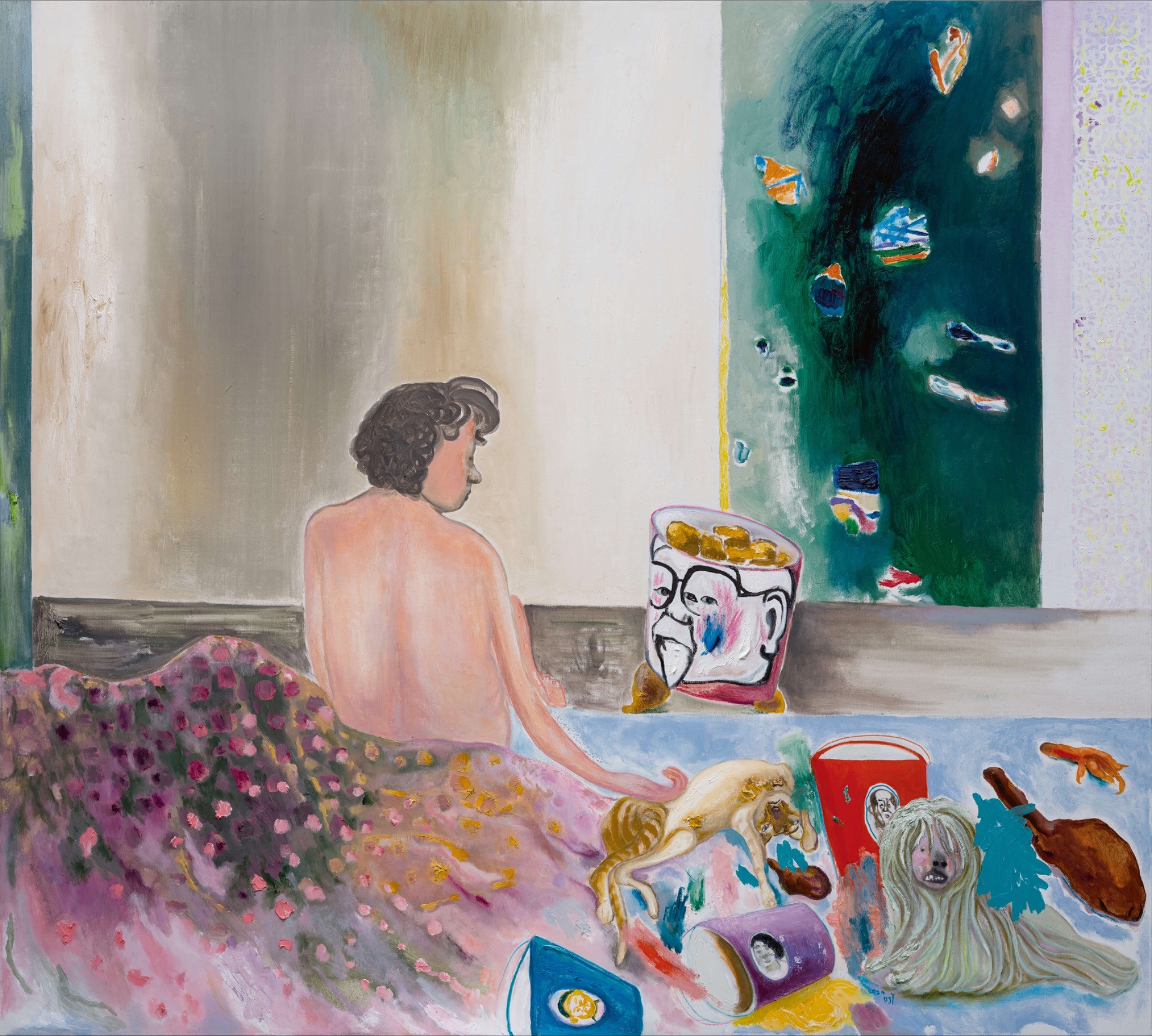
Commerce mediates this process. One of the first works in the show, Yúqiáo (The Fisherman and The Woodcutter) No. 20 (2024) by Duan Jianyu, shows the artist nude on a cluttered bed, petting a cat and contemplating a bucket of Kentucky Fried Chicken. The bucket, resembling a Colonel Sanders bust, sits as if just decapitated from a monument—but full of chicken wings. Other fast food containers with their founders’ likenesses litter the bed. The franchise becomes a microcosm of both globalization and the construction of history and the “other.” We may not share gods or countries. Our nations may even be adversaries (as the exhibition’s title referencing Xi Jinping’s use of the “Thucydides Trap” implies). Nonetheless, there is a religion that unites us all, breaking down what is deemed foreign, if only temporarily: we are all vying for or otherwise controlled by the same gospel we call capital.
Nearby, Ed Ruscha’s Course of Empire (2005) extends this idea. Referencing Thomas Cole’s The Course of Empire (1833–36), which charts a Roman-like city’s rise and fall as a cautionary tale for the US, Ruscha shows the same industrial buildings at moments a decade apart, with grayscale originals and later, altered versions in color. In Blue Collar Tool & Die (1992) and The Old Tool & Die Building (2004/2005), an American factory is overlaid with deliberately nonsensical Chinese and Korean lettering. Cultural and linguistic differences become decoration: language loses meaning and instead serves to mark the “other.” In that sense, the work prefigures the flattening that defines a trend like Chinamaxxing, where centuries of history and culture become an aesthetic for self-fashioning and, more broadly, capital growth.
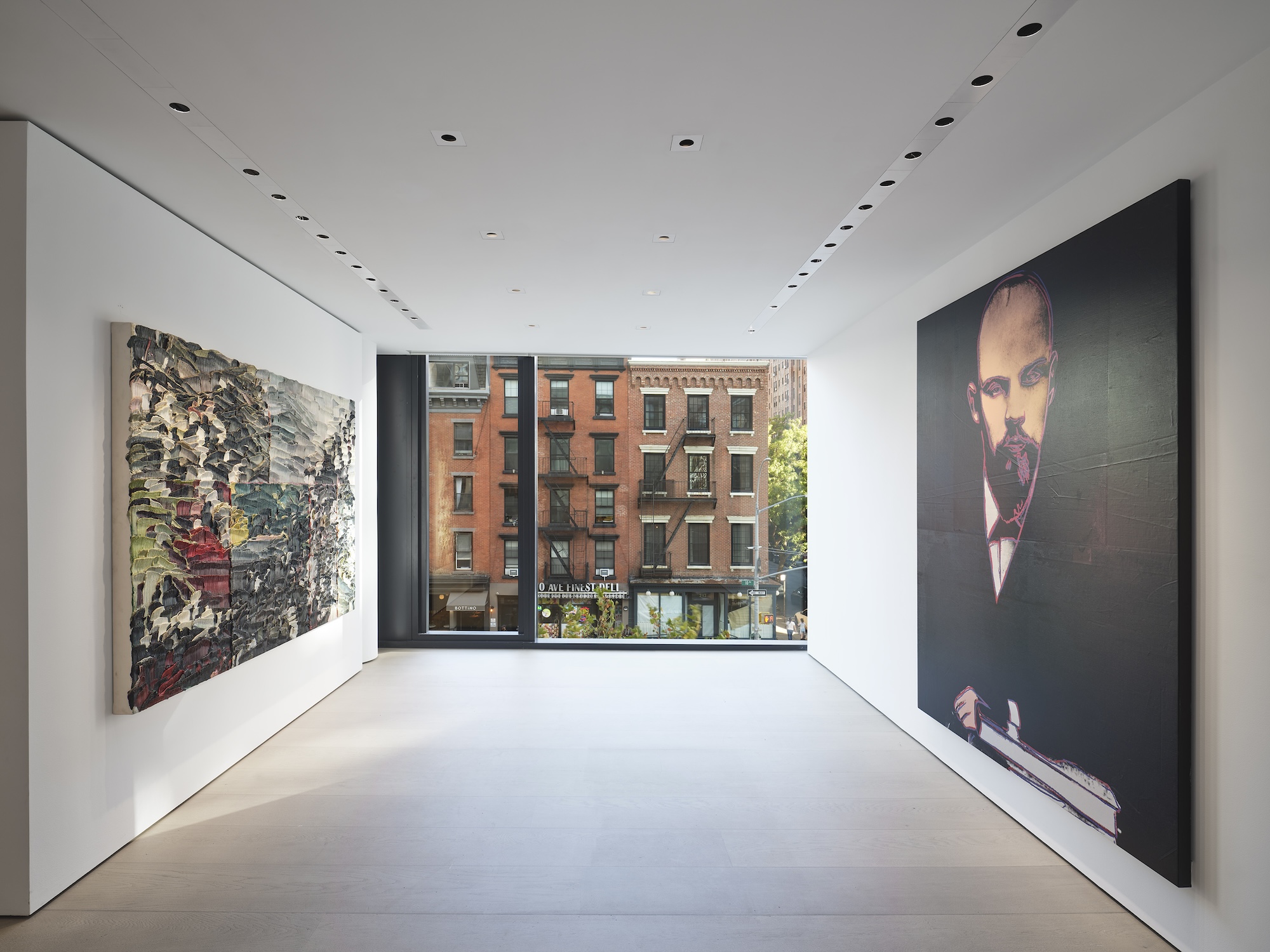
Across the room, Li Songsong’s Ciao Ciao (2022) considers a different though related kind of distortion: the obfuscation of political memory. The painting depicts Joseph Stalin laid to rest at his funeral, a historical moment that contributed to the split of the Sino-Soviet alliance and the eventual end of the Communist bloc. However, without knowledge of the source material, the viewer cannot easily identify Stalin or the funeral at all. Li divides the canvas into a grid and buries any sort of identifiable traits in thick strokes of oil paint. Although the history remains, and a heaviness is certainly present—bright red pigment seeping through the edges of the grid—the context is almost completely obscured.
Hanging opposite, Andy Warhol’s Lenin (1986) transforms proximate political history into consumer imagery, rendering Stalin’s predecessor in the same clean lines and bright colors Warhol used to produce commercial silkscreens of celebrities and soup cans. Where Li makes history difficult to see, Warhol makes it instantly recognizable, turning Lenin into a commercial image. Together, the works suggest two opposing but nonetheless converging tendencies through which history is remembered: buried beneath layers of interpretation or flattened into a familiar visual commodity. Either way, history is divorced from reality, transformed, and consumed.
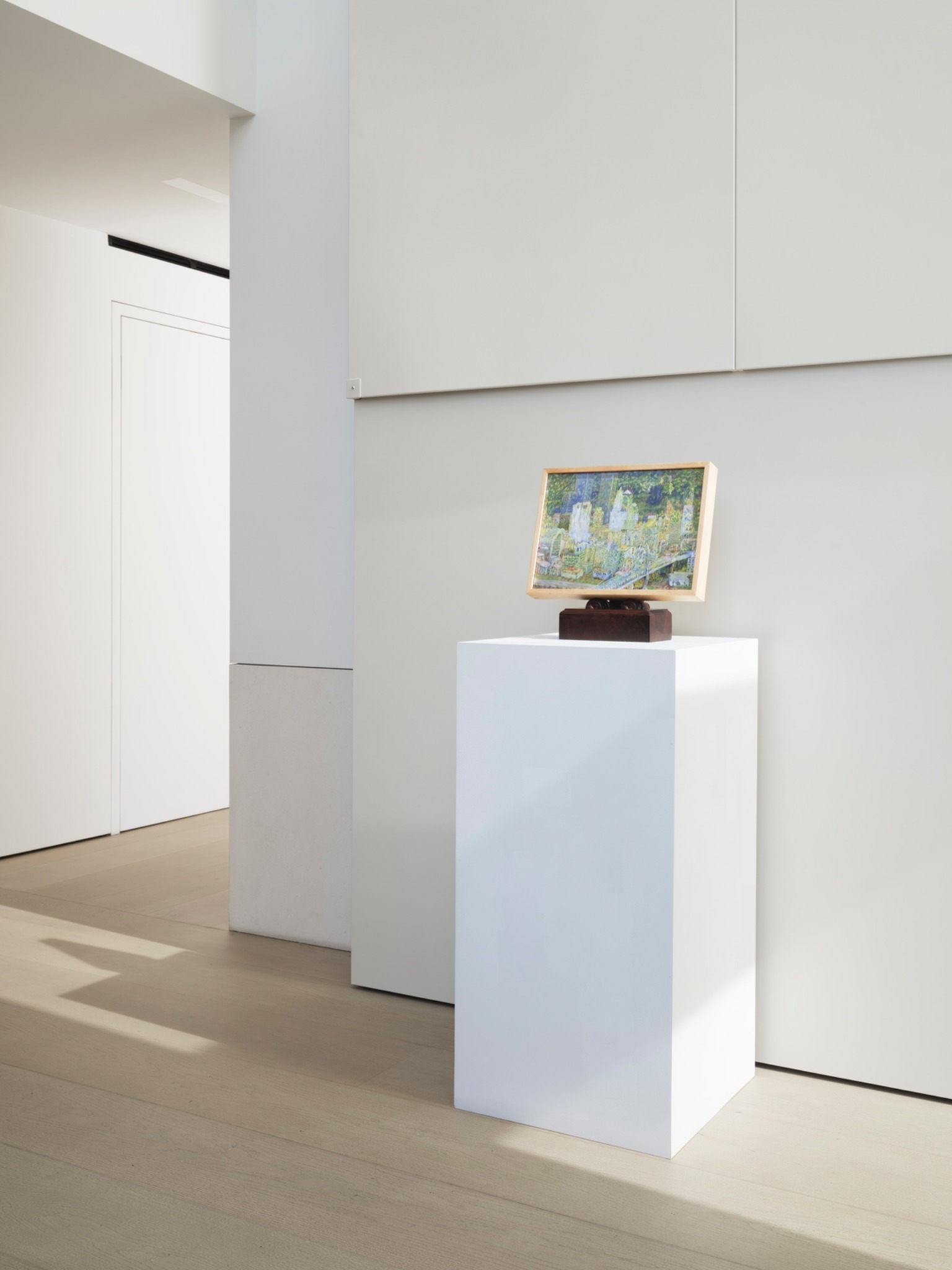
Around the corner, Wang Ye’s Manhattan B (2021) further explores the interplay between identity and fantasy. The work is derived from an image generated by an early AI system that was trained on photos of Window of the World—a Shenzhen theme park filled with reduced-scale replicas of world-famous landmarks, including a miniature model of pre-9/11 Manhattan. The image was then handwoven by Xiang embroidery craftswomen, creating a dizzying loop: a traditional Chinese folk art used to depict an American city that was recreated by a Chinese theme park, and then distorted by AI. Manhattan, a symbol of American power, becomes a ghostly image so warped by the material that it has lost its identity, blurring into the surrounding landscape. The last overtly recognizable feature is the Twin Towers, which themselves appear like a post-traumatic mirage, nearly fading into the background.
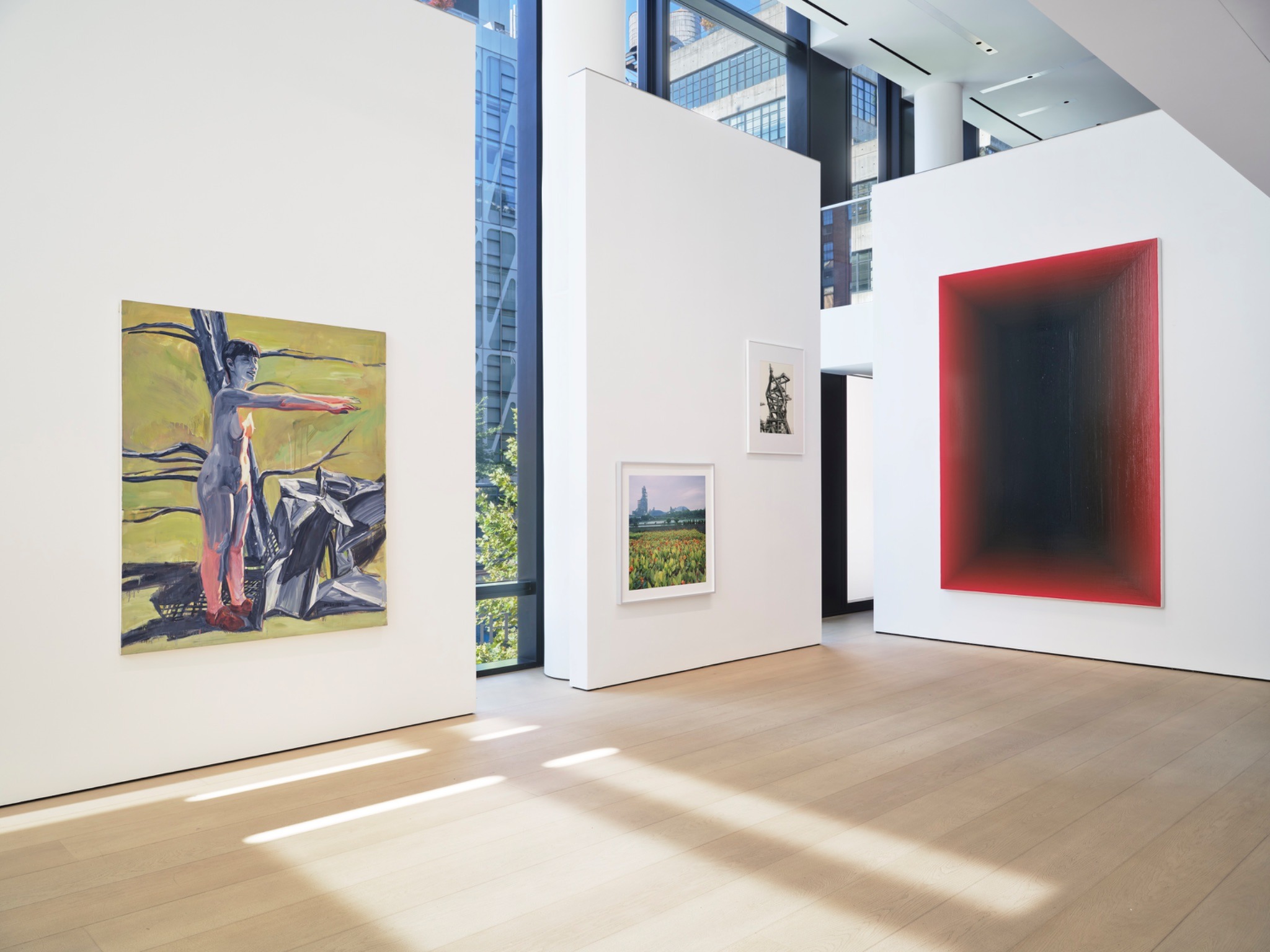
Catty-corner to this work, Wang Guangle’s 121101 (2012) ties these questions of history and the self to physical time. Building the painting through repetitive layers of acrylic, Guangle creates what appears like a portal that gradually deepens from crimson into a dark center. The technique draws from Fujian customs in which elders add another layer of lacquer to their own coffins every year to prepare the wood for their eventual deaths. Named for its completion date, the work stands in stark contrast to the fleeting nature of self-construction amid an increasingly online world. Instead, Guangle evokes the self as the accumulation of unglamorous days through physical endurance. Here, one’s self is simply their existence; it is to be alive in the world, and to be alive also means to progress toward death with each passing day—those bright red corners slowly fading into an eternal, inescapable abyss.
Cloris (Han) Dong’s I Am Your Mirror (2026) turns the focus further inward. To activate the installation located upstairs, viewers speak “I am human” into a microphone. The screen then guides them through everyday scenarios, instructing them to smile and then judging whether their expressions appear genuine using facial recognition technology. The work ends with the phrase “I AM YOUR MIRROR” appearing on screen. Like using a mirror—whether to looksmax or otherwise perform oneself—Dong’s installation demonstrates self-presentation as something evaluated from the outside. We, the Western viewer, perhaps get a taste of our own medicine, becoming ourselves an “other.”
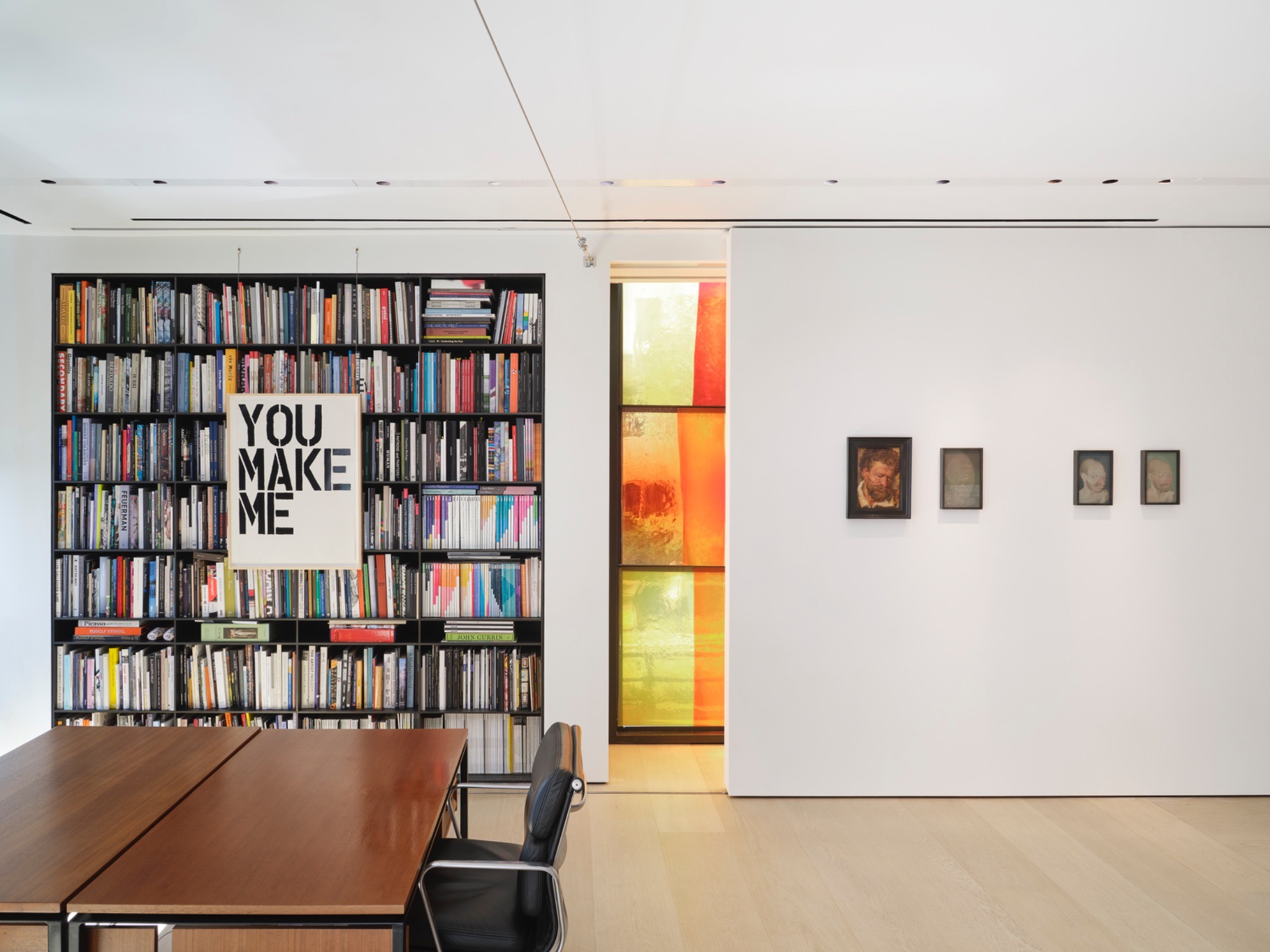
Christopher Wool’s text-based work Untitled (1997) displays the words “YOU MAKE ME” in black, blocky letters. Identity, the phrase suggests, is never entirely self-generated. The United States constructs itself in relation to China. China constructs itself in relation to the West. The Chinamaxxer constructs a persona by consuming a fetishized foreign “other.” In Thucydides Fever Dream, and so too in our reality, history is caught in a hallucination, a room of mirrors in which no self exists separate from the reflection of another—the “other.”
Thucydides Fever Dream is on view at Hill Art Foundation in New York through December 19, 2026.