Tim Breuer at Champ Lacombe and TRAMPS
Review
Something inexplicable struck me the moment I first gazed into a lover's eyes and saw myself small and nestled between the edges of their iris. Astonished by the totality of their gaze, I questioned if I was actually a part of them and not a separate entity. Goki Muramoto's recent exhibition at Nguyen Wahed Gallery’s basement, Eyes Half Open, curated by Sofia Thiệu D’Amico, rekindles just that feeling.
Muramoto’s goggle-like headsets, titled Lived Montage (2020–), lie on a white pedestal on one side of the gallery. On the other side, a white-clothed table holds an assortment of objects straight out of a painter's still-life studio: fruits, a copy of Ways of Seeing by John Berger, a wine glass, and a teddy bear. Upon putting on the device, the viewer soon recognizes the space they are in, but instead of seeing through the device, one sees the views from other headsets instead. Whenever the wearer blinks, an internal sensor triggers a switching of “channels” to another headset's view. Instead of being an "extension" of your eyes (like Marshall McLuhan would say), these interlinked headsets reveal vision’s limitations. You must adapt to seeing through another person’s eyes, settle in and marvel at the optical dissonance as perception becomes untamable by willful bodily movement.
.jpg)
A naive thought comes to mind: perhaps seeing the world through another's eyes is a poetic and artistic first step to learning about empathy and may even bring world peace (ha!). Yet, I soon find the experience much more destabilizing and unnerving than expected. The artist guides participants through an attempt to locate and touch the objects on the table. Nothing about my first caress of the teddy bear can prepare me for the moment “my” vision catches up with this action. In my headset screen, I see another hand also lightly grabbing the toy, our fingers close but not in contact. This tender image propels me, against any deliberation, to seal the touch. I question, in both my head and heart, where my perception ends and another's starts. My flesh-bound self slowly corrodes, as I become privy to a world of another, and they mine. Falling into a choreography of uncertainty and speculation, I yearn for reassurance from another's touch. Moments I can catch a vision that seems authentically mine only last until I need to blink again. To confront the immensity of my hunger for another is to accept the impossibility of my own control.
Muramoto's vision device embodies a nostalgia for the early days of cinematographic history. I think of Annette Michelson's sublime formulation: "Film, our most vivacious art, is young enough to remember its first dreams."1 With cinema’s history only a stone's throw away from our screen culture, this handcrafted image-generating apparatus falls more in line with Edison's kinetoscope than the dystopian Meta VR headsets. I would use these precise words about early 1900s cinema by theorist Tom Gunning to describe awe and affective response elicited by Muramoto’s device: "The spectator [...] remains aware of the act of looking, the excitement of curiosity and its fulfillment."2 As the viewer experiences vision anew, the heightened awareness of the gaze demystifies the totalizing reality effect embedded in our quotidian screen technologies.

Muramoto’s other series, Training Wheels (2025–), rests quietly against a white brick wall. Three clear frames hold small polished brass discs, each with a hole in the center. Underneath the discs are instructions for using them as visual devices, which read: “See, believing that every color is emitted by itself”; “See, believing that everything has touched everything”; and “See, believing that there will be no light.” The instructions read as a poetic ode to imaginative perception, decentering the eye as the sole locus of seeing. They feel like whimsical invitations to imbue one's performance of looking with spiritual potency, restoring fantasy and sacred ritual into the medium of vision.
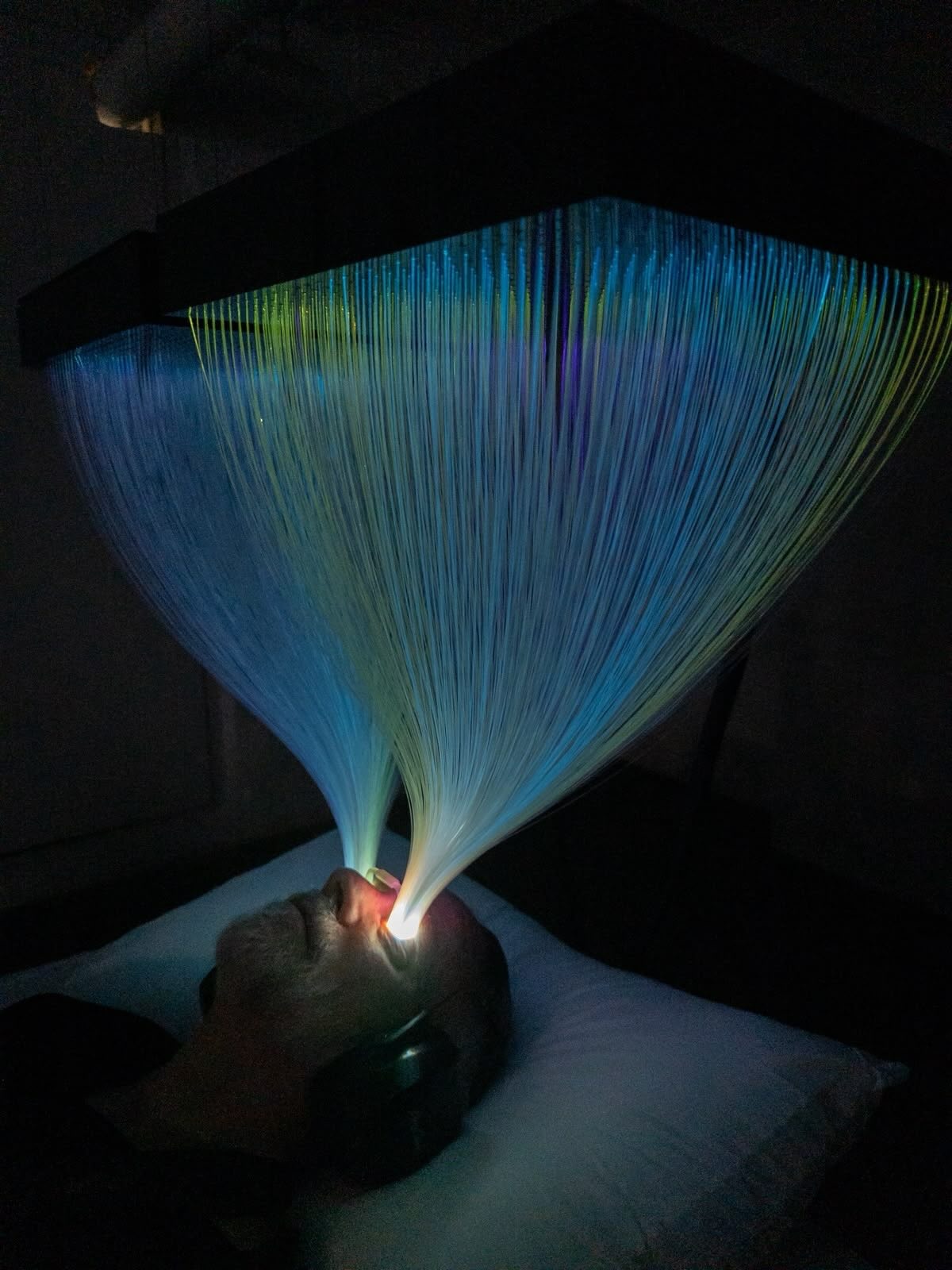
“See, believing that there will be no light”—the last instruction in the Training Wheel series foreshadows the final work in the exhibition: Imagraph (2020–), which is situated in the gallery’s dark basement. Imagraph is a machine that projects video onto closed eyelids. This impressively crafted installation offers a bed for the viewer, above which an amalgamation of optical fibers is directed downwards from two hanging panels. Before each experience begins, Muramoto secures the end of this device to lightly press on the viewer’s eyes and adjusts its color balance to their blood. Glowing colors cascade across the projection, sometimes flickering, sometimes drenching the full field of vision with their hues. For a setting akin to a speculative sci-fi sterile dream lab, the experience of Imagraph was surprisingly disarming, cutting closer to being absorbed in a planetarium's panorama or marveling at one's own floaters before sleep.
To experience Muramoto's exhibition is to have your senses dislodged and rearranged anew. Inspiring a deeply romantic sense of closeness amongst viewers is no small feat for a gallery show. While Muramoto's devices may never be able to fix all errors about human perception, it is heartening to encounter art that reminds us that there is no true intimacy without the dissolution of boundaries between you and me. Through Eyes Half Open, Goki Muramoto returns poetry to our senses.
Eyes Half Open was on view at Nguyen Wahed Gallery from June 1 to July 2, 2026.
1 Michelson, Annette. "Film and the radical aspiration." Film Culture 42 (1966): 34-42.
2 Gunning, Tom. "An aesthetic of astonishment: Early film and the (in)credulous spectator." Art and Text 34, no. 1 (1989): 31-45.