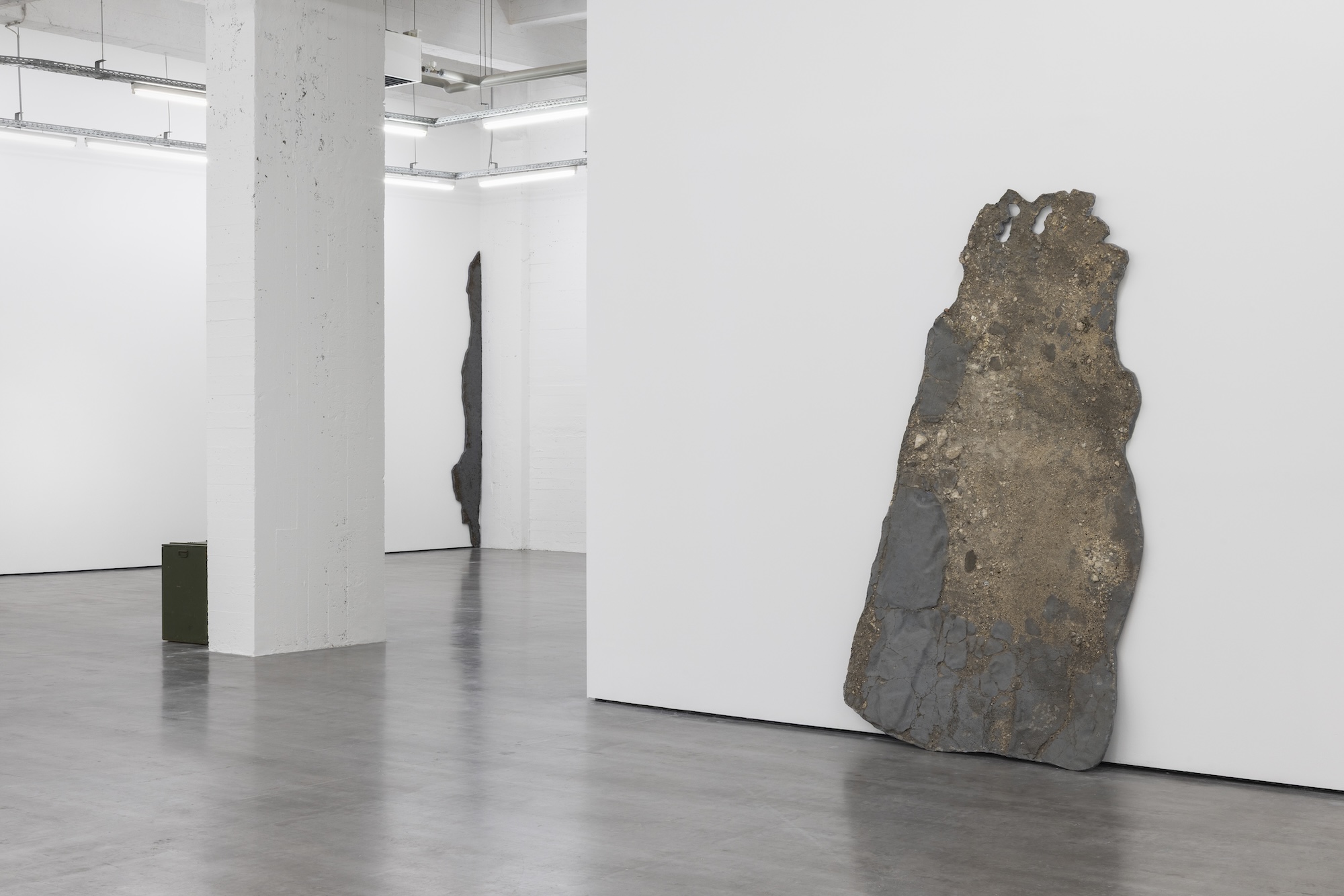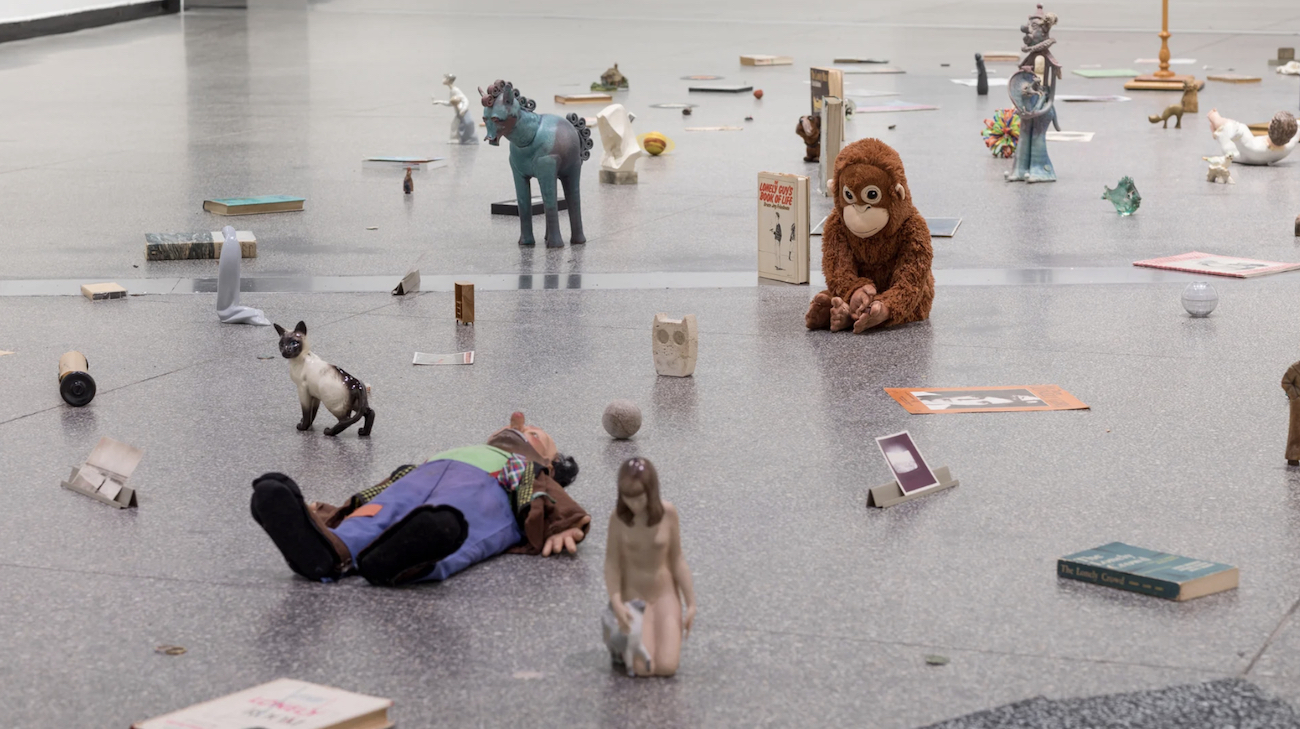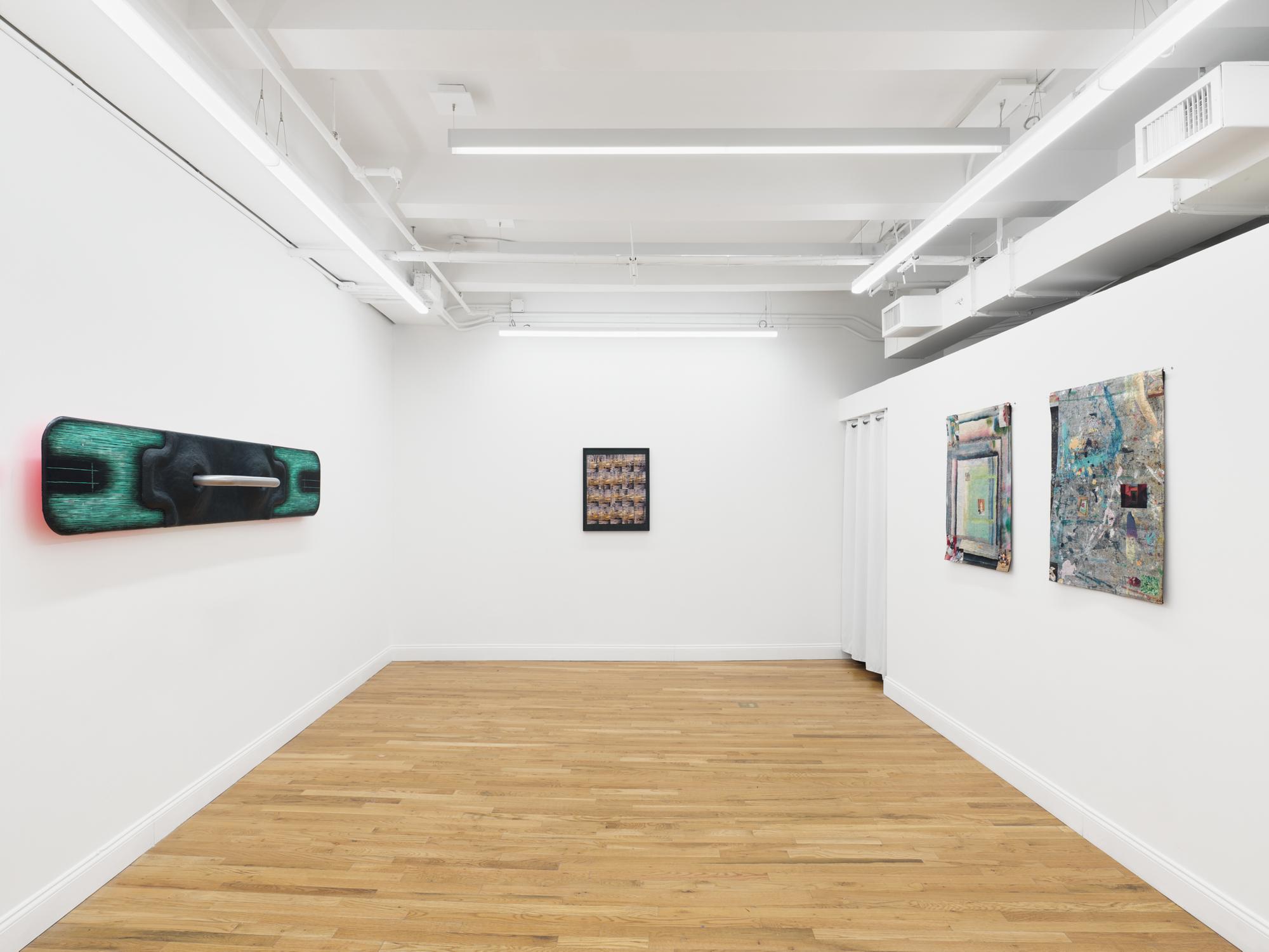
“Wetware” at RAINRAIN Gallery, Curated by Spine
Review
.jpeg)
A small canvas hanging in Ignacio Gatica’s Bushwick studio resembles a stock trader’s computer screen gone blurry. Its rows of colorful sums, percentages, and abbreviations at times look more like stalagmites than numbers or letters. The objects in the Chilean-born artist’s studio seem to orbit currency and value. Hanging over a stiff banker’s executive office sofa is a patchwork quilt composed of well-worn canvas money bags. The artist—circumspect and serious—likens the bags to ghosts, given our increasingly cashless society. Across his practice, Gatica is deeply attuned to a world flattened by capital—homogeneous, like one vast shopping mall. Many of his ideas come together in his experimental documentary-style video installation for the 2026 Whitney Biennial, Sanhattan (2025), which reveals financial ideology embedded in architecture. The installation focuses on Santiago’s financial district, known as Sanhattan because it was modeled after Manhattan.
Inside a flat file tucked into a corner of Gatica’s studio are collage drawings he made while planning the Whitney installation. On top of the flat file, a plexiglass case holds a copy of the August 1976 issue of The Nation featuring the cover story “The ‘Chicago Boys’ in Chile: Economic Freedom’s Awful Toll.” The article examined the consequences of neoliberal economic reforms conceived by academics in Chicago and imposed by Augusto Pinochet—part of the historical backdrop for Sanhattan. Rather than illustrating economic history, though, Gatica tracks the visual forms through which financial systems and assumptions become legible. Discussing works that inform his practice, Gatica points to Brazilian artists Cildo Meireles, who printed zero-dollar bills in the late ’70s and early ’80s to stress the symbolic quality of money, and Jac Leirner, who, in the early ’90s, arranged large volumes of paper currency in snake-like forms as a comment on shifting value.

One of the things Gatica is proud of about this biennial is that the curators Marcela Guerrero and Drew Sawyer present a broad view of who an American artist might be, especially since, as his work demonstrates, the United States, its economy, and visual culture have so clearly impacted other parts of the world. In Sanhattan, a hand holds up photographs of buildings from Santiago in front of the Manhattan buildings they resemble. “Architecture itself can be seen as an ideological tool,” Gatica says, “because it separates spaces; it constrains and encapsulates, and the model itself becomes an original.” On either side of the film are two LED tickers running through coordinates. “They are synchronized with the video,” Gatica explains. “Each one starts in one city and ends in the other when the video ends.” Reminiscent of his painting of blurry financial accounting, he adds, “If you feel suspended in between the coordinates, I think that feeling of a third space is an interesting kind of dissonance.”
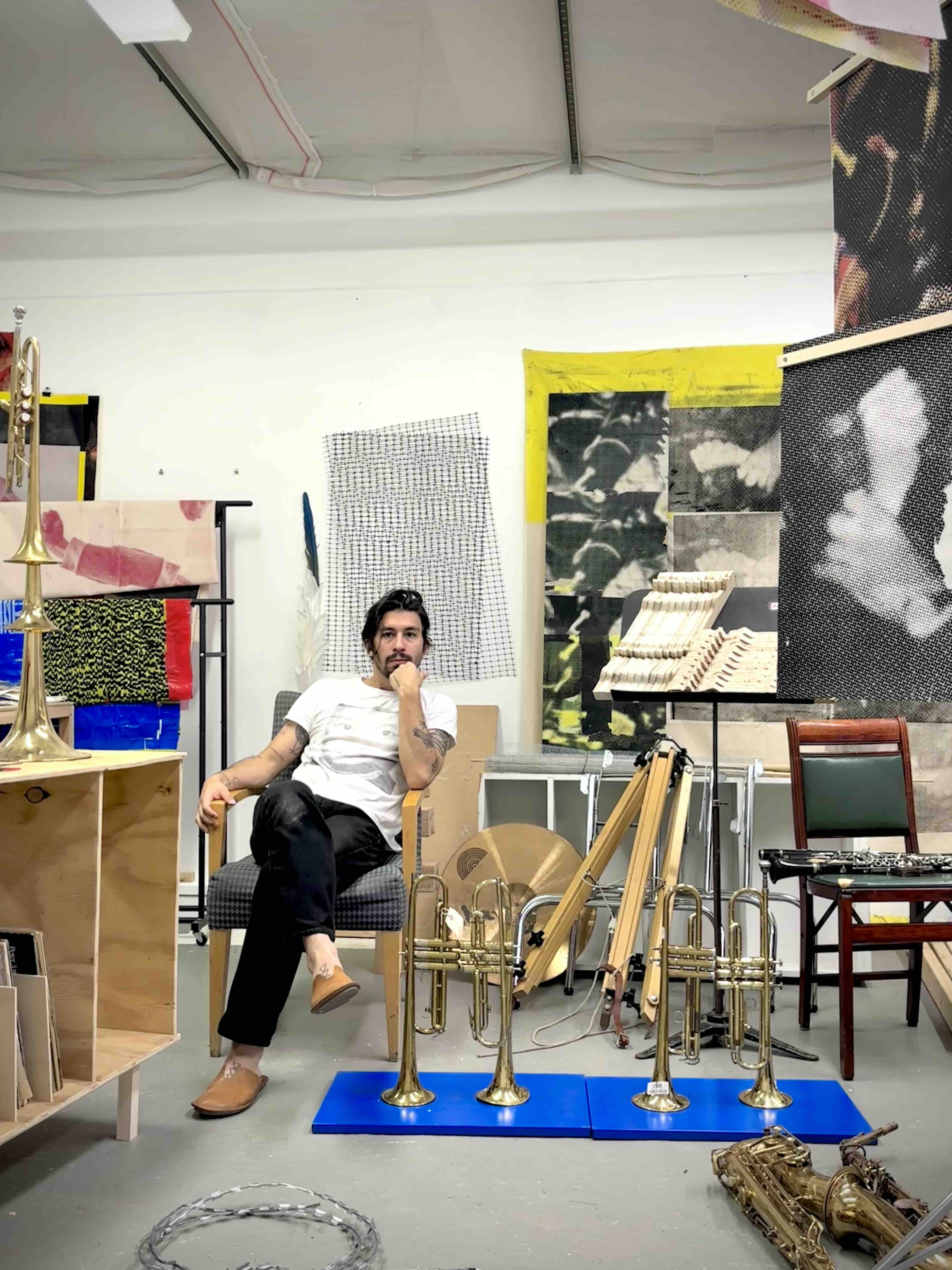
In the corner of artist Alejandro Valencia’s studio sits a box of instruments: tuba, cellos, a drum kit. Against one wall lean several tripods. The innards of an old printer lie under a table. All of these materials, he says, have been found on the streets of New York City. All of these materials, he plans to give new life. He sees potential in the discarded and the obsolete, asking his viewers to question their own ideas on consumption and replacement. “New York is a microcosm of a capitalist system,” he says. Fixing, rather than replacing, is important to Valencia’s work and its messaging about alchemy and change. The tripods will be used as sculpture stands. The printer parts will be retrofitted to display new images. “What does this object do and how can I make it do other things?” he asks, explaining he’s interested in materials that have a charge, a weathering, a life of their own before he encounters them. His approach to artmaking has become a part of its meaning.
A recent MFA graduate of Columbia University, Valencia’s work investigates how material histories are disrupted and transformed, reconfiguring notions of collective memory, identity, and power. He is interested in what Fred Moten and Stefano Harney have called The Undercommons: the ungovernable realm of social life in response to history, politics, and context. Their 2013 book The Undercommons: Fugitive Planning and Black Study asks what lies beneath institutions of control. It became well known for its critique of academia, questioning how its regulations have blunted the enlightening conversations that the institution is meant to encourage. Valencia’s 2026 thesis exhibit, DYNAMO (RaTM01) at the Miriam and Ira D. Wallach Art Gallery, slyly nods to Columbia University’s recent failure to acknowledge the genocide of the Palestinian people, though it goes beyond a simple critique. Like the found materials used, Valencia encourages viewers to bring their own history to his work. He doesn’t want the value of his work and its messaging to only be political, he says. Doing so would not invite the viewer in and allow for more robust conversation. This, in turn, would do the very thing that Moten and Harney have accused academia of doing.
Valencia is currently working on a new exhibit that will open in January 2025 at Fred Snitzer Gallery in Miami that investigates politics of care. He’s meditating on spaces intended to care for inanimate objects, like an auto repair shop or artwork conservation studio, and how reciprocity factors into care. “We maintain a vehicle because it provides transport, or we care for a 17th-century sculpture because it provides culture and history. How then does this action of care translate towards human, non-human, and ecological care?” The making of the work itself is also an act of care, allowing materials to retain their previous life and generate a new one in their remaking.
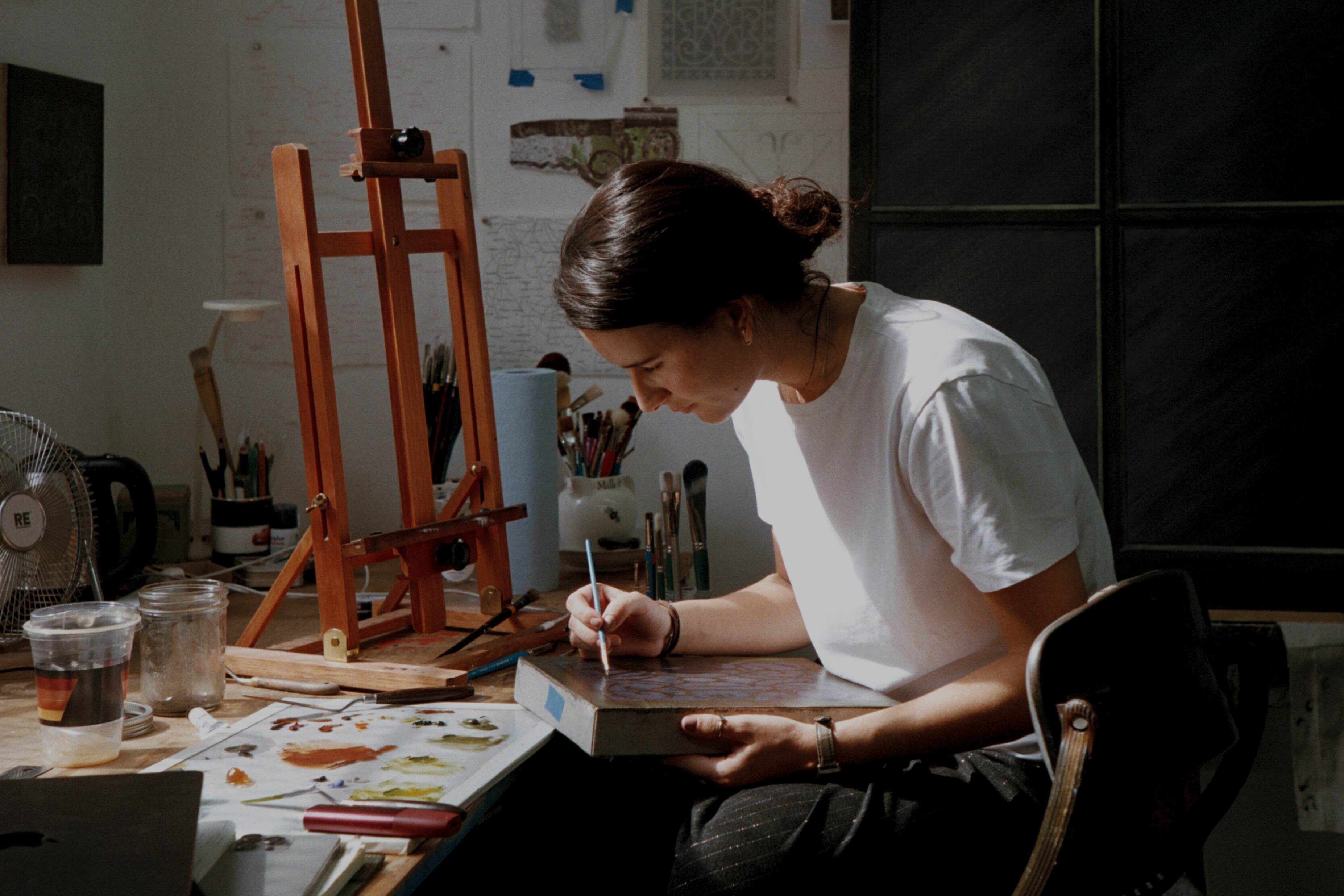
When I walked into Jimena Velarde-Alvarez’s Bushwick studio and saw her in-progress paintings of bare rooms and windows for her upcoming show at Margot Samel, I immediately asked her if she was familiar with Vilhelm Hammershøi. Smiling, she went up to a wall where several printouts of his Danish interiors were hung as reference points. Like Hammershøi, Velarde-Alvarez contemplates literal and metaphorical interiority: “I'm thinking about moments of attention and pause where the interior world is revealed, an interior experience.” Here, the artist takes up this perennial theme and situates it in a contemporary context for our consideration.
Originally from Lima, Peru, Velarde-Alvarez came to the United States to enroll at RISD and pursue a fine arts degree. After exploring sculpture and architecture, she decided to focus on the school’s painting program, which was a critical move. She recounts that “What drew me the most was the memory of the surface. Oil paint having history on the canvas and being able to see layers of time, time spent with the surface, and remembering what I was thinking when I was doing a certain mark.”
Since most of the pieces were in progress during my visit for her upcoming solo show at Margot Samel, La sombra del tiempo, I had the privilege of seeing the initial layers of paint on the artist’s canvases as she worked, which let me imagine how the already refined surfaces would continue to evolve into something somehow even more tangible. Each painting is structured by depiction of frames: crossed windows, doorways framing empty interiors, and even ornate grates. The formal, geometric rigor combines with the layering of paint to make each painting worth slow, sustained looking.
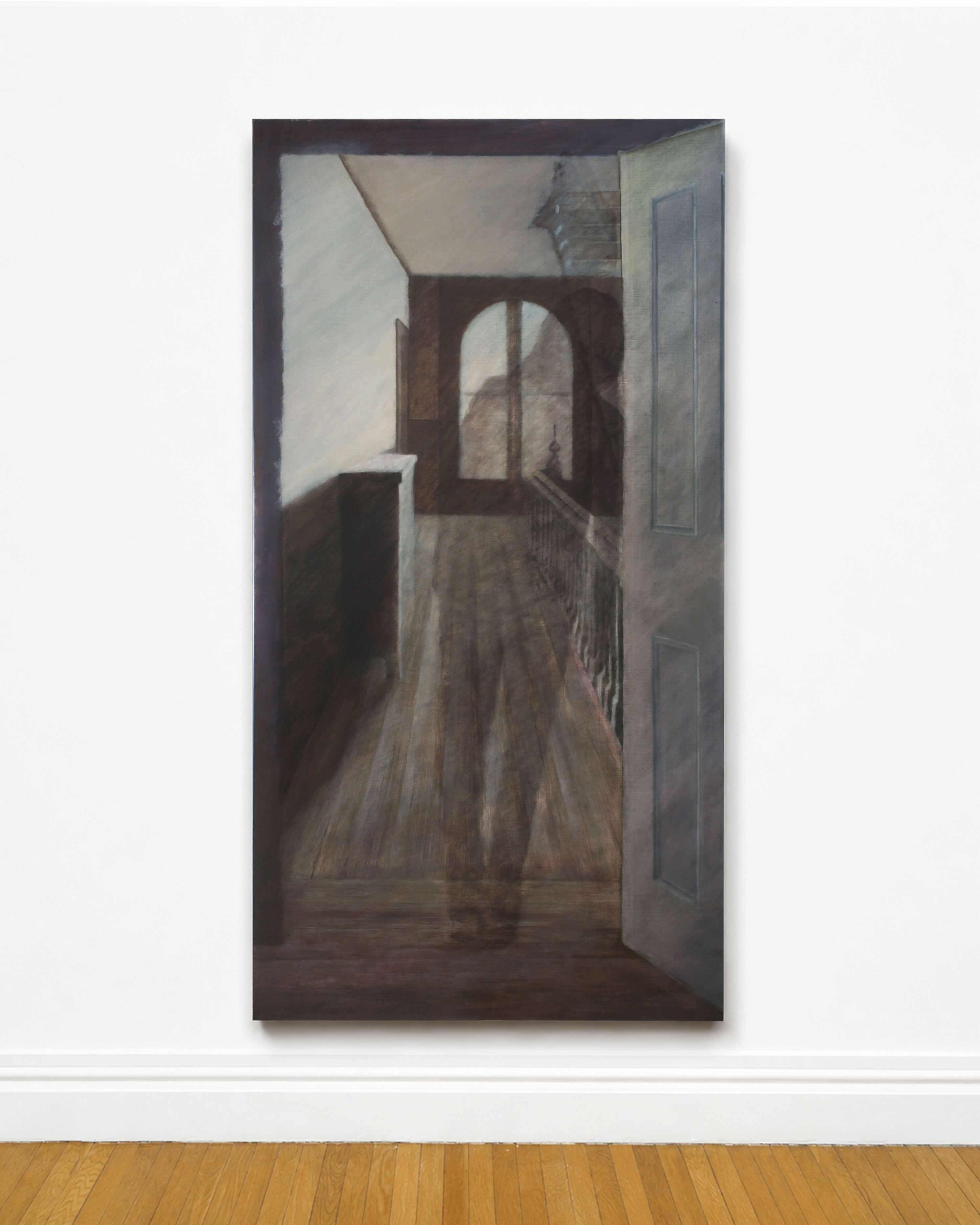
One of the artist's signature motifs, shadows, had not yet been added. Velarde-Alvarez inserts these silhouettes into her compositions to inscribe herself within them, rather than merely suggesting the presence of the self through absence. She explained to me, “When I started working with the shadow, it was the self. But then over time, I thought about it as this vestige of time, evidence of something that was there, a return to the same place, but also the form of something that becomes clear over time.”
Velarde-Alvarez also contemplates her work in relation to the way digital technology can so easily and too quickly pull our attention. For the artist, the fast-paced information overload becomes a way to avoid the world and ourselves. In turn, she values the notion that “Everyone carries this whole invisible world with them, and we get hints of it, but we're lucky for those moments of connection that are transparent, and you see each other.” Yet the strength of Jimena Velarde-Alvarez's work lies in the way these moments no longer feel “lucky” but innate, eliciting rare connection through her art.

To be in Sizhu Li’s studio is to be in her home, her life, her story. Looking into the material process of her creative practice is unequivocally intertwined with the personal. But the element of intimacy present here does not provoke estrangement; rather, it elevates the deep resonance of her work. Li forges the nuances of her own story into a collective poetics.
The Chinese-born, Houston-based artist tinkers with her primary materials such as metal, light, and wood in a garage-turned-studio passed down by her predecessors. Though her practice has most recently been demarcated by her ongoing series Moonment, which comprises large-scale installations of thin aluminum sheets with oscillating waves provoked by table fans, she has recently returned “full circle” to her original artistic training in illustration.
At the present moment, Li finds herself simultaneously enduring the past and the future. As she navigates the early stages of motherhood for the first time, her creative impulses have led her back to her undergraduate training in children’s bookmaking.
In her studio, she maintains her culminating BFA project as a handy reference: a beautiful storybook detailing the arrival of an alien civilization to a new planet only for them to desert it because it does not shape up to their original home. She also unveils a storyboard that she is in the process of drafting for a new children’s book that bears the technical rendering abilities she acquired in school but later exchanged for sculptural experimentation.
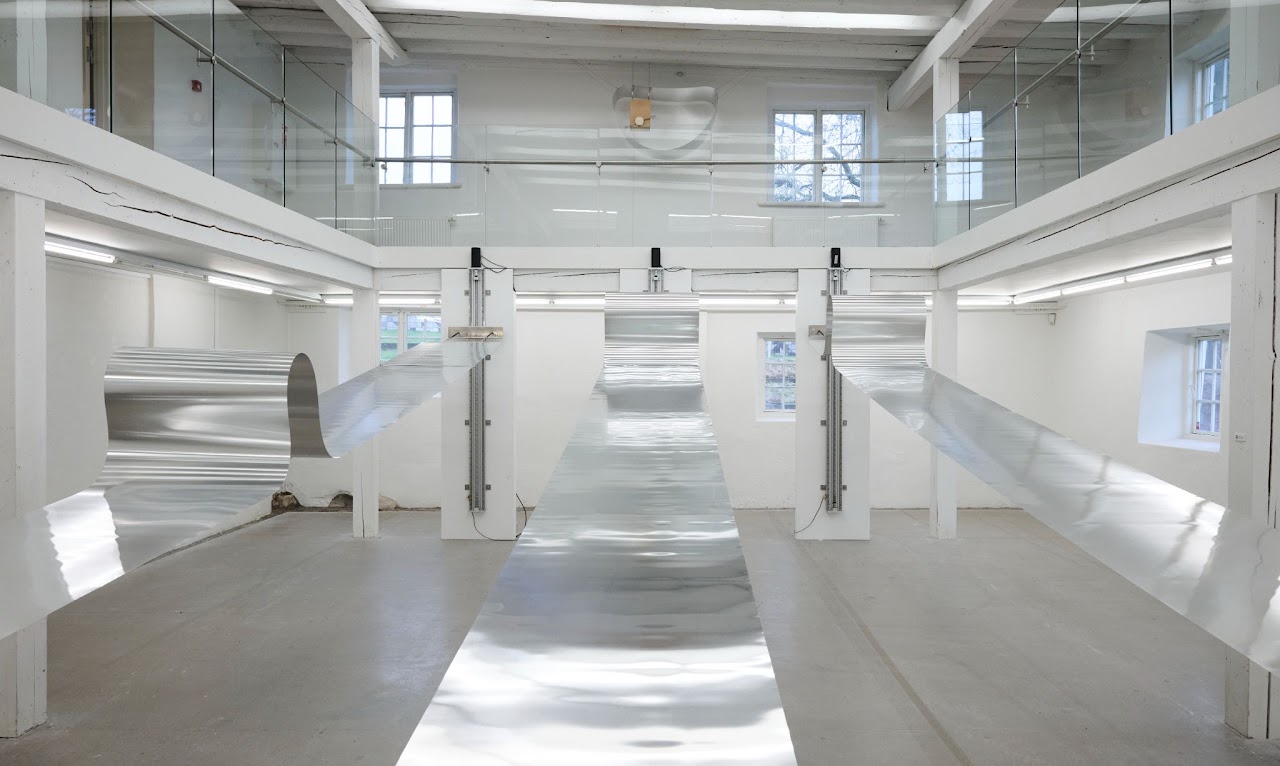
Li jokes that she has always liked to make “dark” children’s books, insisting on telling kids the truth about the world they live in. This is an ethos that not only has strengthened as she raises her little one, but also one that connects her sculptural work and her rediscovered illustration practice. At the core of projects like Moonment is a dedication to storytelling. Li aims to elucidate the intricacies of lived experience in her engagement with physical material. Her sculptures abstract these narratives via the arrangement of colloquial objects yet present their sentiments potently. Her prior and upcoming storybooks seem to relay direct narratives to younger audiences but also carry subliminal ideas made apparent to adults. “All my work has a little story behind it,” she remarks, and it is through these stories that she bridges the gap between illustration and sculpture.
The foundation of Li’s work is conducted in her home, yet the idea of a “studio” for her extends beyond this particular space and into each specific gallery space when she is actively installing her work. Such will be true for her upcoming duo exhibition at Fou Gallery, New York, this fall. Whether constructing kinetic metal structures at a grand scale or drawing the intricate details of a children’s fable, the practice of Sizhu Li aims to tell vibrant stories all while underscoring one’s own.
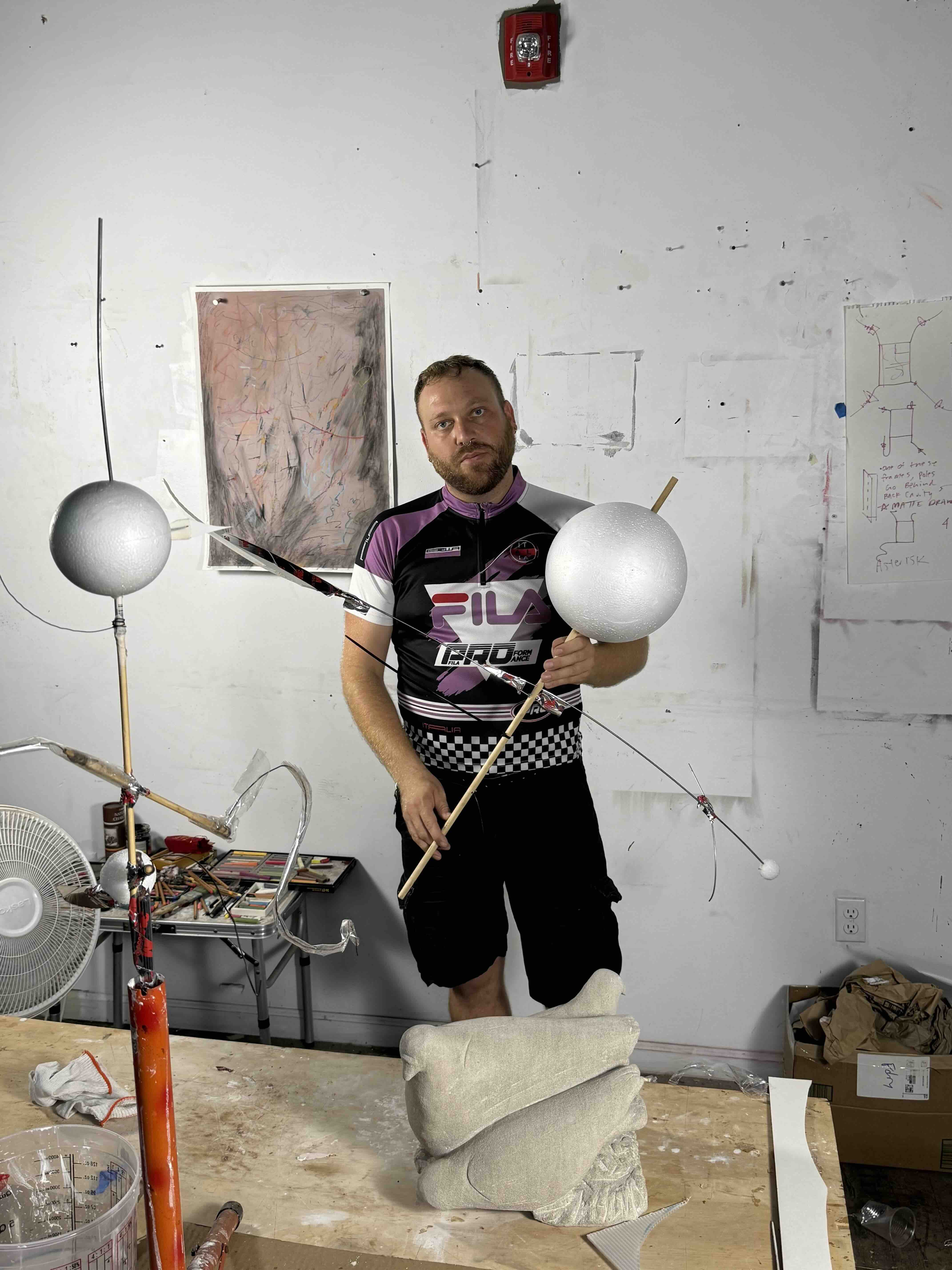
Zach Hill is an interdisciplinary artist, educator, and curator who earned his MFA from the University of Pennsylvania in 2019. His curatorial work includes Zach’s Crab Shack, described as “a queer contemporary art gallery hiding behind the façade of a campy beach-side crab stand.” Hill’s current body of work brings together his multi-media sculptural background with a drawing practice that took new forms during, and in the wake of, COVID lockdown.
While discussing Hill’s approach to drawing and its relationship to his training as a sculptor, he articulated the two media as having distinct but inextricably interwoven: “For me, sculpture and video have always lent themselves more to a conceptual practice. Drawing can be difficult to hyper-conceptualize depending on the subject matter—and I’m typically working abstractly. But my sculptures and videos are also abstractions, so there’s a similar thought process behind them.” Hill’s recent body of work brings together drawing and sculpture with his practice of constructing frames that both pull focus to the pastels and also expand their interactions in the three-dimensional space of the gallery. For Hill, “the framing is integral; I don’t feel like the drawings are finished until they’re framed and ‘sculpture-fied.’” This is particularly true of the work I-70, a multi-panel pastel framed by welded iron, adorned with a flock of various decoy birds and finished with dripped wax stalactites reminiscent of bird shit. First included in his fjord solo show, Hill described that at this stage of his practice “things respond to each other. Drawing for me is generative, because I can show up and do this activity about composition, form, and color, especially in the newer pieces, which are super Technicolor. The sculptures grew from those.”
As might already be apparent with the description of I-70, Hill’s practice holds a sustained attention to material facture with conceptual depth manifest as improvisational camp humor: “I feel I-70 hits a humor and criticality I haven’t hit in a lot of the other drawings. There’s a solid concept I can stand behind, which is exciting and something I want more of. Humor gives an opening for your audience to move into a piece. It’s almost always welcomed. In my work, there’s often humor with something dystopian underneath, which feels like life right now… [I-70] developed one step after another. When I glued the paper together, the only idea was “landscape.” Later, I wanted to think about making a landscape drawing and looked at American landscape paintings, but in my own abstracted style.”
In addition to its tongue-in-cheek intervention in the tradition and politics of the American landscape, I-70 also speaks to Hill’s Midwestern roots in Lawrence, Kansas and early performance-art training in Milwaukee, Wisconsin. “I grew up in a town that I‑70 runs directly through,” Hill says, “it divides the country in half. Landscape for me is tied to growing up in Kansas. We’d drive across the plains to the mountains. I think about the drama of that stark environmental contrast a lot . . . I think the Midwest is a place where there are more art practices that use humor. The East Coast is a bit more “serious.” I like being from the Midwest and living on the East Coast because I’ve learned to balance those approaches in a way that maybe is now paying off in some of the work.”
This discussion of electronic music festivals and their permeation into Hill’s art practice opened onto our closing discussion of his participation in rave aesthetics as a social-aesthetic practice that is not wholly separate from his broader artmaking. He evoked his work Ultimate Revenger as one that “directly comments on nightlife because the central found object is a ’90s lighting rig. That piece achieves something I often strive for in my practice: it’s both figure, implement, and infrastructure. Ultimate Revenger becomes many aspects of nightlife. It uses videos of POV shots of flowers, thinking about pollination and people in front of you. It has one video on one hand that’s a moon and one that’s a sun on the other, thinking about raving as a passage of time. A big part of raving is when it becomes night or day, and that transition in time and space.” From the rave to the studio, across drawing and sculpture, Hill’s practice melds absurdist humor with an incisive attention to materials’ capacity to invite meaning through conflict.