.webp)

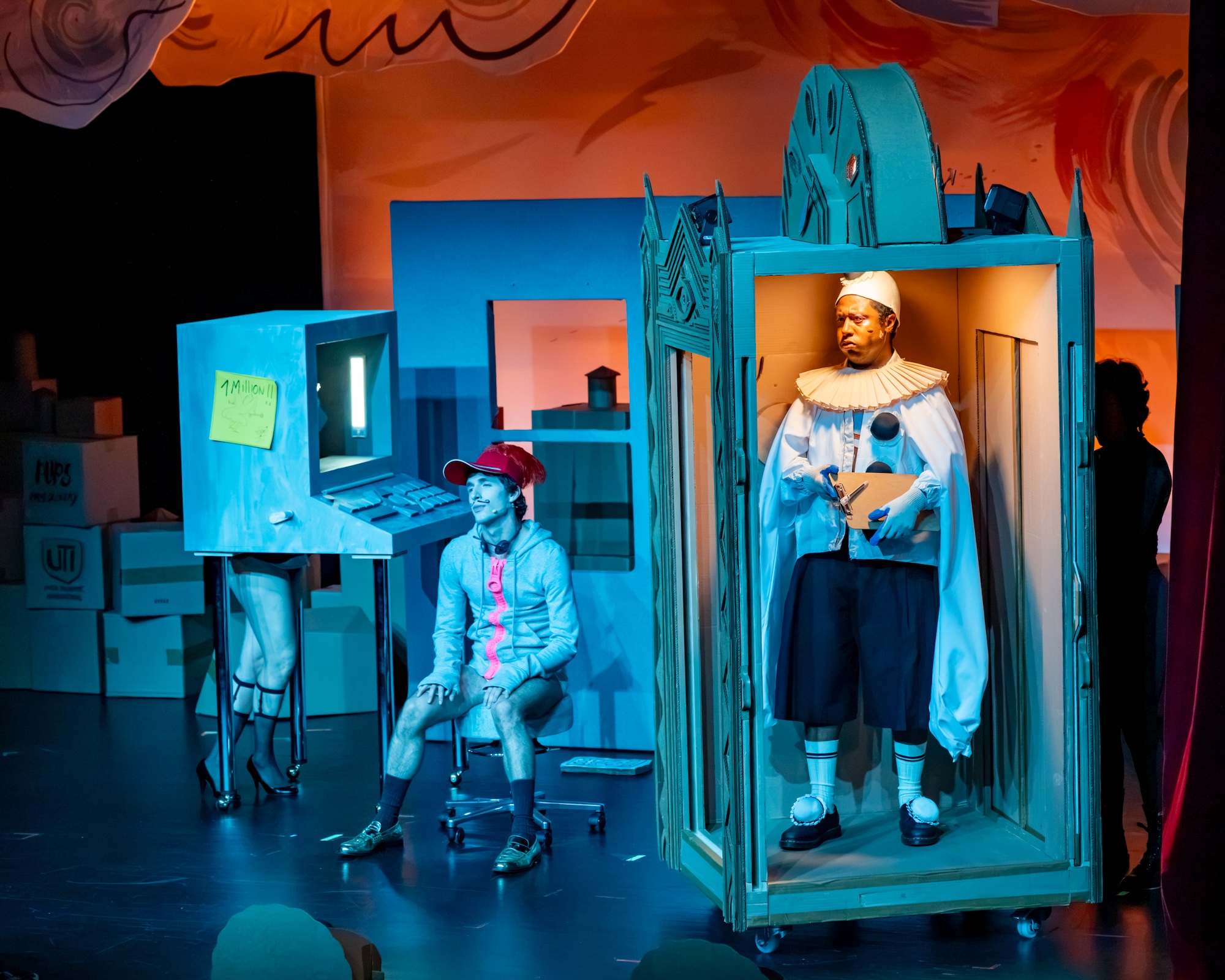
Camille Henrot: “Commedia dell’arte” at L’Alliance New York
Review
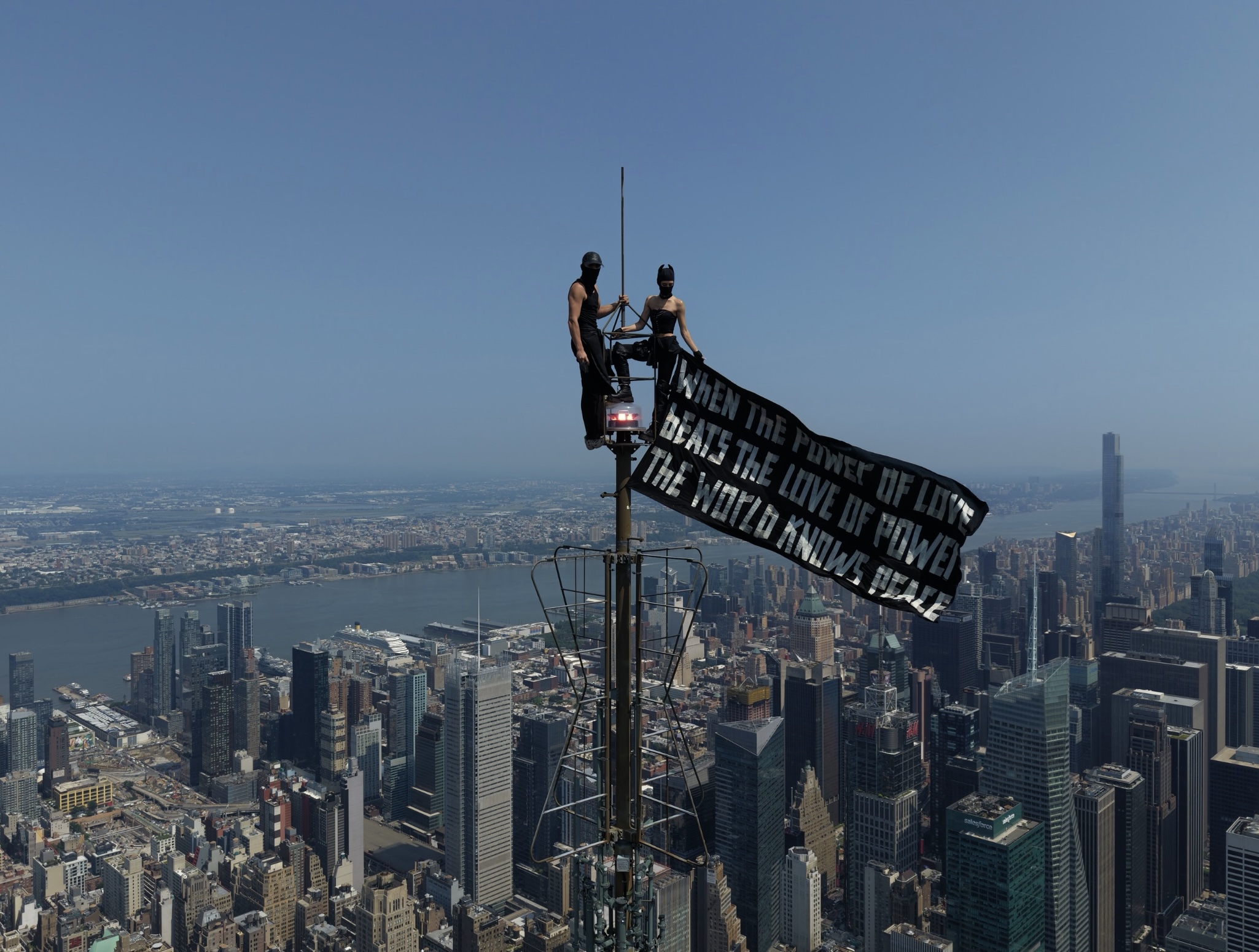
On July 1, social media feeds were overtaken by images of a couple scaling and staging a marriage proposal atop the Empire State Building. The Russian duo Angela Nikolau and Ivan Beerkus identify themselves as “rooftoppers,” positioning their climbs as performance art. They have built a business around brand sponsorships while also selling photographs of their climbs as NFTs. Their latest New York City stunt coincided with an advertising campaign for their Netflix documentary Skywalkers: A Love Story (2024), which chronicled their climb of Merdeka 118 in Kuala Lumpur.
The most compelling question is not whether their actions constitute performance art. That debate feels increasingly beside the point. Performance has been absorbed not just by the contemporary art market, but by late capitalism itself in its emphasis on visibility and branding. The most interesting aspect of Nikolau and Beerkus’s action is not even the climb itself—it is the drone that converts an ephemeral performance into a reproducible image designed for viral circulation. The use of the drone in this intervention evokes a defining condition of contemporary subjectivity, wherein self-commodification and self-surveillance are no longer distinct but rather mutually constitutive processes.
The drone documents a carefully orchestrated sequence: the couple climbing to the top of the Empire State Building’s antenna structure, unfurling a black flag bearing the words, “When the power of love beats the love of power, the world will know peace,” and finally, Beerkus kneeling to propose to Nikolau. The day after the feat, the couple posted a victorious image of themselves at 1,454 feet to Instagram with the caption: “@angela_nikolau and @beerkus are currently unavailable, and we knew this in advance—so this post was pre-scheduled and is now publishing automatically.” This post refers to the couple in the third person, implying a sense of distance from the subjects, even though it appears on Nikolau’s own account. The drone image speaks and sees for the artists, effectively collapsing the distinction between human consciousness and techno-consciousness. Simultaneously, viewers are interpellated not only into the drone’s aerial gaze, but also into its seemingly sentient imagination, occupying an omniscient, godlike perspective that renders the climbers—and the city—fully knowable from above.
In his essay “Drone Metaphysics” (2015), Benjamin Noys argues that drones have come to function as the “traveling eyes of God,” their apparent autonomy masking the military and surveillance infrastructures from which they emerge. Rejecting the tendency to treat drones as neutral recording devices, Noys cautions against the techno-fetishization that humanizes these machines and obscures their entanglement with systems of war and state power.1 As the drone has become an aesthetic technology, it has entered not only the consumer market but also the art market. Such treatment of military and surveillance technology renders it both mundane and sublime, while dangerously converging feelings of idealism and indifference.
Nikolau and Beerkus’s content cultivates a perception of illegality and anarchy, but these circulated images paradoxically derive their power from hypervisibility. Many of their climbs involve criminal trespass on private property. Their documentary features their narrow escape from police while climbing Merdeka 118, the second tallest building in the world. Despite multiple arrests for similarly high-stakes interventions, the couple continues to risk major consequences, even in countries where penalties for trespassing are particularly severe.

The couple record every step of their climbs, both for their personal channels and for brand campaigns. In a recent promotion for Diesel, the couple appear kissing on rooftops in major cities across the globe. They are dressed in the brand’s signature denim as the camera flies above them, capturing the cities below. They passionately make out, acting unaware of the camera as well as the deathly drop. In each clip, they position themselves at the very edge of the roof, their legs dangling off carelessly, their bodies entangled in one another.
Aside from a glimpse of Diesel’s slogan, the advertisement looks nearly identical to the rest of Nikolau and Beerkus’s rooftopping content. Diesel’s catchphrase, “For successful living,” is embodied by the couple’s business model, which relies on the commodification of themselves with an aesthetic contingent upon the constant surveillance and circulation of their experience, persona, and image.
Self-documentation is foundational to the history of performance art. While the performance itself, the live, ephemeral aspect of the work, is almost always privileged, the documentation acts as a crucial support system that ensures the work’s afterlife. For example, in Tehching Hsieh’s One Year Performance (Time Clock Piece) (1980–1981), the artist obsessively documented a year of his life spent confined to his New York City studio. Every hour, on the hour, for 365 days, Hsieh punched in on a time clock and took a photo of himself wearing a grey jumpsuit. Art historian Amelia Jones writes about the significance of the camera in Hsieh’s work, suggesting that the device here can be analyzed as a precursor to contemporary surveillance systems and automatic capture mechanisms: “we witness the collapsing of time into cinematic image [. . .] As cinematic spectators, we participate in an encountering, engaging this stuttering body in relation to our own modes of desiring and instrumentalized embodiment.”2 Jones suggests that Hsieh’s self-imposed documentation of his labor represents a shift in capitalist desire, registering a society on the precipice of changing economic structures. While Nikolau and Beerkus’s artistic practice is radically different from Hsieh’s, their incorporation of the drone comes to symbolize the laboring 21st-century body, a subject whose value is extracted from experiential and affective modes of capital. Their Empire State Building climb, as visualized through the all-seeing eyes of the drone, perfectly encapsulates the unrelenting mechanisms of late capitalism: to capture, surveil, and monetize all aspects of human experience.
The drone in this feat is an extension of the performance and the artists, but also the buildings and the cities that it records. The Empire State Building, an iconic fixture in New York City’s skyline since 1931, has been analyzed by countless architects, urban planners, and historians alike. In When the Cathedrals Were White (1937), Le Corbusier celebrates the city’s skyscrapers as secular embodiments of religious architecture tied to ideals of modern freedom. In Nikolau and Beerkus’s performance, the Empire State Building might then be seen as their own personal cathedral scaled to capitalist extremes, its associations with churches refracted through their marriage proposal. They present themselves not before the eyes of God, but before the eyes of the drone—their only direct witness. It is this very use of the drone—in collapsing economic gain and systematic violence into images of sublime spiritual transcendence—that Noys warns against.
It is difficult to resist these images precisely because they are so effective at producing the feelings they appear to document: freedom, intimacy, fearlessness, and transcendence. It is easy to be seduced by this couple, much as many have romanticized Marina Abramović and Ulay’s decade-long artistic and romantic relationship from 1976–1988. Nikolau and Beerkus’s act is initially reminiscent of The Lovers: The Great Wall Walk (1988), a performance in which Abramović and Ulay planned to be the first to walk the entirety of the Great Wall of China, moving toward each other from opposite sides, meeting somewhere in the middle to get married. However, after years of struggling to raise funds and gain permits from the Chinese government, their relationship had deteriorated. Instead of uniting in ceremony, they met to say goodbye, signifying the end of their romantic and professional relationship forever.
Both performances transform an arduous architectural traversal into a story about romantic love. In their documentary, Nikolau and Beerkus frame their climb as a way of conquering fear and proclaiming their extraordinary commitment and trust in each other. This storyline continues in their Empire State Building climb, as Nikolau reveals on Instagram that her engagement ring is inscribed with the words “your full potential is on the other side of fear.”
Was the Empire State Building climb the union that Abramović and Ulay never had? Not really. Although both works involve endurance and monumental architecture, they diverge in affective resonance. In the New York climb, the drone erases the performance’s physical and emotional labor. While The Great Wall Walk integrates failure and struggle into the work itself, ultimately refusing its initially romantic narrative, Nikolau and Beerkus successfully package romance as consumable content. The ascent appears seamless and obstacle-free: the couple soars above New York, fearless, beautiful, and unconstrained. There is little sense of exhaustion, danger, or imminent arrest. The climb is transformed into a cinematic spectacle of limitless possibility.
The surviving documentation of The Great Wall Walk is far less picture-perfect. Instead, it is steeped in a heightened sense of emotional weight and physical pain. Abramović and Ulay archived their journey with poems, photographs, and film. 16mm footage captures the artists’ goodbye with intimate close-ups of their faces, which look drained.
The historical context of each performance further distinguishes the two. Abramović and Ulay undertook The Great Wall Walk in the late 1980s, when the Wall might have been seen as a monument to imperial defense and, amid the Cold War, resonated with ideas of borders and geopolitical divisions. By contrast, the Empire State Building is an emblem of global capitalist modernity. The drone amplifies this symbolism with its effortless vertical ascent. Where The Great Wall Walk dwells on the body’s limits—its emotional and political extremes—the Empire State Building climb imagines a frictionless world in which corporeal transcendence is not only attainable but achievable without major tribulation.
Marcel Duchamp emerges as an alternative interlocutor, one specifically invoked by the artists themselves. Nikolau remarked that anyone who saw the recent Duchamp retrospective at the Museum of Modern Art—which the couple visited shortly after their Empire State Building climb—would immediately recognize his influence on her work.3 It is unclear exactly which aspect of Duchamp’s work she associates with her own. One might assume that it is his invention of the readymade. Yet what, exactly, functions as the readymade in Nikolau and Beerkus’s performance practice? Is it the appropriation of the skyscraper as a monumental sculptural object or stage? Is it the NFT that transforms an ephemeral performance into a scarce digital commodity? Or is it the drone itself—a twenty-first-century Fountain (1917) just outside the frame? Like Duchamp’s urinal, the drone is a mass-produced technology displaced and then recontextualized into the realm of art. But unlike the factory-produced object of early industrial modernity, the drone belongs to the infrastructures of surveillance, logistics, and military technology. Ultimately, Nikolau and Beerkus’s use of the drone is more convoluted than Duchamp’s appropriation of the readymade object. The drone displaces the artists’ control while redispersing authorship across algorithms, software, and branding platforms.
More fundamentally, however, the readymade here is no longer an object at all, but an entire media apparatus. Surveillance technologies, social media platforms, NFTs, and the attention economy at large provide preexisting systems that can be appropriated as artistic material, whether critically and reflexively or more sincerely. In this case, the performance arrives already formatted for drone cinematography, Instagram grids, and algorithmic circulation.
Nikolau and Beerkus generally refrain from explicit political messaging. In their documentary, the couple briefly discuss the Russia-Ukraine War. While Beerkus mentions that he has Ukrainian heritage, they remain elusive about the political stakes of their interventions. It’s worth considering, though, how censorship in Russia, including restrictions on Meta platforms such as Instagram and Facebook, might shape their understanding of artistic expression, as suggested by the artists. Perhaps this explains in part why their messaging is vague and universal rather than pointed and local.
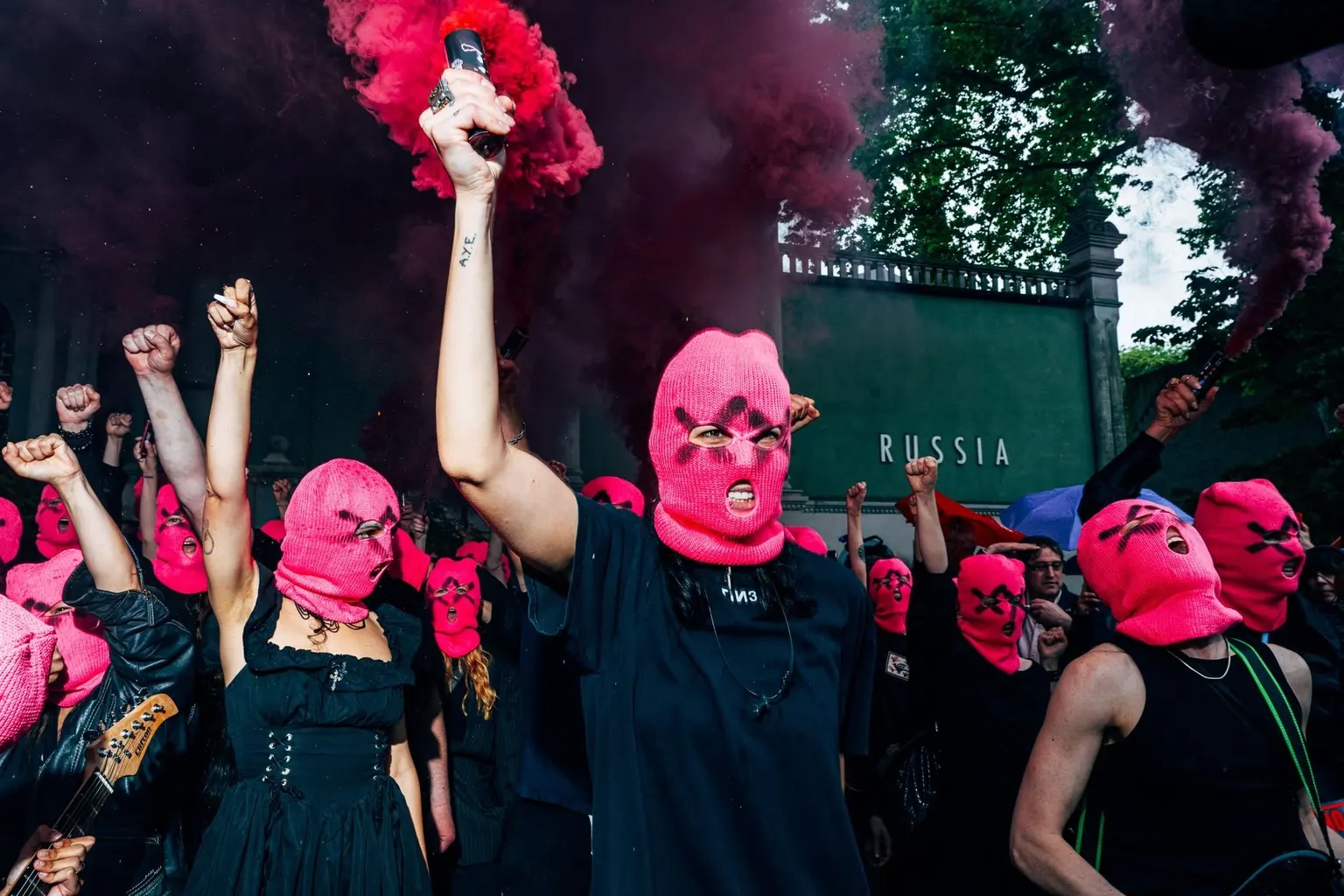
The couple’s lack of targeted political criticism becomes even more striking when placed alongside contemporaries who likewise share work through digital platforms, taking on considerable personal risk, though toward more explicit political ends. A useful point of comparison is Nadya Tolokonnikova of Pussy Riot, who has likewise embraced social media, NFTs, and OnlyFans as parts of her artistic and activist practice. On the surface, both groups cultivate a sexually charged punk visual language that adapts performance to platform culture. Nikolau’s Catwoman balaclava recalls Pussy Riot’s iconic pink protest masks and suggests a shared aesthetic of antiauthoritarianism.
Yet the resemblance ends there. Pussy Riot’s imagery refuses political ambiguity. Their most recent music video, DISOBEY (2026), was filmed as part of a demonstration outside of the Russian Art Pavilion at this year’s Venice Biennale. Pussy Riot and the Ukrainian feminist group FEMEN protested Russia’s return to the Biennale after its 2022 invasion of Ukraine. Footage from the performance/protest denies the removed aerial perspective of the drone, instead placing viewers at ground level from an embodied viewpoint. The video, which captures the pink smoke and police arrests, transforms the camera into a participant rather than an omniscient observer. The repeated refrain, “Get up from your couch and fight... you say you can't change anything... disobey, disobey, disobey,” leaves little doubt about Pussy Riot and FEMEN’s political demands. Where Nikolau and Beerkus’s drone footage aestheticizes risk from a distant vantage point, Pussy Riot insists on immediate proximity, urgency, and direct political address.
The couple’s visual identity likewise conjures the aesthetics of Accelerationism—again, though, without the accompanying politics. With their sleek Matrix-like body-suits, synth-driven soundtracks, and cyberpunk philosophy, their climbs inhabit something akin to an accelerationist aesthetic. Accelerationism is a philosophical theory that urges not resisting but intensifying the infrastructures of capitalism to push such logics to their absolute limits, in the hope of upending the current world order. To be clear, Nikolau and Beerkus are not accelerationists in an explicit ideological sense. However, their climbs embrace such aesthetics with their fusion of platform capitalism into their art and daily lives. In their climbs, height becomes greater, visibility more total, circulation faster, and risk more spectacular. Whether knowingly or not, Nikolau and Beerkus mobilize associations with accelerationism that invite reconsidering the readymade as a precedent for art that incorporates technological systems beyond the artist’s control.
Duchamp’s work was preoccupied with the increasingly entangled relationship between humans and machines. In his oeuvre, as MoMA curator Michelle Kuo explains, “the very human emotions of desire and love are held in tandem with machines.”4 Given the context of World War I, it seems impossible to separate his work from the traumatic violence of military mechanization, particularly the weaponization of technologies such as synchronized machine guns, which transformed aerial combat.
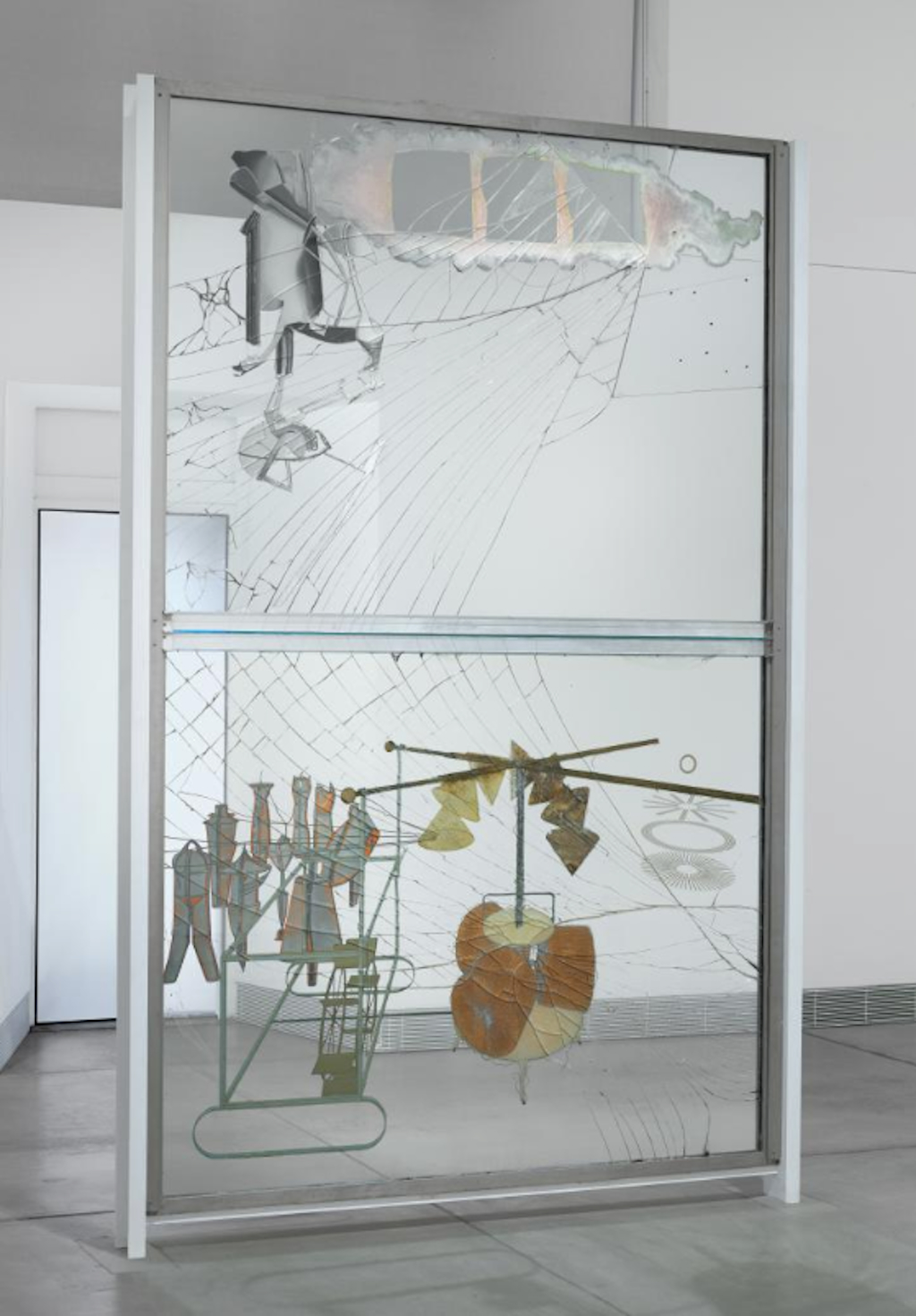
The Bride Stripped Bare by Her Bachelors, Even (The Large Glass) (1915–23) consists of two large glass panels depicting abstract yet recognizable machine-like figures. The most curious figures are the “oculist witnesses” in the bottom right: three silver rings reminiscent of the concentric patterns once used by opticians in vision tests.5 Simultaneously recalling sunbeams or sound waves, these radiating forms are distinguished both visually and spatially, seeming to oversee the courting ritual as mechanized eyes. Duchamp thus thematizes the very act of seeing and being seen through new forms of media, perhaps offering a sort of prehistory of machine vision and surveillance as translated into visual culture.
As Beerkus kneels below Nikolau, proposing beneath the Empire State Building’s spire, a drone hovers above and beside them like a contemporary oculist witness. The fact that The Large Glass is staged as a courting ritual underscores Duchamp’s interest in the technological mediation of desire, which is literalized through this performance. In Skywalkers: A Love Story, Nikolau expresses her longing quite poetically, wishing “to come touch the sky, to be a part of that beauty, that greatness.” The heavenly skies she seeks are not above the white cathedrals of the past, but the skyscrapers of the future made of metal, iron, glass, corporations, and investment capital. To touch the sky in 2026 is to perform before another kind of ocular witness—not God, but a camera.
References:
1 Benjamin Noys, “Drone Metaphysics,” Culture Machine 16 (2015): 1–22, https://culturemachine.net/vol-16-drone-cultures/drone-methaphysics/.
2 Amelia Jones, “Encountering: The Conceptual Body, or a Theory of When, Where, and How Art ‘Means,’” TDR: The Drama Review 62, no. 3 (Fall 2018): 13, https://doi.org/10.1162/dram_a_00770.
3 Angela Nikolau, Instagram direct message to followers, July 24, 2026.
4 Michelle Kuo, in “Marcel Duchamp. Bride. 1912,” Marcel Duchamp audio playlist, Museum of Modern Art, accessed August 8, 2026, https://www.moma.org/audio/playlist/352/4916.
5 Steven Zucker and Beth Harris, “Marcel Duchamp, The Large Glass,” Smarthistory, accessed August 8, 2026, https://smarthistory.org/duchamp-largeglass/.