.webp)
“Love in a Fallen City” at lovers
Review
Spencer Brownstone’s exhibition Second material takes a quote from Ovid’s Metamorphoses as its point of departure: “All things are in a state of flux, and everything is brought into being with a changing nature.” On view through August 14, 2026, Second material brings together the works of Jane South, Abby Cheney, Adriana Gallo, Krista Clark, and Szabolcs Veres. Collectively, these artists carry out an investigation into the bodily, ecological, and economic processes that prevent materiality from settling into a fixed condition.
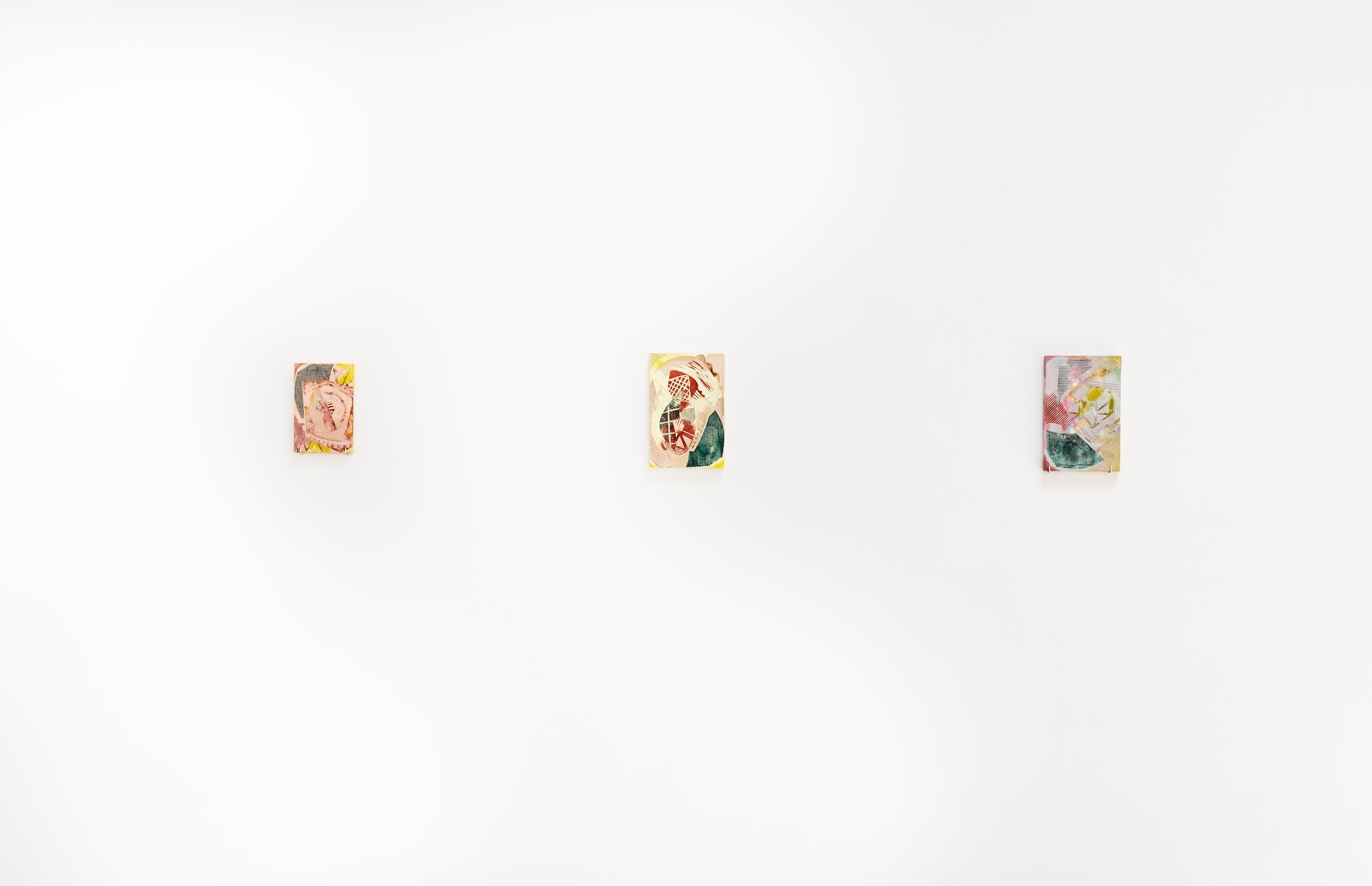
Jane South carves and inlays pigment in geometric cast mineral composites. Camber (2026), Incline (2026), and Nook (2026) carve grids and cut forms into stamped and blotchy hues, blurring the distinction between sculptural and color forms. Whether they could be read as aerial views onto archeological sites or windows into whimsical yet structured worlds, these pieces condense form and the wear of time into residues, etchings, and protrusions; South’s past architectural installations are compressed and distilled in plan view. In Camber, this density and perspective evoke questions of scale and context; the softening geometries become intestinal and flesh-like, much like how an excavated quarry begins to resemble an open wound.
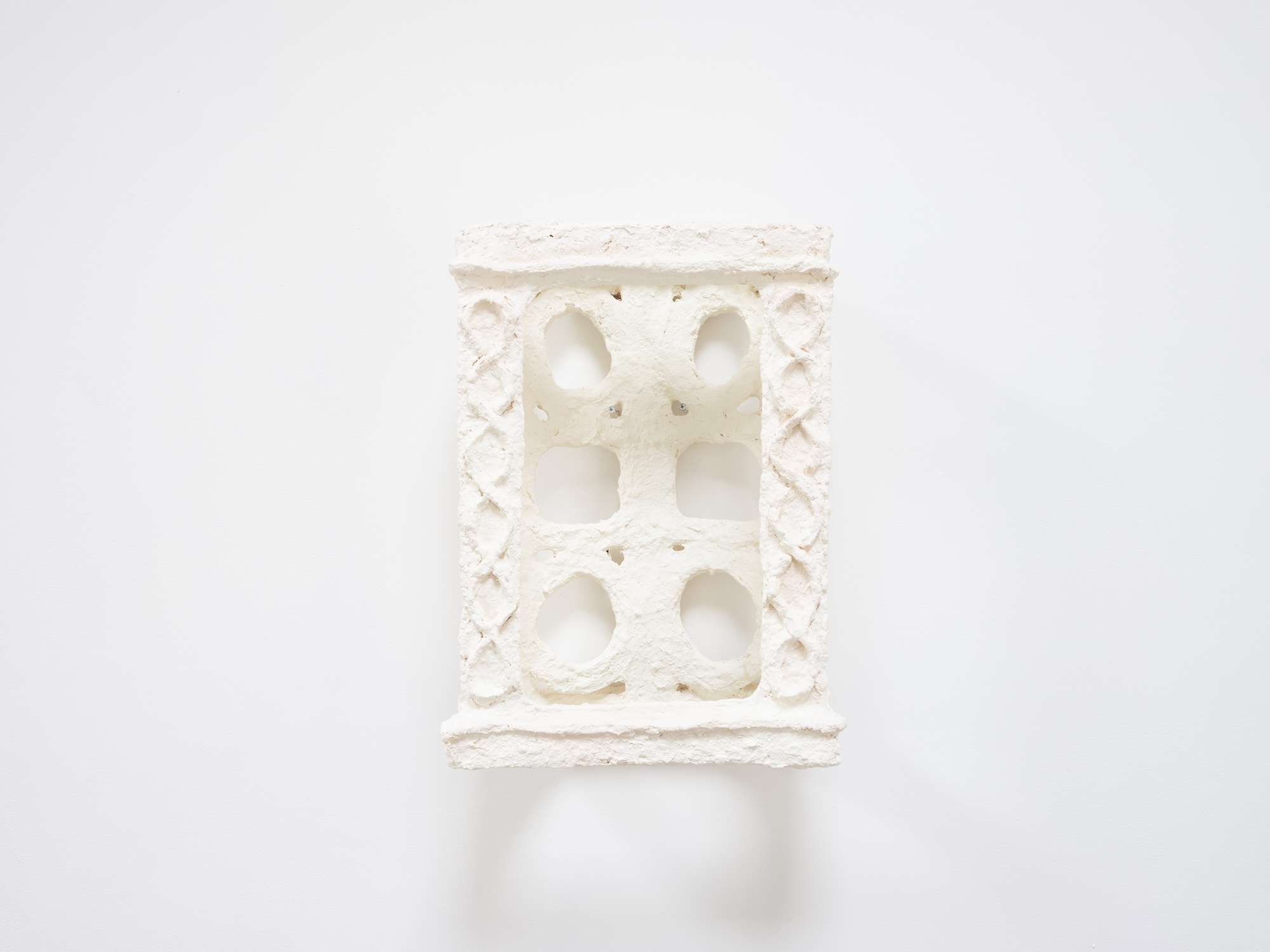
On the wall to the right, Abby Cheney’s pulpy sconce—a work of small architecture in and of itself—is ornate with entwined forms and cutouts. Concave (2024) invites one to not only look through, but to look within, as it creates and holds space through its doughy, porous form. Through aggregated cardboard, paper pulp, and found materials, Cheney’s sconce is altar-like, full of crevices and openings where little fragments of divinity might coalesce and stay awhile—not for the allure of smoothness or perfection, but to dwell and snag on the texture of the quotidian.
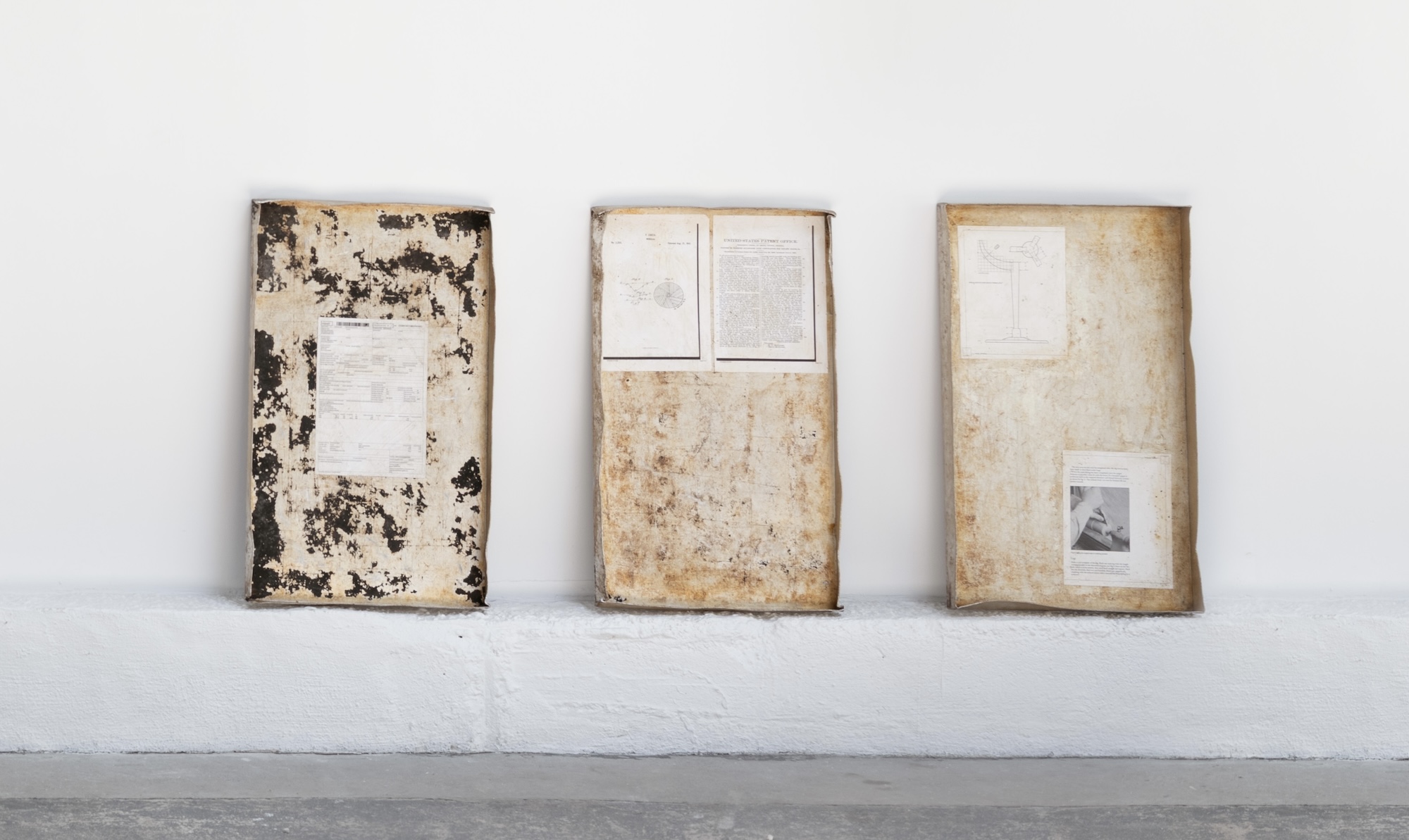
Adriana Gallo combines readymades with figments and glimpses of extended historical and material processes: a miniature model of a grain mill, burnt wheat, and the customs import form for the wood chest incorporated in A rude and undigested mass (2025). This piece and Table Turning 1, 2, and 3 (all 2025) incorporate found materials in various senses, including pages from the 1990 book Making Shaker Furniture and an 1841 millstone patent, pasted into used baking sheets. These documents situate these pieces not only within historical, industrial processes but also in relation to each other, the artist, and geopolitical bureaucracies. The import form contains the artist’s address, the chest’s country of origin (France), and a comically diminutive description of goods for the 19th-century bread safe as a “walnut bread box.” Both installations bear visceral traces and caresses of human hands: the grain puckered and uneven, the bellies of the baking sheets each distinctly etched and rusted, their corners pinched with use.
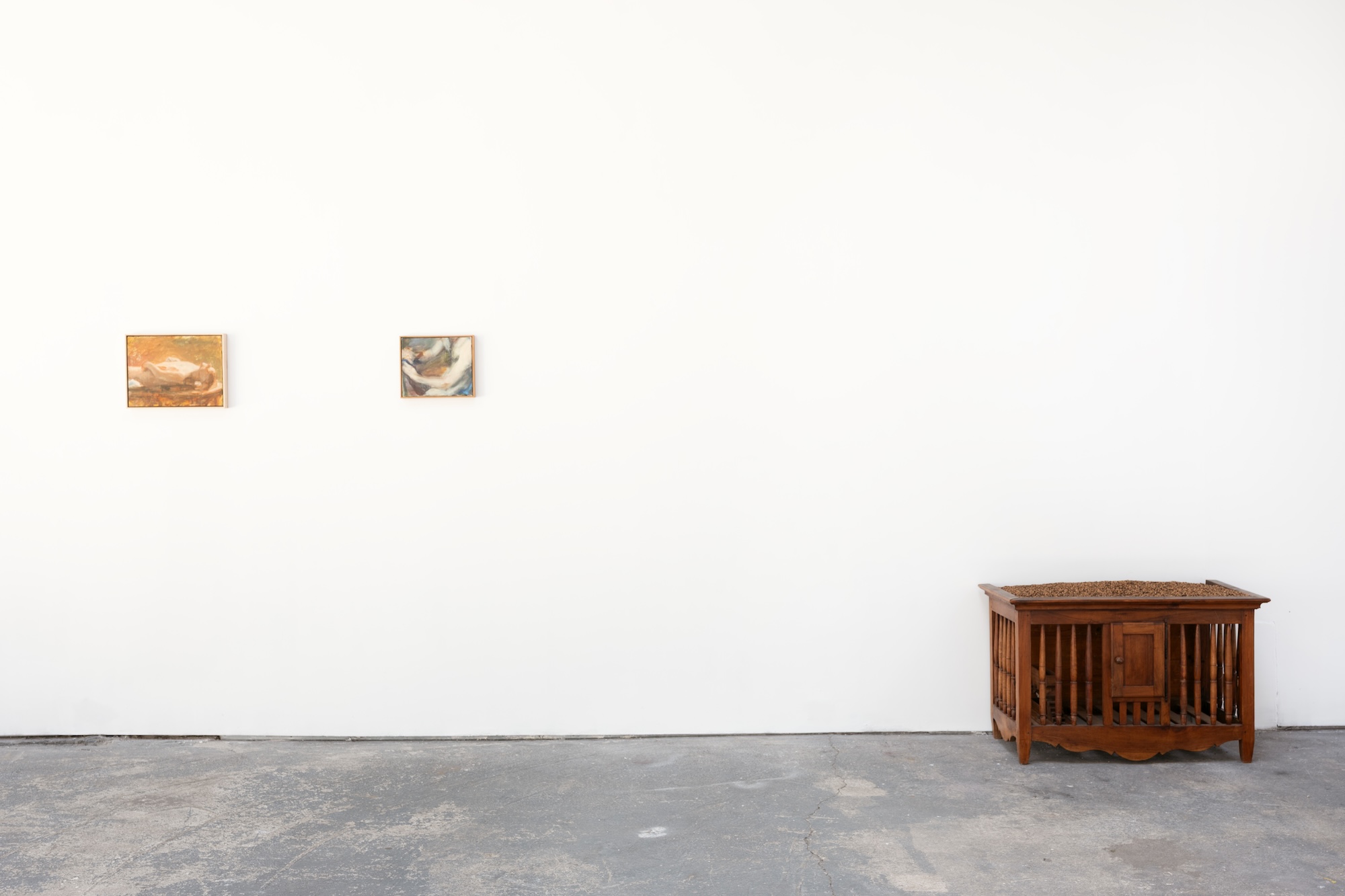
Meanwhile, Szabolcs Veres’s brushwork creates bodies not as form but as movement. Body Cast (2025), Untitled (2022), and Dancers (2024) build layers of oil into bodies that are more than bodies—figures that contain their own pasts and futures, their own palimpsests and potentialities of gestures. In Dancers, negative space is constituted by dark, cool forms that impress upon and coexist equally with human figures, blurring the boundary between subject and background, the corporeal and the spatial. If the comfort of having a human body emerges from the fiction of its durability, the disquiet that Veres’s work evokes could be attributed to the extended temporalities of the figures he renders and the embodied spaces they inhabit.
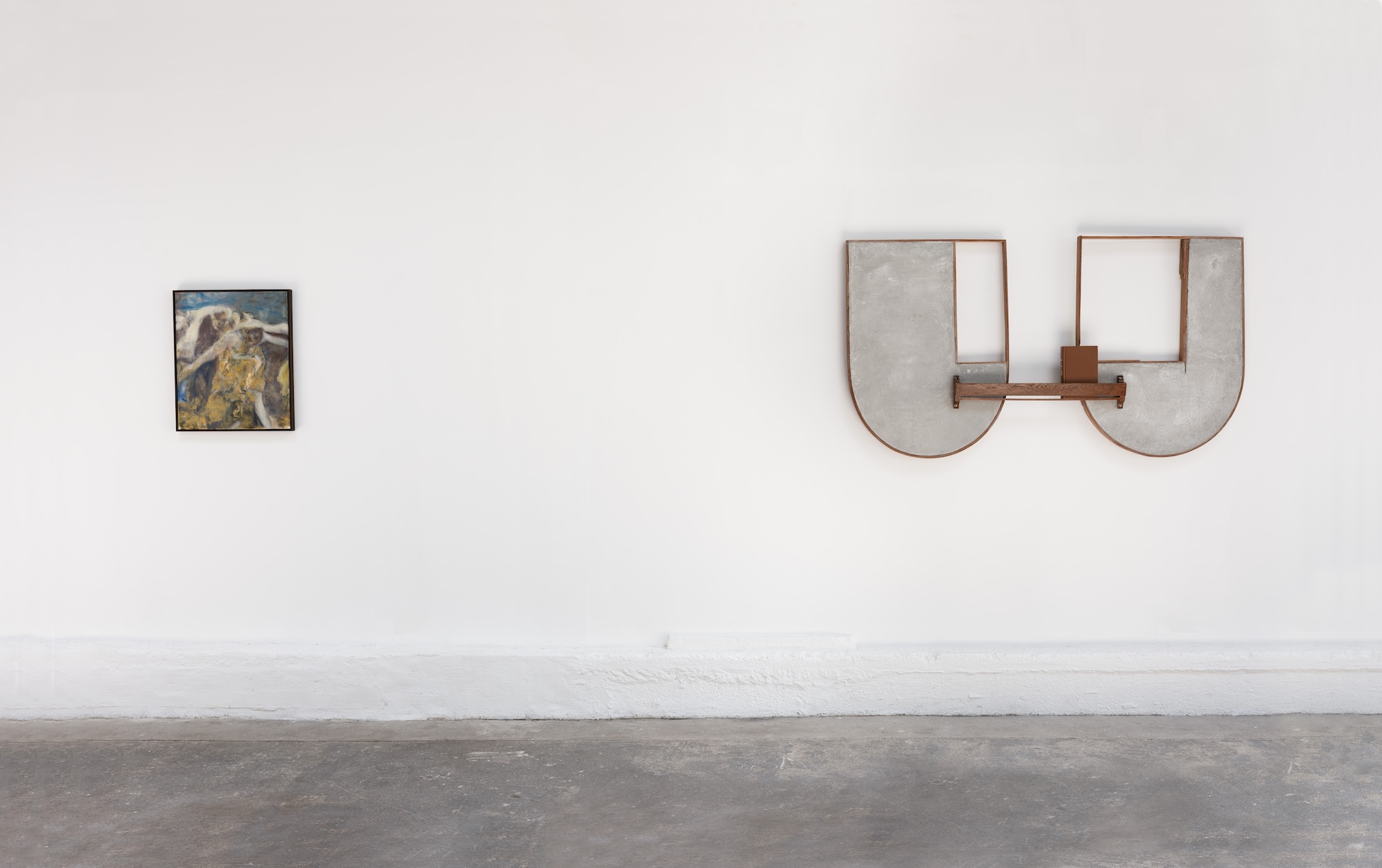
Krista Clark constructs portals to worlds open and closed: windows bright with the white of the gallery wall, inverted doors partially sealed with concrete. In Mother, Daughter, and… (2023), a wooden shelf holding Alice Walker’s womanist prose compilation, In Search of Our Mothers’ Gardens, bridges swooping concrete U’s framed by thin strips of wood. Clark’s oeuvre reveals these U’s as a motif within her corpus of architecturally laden paintings and installations, evoking a doorway into sacred space. This piece is also inspired by Barkley L. Hendricks’ Father, Son, and... (1969), a painting composed of three arching backboard canvases and perspectives of a basketball hoop. Following this amalgamation of the biblical and the everyday, Mother, Daughter, and… reconstitutes these themes into a feminist and industrial ode that is more than the sum of its parts.
Duchamp contended that all paintings are “readymades aided,” given that the tubes of paint used in these “works of assemblage” are themselves manufactured. This exhibit reifies and extends his proposition, highlighting the work of gathering and compositing while challenging the concept of a fixed, prepared material or object—in some cases bringing the manufacturing process to the fore. Through this lens, each of these artists’ works can be encountered as assemblages of varying scales and material processes, bearing residues of what was left out, behind, and within. Their second materials might be the traces we cannot see: the oils wiped from the canvas, the scraps carved to form the grid, the contents of In Search of Our Mothers’ Gardens, the distorted cardboard frame, the unburnt wheat. Together, these works remind us that the otherworldly—the slippage from one way of being to the next—can be accessed through the foundational paradox that material is not inert substance but accumulated process.
Second material is on view at Spencer Brownstone from June 11 to August 14, 2026.