%2C%20dir%20(2).%20Brydie%20O%E2%80%99Connor%20-%201.jpeg)
.webp)

Kern Samuel: “IM” at Derosia
Review
“Bunker” is an apt title for Sandy Williams IV’s solo exhibition at Arcadia University, which coincides with the country’s semiquincentennial—a moment of renewed scrutiny of the nation’s founding myths and promises. The word has varied associations, from survivalist dwellings and military fortifications to the Black Panther Party’s use of sandbags around community buildings for both literal and metaphorical safety from police raids. Williams mobilizes these layered associations to build a space for retreat and reflection. As the exhibition text reads, “Bunkers are the things we hold onto. They are time capsules that preserve something specific about the past, protect us in the present, and prepare us for our worst visions of the future.”
Near the entrance of Spruance Gallery, two screens display eight videos on loop from the Exhaustion Series (2015–26). In each iteration, one of the artist’s friends executes a repetitive activity, continuing until they can no longer do so. These endurance exercises came from the artist’s experience with chemotherapy, when constant waiting—for appointments, infusions, results—changed their relationship to time. In the videos, the activities range from treading water, a physical task charged with a sense of impending peril, to playing a single note on the saxophone until fatigue sets in. In Exhaustion III (Geoffrey Culburtson smashes rocks), the performer pounds a rock with a sledgehammer for fifteen minutes, slowly chipping away while lending a rhythmic pinging, ultimately leaving the rock in shards. With the subject’s face and body obscured by protective gear, the act is reminiscent of the African American folktale of John Henry. In it, John Henry seeks to outwork and outmuscle a mechanized drill by hand. He achieves this goal, but it kills him.
From this introductory installation, an angular pathway guides visitors to an enclave housing Elephant (2026), a timer embedded in the wall that is engineered to reset to zero upon the touch of a visitor, preserving only the duration since the previous encounter. Where the Exhaustion Series registers time through sustained physical effort, Elephant measures time relationally. Each visitor encounters the increment of time since the last touch of an unseen predecessor, creating a temporal chain of tactile engagement that mobilizes interplay between presence and absence. In turn, Williams prompts questions of how fleeting moments of contact accumulate and enter shared archives. Instead of the past as a fixed phenomenon, the installation evokes the instability of collective memory as shaped by successive exchanges.
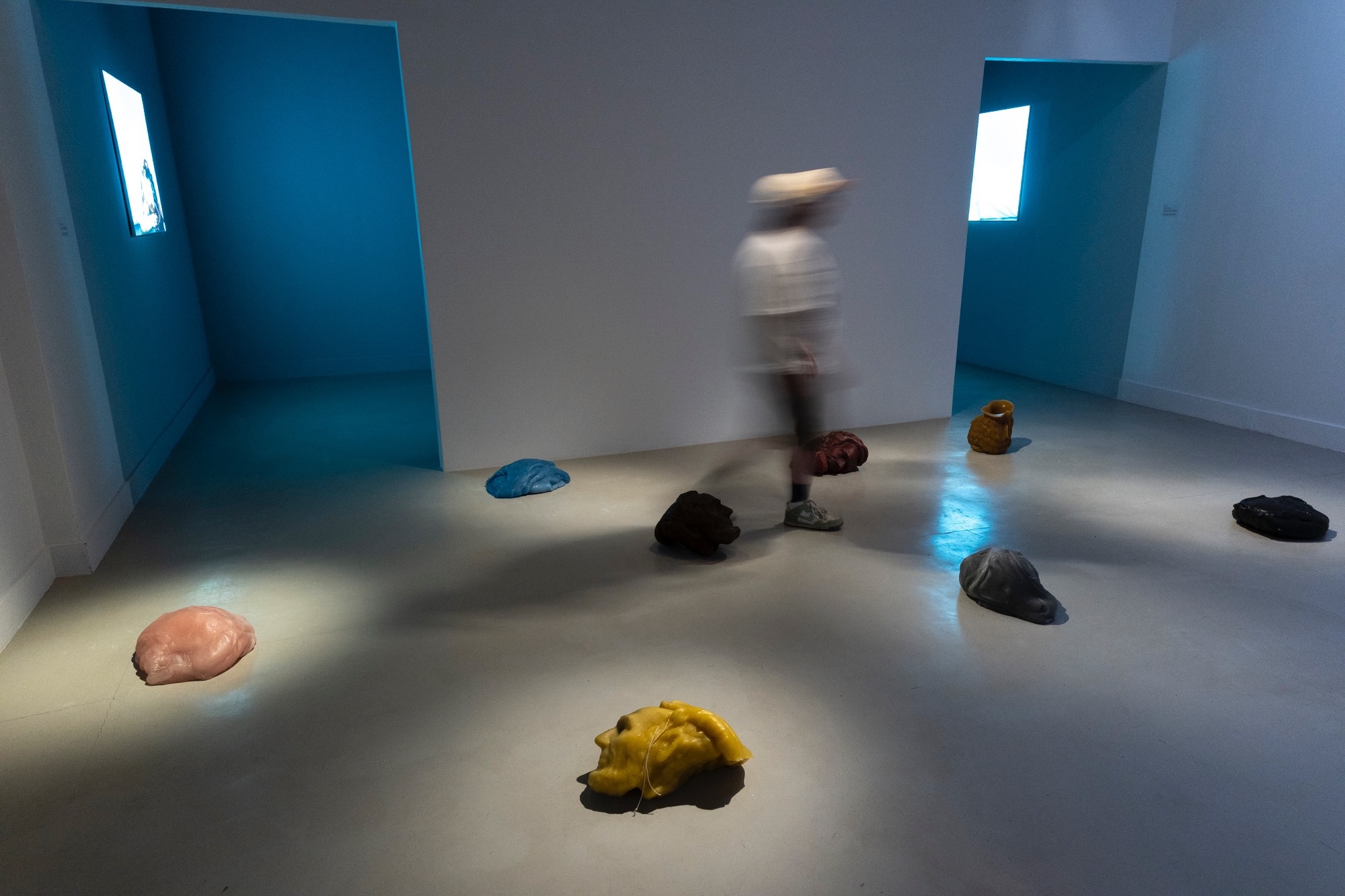
Williams further probes the reliability of memory with Life Mask, Death Mask (Lincoln) (2026): a series of wax-cast heads modeled after Abraham Lincoln in varied states of deterioration. These palpably fragile sculptures, scattered across the floor, recall a minefield in requiring careful navigation of the dimly lit space. The positioning of the sculptures on the ground—instead of a plinth or pedestal—subverts honorific expectations of an important, overdetermined subject. The presence of wicks in these semi-melted forms reframes the sculptures as candles misshapen through use, decayed by design. Together, the heads, some unrecognizable, stage both the making and unmaking of monuments, suggesting the metaphorical fragility of patriotic ideals. Here, Williams underscores the extent to which narratives about Lincoln in particular are as elastic as melting wax. The installation simultaneously evokes the endless circulation of this president’s image as a representation of national identity, mobilizing the tendency for reproduction to strip historical figures of specificity. In turn, the artist invites reconsideration of Lincoln’s status as a figurehead of national unity and progress. After all, many historians have suggested that his opposition to slavery was incentivized by economic and political concerns rather than by a commitment to racial equality.1
Williams shifts attention to the future with the sketches displayed on the walls surrounding these melted forms. Given that sketches are rarely included in formal presentations, the artist shows a commitment to speculation as part of art-making as a mode of survival. The Underground Dreams series (2026) consists of graphite drawings of imagined sculptures, specifically a series of manhole covers in the shape of clouds. Williams references Ralph Ellison’s Invisible Man (1952) by posing the question of “what it means to dream underground.” This generative imagery is displayed next to more triggering symbols for Black people: The Speed of a Bullet (Study) I and II (2026) imagine the flight path of a bullet. The zig-zagging motif in the drawings is reminiscent of Harold Edgerton’s Bullet Through Apple (1964), a famous composition of a bullet caught in medias res in a revolutionary moment for high-speed flash photography. In Williams’s drawings, as in Edgerton’s less abstract photograph, the bullet appears decontextualized.

Displayed at the furthest end of the gallery, Exhaustion X (2026)—a more recent iteration of the Exhaustion Series—acknowledges collective fatigue, inviting viewers to pause in darkness. The artist appears on one channel, seemingly gazing at their partner, Carmen Baltzar, who appears on the opposite channel, looking back toward the artist. Their expressions—Sandy’s intermittent smiles and Carmen’s unflinching stare—barely change over the two hours and twenty-one minutes. Williams’s tattoos include the words “Not Fragile” alongside two clock icons that rise and fall with each breath. Against the stillness of the two figures, these subtle movements become a reminder of the slow but steady passage of time in the context of this intense exchange, a prolonged relational encounter. This installation, much like Elephant, makes time feel simultaneously expansive and intimate, asking what it means to remain present with another person for an extended period.
The exhibition as a whole amounts to a mediation on the passage of time through a formal language of repetition. The sound of heartbeats serves as a kind of metronome, linking the space through a rhythm that is visceral, reiterating time as an embodied phenomenon. Simultaneously, Bunker denies fantasies of the stability of history: the stopwatch resets to zero, wax monuments appear to deteriorate, and subjects repeat actions until they can no longer continue. Williams effectively portrays endurance as an active process tied to memory, both recalling fragmented recollections and imagining uncertain futures. What do we preserve when the structures we have inherited—like national myths, monuments, and histories—have fractured? What forms of refuge might be built from these fragments?
Bunker is on view at Arcadia University’s Spruance Gallery until December 6, 2026.
1 Vorenberg, Michael. "Abraham Lincoln and the Politics of Black Colonization." Journal of the Abraham Lincoln Association 14, no. 2 (1993): 22-45.