
.webp)

Unsympathetic Clock: In Conversation with TJ Shin
Interview
Climbing the steep stairs to the third floor of an apartment in a historic district in Midtown East, one enters a distinct sound environment. The faint hum of a running motor, a disorienting mixture of artificial and human voices, and footsteps moving across the old hardwood floor form a disjunctive yet oddly soothing music of their own. Around two central machine-based installations, ink drawings and art tools—and the occasional presence of a resident cat—fill this studio-cum-exhibition space with warmth and a lived-in quality.
Curated by musicologist Rui Hara, The Cave of Tongues presents new works by Japanese artists Nana Shimomura and Chiku Komiya that explore the generative potential of deconstructed, misunderstood, or otherwise illegible language. The exhibition places two faltering “language machines” within an intimate social environment, asking: Can relationships be built, sustained, and expanded through broken language? At a time when we increasingly rely on machines to produce standardized, “correct” forms of language, can machines also make room for poetic failure? When language falters, leaks, or stutters, what exactly gets communicated?
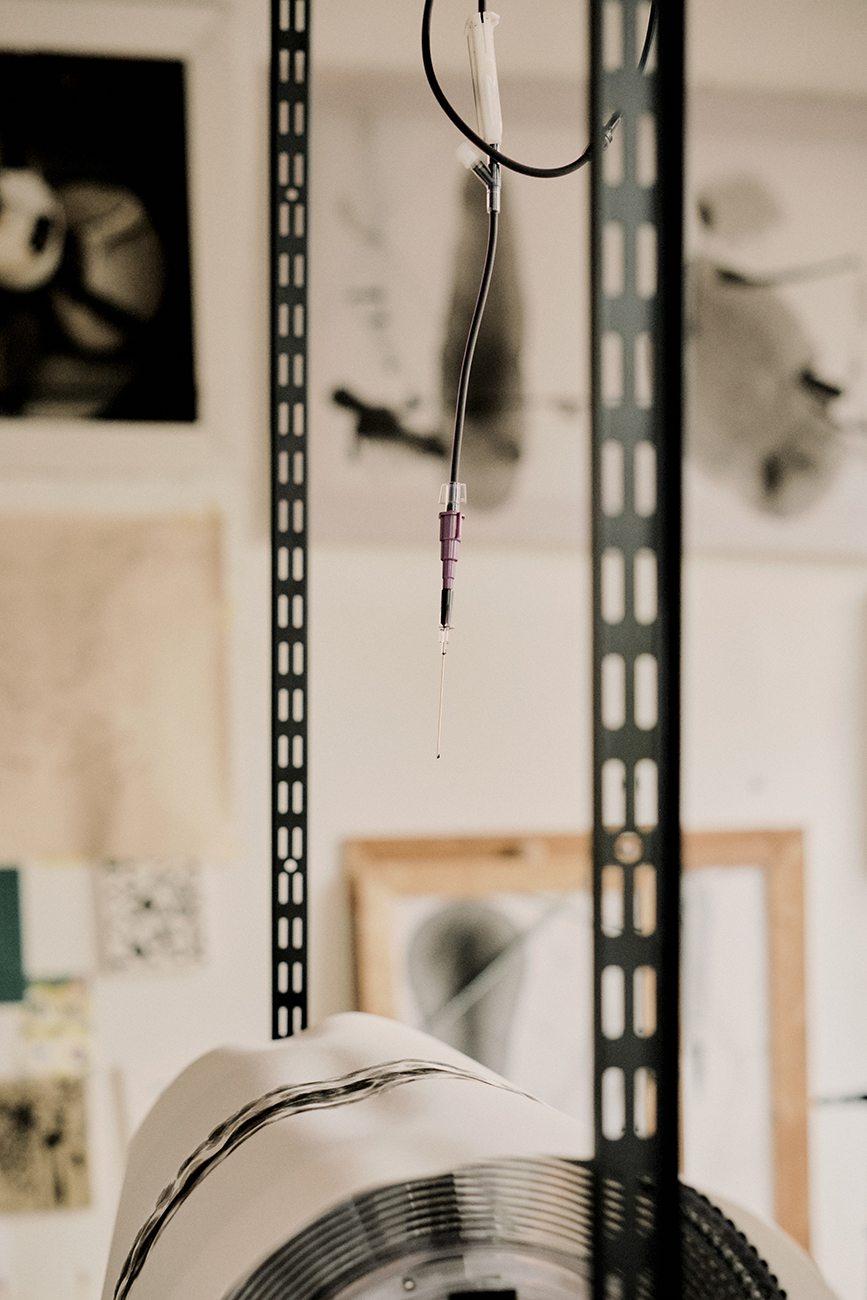
In the center of the exhibition space, Shimomura’s A Time Drop (2026) instantly draws the viewer’s attention. From a needle attached to an IV bag hung close to the ceiling, ink slowly drips onto a continuously rolling sheet of paper. With the paper loosely wound around a running motor, the drops of ink form irregular lines made up of discrete dots. Yet the crux of the piece lies less in the image that it produces than in the theater of tension and release that accompanies the falling ink: the gradual formation of a dark bubble at the tip of the needle, the time spent waiting for it to drop, the anticipation that builds in the room, and then the sudden release—before the process starts all over again.
Evoking physical vulnerability and dependence on external support, the IV bag stands in for an absent body that unsettles assumptions about artistic agency. It also transforms ink into a kind of vital fluid that sustains the work, not by means of the artist’s autonomous action but through the contingencies of gravity and delay. If ink and paper allude to calligraphic practice—the basis of Shimomura’s broader body of work—the makeshift machine replaces writing with abstract and unpredictable mark-making, while displacing the gestural control, expressive authority, and legibility typically associated with classical calligraphy. Instead of clear communication, writing gives way to leakage and irregular notation that unfold over time, holding the audience in suspense.
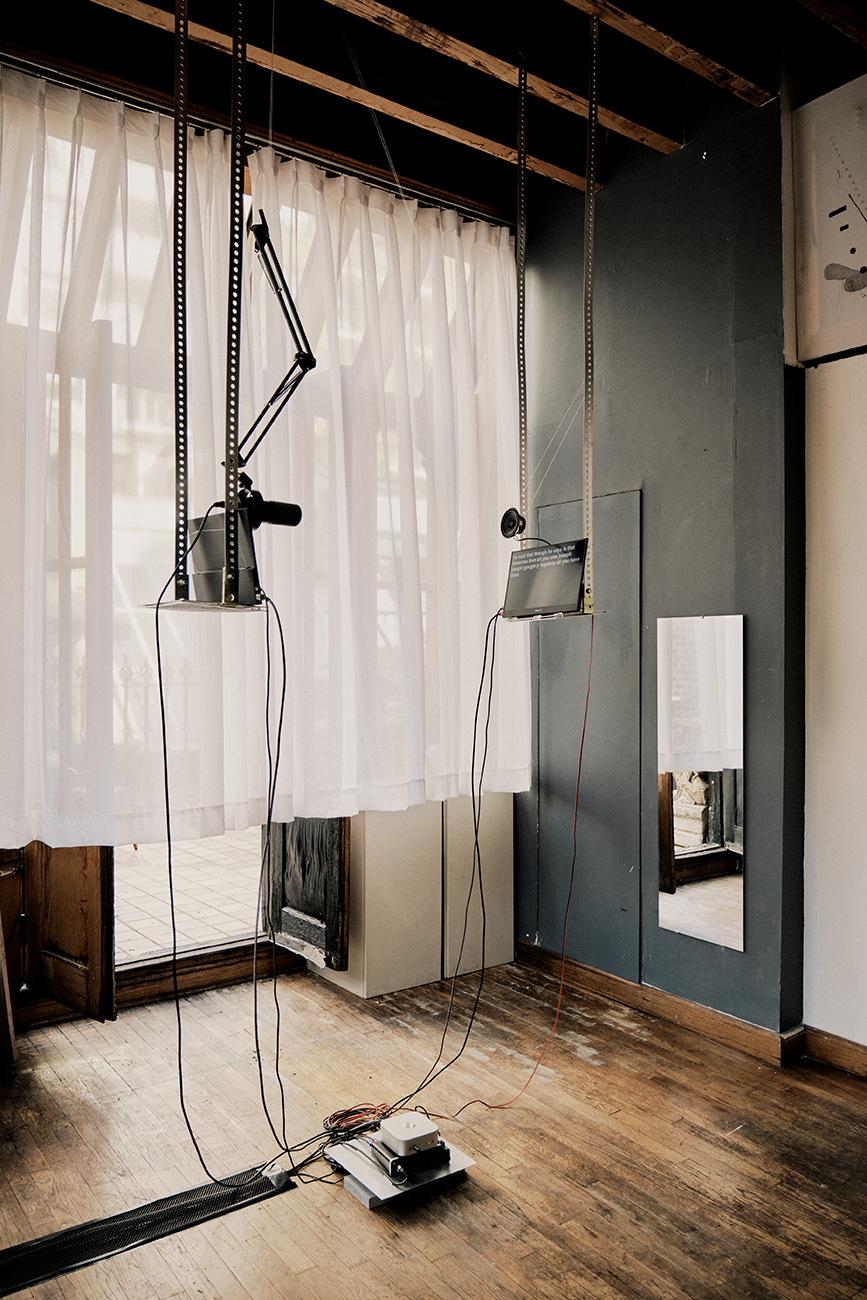
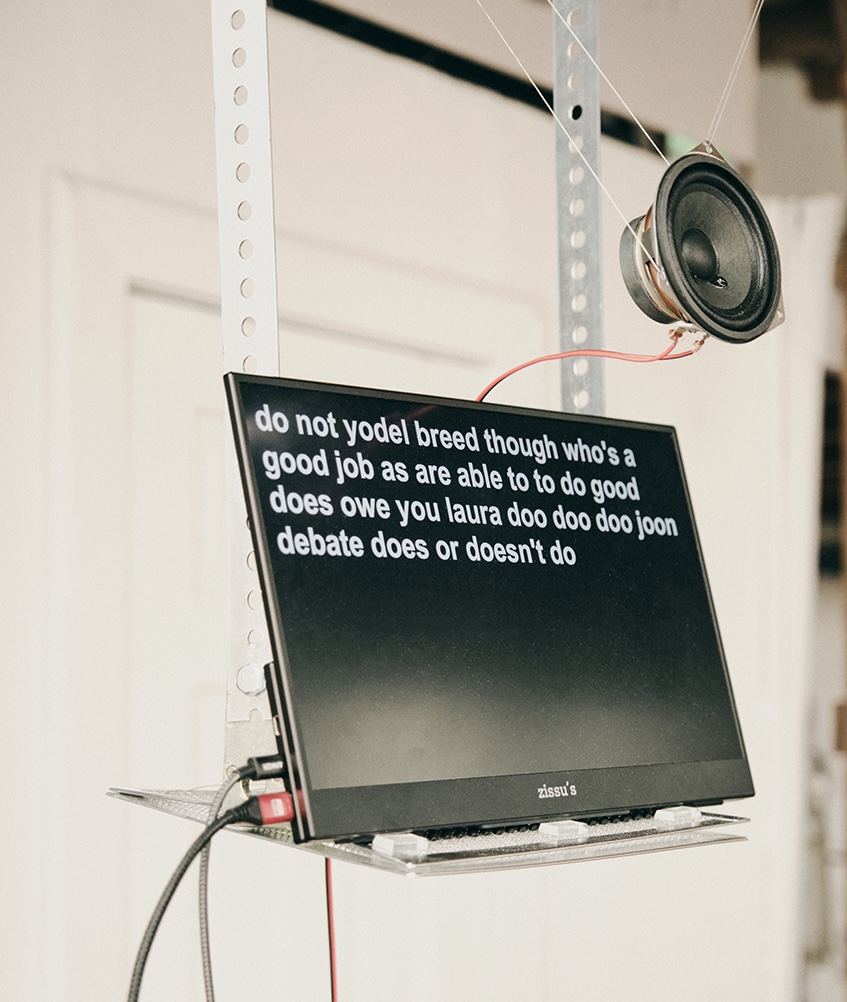
Komiya’s And then, O-ren Knew ’twas a Song (2024/26) stages a more explicit instance of linguistic instability. The title refers to “O-ren,” one of Apple’s Japanese-language text-to-speech voices. Two monitors, one fitted with a microphone and the other with a speaker, are suspended from the ceiling and connected by cables to a Mac mini on the floor. The piece is set up as a feedback loop between a machine speaking English with a Japanese accent and a transcription program calibrated to understand standard English speech, so that misheard text is constantly fed back into the speaking machine. Occasionally, the listening program also picks up the ambient chatter of visitors, altering the words and pitch of the machine’s voice. As the system continues to listen, mishear, speak, and then listen again, the resulting stutters and distorted sentences continuously evolve through the recursive process and in relation to the room. In this way, the machine produces what the artist has called its own “poetry” or “songs.”
Beyond recognizing creative potential in moments of flawed communication, Komiya’s work further raises the question of hierarchy in communication. What kinds of speech are recognized as clear and transparent, and what kinds are returned as errors or noise? It is precisely this asymmetry—between speech marked as foreign and thus unintelligible, and a normative language environment that privileges certain ways of speaking over others—that constitutes O-ren’s poetry.
Such questions feel particularly charged at a time when technology and politics are increasingly pushing language toward standardization. Advances in areas such as machine translation, autocorrect, and predictive text promise smoother and more efficient communication between individuals and across differences, while the recent Executive Order declaring English as the official language of the United States posits unified language as a national goal. Against this narrowing of what counts as acceptable speech, Shimomura’s deconstructive writing machine and Komiya’s mismatched speaker and listener set machines up to fail, in order to examine what might be preserved when language remains incoherent and dispersed.
Pidgins and creoles, having developed among groups without a common native language, demonstrate how forms of speech can come into being from contact, become stable, generate their own structures of meaning, and sustain social relations. Dialects and vernaculars have likewise served as vehicles through which communities have formed and strengthened. The unstable languages one encounters in The Cave of Tongues may not cohere into a unified system of communication. What emerges, instead, is something close to a Glissantian ethics of opacity—a mode of coexistence in which relation remains possible without requiring fluency or complete understanding.
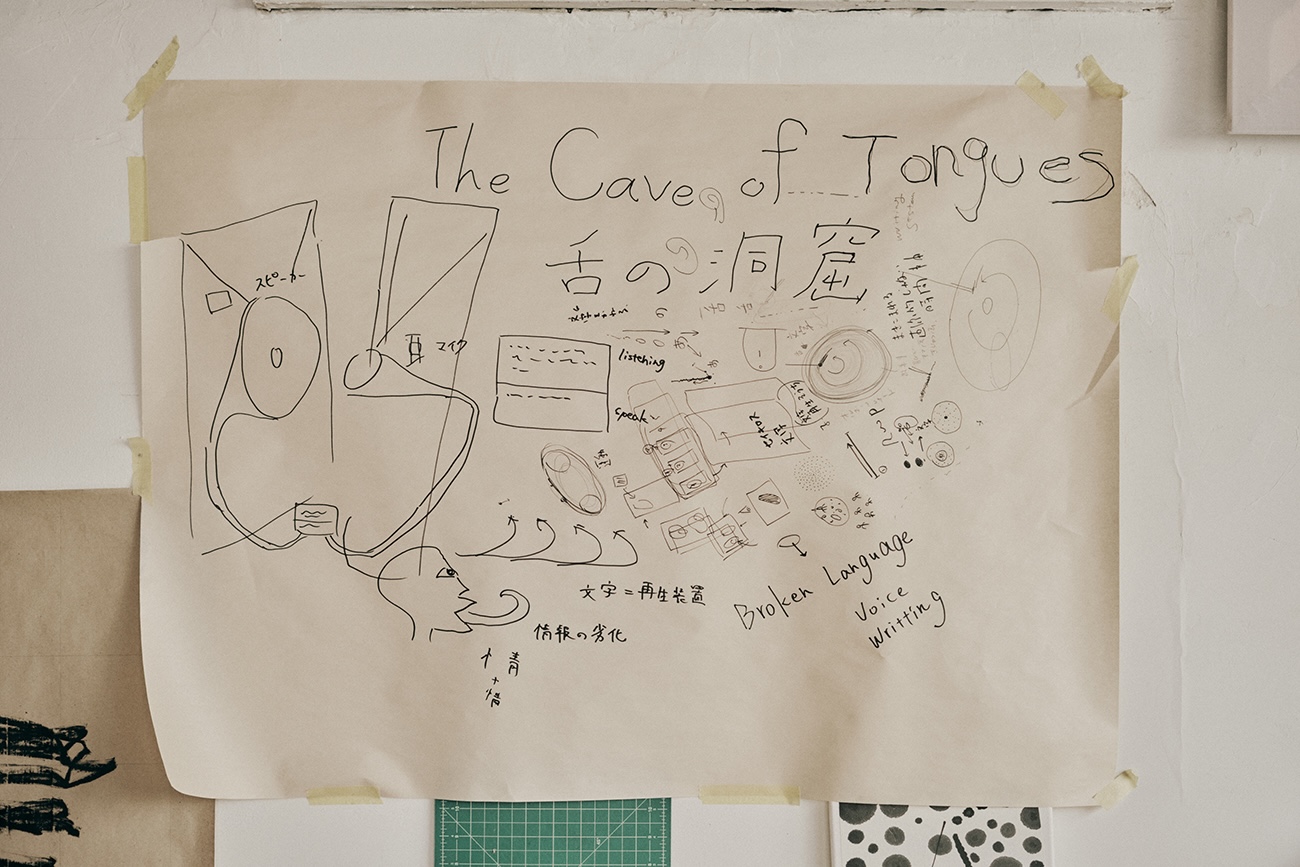
Set in a sunlit studio whose address is deliberately withheld from the public, the exhibition admits only a small number of visitors at a time by appointment. In this intimate setting, visitors are drawn into conversation and become more attentive to the presence of one another as well as the machine interlocutors, even if only briefly. In this sense, “cave” does not signal darkness or isolation but instead stands for a kind of temporary shelter, where imperfect communication can serve as a ground for new kinds of relationships. Yet how far can an ethics and aesthetics of faltering language survive outside the cave—in spaces where legible and fluent communication, often tied to marketability, so often dictates what becomes visible and valued? The sequestered, private space in which The Cave of Tongues takes place suggests that breakdowns in language can thrive here precisely because they are temporarily held apart from the pressures that would otherwise discipline or absorb them.
The Cave of Tongues was on view between June 15 and July 17, 2026. The exhibition is curated by Rui Hara and features artists Nana Shimomura and Chiku Komiya.