

FotoFocus Biennial 2026
Review
Anyone who has waited anxiously for a USCIS decision knows how uncertainty settles into the body—contracted muscles, an aching back, shallow breath. In the weeks surrounding Brazil’s presidential election and the US midterms, political anticipation gave these private sensations a collective dimension. Memories of Disruption, a program of five works presented at BRIC on November 7, 2026, as part of The Immigrant Artist Biennial, investigated how bodies absorb such pressures and how sound, moving images, and shared space might alter the way they are felt. Curated by Sofia Thiệu D’Amico and Sanna Almajedi, the program moved between the sensory traces of violence and migration and the possibility of experiencing them alongside others.
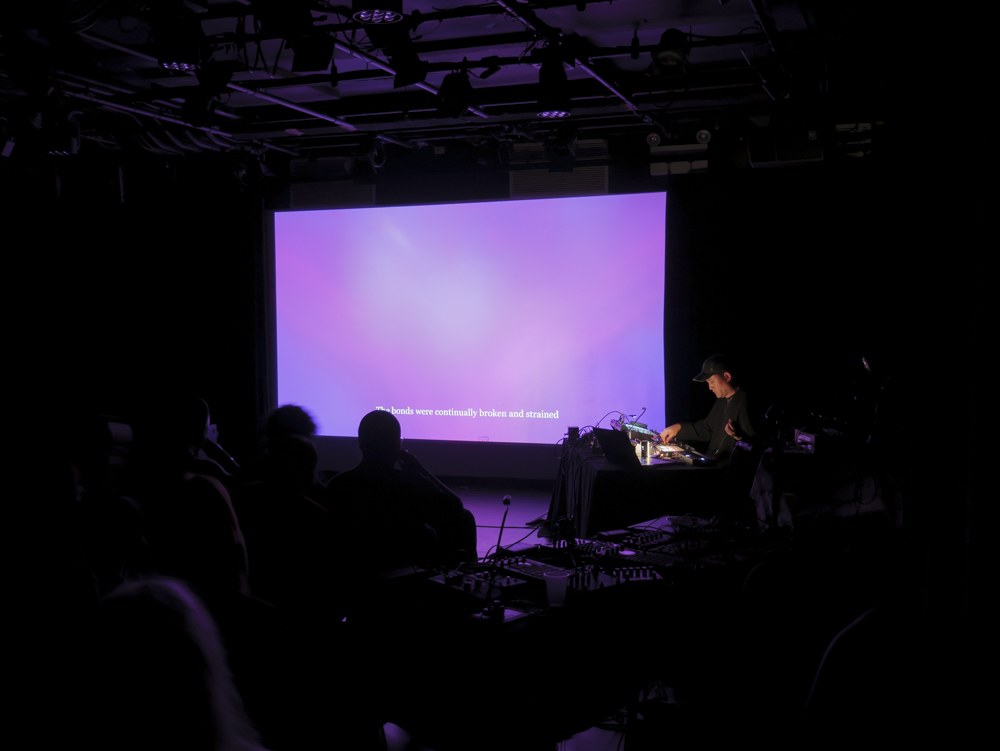
Three of the works were sonic performances in which the artists’ bodies activated their devices or instruments. In Absence full / Absence glow, Andrew Yong Hoon Lee projected an essay film about language and migration, mixing found footage with his own images. It was accompanied by a soundtrack created live at the mixing desk. Lee described the piece as a tone poem.
Lita Vinueza, in turn, presented Sonic Liberation Devices, framed as a series about Palestinian cultural expression. She played with collaborators Máti Flores and Wauce, using DIY instruments such as a microphone made from a vintage telephone handset, resting on a keffiyeh.

And opening the night, Ivana Dama performed the striking Siren Disk. Wearing big glasses and a long black coat, Dama looked like a scientist as she took her place at the foot of the stoop, in front of her sonic sculpture: a massive silver barrel with a disk on top. Dama’s device was inspired by Opelt's disks, fabricated by Rudolph Koenig, in Paris, around 1865. Dama repurposed a lab instrument and used science as a site of experimentation on how the body perceives sound and is affected by it. Whenever the artist operated the metal tools that released nitrogen over the disk, it produced a sound similar to a siren.
The very controlled and ascetic setup of the performance contrasted with the inner turmoil it created. Dama was a child when she had to hide in a shelter during NATO’s 1999 bombing of Belgrade. In conversation with curator Almajedi, published in the biennial’s catalog, Dama remembered the experience of hearing the sirens twenty years later at a memorial: “My body recognized the sound before I could consciously process it.” While this performance did not literally reproduce the sirens she heard as a child, it evoked the memory and trauma of living through such an event. The sounds were interrupted—too long, too short, meshed with other frequencies.
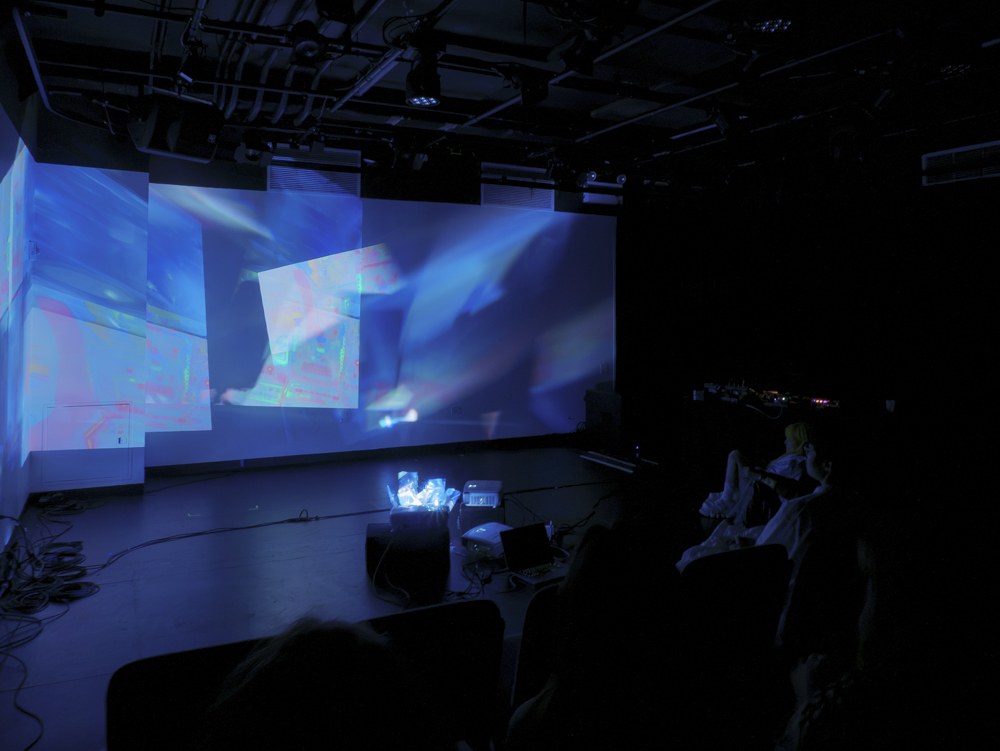
The audience then moved to the Artist Studio, a dark room where two works built on projection were presented. For Ocean Terminal, Simon Liu and Charlie Perez-Tlatenchi created a multimedia installation. Two projectors pointed to different walls, expanding the traditional horizontal window-shaped viewing format of the film into a space. A rotating apparatus with a dozen lenses refracted the light in different directions, rendering a carousel of shards. The visual fragmentation materialized the shattered memory of the artists’ places of origin: Hong Kong and Sunset Park.
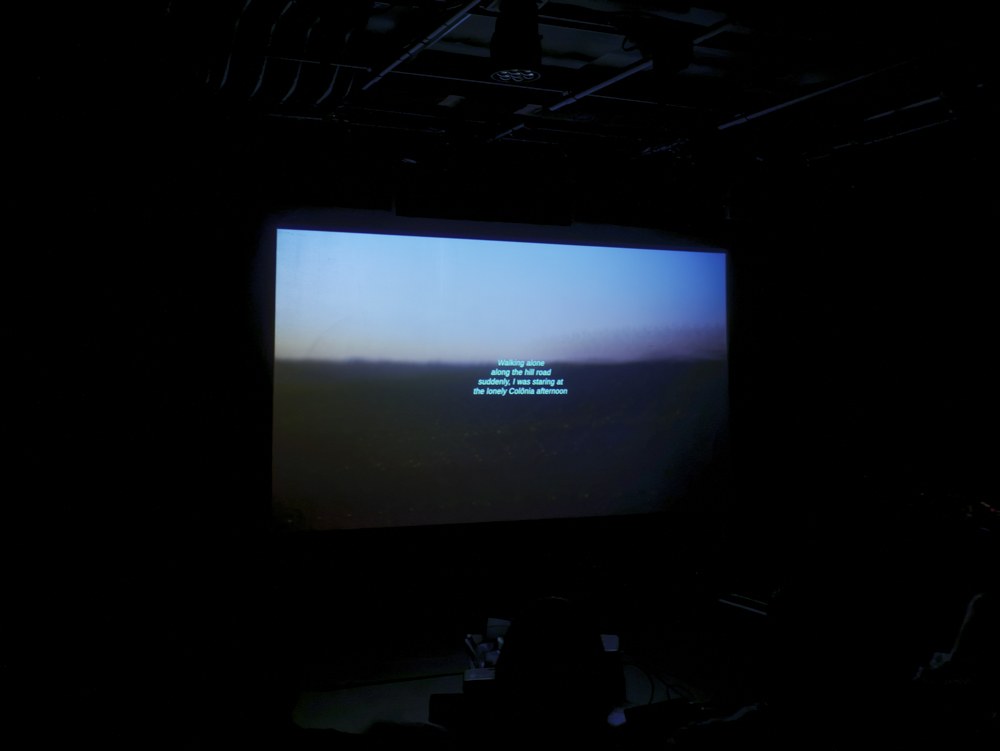
As in Dama’s performance, where history is converted into matter (air), in Maya Jeffereis’s Land of Eternal Summer (2025), history takes material form in the film itself. Jeffereis’s work opened with the sound of the sea, and the 16mm images seemed drenched. The artist explained that she brought seawater from Rio de Janeiro in travel-sized bottles: “I soaked my film in this seawater until the emulsion began to lift and the archival images started to disintegrate.” She sought to bring physical elements from the two countries the piece addresses, Brazil and Japan. Seawater, açaí, coffee, and different plants were used to develop it, making the work not just a documentary about migration between the two countries, but also, in and of itself, a filmic art-object that embodies migration.
Coffee tied the Japanese Brazilian story to the history of slavery. After slavery was abolished through the Golden Law (Lei Áurea) in 1888, facing labor shortages, coffee plantations increasingly turned to immigrant labor, initially from Europe and, beginning in 1908, from Japan. This connection manifested in the film's soundscape. We heard a Japanese narration over images of Brazil, with the sound of ships mixed with percussion played on instruments of Afro-Brazilian origin.
The night’s works recalled the question that Deleuze asked in the face of Spinoza’s writings: “What can a body do?” Does the body exist only to be subjected to the horrors of history? Or can it also reshape inheritance as the water slowly carves the stone?
In both Siren Disk and Land of Eternal Summer, the body was not history’s victim, but its keeper and an agent of transmutation. As with the sirens, which were not reproductions but resignified memories of the past, the body submitted history to a remaking.
When the artist's physical body was extended into the body of the work, a space opened where personal pain was transformed into something that could hold and carry collective pain. Dama’s personal memory became a communal sonic sharing, and the immigrant legacy Jeffereis drew on turned into a film made with the matter of two lands. The embodiment of the ordeal amplified our ability to face it. The biennial’s choice to hold events instead of exhibitions gathered bodies together in the same space so they could feel alongside each other.
So, what can a body do? In times of political earthquakes and extended periods of uncertainty for immigrants, Memories of Disruption pointed toward a kind of solidarity. If my experience is a shared experience, then it must be taken seriously. It is in such spaces that we can escape isolation and imagine other futures for us all.
Memories of Disruption took place at BRIC on November 7th as part of the third edition of The Immigrant Artist Biennial. It was curated by Sanna Almajedi and Sofia Thiệu D'Amico.