
.webp)

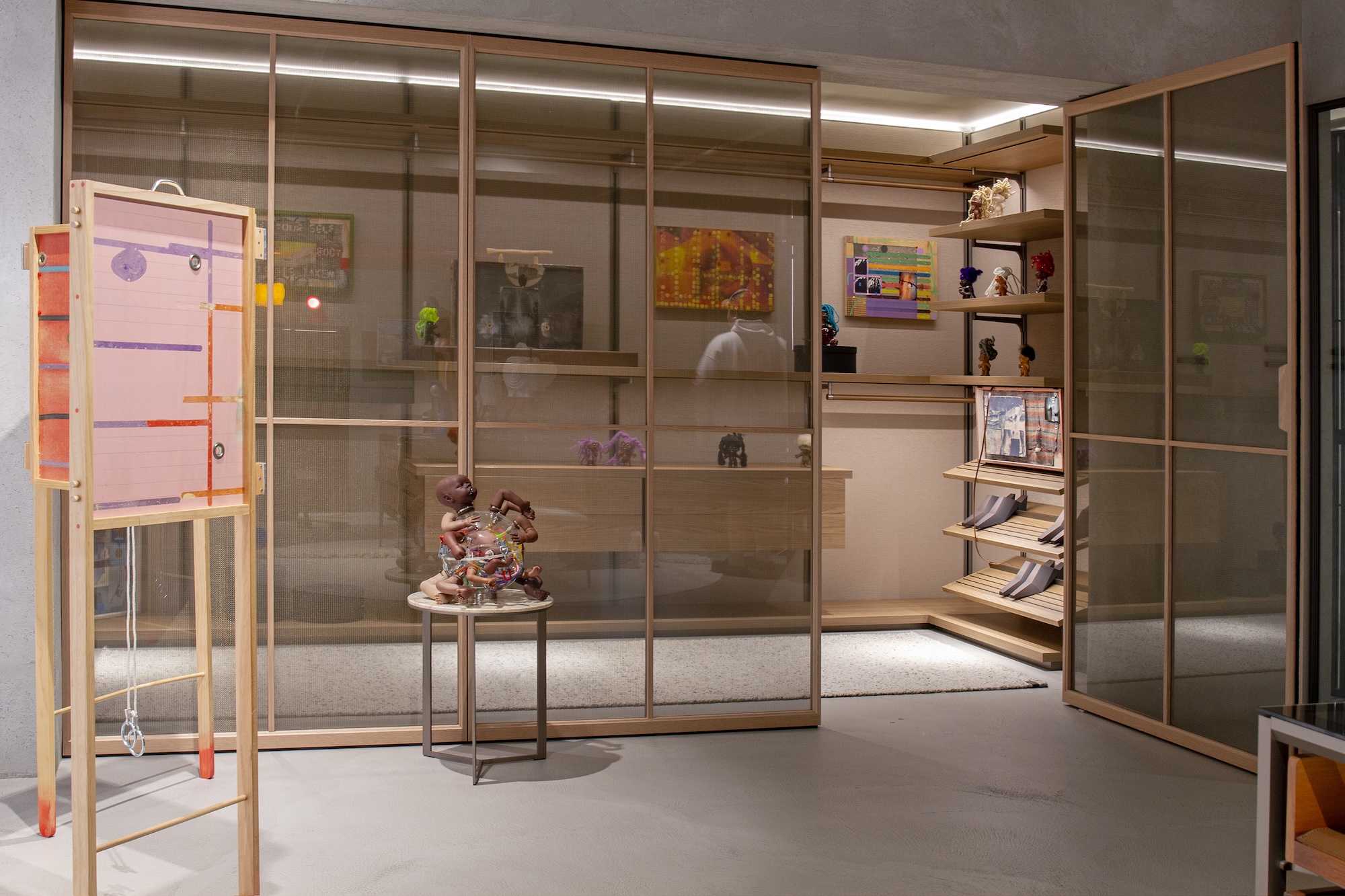
SPLIT LEVEL 2026
Review

“KAFKA! KAFKA! KAFKA!” he screams, and she stops.
“Kafka” is the safe word used by a character named Dave in Ayanna Dozier’s new, unreleased short film Forgetting You is Like Breathing Water, a work that oscillates between devastating, BDSM show-and-tell, and a pointed meditation on consent and heartache. I watched a digital transfer from the 16mm color footage that Dozier shot on her laptop. She works explicitly and exclusively on film with an almost fetishistic reverence for the material. We sit together at a desk in a shared workspace populated by photographers and designers.
It isn’t a traditional studio, but it functions just as well: a space to meet with focus and intention. It’s a useful reminder that artists always find a way. In a city like New York, there is no single model for sustaining a practice. For Dozier, this arrangement makes particular sense. She moves constantly between print labs across the city and frequently crosses state lines to teach at Amherst, where she is an Assistant Professor of Film Studies in the Department of Communication. She tells me that this Greenpoint building, which is now home mainly to artist studios, has lived many lives: it once housed erotic film sets, as well as a portion of Jay Z’s 2004 music video “99 Problems”. Dozier sits, somehow, squarely within those histories: an artist committed to examining sex and the interior lives of sex workers while maintaining a rigorous engagement with pop culture.
Back to the film, which is in consideration for upcoming festivals and runs about seventeen minutes. Dozier presses play. I catch her scrolling on her phone, seemingly disinterested in watching me watch her work. It’s oddly comforting. Being observed while observing can be exhausting; the distance feels generous.

The film follows Selene, a dominatrix who meets one of her regular clients—a professor—for a session. Dave has the look of a classic Brooklyn white boy: tall, lanky, faintly sheepish. He arrives seeking punishment and redemption. But he cannot handle the encounter. “Kafka! Kafka! Kafka!” he pleads, halting the scene. In a reversal, he confesses something shocking to Selene. The balance shifts again; Selene responds with comfort and escalation. The scene is painful to watch. Trespass meets trespass.
When the film ends, I feel uneasy. I asked Dozier if she would be open to feedback. She responds quickly: “I’ll take an observation. I don’t want feedback, as the film is complete.” The distinction puzzles me, but I try. I told her the final scene felt long. She smiles. “Did you feel time?” she asks. “Yes,” I said. And that was precisely the point. She wants “viewers to be held in the moment of violation” and forced to sit within its aftermath. Her command as a filmmaker is astonishing; she manipulates duration with the precision of a dominatrix. My gaze and my time fall under her control.
Eventually, I come back to my body and ask what she’s working on next. She opens folders filled with digitized prints that will be used as the basis for a series of leather sex swings featuring photographs printed directly onto the leather. For this new work, Dozier invites subjects to spend extended time in bed. Using entire rolls of 16mm film, she generates still images from prolonged moving-image sessions. Participants are encouraged to be aimless. Some nap, some yap. Some play games while others sext their lovers. Dozier documents it all. Here, time is returned to the sitter. I can’t help but read this generosity as an offering. A correction to history’s long tradition wherein people who are treated as objects of desire are also stripped of agency.
Before we leave, Dozier tells me she’d like to make my portrait on expired Polaroid film. I oblige. Watching her set up the 4x5 viewfinder camera is its own performance. I stare into the lens, smiling slightly—amused, a little shaken. I help her tidy up, and we head toward the train together. We talk about music. Just before I can properly say goodbye, she runs ahead to catch the next train. At the top of the stairs, she turns back, blows me a kiss, and disappears underground.

Lily Hyon’s Park Slope studio is crowded with a parade of silicone feet. They stand on shelves among the stacks of handcrafted pink Agent Provocateur lingerie boxes and unoccupied high heels, on the floor near the curing flex foam yellow bricks, still packed in shoes in boxes (but not, technically, shoeboxes). The feet are a diverse bunch; some bare, some tattooed, one a deep red. They come from the same source—they were all cast from Hyon’s own feet, although not at the same time—but have left her behind to embrace their own personalities.
As she sips from her boba, Hyon points out the bricks, the foundation of Desire Path (2026), a sculptural homage to The Wizard of Oz, depicting a ruby-shod foot taking a step on a snippet of yellow brick road. The film is deeply important to Hyon; the first thing she asks me is if I’ve seen Wild at Heart by David Lynch. Desire Path is an explicit Oz reference, but she explains that it has informed the rest of her work, too. Dorothy’s shoes are her borrowed power, and Hyon sees that replicated in the six-inch Louboutins her great aunt wore to work as a hair stylist every day. “It's more than the economic value of it,” the artist tells me as she carefully positions a heeled foot over a silicone cigarette. “It's the fetish value of these things. [Heels] symbolize ambition, power, agency," she states.
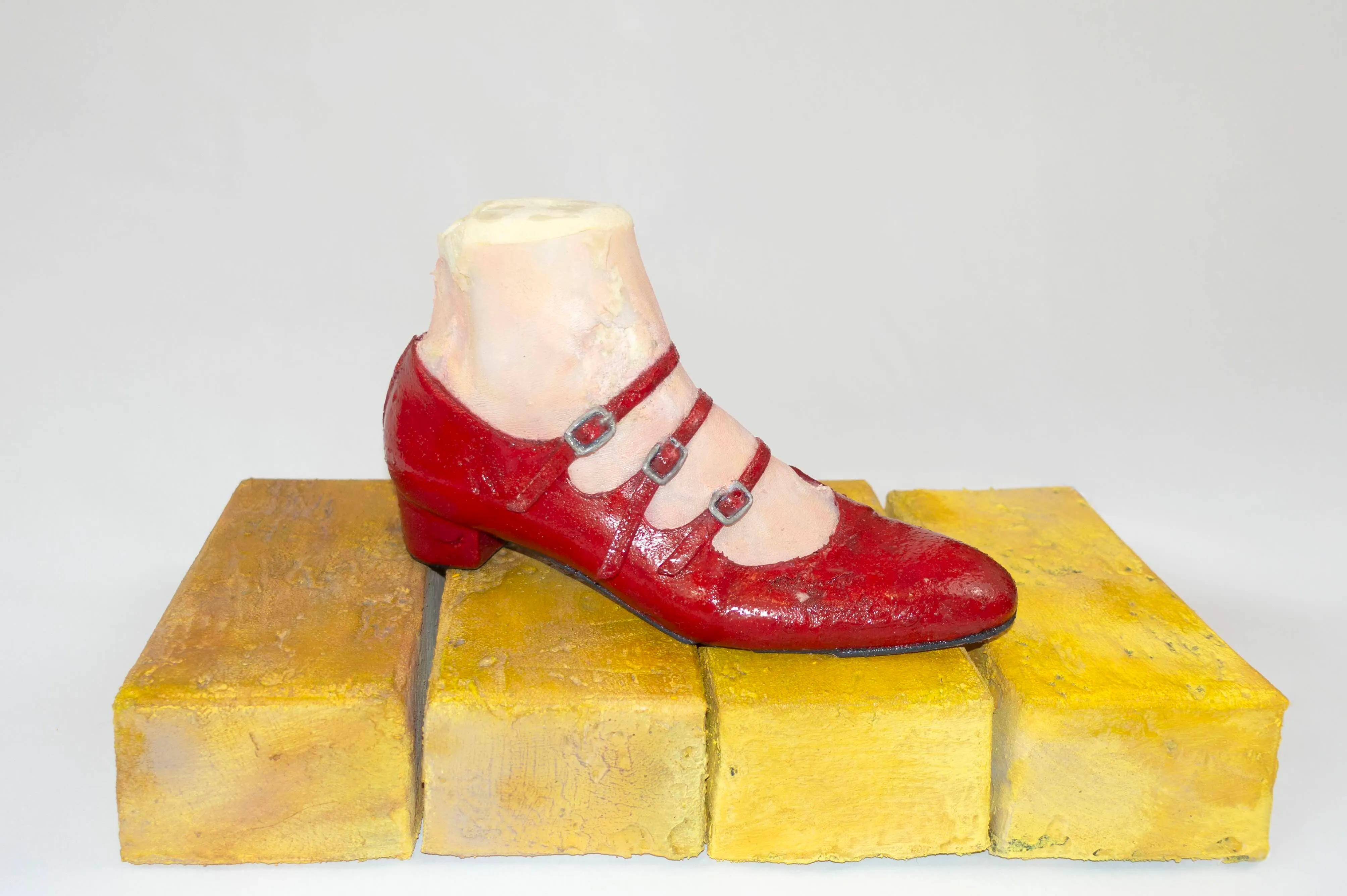
Hyon has come to terms with fetish being essential to her work. Her feet are not severed from a body, and they’re not sex objects in and of themselves, but they are products of violence and eroticism. Intro (2025) models a “Loyal”-tattooed foot with a pair of black underwear, conjuring an ironically disloyal woman putting herself back together after a quickie. The feet in Hyon’s work are dirty and used, discarded like, perhaps, all women. “No matter how they’re dressed or what they look like, they’re all dirty and grimy. It doesn’t matter. We’re still going to be treated this way.”
Not that she doesn’t have fun—Desire Path is a piece Hyon describes as “ha-ha funny,” as playful, and that’s the tone of her studio. Calico Critters live next to lacy socks. To Hyon, feet may be a metonym for the female body, but they’re also abject in an undeniably silly way. Like Louboutins, there’s something sort of tacky about feet, and desire emerges from that tackiness. “At the end of the day,” she says, “it’s kind of just feet.”
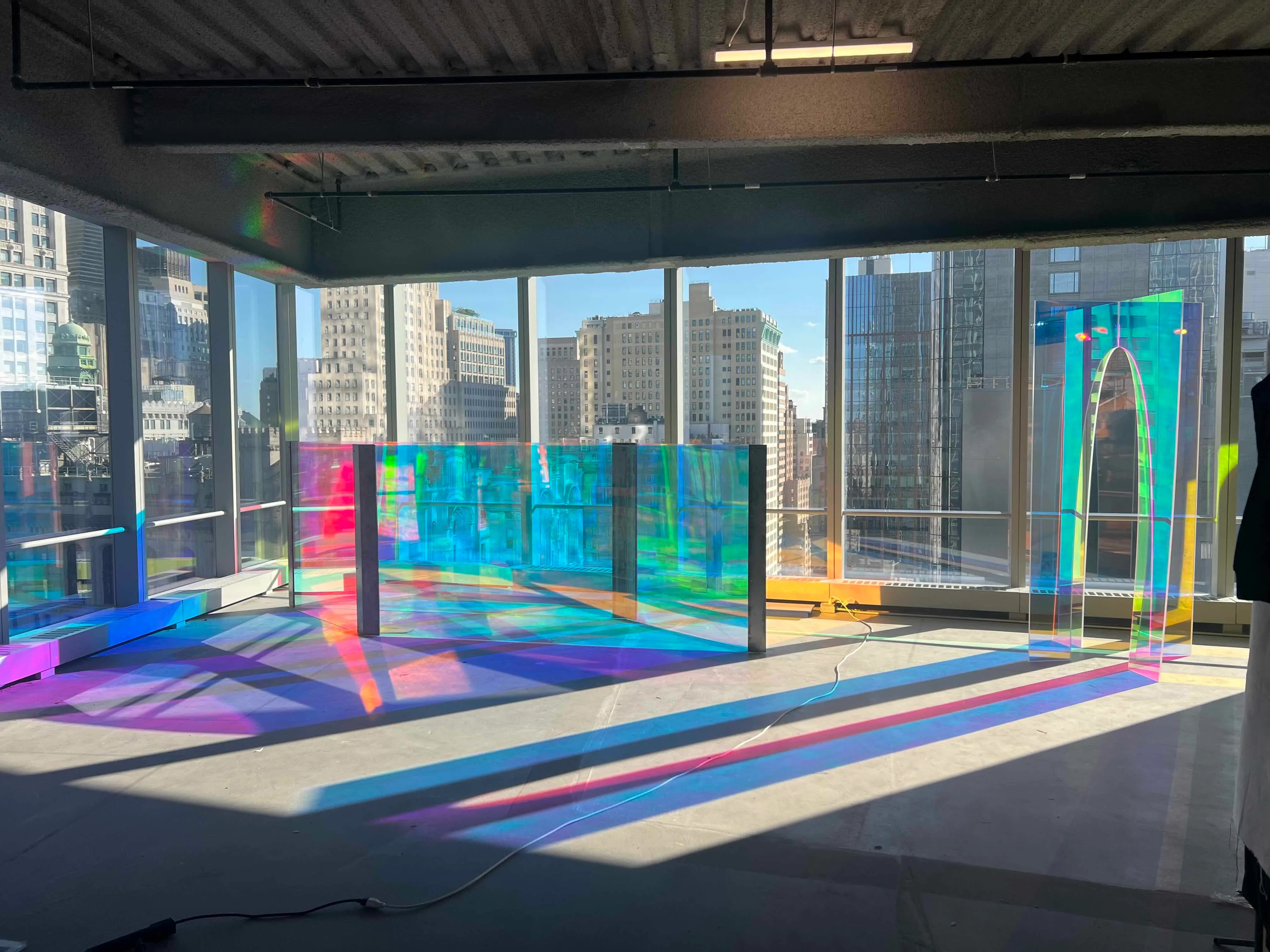
Encased in glass on two sides, Marcus Manganni’s corner studio on the twenty-eighth floor of the World Trade Center is primed for his ongoing exploration of the conditions of visibility within surveillance systems. The transparent walls of his space at Silver Art Projects embed his architectural installations within a reciprocal field of seeing and being seen. Manganni has staged an environment in which reflections and refractions ricochet across glass and acrylic surfaces, shifting as the light changes throughout the day. Revolver (2025), a vertical structure of intersecting arches, is positioned in the corner next to Panoptes (2023), a semi-circular form that evokes the panopticon and casts a complete rainbow spectrum on the floor. As Manganni explains, his use of salvaged materials is crucial, given how these remnants—the excesses of luxury construction projects like those underway just outside the window in the Financial District—materially bind the resulting work to the very infrastructures it critiques.
A blue-tinted, reflective wall-based work distills Manganni’s approach in channeling lived experience toward systemic analysis. Spurred by his realization that a Brutalist window at an Ivy League institution was identical to a federal prison window in Colorado, Bluest (2024) underscores a shared architectural logic of discipline underpinning elite education and mass incarceration. By converting the window into a mirror, substituting transparency with reflectivity, Manganni renders tangible the viewer’s implication within such systems. Throughout his practice, Manganni approaches architecture not as a neutral backdrop but as a social framework, an active mechanism through which institutional power is organized and sustained.
Manganni approaches light not solely as a subject or an effect, but as a primary medium. He recalls his experience in solitary confinement, when a narrow shaft of daylight functioned as his only connection to the outside. Improvising with a potato chip bag, he began to explore sun-mapping, a technique that continues to compel his practice. While light might function as a metaphysical lifeline, it is also a mechanism of control, a precondition of surveillance. Manganni also notes the trauma of artificial lights that are never turned off within carceral systems. He channels this complexity of light as an infrastructural force—simultaneously generative and coercive—most recently with a series of wall-based works that incorporate artificial lighting on surgical gauze canvases, recalling Alberto Burri.
Manganni speaks of his process in Lynchian terms as a pursuit of “big fish.” He likens drawing and collaging to “push-ups” that keep his “overactive brain” in motion. On the concrete floor, he has arranged six obsolescent smartphones next to an image taken from a bodega's “wall of shame” of alleged shoplifters, which has been stripped of any identifying features, rendering the figure anonymous. Nearby, a black-and-white drawing reduces surveillance equipment to an amorphous, barely legible silhouette. Here, abstraction is a strategy of resistance rather than withdrawal. Manganni complicates demands for visibility and legibility, a tactic that reappears across his studio. Transparency gives way to distortion, reflection, and fragmentation, producing a perceptual field in which no single position holds. To look is to be folded into what is seen.
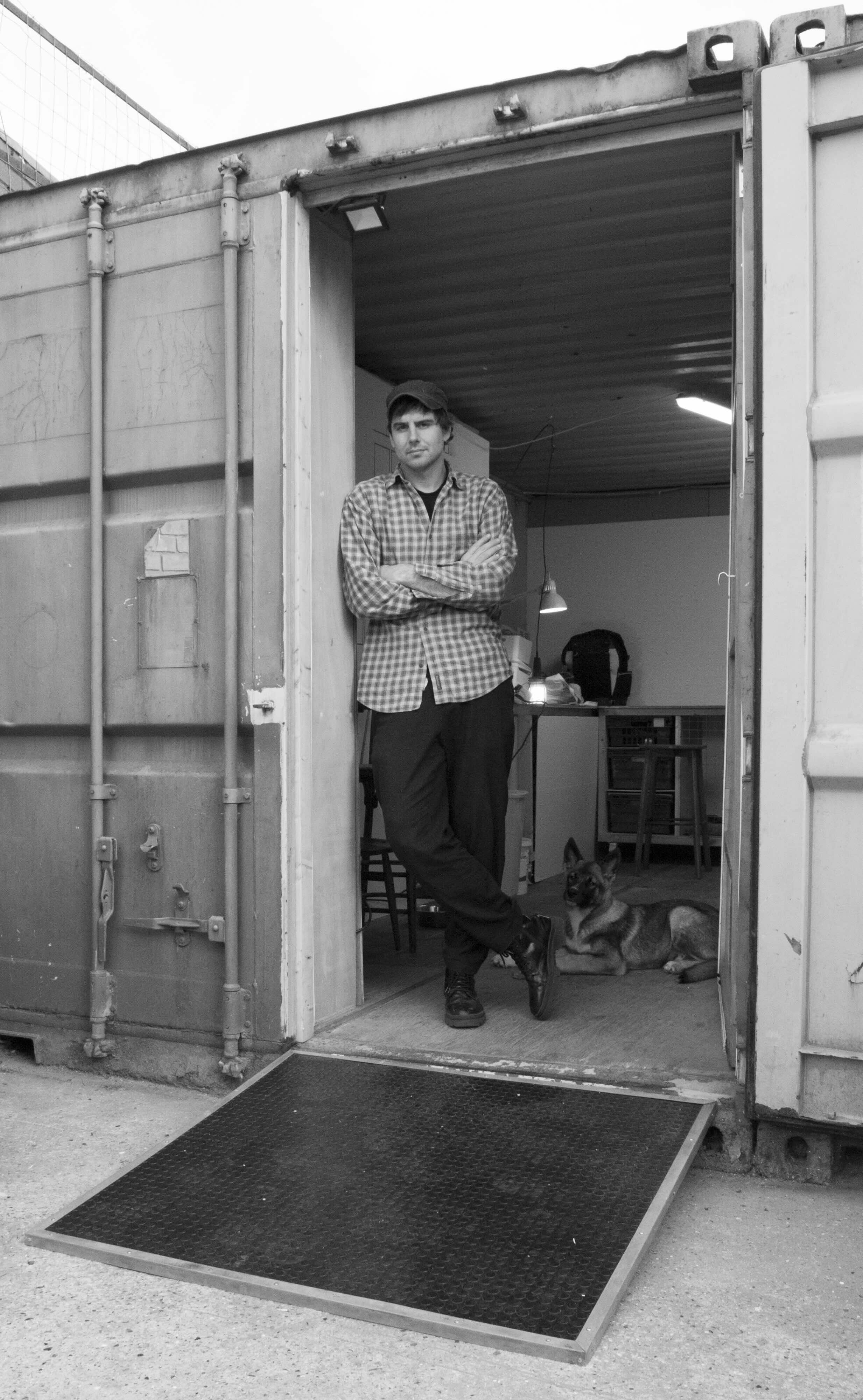
Massimiliano Gottardi used to have a more traditional studio in London. He’s since left the space, opting instead for a shipping container just a stone’s throw from his flat in the eastern part of the city. “I'm now really enjoying it, because the summer is coming slowly," he tells me. "There is space outside, and my practice is sometimes dusty. Sometimes I use fire. So it's quite useful to have an outside space in London.” There’s an eclectic energy within the complex that mimics his work. He’s the only visual artist there. He has been accompanied by the likes of a bike mechanic, a musician, a gardener, and other workers who inhabit the nearby containers.
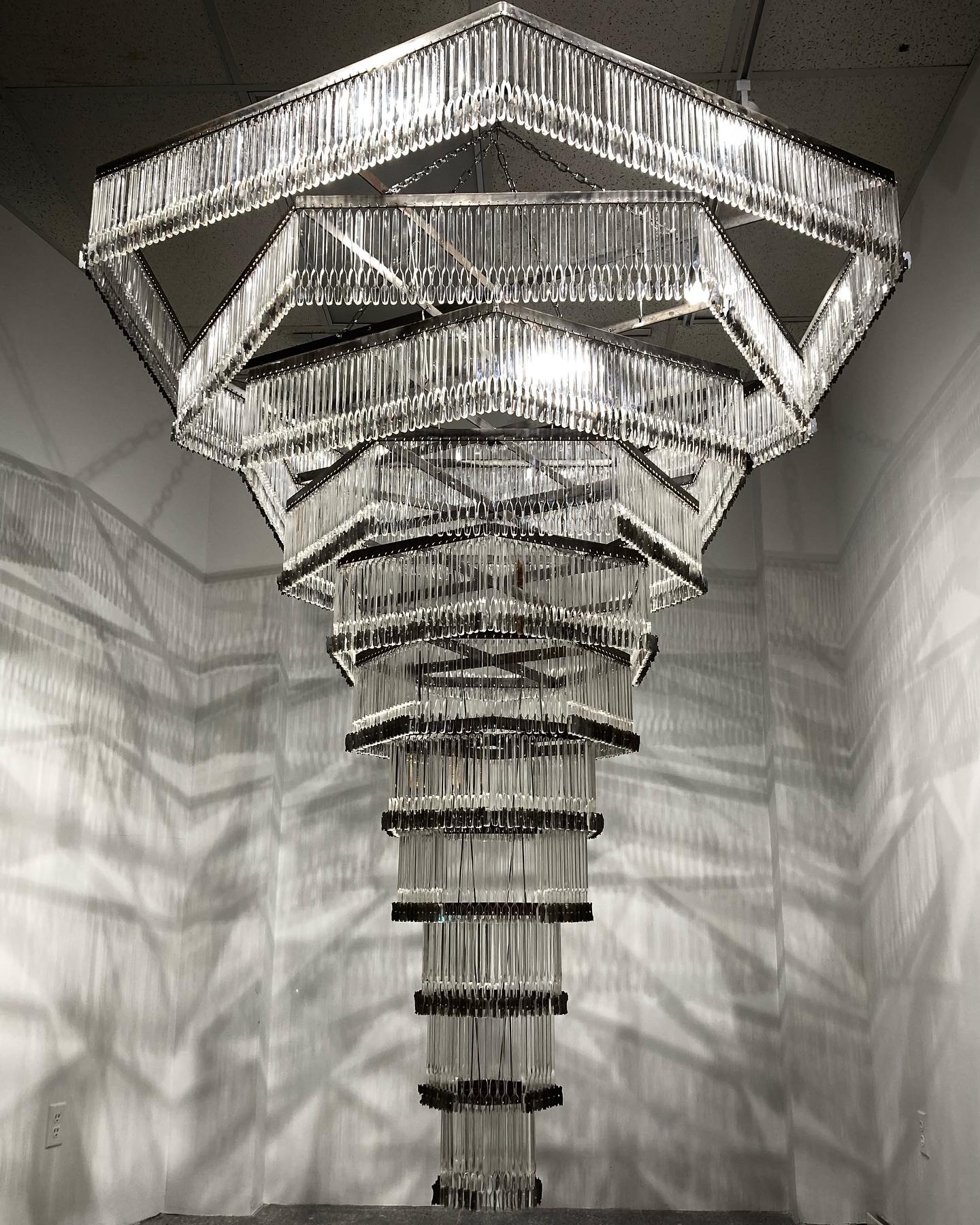
He notes that the reutilized block is more in line with his work as he pivots more into a contemporary art practice of ephemeral sculptures built with found materials. His work is burnt wood that makes up a dodecahedron. There is a sofa bed tacked vertically to a wall. Technologies past suspended in water. Previously a painter, this manufacturing-heavy practice in sculpture is one that Gottardi has grown an affection for. Speaking about his recent show, Zero, at Alice Amati Gallery, he touches on the glass vessels of Mirages I, Mirages II, and Mirages III (all 2026). “The aquarium is made by me. I just ordered the glass: the thing that I cannot do. But I mainly try to learn through the process. I really enjoy making the stuff by myself, so it's an occasion to learn new things every time.” His practice becomes an ongoing interrogation of material and form.

Although wood has consistently been a staple in his work, he’s recently found an interest in wax. As his previous show dealt with themes of the future, prediction, and inevitability, he found the significance of the material intriguing. “The use of the candle in religion, the idea of a candle as a wish or as a way of prayer as well,” he says, listing all the auspicious ways wax has revealed itself. “But there is also something in the use of wax that speaks of transformation; it brings to mind foundry sculpture, when the material, still in wax, can be molded, corrected, and refined. It's a state of precarity of the form that really fascinates me. In parallel, it suggests the continuous, small yet significant transformations in how we perceive the world, shaped by everyday discoveries and experiences.”
Gottardi has been in London for about a decade. Before this, he was living in the water-bound city of Venice, Italy, where he was trained and practiced as a painter. On moving to London and going back for a graduate degree at the Royal Academy in London, Gottardi notes a changing relationship to material. “Working with found objects, reconfiguring them or incorporating them into my compositions, allows me to engage fluidly between the work and the world around me. It also becomes a kind of disappearance of my touch, something that I’ve found increasingly, and strangely, intriguing over the years.”
.webp)
There is something special about a studio visit with an artist you haven’t really seen in years. Phoebus Osborne and I have known each other since 2016. We fell out of touch, but over the past six months, we found ourselves repeatedly breathing the same air. After months of passing hugs and kind smiles, Osborne and I finally set a date to meet at his studio in Long Island City. Central to Osborne's practice is an ongoing fascination with materials that regulate visibility. Privacy film is a recurring medium, but this inquiry extends to welding curtains, bleach, and etching, all deployed to manipulate what can be seen and what remains withheld.
The first series we discuss consists of printed images that are symmetrical and almost psychedelic: mirrored photographs of cave walls. These prints are stills from a video Phoebus presented at Parent Company just a few months ago, now translated into an editioned print series. Visibility is key here: caves are spaces defined by the absence of light, yet we see their interior here. Phoebus traces his interest in caves to an affinity for the underbelly and even to the anus, which he describes as “the black sun” of the body—that which we don’t often see. Looking closer, I begin to register bodily symmetries within the compositions.
Though these are editioned prints, a simple reproduction felt incomplete. Osborne recounts a moment of revelation that occurred, as many revelations do, in the bathroom. In a kind of flow state (literally pissing), he noticed a bottle of bleach. The solution became obvious: each photograph would be hand-painted with bleach, stripping pigment away and introducing another layer of erasure. The result is startling. Denatured color blooms across the surface like engulfing flames. The images are changed, simultaneously exposed and obscured. It is also a clever conceptual maneuver: each edition is now singular.

We turn to a large photographic print on the wall that initially reads as a conventional landscape with rocks, brush, and lush green vegetation. A strip of orange welding curtain has been placed across one section. The saturated hue produces a vibrating high-visibility effect, bringing into focus two figures otherwise camouflaged by the green foliage. Phoebus’s partner and a friend lie tenderly among the brush, sheltered and hidden. I can’t help but read the work as a meditation on cruising, on queer refuge within wild nature.
When I ask where the photograph was taken, Osborne gestures toward another print nearby. It depicts a petrified forest in upstate New York. He points out grooves in the earth, negative spaces where ancient tree roots once existed. Nature’s own lost-wax casting. Out of the corner of my eye, I notice a volleyball-sized rock resting on the studio floor. Phoebus guides me toward it. The rock is jagged, deeply textured. It, too, comes from the petrified forest. He admitted to feeling complicated, even guilty, about removing it, but described it as a keepsake of deep time. Strange forms emerge from its surface: fossil traces of creatures from another world. Resting atop the rock is a circular pane of etched glass, larger than a human head. On closer inspection, the etched image depicts the very scene from the photograph: two figures reclining together, protected by foliage. Phoebus has installed a privacy film on the reverse side, creating a subtle mirror.
I’ve often felt like looking at art is akin to time travel or astral projecting. As I peer into the work, into this moment of queer shelter affixed atop ancient geology, I see myself reflected back. Connected, strangely and tenderly, to a lineage that feels both displaced and anchored: of faggotry, odd biology, survival, and love.
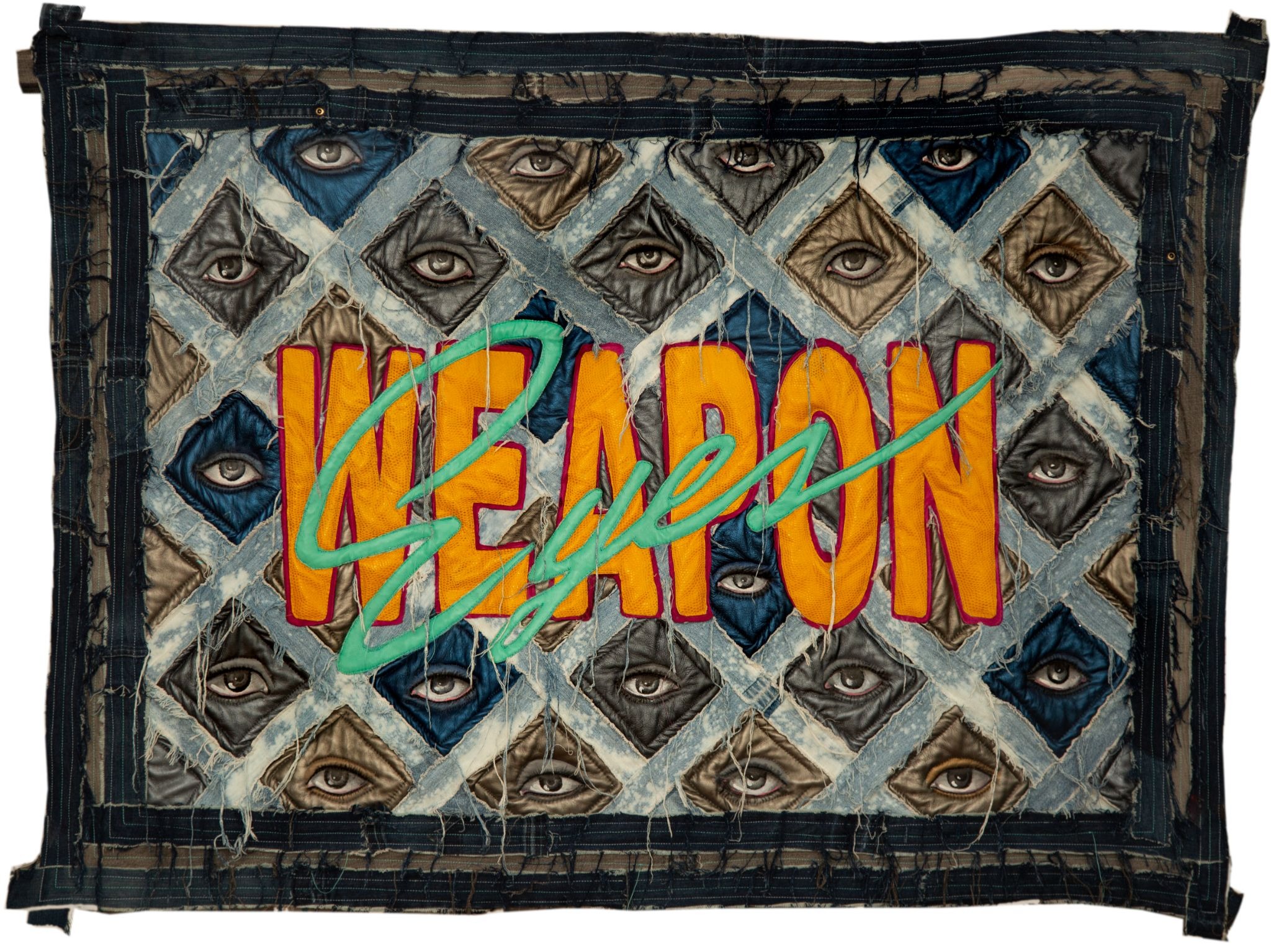
A little ironically, a little unsettling, a funeral parlor anchors a bustling corner of Cobble Hill, Brooklyn. Four floors above, out of view and out of register, is Aaron Cobbett’s studio, part apartment, part lived archive. He has been there for twenty-six years, long enough for the walls to accumulate more than time.
Stepping in, the space reeks of glamour. Every surface is lined with vintage C prints, a dense record of Cobbett’s photography, work that helped define the visual language of New York nightlife in the 1980s and 90s. Placed throughout are his obelisk sculptures, which he began in 2023 during the Governor’s Island Lower Manhattan Cultural Council residency. They don’t just punctuate the rooms; they act as conduits, holding the charge of decades of relationships, chosen family, love, transformation, and the ongoing grief of lives lost to the AIDS crisis.
The apartment, saturated with the colors of his photographs, cheetah print curtains, and layered textiles, is immaculate. You wouldn’t guess that, rolled and stacked with precision, thousands of feet of meticulously stitched quilts are waiting to be unfurled. Cobbett turned to textiles in 2016, a deliberate pivot away from photography. The shift reads less like a departure, more like a distillation, translating ideas he had been circling for years into material form.
The attention is catching up to the new work. Last year, he mounted a solo presentation at ArtCrawl Harlem House on Governors Island, curated by Ulysses Williams. Currently, his solo show, Semi-Precious, is on view at KAPOW, a Lower East Side gallery helmed by Kourosh Mahboubian.
One of his formative quilts, a portrait homage to Cobbett’s best friend, Shawn, isn’t on view, but its presence is felt, tracing through all the work as a quiet constant. A massive, wall-dominating piece, Trees (2026), is installed in a cylindrical form, wrapping around what Cobbett calls the “emerald city.” The gesture shifts the quilt from surface to structure. Light catches on the faceted, glittering fabric elements, echoing the obelisk forms, so the work doesn’t just hang, it accumulates and redistributes energy.
What emerges across the exhibition is insistence. Cobbett refuses to let his history settle into something fixed. Instead, he folds the memory of Shawn into the present, alongside decades of photography that shaped a generation and a punk sensibility. Cobbett’s textiles don’t illustrate a scene—they compress it, along with intimacy, excess, loss, and survival, into surfaces that continue to pulse.

At the threshold of Gi (Ginny) Huo’s solo exhibition spinnerets, a 16mm film flickers: a spider morphs into a cluster of leaves, then returns to its original form. In Huo’s exhibition at HESSE FLATOW, curated by Jess Wilcox, the spider becomes a structuring metaphor for tension—both predator and prey, tethered and airborne, fragile and unyielding—pointing to systems of power and survival that repeat across histories. It weaves webs that trap, but it also releases and drifts. This oscillation between opposing forces becomes a method through which Huo threads together histories, materials, and images without fixing them in place.
The title spinnerets refers to the organ through which a spider produces silk. For Huo, this point of origin is also one of dispersal and departure. In addition to weaving webs, spiders travel vast distances, carried by forces they cannot fully control, through a process known as ballooning, Huo tells me. Suspended midair, the spider hovers between agency and surrender: a small body tied into larger systems, where intimate scale meets expansive forces. Spiders balloon to escape predators, avoid crowding, and repopulate elsewhere. This movement suggests a broader condition of displacement, where bodies are carried into new environments and adapt in ways that make return uncertain or impossible.
Huo connects the drifting spider to the “balloon wars” between North and South Korea, in which leaflets were dropped across the border. References to personal and historical contexts surface through abstraction and indirection, held within the work’s shifting forms rather than a fixed narrative. Visibility and concealment serve as both protection and risk, echoing the spider’s reliance on camouflage: remaining unseen as a means of survival yet also as a condition of vulnerability.
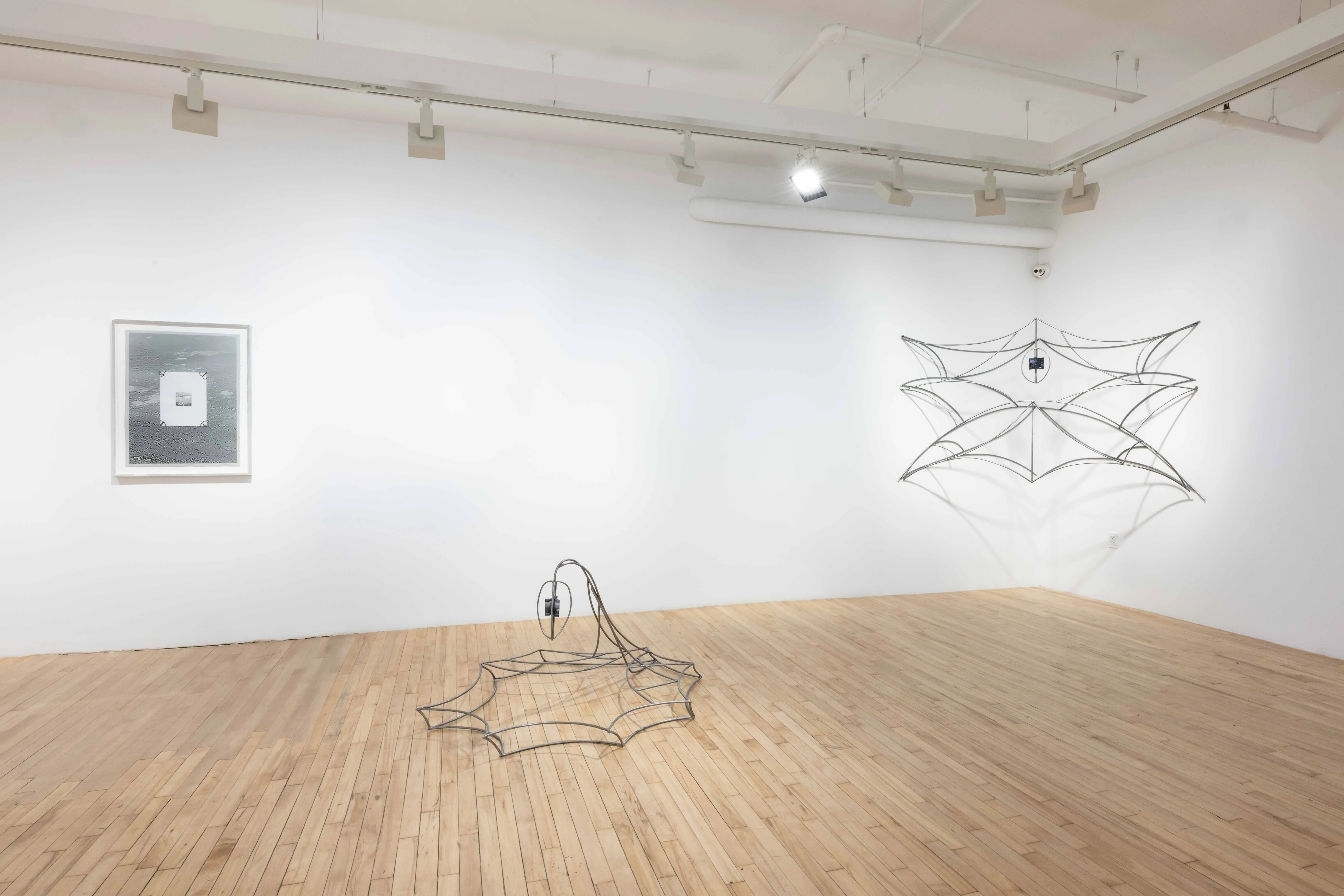
Across the gallery, hand-bent steel sculptures extend across the floor and walls, tracing web-like structures that feel at once rigid and precarious. Some lift slightly away from the wall and floor, arcing upward and subtly suggesting the spider’s capacity for ballooning—an abstracted gesture toward flight and dispersal. The sculptural elements are encircled by framed works that combine drawing and photography within a single image. Each frame centers a rendered drawing based on photographic images—balloons, airborne spiders, and aerial views of land—surrounded by an enlarged fragment of the same image. As it expands, the photograph breaks down into pixelation, at times resembling satellite imagery, moving through stages of translation. Reminiscent of early aerial photography used to map and claim territory, the work shifts the viewer from Huo’s intimate, hand-drawn marks to a distant, observational view, where meaning moves between personal image and systems of mapping and control.
Material choices extend this logic of duality, where opposites remain in active negotiation. Huo notes that spider silk is, by ductility and tensile strength, “stronger than steel,” a fact she discovered only after completing the work. The exhibition seems to anticipate this discovery: that what appears fragile can be stronger than what seems fixed. Acts of binding, stitching, and threading recur throughout. Drawing becomes a form of tethering, its repetitive movement producing a durational and embodied process. “Drawing became a space for thinking,” she shares.
Nothing in spinnerets resolves cleanly. Instead, the work holds contradictions in tension: visibility and concealment, intimacy and protection, movement and entrapment. Like the spider’s silk, these threads are nearly imperceptible until they catch the light, revealing a structure that is delicate, expansive, and unexpectedly resilient.





%20.jpeg)