.webp)
Kern Samuel: “IM” at Derosia
Review
We live in a time where the clash of art and technology is inevitable, but from corny AI-generated cartoon portraits to dynamic animatronic sculptures, where do we draw the line between the autonomy we exercise in creation and the autonomy we give our technological creations? Regardless of our feelings on the further development of certain technologies, it’s a question with wide impacts on our future: our livelihood, our intellectualism, our art and culture. But what if we shift the lens away from human concerns and towards the technologies themselves? What happens to the physical manifestations of these programs? Kingston-based artist Felix Beaudry explores exactly that: giving the technologically developed a physical body.

Graduating from RISD with a focus in ceramics, Beaudry turned to textiles after accessing the school’s computerized textile equipment. Though he learned both weaving and knitting in school, he ultimately moved fully into machine knitting, drawn in by the way knitted fabric can be shaped as it’s being made. Unlike weaving, relying on a fixed grid of warp and weft, knitting yields the ability to build form and surface simultaneously. Exploring the ability to sculpt fabric as it grows is what opened the door to his now-signature three-dimensional heads and bodies. Heads were always a point of fascination for Beaudry—his mother being a figurative painter—and became his focus as he transitioned from two-dimensional to sculptural textiles. Beaudry says he is “just starting to understand” how he likes to create faces: after over five years developing a way to depict a face using three-dimensional textiles and smooth out the features, they’ve now evolved to where he can change the faces to express more than just a likeness to humans. He draws a clear distinction between his subject and what he truly creates: “Not a body in and of itself, just a depiction of it.”

In Beaudry’s recent solo show Malleable Young Men with SITUATIONS, his piece Smokey Dog Council (2026) acts as a couch made of cushioned bodies. Visitors were welcomed to sit on the piece—a dare to sit on the nude laps of large-headed couch men, who peer over your shoulders in varying states of discontent. Joined by another viewer at the gallery, he told me, “It looks like a party, but I can’t tell if I want to join.” Whether or not viewers actively choose to philosophize or take these figures at face value, there’s still the unavoidable question of their emotion, feeling, and autonomy at first sight. Take Smokey Dog Council: the figures seem to be having very specific kinds of times, and piecing together their emotions is half the joyful bizarrerie. They are brought into existence through a navigation process and constraint, and it shows in the discomfort exuded from them. In the couch, the fully nude men feel trapped within the outline of the sectionals they make up.
As with many of his pieces, it’s clear Beaudry’s interest does not lie in realistic depiction, but in exploring the body and skin at a deeper register. Markmaking is not lost in his coloring and shaping within the textile surfaces—rather, the knitted bodies display expressionistic skin, almost as if it were drawn on with pastels. His color overlays are one of the most interesting parts of his work, in close conversation with the general 3D forming—colors emphasize sculptural contours, not allowing the textile work to take a back seat in the figures’ presences. Intricate patterns cover the oversized heads, some like a grid, as in Globe (2026), where a grid of knitted lines follows the actual contours of the head, feeling flesh-deep, and forming, as Beaudry puts it, “a strange kind of topology.” The grid calls to the longitude and latitude lines of a globe, while also giving distinction to the otherwise flat, single-colored figures knit into the sculpture.
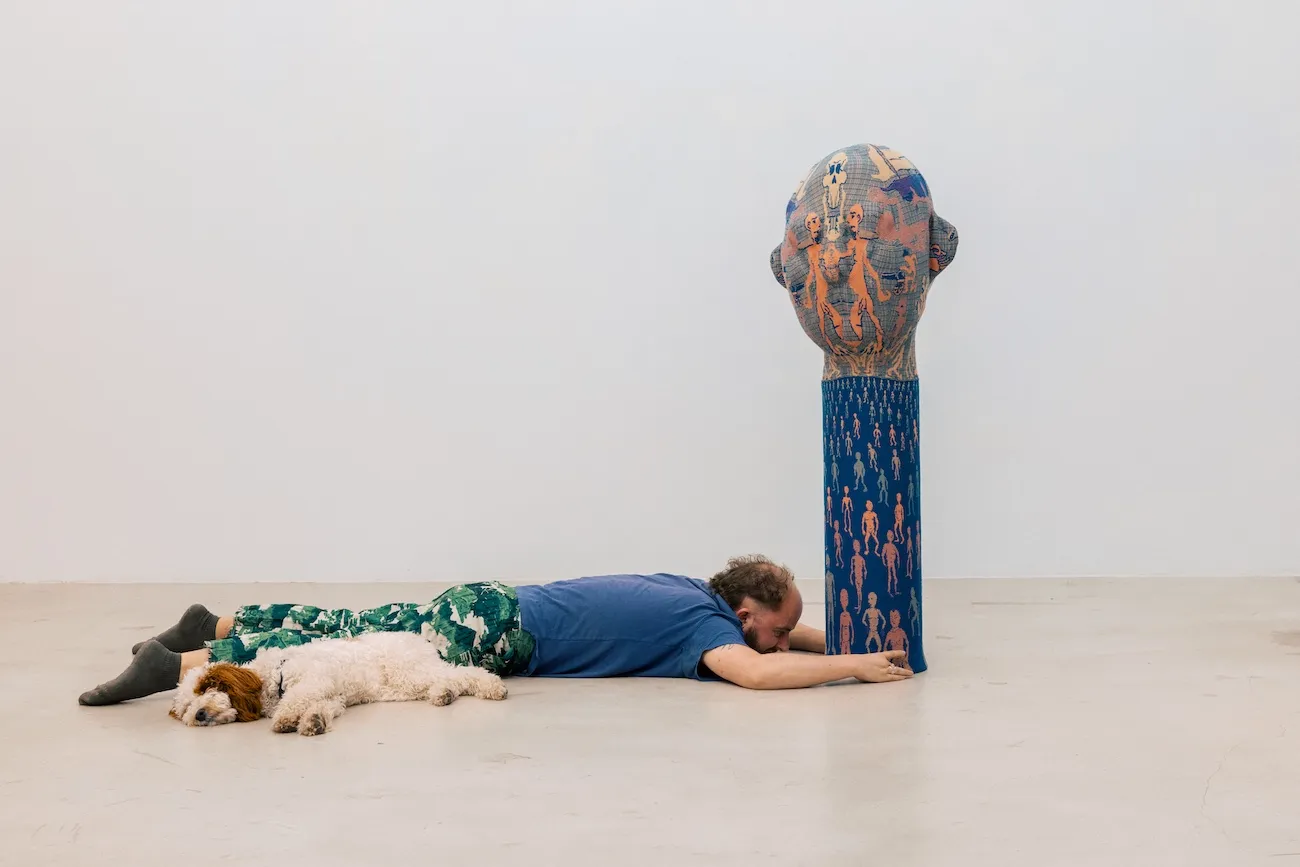
Beaudry is not blind to his work’s “grossness;” he aims to make works that invite viewers to touch the intimate and experience that grossness firsthand. He wants to locate the threshold where everyone, at some point, is bound to be grossed out, or be gross themselves. Somewhere in the sweet middle of that tension between being fascinated by grossness or repelled is a great intimacy, or what Beaudry calls it, “disgusting desire.” This push-and-pull dynamic is even legible in Slumber Paddy (2026), where a large knit head tops a mattress covered in sheets reminiscent of the ‘90s, often patterned with dinosaurs, race cars, and cowboys for young boys. The twin mattress, though, is covered instead in nude figures, curled up or limbs extended, one even wielding a sword, others mischievously wrestling. The warm palette of saturated skin tones and dynamic poses sits in uneasy tension with the overall figure’s ominousness. The mattress-body is slouching in the corner of the gallery space, like someone who arrived but never quite entered. The strangeness of nude bodies on something so clearly referencing childhood bedding adds to the unease the dejected figure already brings.
The “serializing of the body”—the sense that bodies mean less in today’s digital world, and likely even less in the future’s—is a central pull for Beaudry. It is a widely discussed, impending notion that robots can be programmed to do our jobs and experience our passions, such as making art. Similar to war, the throwing away of countless bodies causes them to be serialized in anonymity. It’s this cultural backdrop of erasure that gives Beaudry’s multiplying bodies their weight: serializing the body means more when bodies themselves mean less. What does it mean to birth bodies that hold no agency? While serializing the body is removed, impersonal, Beaudry also shares that creating them can feel “god-like, even parental”—a big responsibility that places agency squarely back in human hands even as the mechanical world strips it away. And yet the body, once created by code and constraint, is no longer his. He ponders what you give to a body that's separate from you, and how it will move through the world.

Being queer in the digital realm is another through-line in Beaudry’s practice, a space that has traditionally been male-dominated and yet shaped at its fringes, in the “outskirts of internet community,” by queer experimentation. Decades ago, video games had countless restraints on what a user could create, actions limited to pointy, geometric visuals and vectors. Beaudry is inspired by the drive of early internet users to hack around these constraints, building games and technologies that they wanted to experience, which resulted in now-common aspects like gaming skins, “breaking” games to reveal hidden easter eggs, and building whole queer worlds inside systems that weren’t designed to hold them. These kinds of limitations mirror Beaudry’s process, where he creates knit code and layers colors on top, navigating the parameters of the knitting machine. Working around parameters to technologically exist leaves its mark on what gets made, carrying the evidence of their difficult birth. The figures that emerge from this process of navigating restriction are shaped by it, their strangeness a direct record of the resistance required to create them.
Beaudry shows me a file of the directions for the knitting machine to produce one of his faces: an immaculate, electronic conception, a digital fetus that looks anything but human. To my untrained eye, it appears more like a jittery sound wave. To know that this is what bears his heads into the physical world is staggering. A multilayered system creates the fabric: Beaudry writes the code for the machine to produce the heads, and AI assists him in analyzing the topology of the faces, calculating their contours to generate patterns—like the checkerboard or grids seen on some heads—which then instruct the industrial knitting machine. When I hear of “AI” buzz within the art realm, I consistently meet it with a sigh, but Beaudry’s use of AI lends itself to a performance of sorts, the robot helping to create itself. Beaudry’s practice acts as a vessel for technology, physicalizing itself through him, needing the human hand as opposed to the other way around. Pictures of his studio in Kingston show a knit face-skin being birthed from the machine and limp, deflated heads before they’re stuffed. There’s an eccentric, more colorful Texas Chainsaw Massacre quality to it. The work demands the process be read through the pieces themselves, showing the marriage of what he calls the “queer, fleshy physical side” and the “mechanical, digital tech side.” “When I’m in it,” he says, “I’m so detached from what the final pieces will be.”

Beaudry draws the most thought-provoking historical and contemporary through-line I’ve encountered in a while. His work references Greek mythology in the sense that, where the Greeks were conceptualizing the elements around them as human forms, the next iteration of that might be us doing the same with technology: casting the digital in our image, giving it bodies, faces, and the weight of existence. Beaudry’s work sits with exactly this kind of physical birth, exploring autonomy and the godlike act of bringing into existence what has not asked to exist. Aren't we all, to some degree, forced into a given life? Are we pushing the existential curse onto the digital in order to examine our own? As Beaudry sees it: “With AI, [it’s] not just about depicting bodies anymore, but thinking how they would exist.” That question, I think, is only going to get louder.