Alix Vernet: “LANDMARKS” at Chapter NY
Review
Sincerity is hardly the art world’s default language. In a field where obscure theoretical framing often overshadows intellectual honesty, and the tokenizing rhetoric of representation routinely overpowers lived experience, Orange Li works from the inside out, curating from embodied knowledge, guided less by strategy than by urgency.
With the sensibility of an artist, Li draws from personal experience at once visceral and cerebral without packaging it with narrativized resolution or retreating behind interpretive structures. Li simultaneously resists the tendency to stage vulnerability as performance and leverage trauma as credibility. What makes her approach radical is the tenacity and the raw vitality that drive her to inquire, to create, and to let the exhibition stand as an unguarded extension of herself.
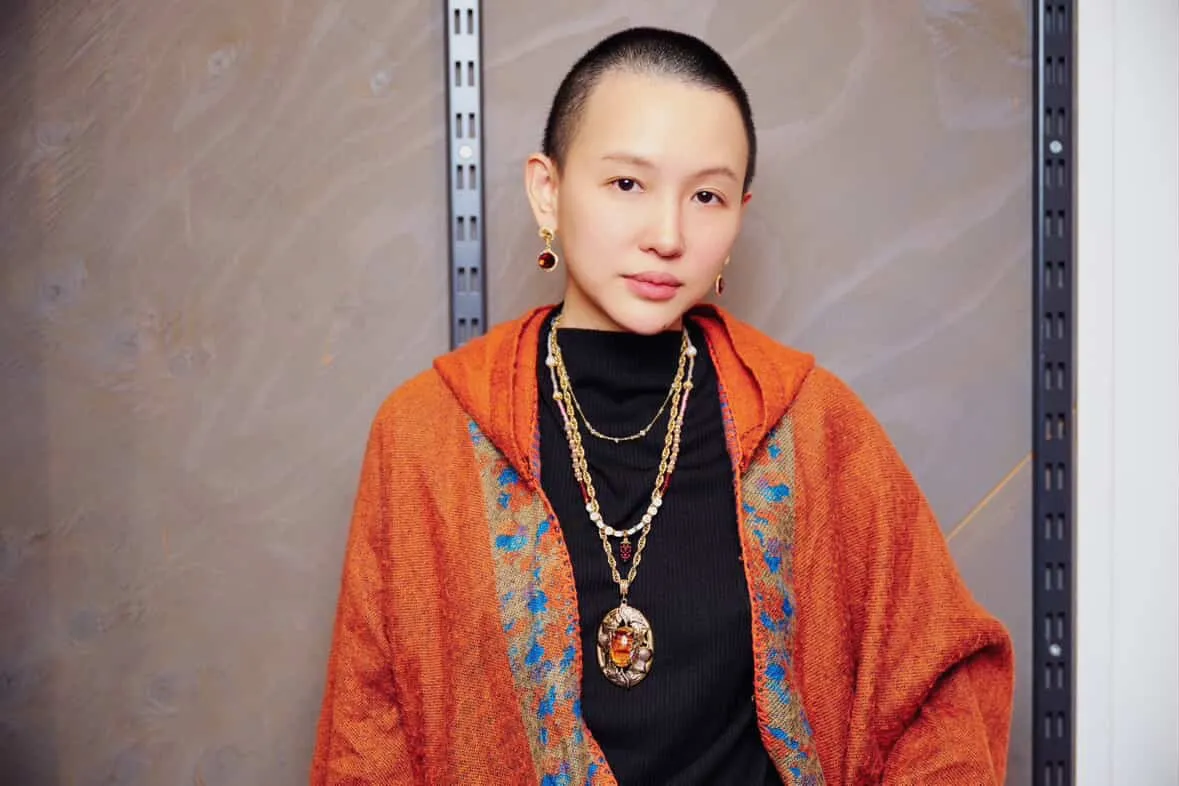
Li approached The Nurturer & the Hunter in a Room of One’s Own as an act of self-reclamation. The curator emphasizes this project—a group exhibition of eighteen women artists—as viscerally true to her survival of gender-based violence throughout her life. This presentation reflects on the weight of systemic gendered oppression, while offering a provocative model of matriarchal thinking—though perhaps not in the way one might expect.
Set in the newly-launched Creative Arts Center at the Jersey City Free Public Library, the exhibition maintains a community-oriented spirit with altruistic undertones, as reflected by the inclusion of artists’ Venmo codes in the checklist, directing all sales to the artists. In an interview, Li outlines her approach in working with this group of women artists, many of whom created new work in response to the theme: “I want to provide a platform—not a stage—for artists to safely show the vulnerabilities that inform them most, without the pressure to perform or produce, so they can be their most authentic and dignified selves.”
The project emerged from a dream in which a hieroglyph guided Li toward an Egyptian lioness-goddess within a matriarchal order. As both the hunter and the nurturer, the lioness embodies a dual power. “As women, we hunt not only to survive, but to sustain our creativity and to speak to the world about what we care for,” states Li. Inspired by the work of Dr. Heide Göttner-Abendroth, a leading scholar of matriarchal studies, Li sought to cultivate a matriarchal system within the exhibition, not as a parallel to patriarchal frameworks, but as a fundamentally non-hierarchical, non-dominating, and fully egalitarian mode of relation.
Following this vision, she invited the artists—a group including several of her own quasi-maternal figures such as Jennifer Wen Ma, Sohee Koo, and Marilyn Minter—to work within distinct physical parameters: miniature boxes. This nomadic format recalls the radical legacy of Marcel Duchamp’s Box in a Valise (1935–41), in addition to Virginia Woolf’s groundbreaking 1929 essay A Room of One’s Own, an explicit reference underscored by the exhibition title. This text, much like the show itself, asserts the necessity of claiming space as a precondition for creative autonomy.
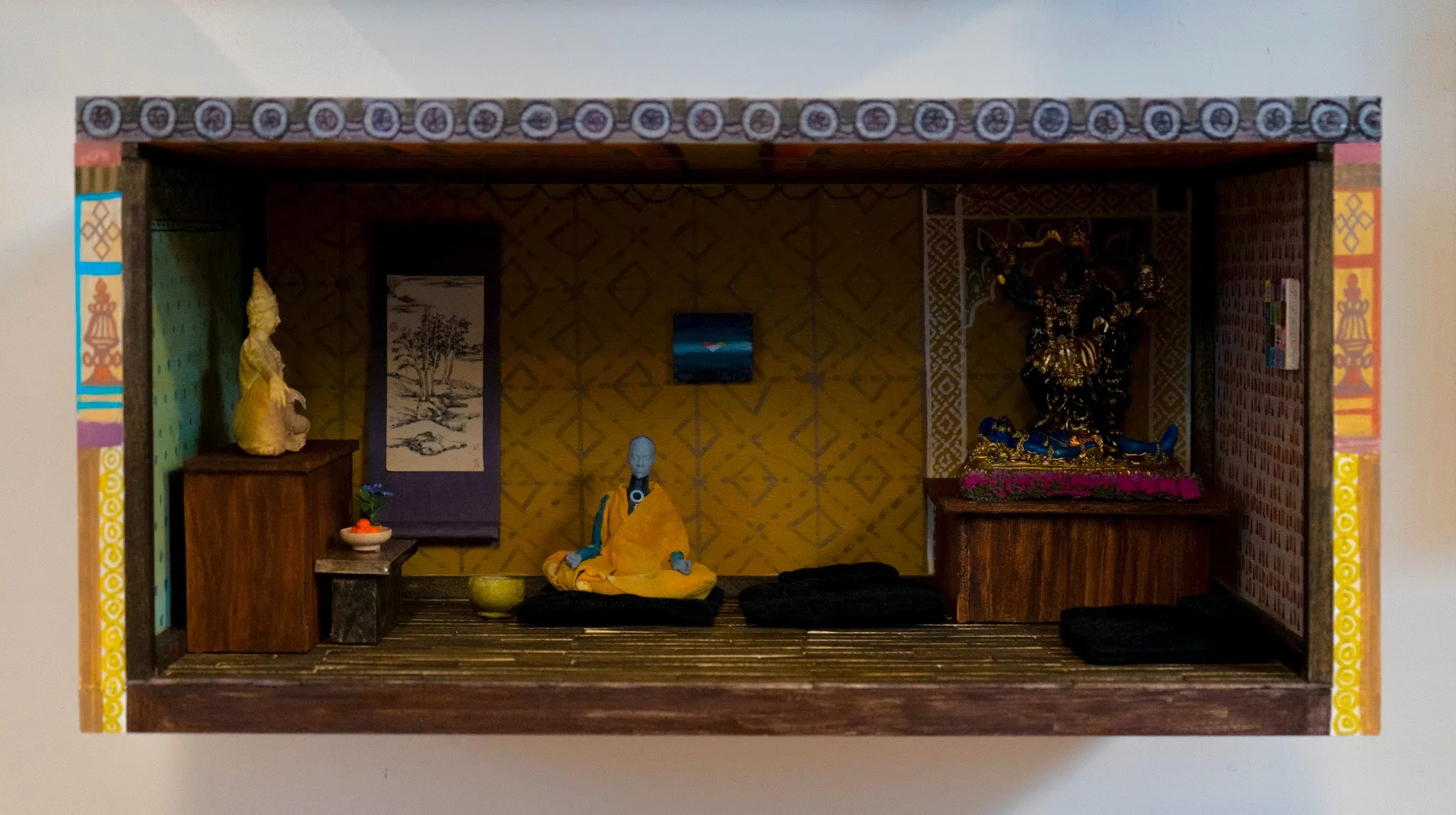
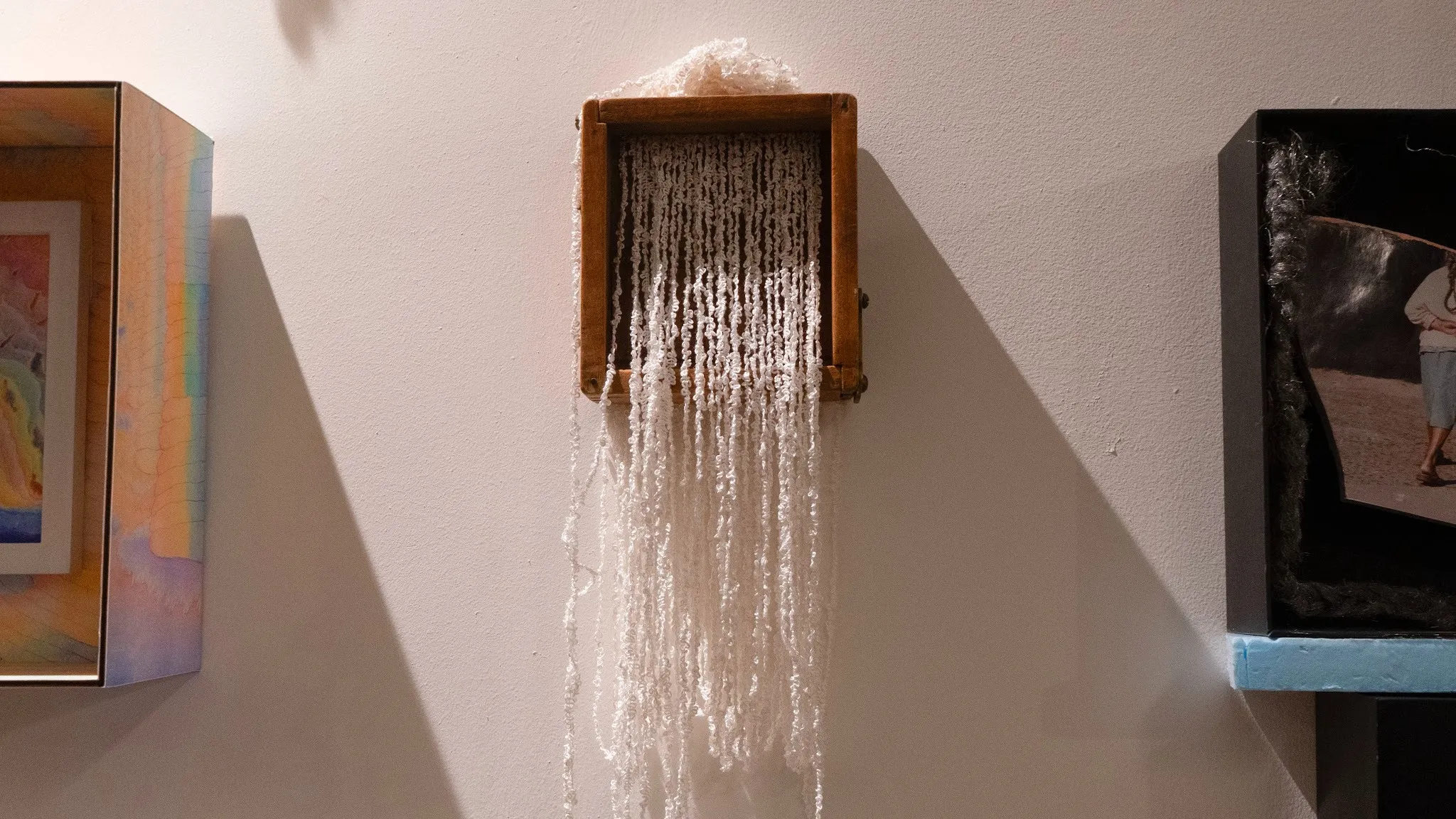
Maisie Luo’s Robot Nun Meditating in the Presence of Kālī and Guanyin (2026) presents a referentially saturated scene charged with Buddhist symbolism and a timely cyborgian twist. Icons from disparate thought systems converge here not as a neat synthesis, but as a gesture toward synchronicity. Nearby, Rossana Martinez’s Winter Morning (2026) weaves a sensual scene with found silk bouclé and a butter mold, where domestic space is intertwined organically with nature. Toward the corner of the space, Meiting Li’s Everyone Needs a Container (2026) features a video projection onto a tin can with a liquid surface. The flickering bodily imagery heightens the diorama’s seductive charge, while quietly probing the conditions of mediation. Each work is a microcosm of its artist’s intimate vision; together, they compose a topography of feminist sensibilities rooted in personal urgency, one that perhaps offers glimpses of hope.
Hope did not come easily for Li. She recalls growing up in Taiwan, where she was excluded from the family altar as a girl, even as the oldest child. At age five, she was nearly sold by her father for TWD $300,000 (approx. USD $9400). She later faced domestic violence—stalking, surveillance, drugging, and sexual assault—experiences for which she is still finding language. From a survivor to what she calls a “thriver,” she now seeks what lies beyond survival in an alchemical process of destruction and rebirth, which unfolds through art-making, rituals, and her founding of the Dandelion Dream Art Residency (DDAR), a women-centered platform dedicated to healing through creative practice. With each project, she lays herself bare before an audience, revealing the most tender registers of pain, while evoking what lies beyond suffering. Through this visceral, reflexive unfolding, curation becomes anything but beige.
The idea of radical sincerity emerges here not as a clear-cut strategy but a fundamental shift in the conditions of curation, one that emerges from lived experience—from an itch or a pain—without abstraction. Curation becomes an artistic practice in its own right, responding to a deeper calling without hiding behind inherited frameworks that signal legitimacy. In this sense, the curator operates less as an author than as a conduit, allowing forces beyond individual agency to take form. The resulting work is driven neither by a compulsion toward resolution nor an aestheticization of trauma, but by a relinquishing of ego, through which greater resonance can emerge.
This show is premised on matriarchal thought registers her recent realization that utopia—much like The Peach Blossom Spring (桃花源記) and “pure land (淨土)”—is not merely a spiritual realm confined to imagination. Rather, the concept points toward ways of living alternatively within extant systems from the past and present, extending into a collective planetary future. While utopia denotes “no place” in Greek etymology and Thomas More’s formulation, matriarchal modes of thinking offer non-hierarchical possibilities, holding space for forms of ancestral knowledge in a perpetual state of return. This exhibition marks a sincere gesture toward such reclamation.
The Nurturer & the Hunter in a Room of One’s Own is on view at the Jersey City Free Public Library Creative Arts Center from February 21 through May 17, 2026.