Alix Vernet: “LANDMARKS” at Chapter NY
Review
Mimi Biyao Bai is a New York-based multimedia artist whose work probes cultural assimilation against the backdrop of the global military-industrial complex. Born in Xi’an, China, Bai’s practice is rooted in close research into military history, drawing on both its imagery and its materials. Camo netting, ballistic gelatin, harnesses, and ghillie suits recur throughout her sculptures, videos, and works on paper, exposing the ways that fantasies of protection and survival are bound up with labor, discipline, and exploitation.
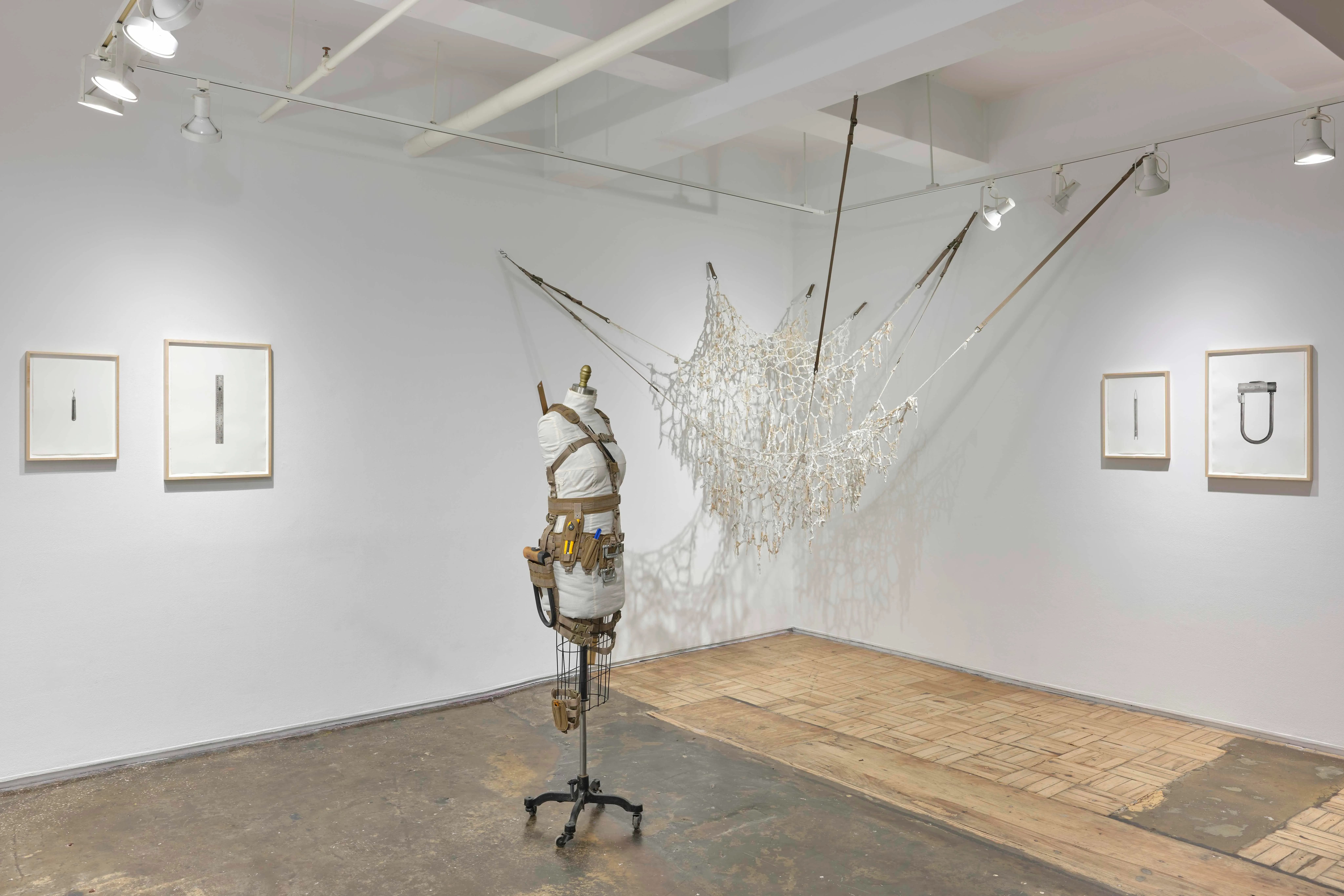
Bai’s installation Net (2020–24), included in the group show Textures of Feminist Perseverance at Cuchifritos Gallery, refracted these themes through the history and visual logic of camouflage. Knitted entirely by the artist in a striking safety-orange shade, the piece turned military concealment into something conspicuously visible, foregrounding the evergreen cultural tension between blending in and standing out. Her first New York solo exhibition, More-than-Self-Defense at A.I.R. Gallery, extended those themes by pairing hyperreal ink drawings of everyday studio tools—mallets, netting needles, clamps—with a military-inspired harness that recast them as potential weapons.
Bai’s inspirations continue to encompass Westerns, action films, the natural world, and prepper culture to ask how safety is staged, sold, and embodied. IMPULSE Magazine spoke with Bai in her Brooklyn studio about the recurring themes in her work, new projects, and the ways studio practice spills into daily life.
J. Cabelle Ahn: Let’s start with the central role that military history plays in your work. What first drew you to that history?
Mimi Biyao Bai: Around 2017 or 2018, inspired by conversations with my friend and artist Gabo Camnitzer, I started thinking about the connections between visual camouflage and cultural assimilation. They’re both strategies or adaptations for survival that depend on who’s seeing you and how you’re being seen
I often use safety orange in my work because it’s highly visible to most people, but deer and many other prey animals don’t register that color in the same way. Depending on who’s looking, camouflage can either signal or obfuscate, and that felt resonant with my own experience of being an immigrant and all the different ways of adapting.
That research very quickly led me to netting and to thinking about wartime technology and how it connects to empire and imperialism. Camouflage continues to be something I come back to because, beyond its military applications, I’m also thinking about plant and animal camouflage in the natural world.
JCA: You showed a safety-orange-colored piece, Net, at Cuchifritos in 2024. Is that work always site-responsive?
MBB: For that installation, I was interested in letting Net inhabit the space, but many of the sculptures I make continue to grow, change, or contract depending on how they’re being seen.
That piece, and other net pieces I’ve made, came out of this research into turn-of-the-century wartime technologies, and into how nets were originally used to adapt to different spaces by filling them with brush or vegetation from wherever you were trying to hide. Similarly, I’m borrowing that utilitarian, multifunctional idea for my own nets.
.webp)
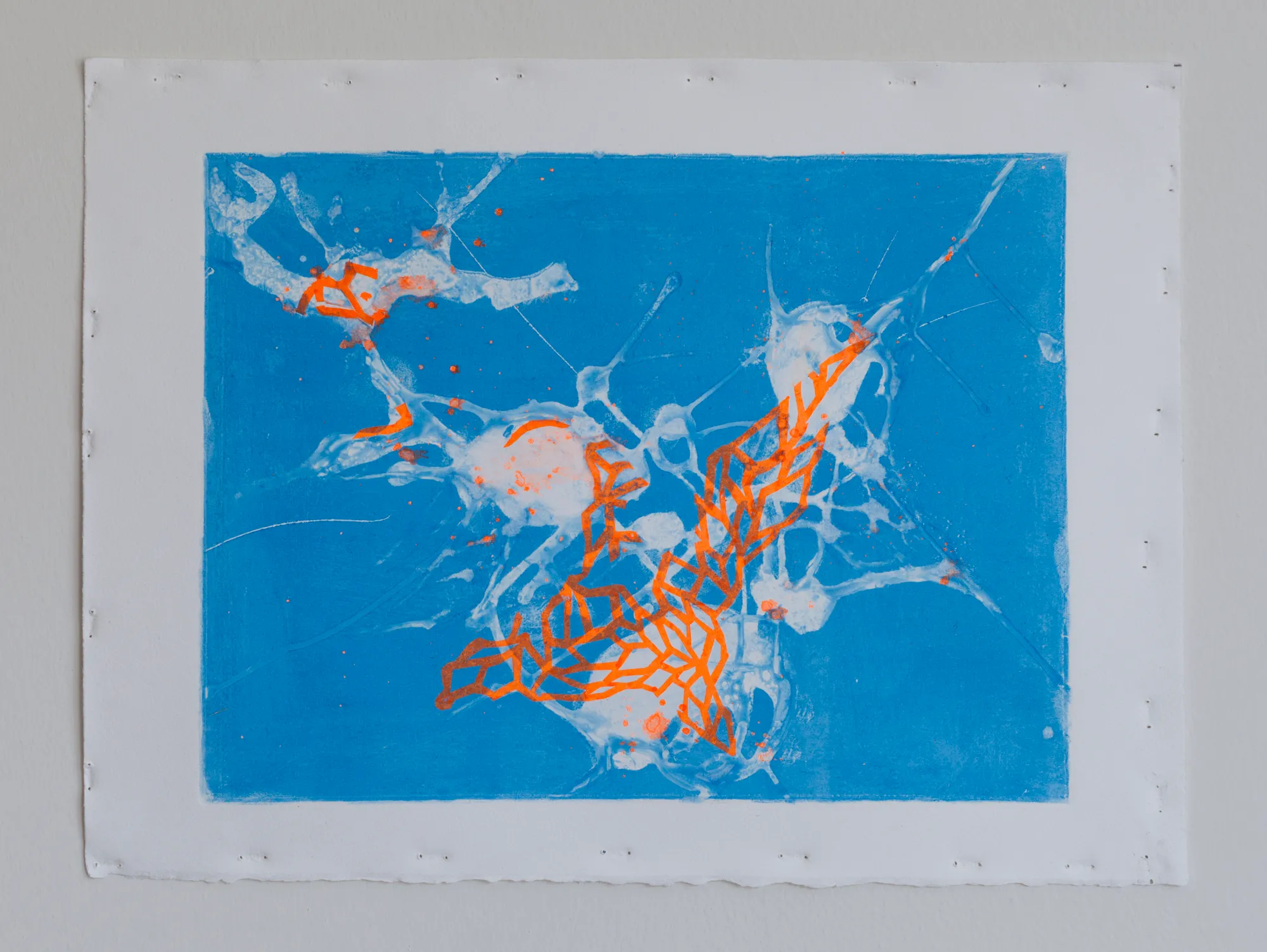
JCA: Here in your studio, I’m also seeing that same type of orange net in this print series and in your new gelatin sculptures.
MBB: I made these prints earlier this year at the Robert Blackburn Printmaking Workshop, where I was formerly a SIP Fellow. They’re monoprints with chine collé. My friend Meena Hasan, who is a painter, and I went to the printshop together and co-created this vocabulary: we each made our own prints, but we were both working with this blue ground and bringing in some of our own studio concerns.
These newest sculptures feature ballistic gelatin, a material used to test the effects of ammunition and firearms on human bodies. It comes in a block, but I melted it and started experimenting with casting it into other forms.
JCA: Are these gelatins modeled on your body?
MBB: Some of them are, actually—this one is a pair of elbows. I made molds in alginate, cast them, and fused them together. Eventually, they’ll be torso-sized, and I’m interested in combining my fabric sculptures with body parts and found objects.
There’s a direct line between the gelatin series and Harness (2024) [shown at the exhibition More-than-Self-Defense at A.I.R. Gallery in 2024], and they all tie into themes of training, preparation, and safety. As with a lot of my work, I’m bouncing between different techniques, materials, and timescales.
JCA: The A.I.R. show also featured drawings of quotidian tools as weapons, if I remember correctly.
MBB: Yes, exactly. I’ve always loved drawing. There’s one for each of the objects [in the harness], and they’re all objects I actually use, like a bike lock or a net needle. With that work, I was really probing this fantasy of self-defense. I had genuine fear at the time, but I was also questioning where that fear was coming from and what exactly I was responding to. In each drawing, I was thinking quite seriously about what it might mean to approach these ordinary objects as weapons.
Most of my work starts at a personal level, but I’m not interested in it being biographical in any straightforward way. I’m very seduced by this idea of being self-reliant, self-contained, of having the capacity to be “safe.” At the same time, I’m repulsed by where that idea comes from. If you take that logic to its extreme, “self-defense” can become a justification for doing violence to others.
JCA: Speaking of biography, can you talk about the avatar of the ghost that haunts your prints-to-film-based works? You’ve often tied it back to a photo of you as a sheet ghost at your first Halloween shortly after you first moved to the US.
MBB: I think I was fascinated by the character of the ghost because haunting is a potent idea on so many registers: on an individual level, in relation to your own history, but also in relation to the history of this country.
In the film Hide & See (2022), I was thinking about the ghost not just as a figure of mourning, but as a kind of funny avatar that wears the skins of the sculptures I’ve made. What would it mean not to be bound by my own corporeal presence? Not simply to represent loss, or to repeat this rote story of cultural or linguistic loss? What new possibilities open up?
JCA: That goes back to something I see throughout your work: this tension between visibility and disappearance, which also echoes in this wall of images in your studio. Can you unpack some of these visual references?
MBB: Some of these research images come from a hybrid lecture/screening I did at A.I.R. I showed clips from westerns and action films like John Wick (2014) and Kung Fu Hustle (2004), because I was trying to situate that body of work within ideas of preparation and survival, but in a tongue-in-cheek way.
I’ve been thinking a lot about the culture of violence—what it means to have access to violence, to have mastery over it, or to imagine certain forms of violence as “justified.” I love training montages in films, and I’ve watched a lot of prepper videos. I think both seduced and repelled by them, but also fascinated by those broader cultural narratives around survival and safety. Those are ideas I’m also thinking through for the film I want to make next.

JCA: What are you reading right now?
MBB: I’m reading a book called The Process Genre (2020) by Latin American cinema scholar Salomé Aguilera Skvirsky. She’s looking at the history of process films—cooking videos, how-to tutorials, anything where someone shows you sequentially how something is done or produced.
That connects back to montage and training sequences in action films. There’s something about the way they compress and stage labor and time. Labor is key to how I make work: in the first net piece I made—Conjuring a future full of pasts (2020)—I hand-sewed on individual sculpted elements to make this immaterial labor of assimilation physical. For the piece at Cuchifritos, I tied each knot of the 14 ft net myself and touched every inch of it. But I’m also interested in different kinds of immaterial labor, and in how to explore that through physical means.
JCA: Another striking element in your work is this suggestion of fetish in the tactility of the gelatin and the way some of the military gear feels almost bondage coded.
MBB: I think the sensual, or the bodily, has always been there, but I’m still figuring out how it comes through. With previous ghost pieces, there was this almost total obscuring of my body, but with Harness, there was a shift: my form became present in a way I hadn’t experienced before.
There’s something that feels very repressed about war and power, and with the gelatin pieces, it’s becoming more explicit. That feels in sync with my own growing comfort in bringing those elements to the fore.
.webp)
JCA: What project or theme are you excited to explore next?
MBB: I’m excited about a lot of things. I’m working on larger hybrid forms with the gelatin. I want to make a film with me interacting with the gelatin sculptures. I’d like to explore making nets in other materials, like cast metal, and I’m still thinking about printmaking.
One thing I’ve been doing over the past few years is going on week-long canoe-camping trips in the wilderness of Minnesota with my friend Eliza Myrie, who’s an artist based in Chicago. We did it for the first time two years ago, and I’d never done anything like it before. It felt like another extension of my work.
It tested a lot of my critiques of prepper culture, because when you’re getting ready for a trip like that, you do become a prepper. You try to cover all your bases, even though there are always things you can’t control. And once you are on the trip, you realize both what you might be missing and how you already had what you needed, be that strength, endurance, or creativity. So, it was also empowering and exhilarating to do it together, as two women of color in that space.
This annual trip has become a way of experiencing my studio practice differently. There’s a personal history there, and a sociology, and a theoretical or conceptual connection to the work—but there’s also the fact that I’m just living it every day.
This interview has been edited for clarity and length.