
“Are you lonely tonight?” at the Australian Centre for Contemporary Art
Review
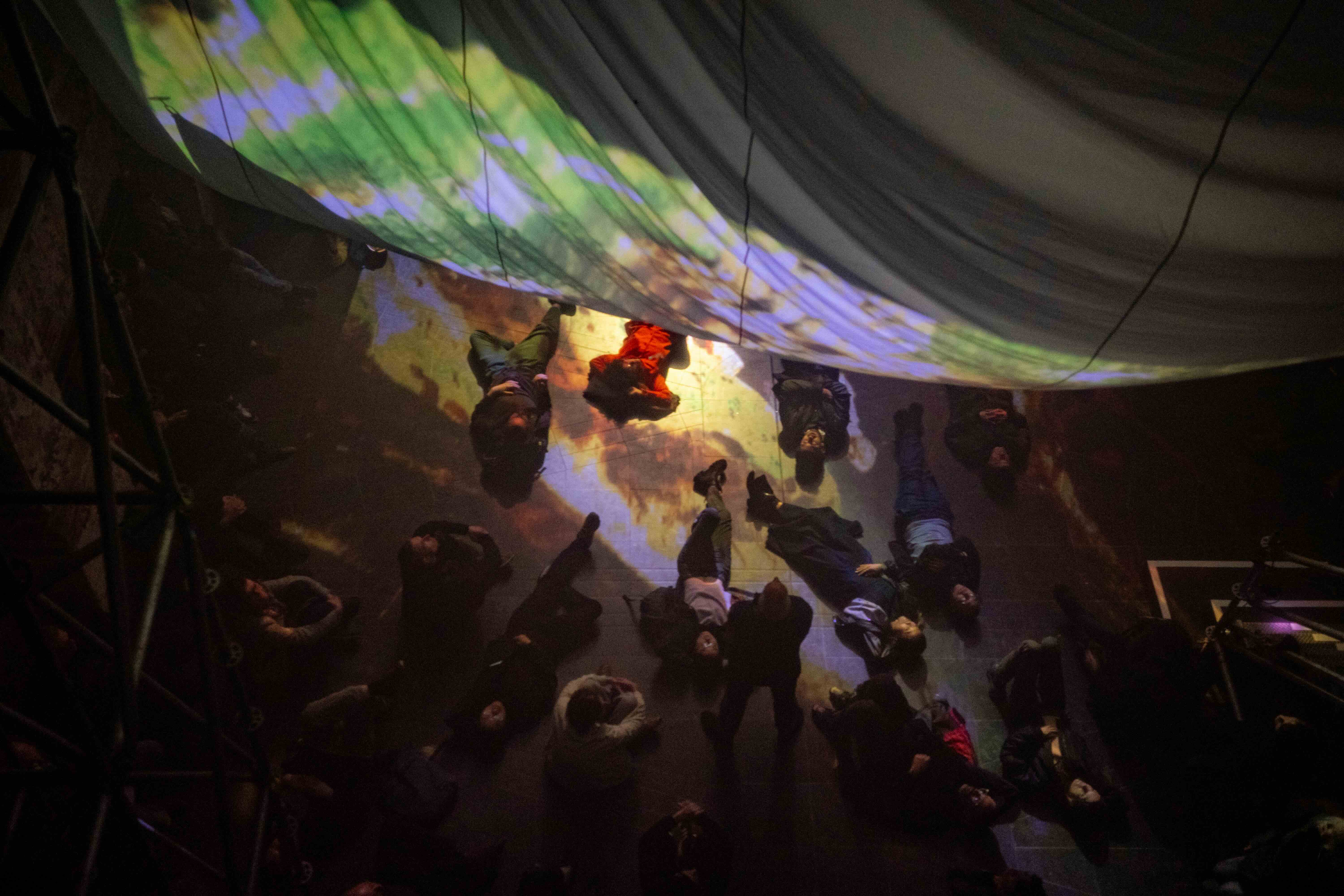
It’s hard to explain A Flower of Forgetfulness (2026). In the simplest terms, it’s a moving-image-based installation at Brussels’s Kunstenfestivaldesarts 2026 by filmmakers Apichatpong Weerasethakul, Rueangrith Suntisuk, Pornpan Arayaveerasid, Akritchalerm Kalayanamitr, and Koichi Shimizu, all of whom have been working together, in various duos, triads, and quintuplets, over the past twenty years. Suntisuk and Arayaveerasid bring expertise from the experimental collective DuckUnit, managing the work’s scenographic elements. To get into the nitty-gritty, A Flower of Forgetfulness is an hour-and-thirty-minute performance of expanded cinema, but the only performer is a gently moving cloth that comes to consume the space. It’s an activation of the Les Brigittines, the 17th-century chapel-turned-arts space, to the sounds of Ryuichi Sakamoto. It’s a two-ish channel video work. It’s a light show and towering scaffolds and indoor clouds. Tilda Swinton makes an appearance. It’s an echo of the ascent up the Sri Lankan mountain, Sigiriya. It’s an ever-evolving work that was just born.
IMPULSE Magazine sat down with the filmmaker and collaborators of A Flower of Forgetfulness to discuss the making of the ambitious project.
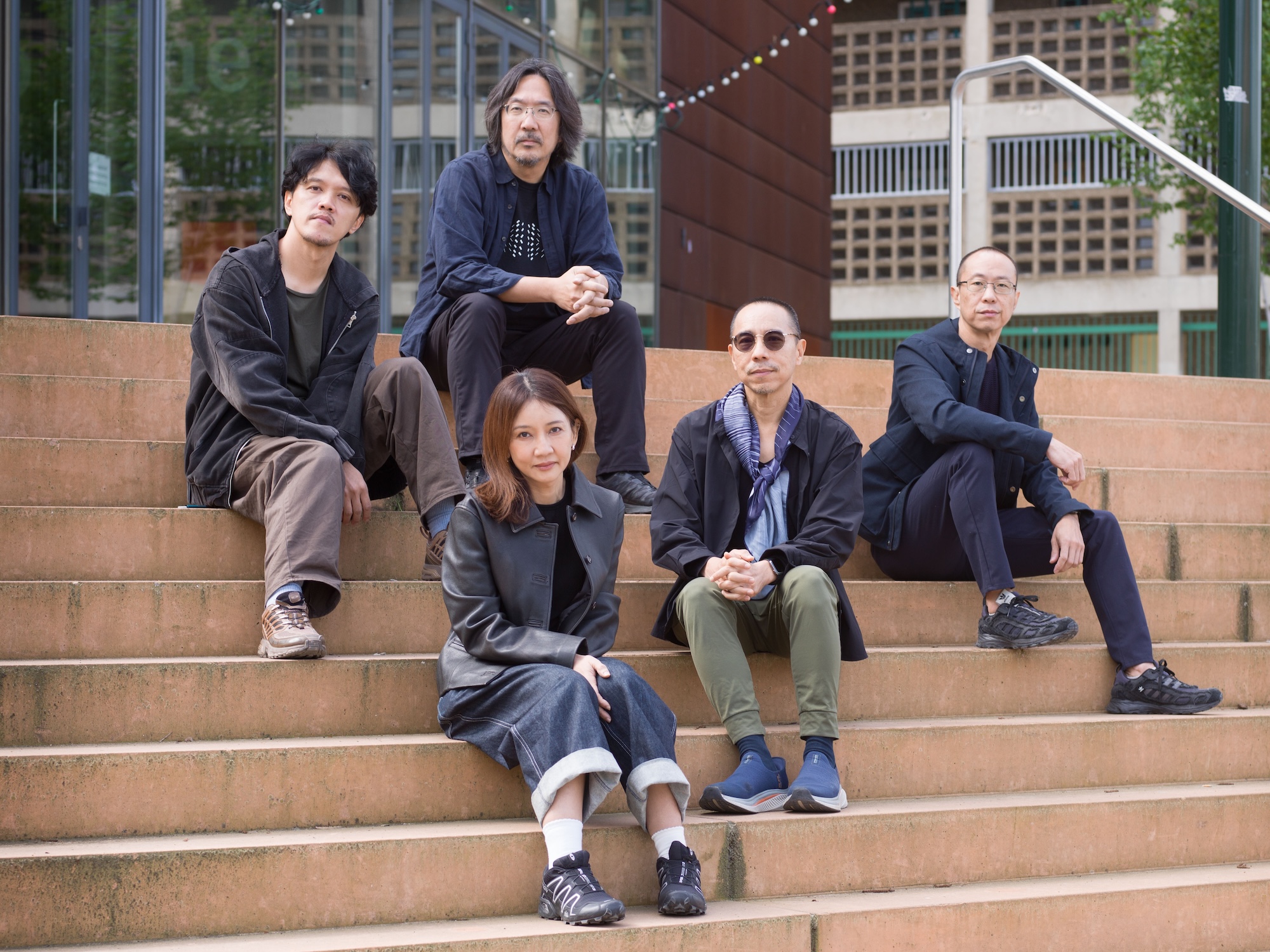
Annalise June Kamegawa: This is a huge piece with a lot of moving parts. What was the trickiest thing to troubleshoot during the installation?
Apichatpong Weerasethakul (filmmaker): I think it's about time—how to deal with the space here within the preparation time. I believe any space is okay if we have time. It's about getting to know, especially for installation, how the piece or the light activates or blooms in the space. This piece is so tough for me because of the limited preparation time.
Akritchalerm Kalayanamitr (sound designer, sound editor, mixer): It was about syncing images and sounds within a very stable system. Somehow, we are still working on finding a solution: What is the best way to be able to perform and have a smooth operation throughout the whole show?
For the creative part, it’s about how we would get another dimension of sound. Because we usually use a lot of speakers to create another dimension by placing two systems of sound speakers. But for this piece, we only have one layer of speaker sets. Once you go up [on the scaffold], you can feel a bit off the axis of sound, which is nice. But somehow, I would rather explore more with the speaker placement so we could create more dimensional sound for the audience. I would like to have it be another world up there so you can observe from above and feel more of the upper level. Next installation!
Koichi Shimizu (sound designer, music composer): We are using the network system, which is controlling everything from the sounds to the motors and the video. Making the system stable is the biggest challenge. We are still working on it.
Pornpan Arayaveerasid (DuckUnit, lighting and scenography): The most challenging thing is placing all these magic elements in this space, within the audience. The audience will travel around all those fabrics, the smoke machines, the fans, and other atmospheric things we have put in. I try as much as possible to have them here within the space of the audience, composing them together with the audience.
Rueangrith Suntisuk (DuckUnit, motor, video projection, tower): We did a test in Bangkok already, but the space is totally different. The height and the feeling of the texture and everything: we tried it in Bangkok, but when we put it here, the fabric itself changed into another person. We have to deal with the audience on the floor and up there [on the scaffold], thinking about how they're going to see it, because we’ve never seen it from up there. So, it's about the time we needed to build the installation from scratch.
AJK: So how did the team come together for this project?
KS: The first time we worked together was ten or eleven years ago for another piece called Fever Room, which we also performed in Brussels in 2016 at the same festival, Kunstenfestivaldesarts.
AK: Koichi and I have known each other since about 2004, but I've been working with Apichatpong since 2003 through film and installation. So actually we are very, very old friends.
KS: And also I’ve been working with Suntisuk and Arayaveerasid of DuckUnit in the music industry since 2003 or 2004.
AK: And Suntisuk, Arayaveerasid, and I have worked together since 2005, starting at this big concert.
AJK: That's a long history.
AK: DuckUnit has done a lot of big concerts in Thailand!
PA: Not anymore. For me, it's too flashy. When you become older, the flash of the lights is just too bright. It's just too much for your eyes! [laughs]
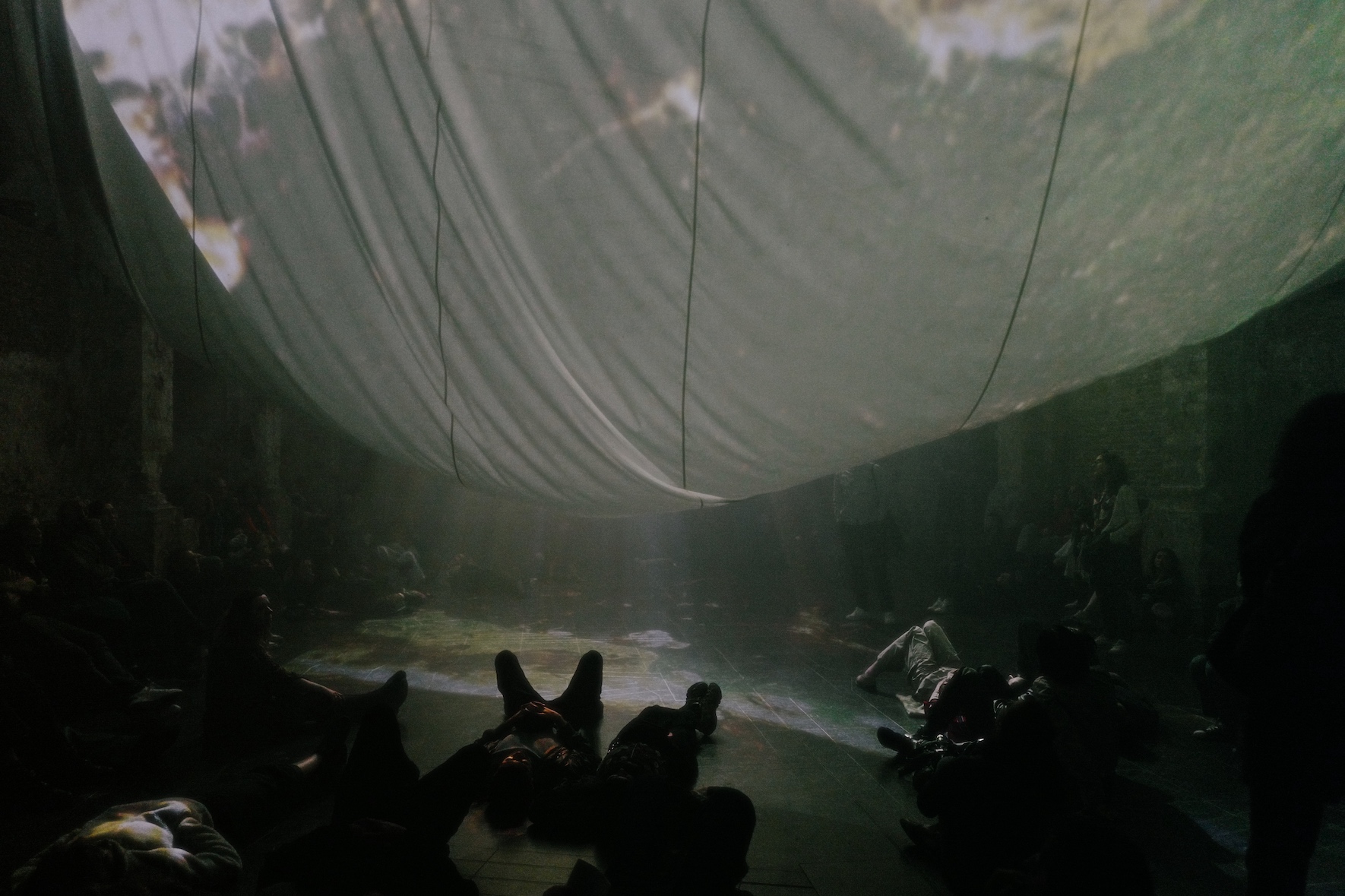
AJK: This exhibition space, in the chapel of Les Brigittines, is huge and old. What was the first consideration when building the piece? Was it the space or was it footage that you'd already had?
AW: For me, it's a mixture of two of our ongoing collaborations. I think the fabric one, A Conversation with the Sun, at Bangkok CityCity Gallery, started in the middle of COVID. I was thinking about how we can activate a cinema screen to be part of the experience instead of a two-dimensional static surface. So we started with that and investigated the motor and the movement. Then, when we were asked to be here [at Kunstenfestivaldesarts] to look at spaces. This one was really striking because of the verticality, which coincides with the project I'm doing now about this mountain in Sri Lanka, Sigiriya, and the need to go up and up to space and to explore other worlds. That's in our DNA, I believe.
AJK: Do you find that having a collaboration like this, with so many creatives, that the themes of the piece change as you discuss it and work in the space?
KS: He [points to Weerasethakul] made a big change at the very end! [the group laughs]
AW: Because we could. You can’t really change the motors. But the video image is fluid—that can be changed. And it's part of the frustration too, because it's so fluid: how it feels through time. We came here and what we planned in Bangkok didn't feel right, but we cannot articulate exactly what it was. For me, the first thing is I cut out the narrative part, just to open images for interpretation, which is tricky. You don’t know whether the audience will follow these kinds of successive images over one another. Also, the big thing is that we envisioned the beginning with darkness and slowly, the light and sound appear. We now think of it as when the audience arrives, the projector is already on. This thing is already breathing and alive. It's more of waking up, this fabric. In the end, we never witness the birth, but just the living and dying.
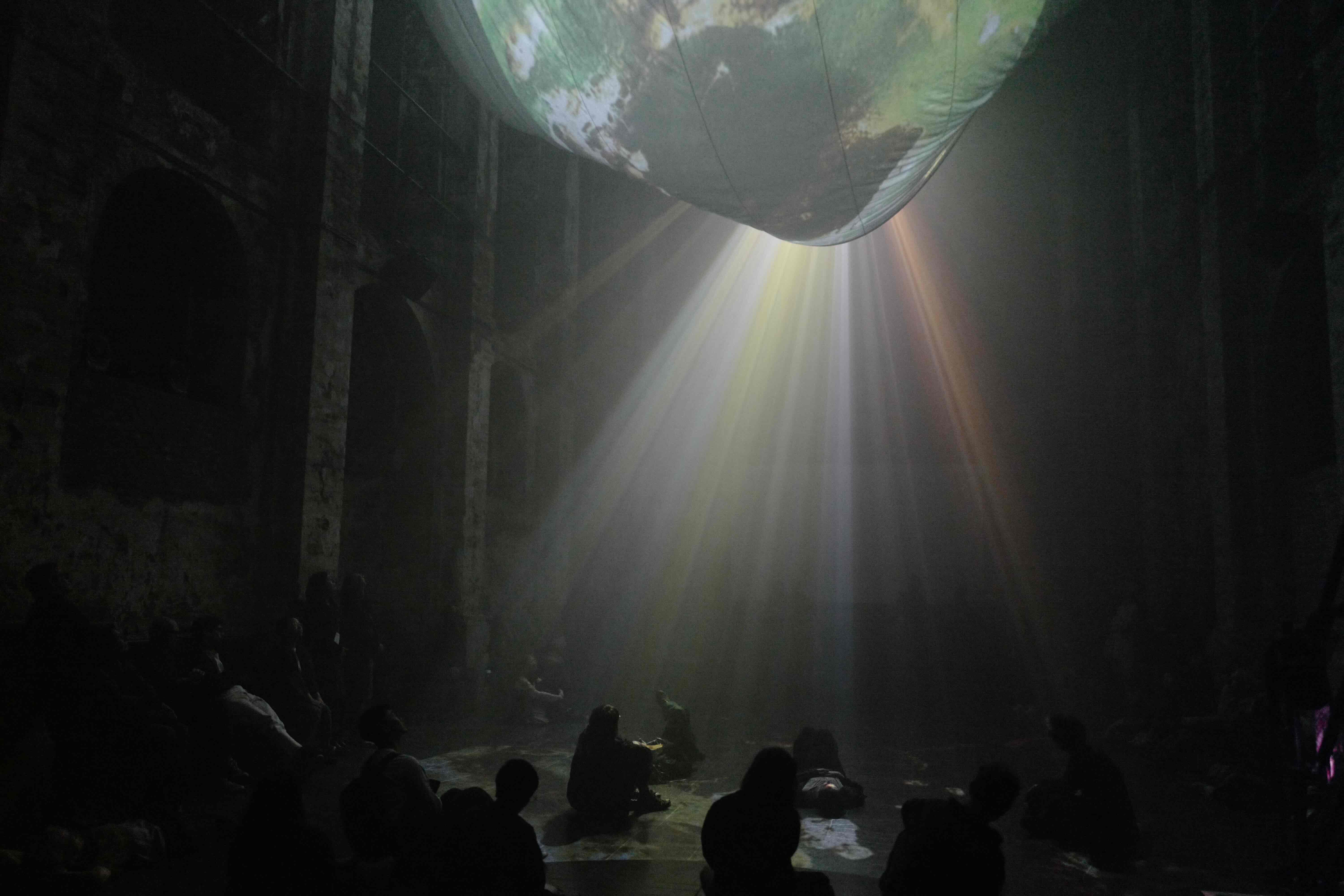
AJK: So when the narrative structure is removed from a piece of work visually, how does it impact the scenography and the music?
RS: We are already prepared for change. How we work is quite fluid because we change all the time. We cut and add things all the time. But this is probably just how we work together. We respond back and forth until we find what works best.
AK: He mentioned that he cut out the narrative elements, but if you look closely at his editing, it is a truly fine piece of work. For me, Weerasethakul is the best picture and sound editor I’ve ever seen. I’ve watched this more than three or four times now, and the editing is just incredible.
At first, we were worried about the echo because it’s a church. We were also limited in where we could hang the speakers—we couldn't hammer into the walls, so we were pretty restricted in terms of height.
KS: To be honest, until I arrived at this venue, I was very concerned about the reverberation. Before coming here, I had been touring different cities in Europe, and I visited many churches to listen carefully to the acoustics of each space. Most of them had extremely long reverberations and echoes, so I imagined that installing a sound-based work in a space with those kinds of acoustic characteristics would be very difficult. But when I actually arrived here, I found the acoustics to be surprisingly natural. It was a huge relief for me, and it also made the sound much easier to control and work with.
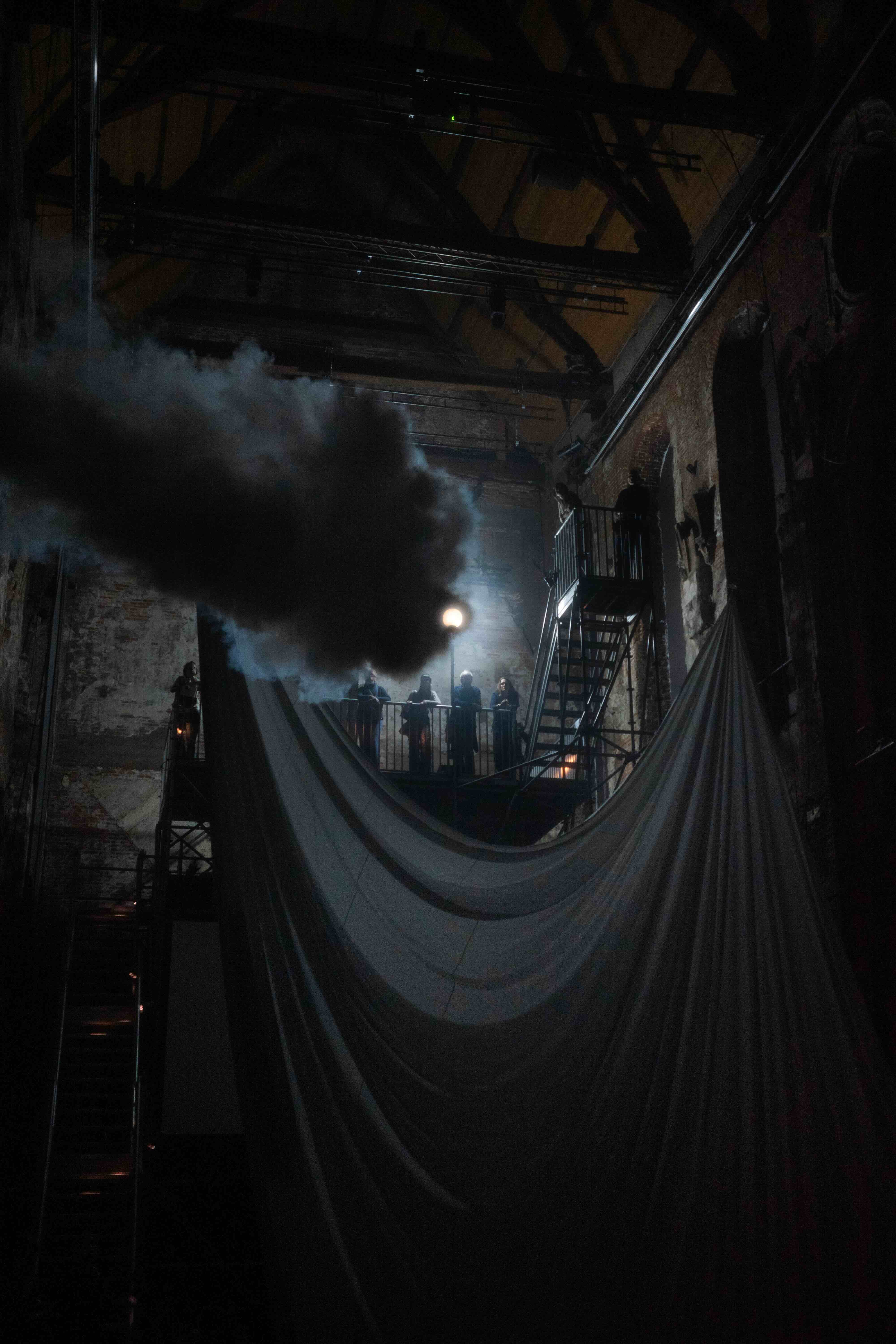
AJK: This work cycles through an uncountable number of compositions. Is there an image or a moment in the work that you will remember this piece by?
AW: For me, it's hard to single out. Everything is meaningful for all the images, and the movement is part of it. I would say because it's part of, like you said, the audience is part of the show. Everything is instinctive when I imagine things, but I didn't imagine people walking up and then the screen to have people walking up to it. To see the audience, the real people physically go up along with the image, synchronizing. What impressed me was that the work is really active. We’re still processing this piece because it’s just been born.
AK: Yeah, if we work in cinema, on a film, we usually have everything 100% in sync with the images. Like if we see people walk, then the sound of footsteps has to be 100% in sync with the images.
But for this piece, somehow, we end up with the opposite. Sometimes the images and the sound don't sync up together, even if it's a footstep. Sometimes you see the image of the people walking up on one screen, but the sound is coming from the back screen, or vice versa. You see the images of the people going up the Sigiriya on the screen at the rear, but the walking footsteps sound is coming from the speaker on the front left. Then later on, you hear the actual audiences walking to sync up with that image itself. Something that we were still trying to experiment with is how people perceive sync and non-sync.
KS: This piece was just born, and we are still surprised every time we experience it. We watch every performance with the same fresh feeling as the audience. I think we still need a little more time ourselves to fully understand what this piece is.
A Flower of Forgetfulness ran at Les Brigittines as part of Kunstenfestivaldesarts from May 8 through 11, 2026.