

.webp)

Marc Kokopeli: “M.Kokopeli CURSED/01” at Gladstone
Review
Melora Kuhn: The Legacy of Disembodiment
Private Public Gallery | 530 Columbia Street, Hudson
July 11 – August 9
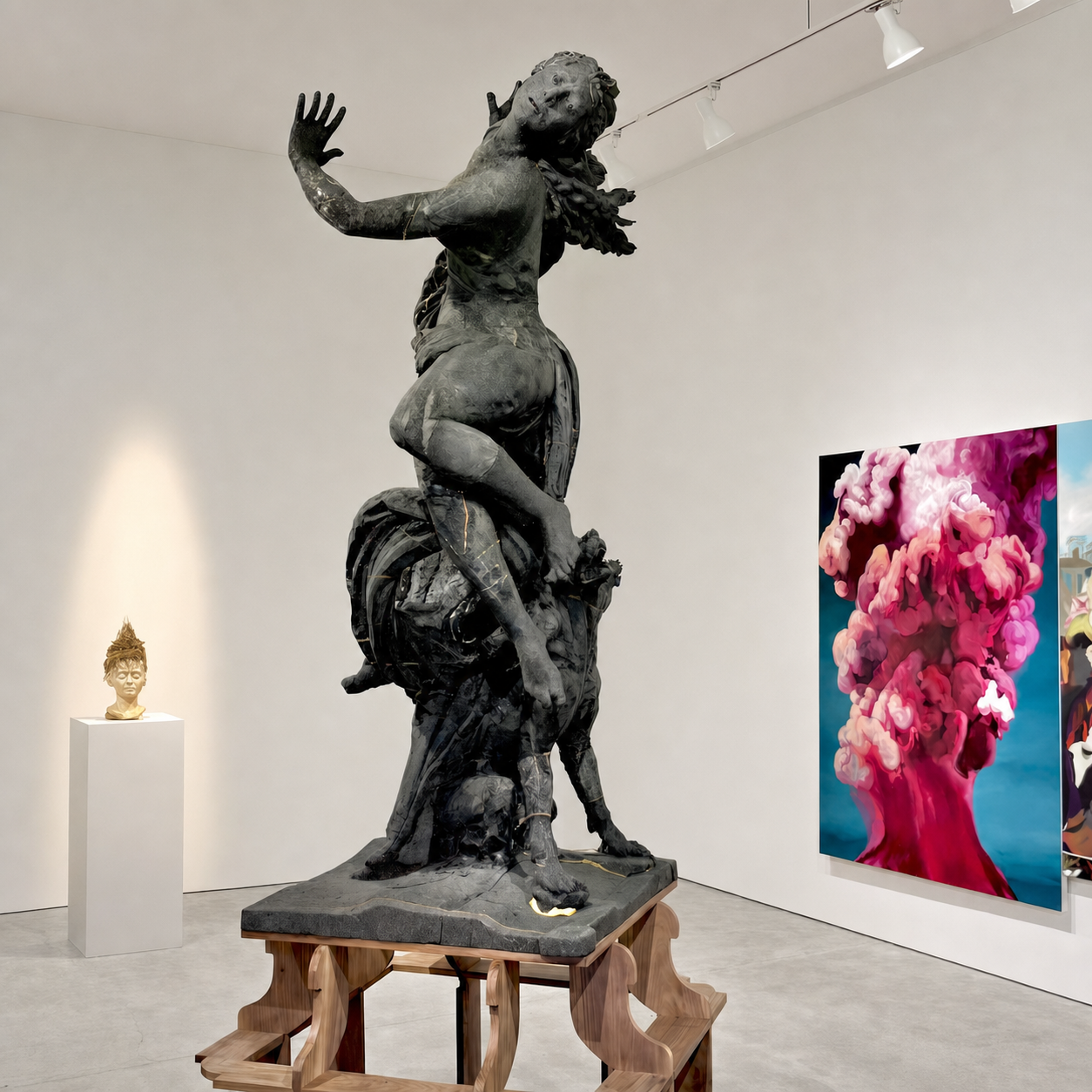
For Melora Kuhn, mythology is far from being a fixed narrative. It is a flexible structure that can be dissected, rearranged, and reexamined. While her work has consistently engaged with deconstructing the subjects of mythology, history, and overarching belief systems, The Legacy of Disembodiment shifts its emphasis from narrative to experience, presenting a powerful meditation on violence and its extensive aftermath. Instead of revisiting myth as historical allegory, Kuhn uses it as a framework for examining how we continue to bear the effects of events long after they have passed from view.
The exhibition centers on a life-sized sculpture of Persephone, modeled after Gian Lorenzo Bernini's painting The Rape of Proserpina (1622). Kuhn's intervention is straightforward and powerful. Hades (Pluto) has been removed, and Persephone (Proserpina) remains, her body still conveying the tension of a horrific encounter. Without the violent aggressor, the work resists the logic of mythological representation where violence is contained within a recognizable and critically unexamined story. Here, attention shifts to the body's condition through its isolated posture, expression, and unresolved relationship to an event that is no longer fully visualized.
This absence is both a formal and a conceptual device, with the sculpture neither illustrating trauma nor seeking to disregard it. By removing the figure that traditionally organizes the narrative, Kuhn transforms Persephone from a subject without agency into one whose experience is now unconstrained by that representation. This act of erasure leaves us to study what is left, inviting us to consider how the effects of violence continue to shape the body after both the image and accompanying story have disappeared. Still, Persephone's gesture is ambiguous throughout, enabling us to read it as defiance, exhaustion, or perhaps teetering on self-possession. Kuhn wisely allows these possibilities to stay active without preference.
Beyond its crucial reworking of Persephone, The Legacy of Disembodiment demonstrates Kuhn's ability to work at an architectural scale through paintings that establish the conditions of our encounter with the central piece while contributing their own dramatic maneuvers of provocation, almost as vignettes. Bold color, layered brushwork, and carefully constructed compositions turn the gallery into a continuous pictorial plane and, one could say, a figurative battlefield. The paintings shift between kinetically charged and fractured, inviting viewers to consider how place, history, shifting perspectives, anger, and silence can be held and contemplated. Their monumentality draws attention to the interplay between colors and tone that shift from one canvas to the next. Taken together, their immensity and restless compositions find their fullest expression through the atmosphere created by the accumulation of these visual relationships. The dialogue between paintings and the anchoring sculpture unexpectedly becomes one of the exhibition's most gripping effects.
In a Free State
Luhring Augustine | 17 White Street, New York
June 26 – July 31, 2026

We often imagine freedom as an escape from violence, grief, or uncertainty. In a Free State, currently on view at Luhring Augustine, however, proposes that freedom can still emerge while remaining inside contradiction rather than only once resolving it. Curated by artists Salman Toor and Doron Langberg, the exhibition acknowledges the contradictions of grief, eroticism, violence, and ridiculousness. It places comic absurdity right alongside violence. Across painting, sculpture, embroidery, photography, and video, the show argues that persistence in absurdity is its own form of liberation.
A first curatorial project for both Toor and Langberg, the figurative painters make an interesting move by putting together a show that keeps the body centered but continually transformed in new ways: an otherworldly creature made of tongues (Florencia Escudero), arrows emerging from a ribcage (Hugh Hayden), tangled animal limbs (Paul Latislaw), and most notably, an upside-down bondage crucifixion in Inverted World (2016) by Carlos Motta. The video depicts men in leather hats and metal chains, skillfully binding wrists with rope before hoisting a man by his legs. The video is sensual, tactile, and painful, closing the binary between suffering and pleasure. Moans of ecstasy and pain echo through the gallery, reminding viewers to experience the exhibition through the contradictions of its works.
While the installation creates some interesting conversations between pieces–particularly the sculptures My Grave (2013) by Huma Bhabha and Press Vest (2025) by Abed Elmajid Shalabi, which read together as weapon and armor–other pairings are based too heavily on visual resemblance rather than active dialogue, causing some works to appear quieter than they might otherwise.
The sculptures are particularly exciting as they are all very different in their respective explorations. Closer inspection of these pieces also produces the largest discoveries: While the entangled animals and limbs of Big Game (2026) by Paul Latislaw first appear to be carved out of stone, a closer look reveals wool and fiber. In the name of love, Hugh Hayden’s practiced merging of everyday objects with otherworldly appendage-like protrusions takes form in a ribcage. A closer look reveals that the arrows do not pierce the ribs but instead seem to sprout from them, producing bodily growths instead of external wounds.

Bringing together exhibiting artists from different points in their careers creates a rich variety. With some well-established artists in the mix, emerging artists like Gaby Collins-Fernandez still don’t have to fight for the spotlight. Her expansive work SO…. (2026) spells out the titular, irresolute vocal pause through works on paper. Phrases like “here we are” and “whether you know what’s coming for you or not” are incorporated into electric and playful, sometimes literal or more abstract, mark-making. One stands out in particular as a fitting thesis for the show: “I continue to persist I vaguely know how.”
In a Free State offers us freedom by a provisional practice of persistence rather than escape, where we can acknowledge the rich contradictions of grief, eroticism, violence, and ridiculousness.
Jason Yates: It Meant Something Before, But Now It Means Nothing
Post Times | 29 Henry St, New York
May 29 – July 25, 2026

In 1918, illustrator Johnny Gruelle introduced America to a character that would become the embodiment of kindness, childhood innocence, and comfort. Raggedy Ann, patented in 1915, was mass-produced as a soft doll to accompany Gruelle’s first children’s book, Raggedy Ann Stories. A few years later, the author debuted Ann’s stubborn-yet-loyal baby brother, Andy, in his second book, Raggedy Andy Stories.
For his solo exhibition at Post Times, It Meant Something Before, But Now It Means Nothing, artist Jason Yates explores the relevance these objects hold more than a hundred years later. Featuring painting, drawing, sculpture, and assemblage, the show examines the legend of the ‘American Dream’ and demonstrates how certain cultural icons serve as stand-ins for ideals such as virtue, safety, and inclusion.
Large-scale renderings of Ann and Andy dominate the main space, lifeless and posed on the floor. Two are wearing newspaper hats depicting anything from Garfield comics to vintage ads for 9-cent packs of toilet paper. The sculptures are mostly made in primary and secondary colors, though an uncanny valley feeling undercuts this playfulness. Amplified in a gallery setting, these youthful toys look tattered and awkward, almost menacing. It’s proof that while some symbols shift over time, their previous meanings still linger in our subconscious, causing a disturbing cognitive dissonance.
There’s a black basset hound in the back room, based on a 1971 My Toy coin bank. Distinctly American and also distinctly commercialized, the sculpture looks forlorn and abandoned, contrasting its initial function as cute children’s memorabilia. Framed drawings nearby spell out short, occasionally ominous, messages in cartoony script: Uh Huh, Oh No, Uh Oh. For Yates, these aren’t just collector's items or nostalgia bait; they're unstable emotional artifacts that’ve evolved into something else entirely. Something strange, confusing, or worse, insidious.
Once popular with kids, the original Raggedy Ann is now a fossil from another era. Since Gruelle first launched her career a century ago, she’s been scrutinized for resembling racist golliwog dolls, claimed by the anti-vax movement, and more recently, reimagined as a horror star, Annabelle. Thought to be inspired by Gruelle’s dead daughter, even the doll’s origins have been obscured and mythologized, with storytellers favoring fiction over fact. What could be more American than that?
Where the Day Starts: Biennale of Contemporary Keramics 2026
Medieval City of Rhodes, Greece
June 6 – October 31, 2026
To enter the medieval city of Rhodes is to feel time loosen its grip. Its stone lanes and fortifications still bear traces of the Knights Hospitaller; at certain moments, the surroundings seem theatrical, with a mounted silhouette about to emerge from the next corner. It is a charged backdrop for the second edition of the nomadic Biennale of Contemporary Keramics, which takes its name from kéramos, the ancient Greek word for pottery.
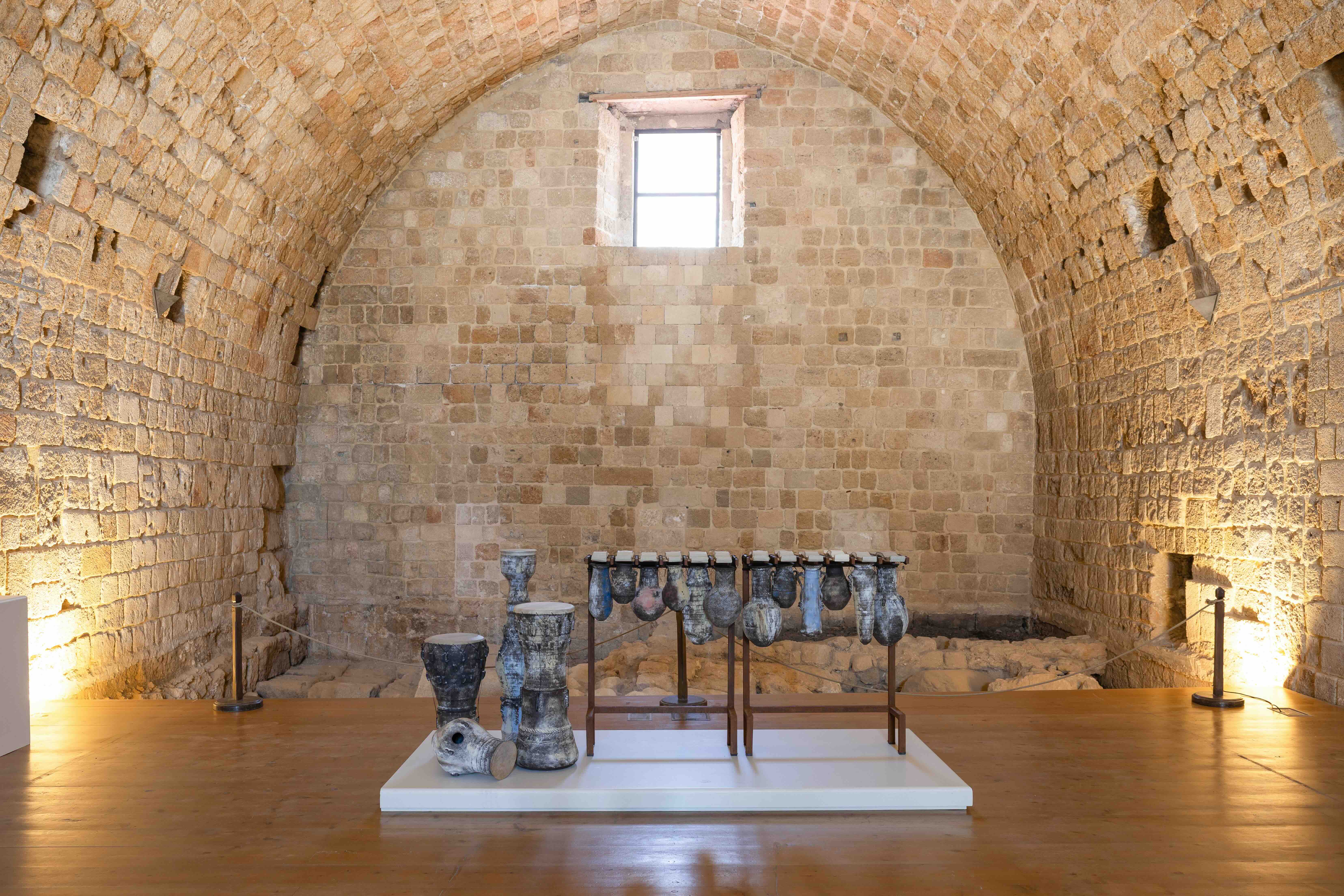
Curated by Loukia Thomopoulou, Stamatia Dimitrakopoulos, and Anissa Touati, the biennale places this medium within a wider Mediterranean conversation. Its title, Where the Day Starts, refers to Rhodes’s mythological association with sunrise. Light becomes more than atmosphere here: it opens a frame for origins and renewal. Although the central exhibition unfolds across five historical venues, I found myself returning to the Armoury De Milly. Tied to the island’s defensive past, the building has an austere presence, and its heavy architecture signals protection and control. The works inside resist that rigidity, bringing softness and resonance into a site once defined by warfare.
Lillian Lykiardopoulou’s Untitled (2025) is a porcelain sculpture of two elongated red volumes. They stand close, almost touching, yet do not merge; they look organic without resolving into figuration. The piece holds union and distance in careful balance. Porcelain gives the surface a vivid luminosity, making the object hover somewhere between sculpture and painting. Nearby, Zoe Williams’s Saint Agatha’s Revenge Parlour Set (2022) draws on the history of majolica and its movement through trade. Made during a residency on the Ligurian coast, the piece turns devotional violence into an unsettling domestic scene: Saint Agatha’s severed breasts, often shown on a platter, are recalled through the pastel green of Sicilian feast cakes. The sweetness is deceptive—Williams uses decoration to expose how brutality can be absorbed into ritual and taste.
Further along, Natalia Triantafylli presents vessels that combine handmade clay with 3D-printed elements generated from scans of her own forms. Nuts and bolts remain visible—nothing hides the join. The arrangement evokes future archaeology, pointing toward a solar ceremony not yet invented. Their hybrid structure avoids sentimentality; instead, it treats inherited knowledge as something precise and alive. The strongest encounter, however, is Vassiliki Kyriaki’s L-akrimaria (2026). This ceramic musical instrument brings together idiophones and membranophones inspired by Mediterranean traditions. Its resonators echo ancient tear bottles, while the title connects Latin and Palestinian Arabic through grief and generosity. Waiting to be performed, the work suggests that shared trauma can find a pulse. I liked how it refuses silence: it does not illustrate pain; it asks to sound through it.
What stays is not only the impressive revival of ceramics, but the way these artists let material carry memory without nostalgia. In Rhodes, clay speaks from within thick walls, in a language that keeps changing shape. That tension gives the exhibition its force and makes the Armoury feel unexpectedly porous today, too.
A World in the Making: The Shakers
Institute of Contemporary Art, Philadelphia
January 30 – August 9, 2026
A so-called final good is that which is produced as a complete object for sale to customers. Designed in the satisfaction of a need, these goods are often household products and comestibles as opposed to raw or partly processed materials which might be purchased for further transformation. A utopian Christian sect which peaked in membership in the mid-nineteenth century, the economy of the Shakers was underpinned by the production of high-quality, sparsely designed consumer goods which have lived on to inform contemporary design aesthetics even as the Shaker movement nears extinction. Mixing historic Shaker writing and objects alongside newly commissioned work from an international group of contemporary artists, A World in the Making: The Shakers at the Institute of Contemporary Art Philadelphia offers an alternative historiography for the United Society of Believers in Christ's Second Appearing: beyond their aesthetic half-lives, this exhibition explores the enduring relevance of the religious and political ideology inherent to these objects.
Merging traditional Shaker worship with inspiration drawn from ring shouts and traditional African-American church songs, Reggie Wilson’s POWER – Every Movement is Sacred (2025) documents Fist & Heel Performance Group in ecstatic motion. Invoking the legacy of Rebecca Cox Jackson, the leader of the Shaker community in Philadelphia and the only Black woman to lead a Shaker community, POWER opens an underpinning hum of sound and motion to enliven the galleries. In contrast to staid contemporaneous illustrations of Shaker worship reproduced nearby, Wilson reminds us that Shaker worship was an embodied, communal, and deeply political act. Embroidered in swirling geometries upon yards of cotton, Kameelah Janan Rasheed’s soaring, ekphrastic banners bring a sense of careful choreography and flurried activity to texts drawn from Jackson’s writing. Invoking a schematic for Shaker worship by Timothy Randlett reproduced in the neighboring gallery, Rasheed offers her own utopian vision for the enduring echoes and reverberations of Shaker teachings.
Shaker labor is something easily idealized as communal, as devoid of Marxist alienation and loaded with spiritual succor. In her famous remonstrance, “I don’t want to be remembered as a chair,” Sister Mildred Baker aptly anticipated the difficulty of disseminating an object history of the Shaker movement. A renowned Shaker singer, Baker feared that the beauty of consumer goods produced by Shaker communities would outlive the spiritual message which they were made to financially support. This dialectical tension emerges in Chris Liljenberg Halstrøm’s My Work Station / My Prayer Room (2025), a hand-constructed, idealized workstation for one. Considered alongside the accompanying Shaker chairs installed nearby, the isolation of the kneeling desk evokes COVID-era optimization and aestheticization of remote work. In its solitude, Halstrøm’s interpolation of labor and prayer troubles the individual and the collective, questioning whether labor can be made worshipful under capitalism.
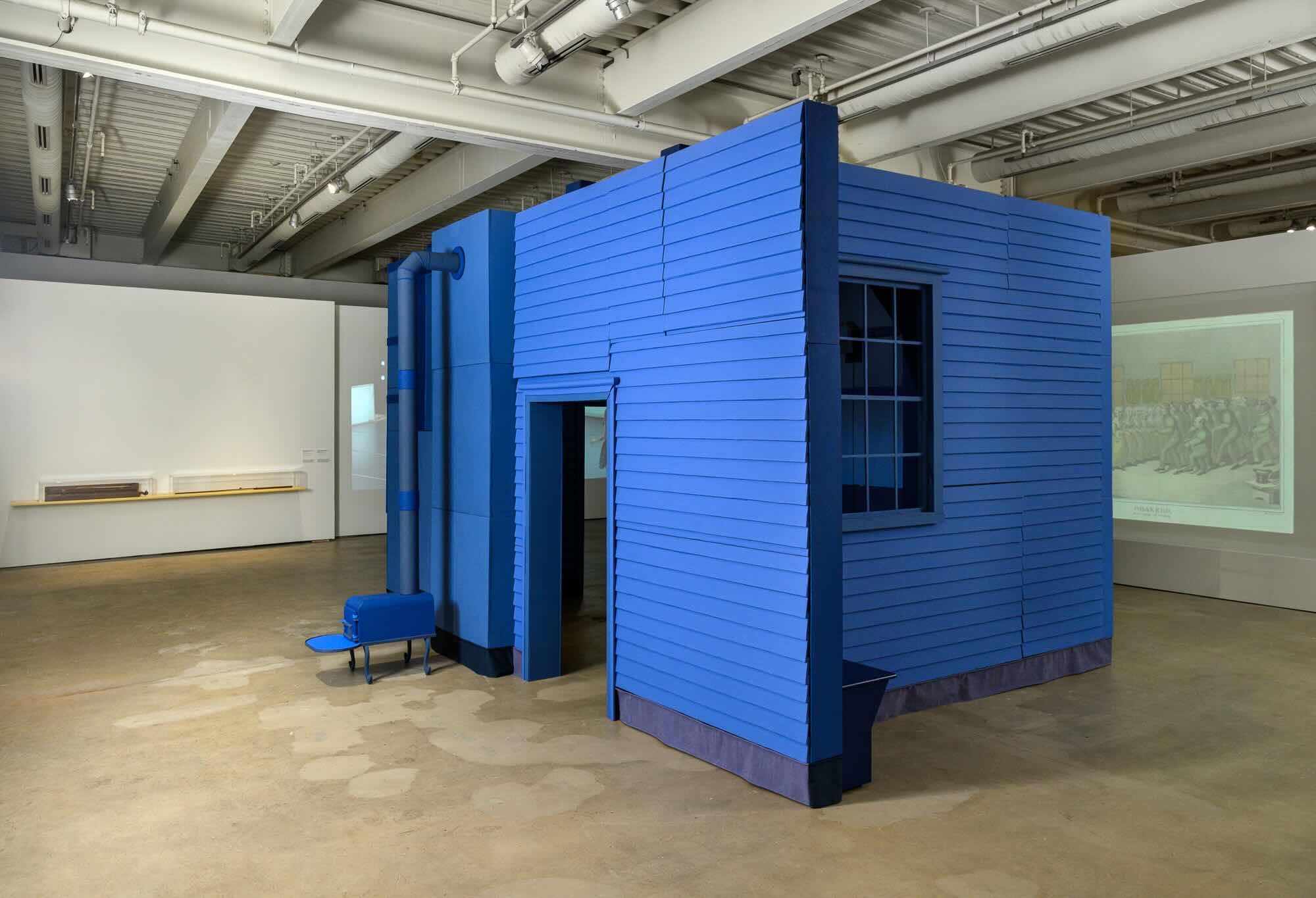
At the exhibition’s entry point, Amie Cunat’s monochrome blue 2nd Meetinghouse (2025) looms. Offering sightlines of and through the exhibition, Cunat’s meetinghouse troubles easy understandings of interior and exterior. Open windows and open doors serve as frames to recast neighboring objects and works, offering a bridge between the inside and the outside. With this logic of porosity in hand, A World in the Making allows the final good of Shakerism, understood as the movement’s lingering social, political, and spiritual influence, to be understood as something tenuous and still emerging.
still life small deaths
Brigitte Mulholland | 81 rue de Turenne, Paris
June 12 – July 25, 2026

The table is set, and the wine is waiting to be poured. But who actually gets a seat?
The history of the still life, or nature morte, is traditionally one of frozen observation, a static scene of cut flowers, ripened fruit, and the spoils of the hunt. The genre would suggest that we are merely spectators of the material world, documenting its decay from a safe distance. Yet, in the hands of the contemporary queer artists gathered for still life small deaths, the still life is re-staged. The curatorial departure point is xenia, the ancient Greek concept of the sacred covenant between host and guest, as Dr. Ksenia M. Soboleva asks viewers to examine who is nourished and who is permitted to belong. No longer a passive arrangement of nature morte (dead nature), the table is rather an active, defiant site of relationship, mourning, and ecological protest.
Just as a still life displays the excessive abundance that is a hallmark of modern life, it also calls attention to the “small deaths” that compose daily existence. The table depicts loss in full color, drawing attention to the human and ecological costs of our appetite. There is, it seems, as Soboleva writes, “a decay already embedded in decadence”.
For these artists, the nature morte genre is inextricably linked to la petite mort: the erotic climax and the dissolution of the self. In moments when a figure is in the frame, lounging amongst the tools of the trade or mirroring the droop of a flower, the genre’s traditional absence of the living is replaced by a tangible, restless presence. Live animals are replaced by deer-shaped lamps, and plastic objects stand in for the abundance of an Earth running out of time. Suddenly, when viewed in the context of resurgent xenophobia and accelerating environmental collapse, painting a wilted tulip or a plucked turkey becomes an act of resistance. The bits of what has been mourned and what has endured are gathered in care, transforming a display of the dead into an altar for the living. In still life small deaths, desire and decay meet at the table to negotiate the terms of our collective future.