

.webp)

“Thucydides Fever Dream” at Hill Art Foundation
Review
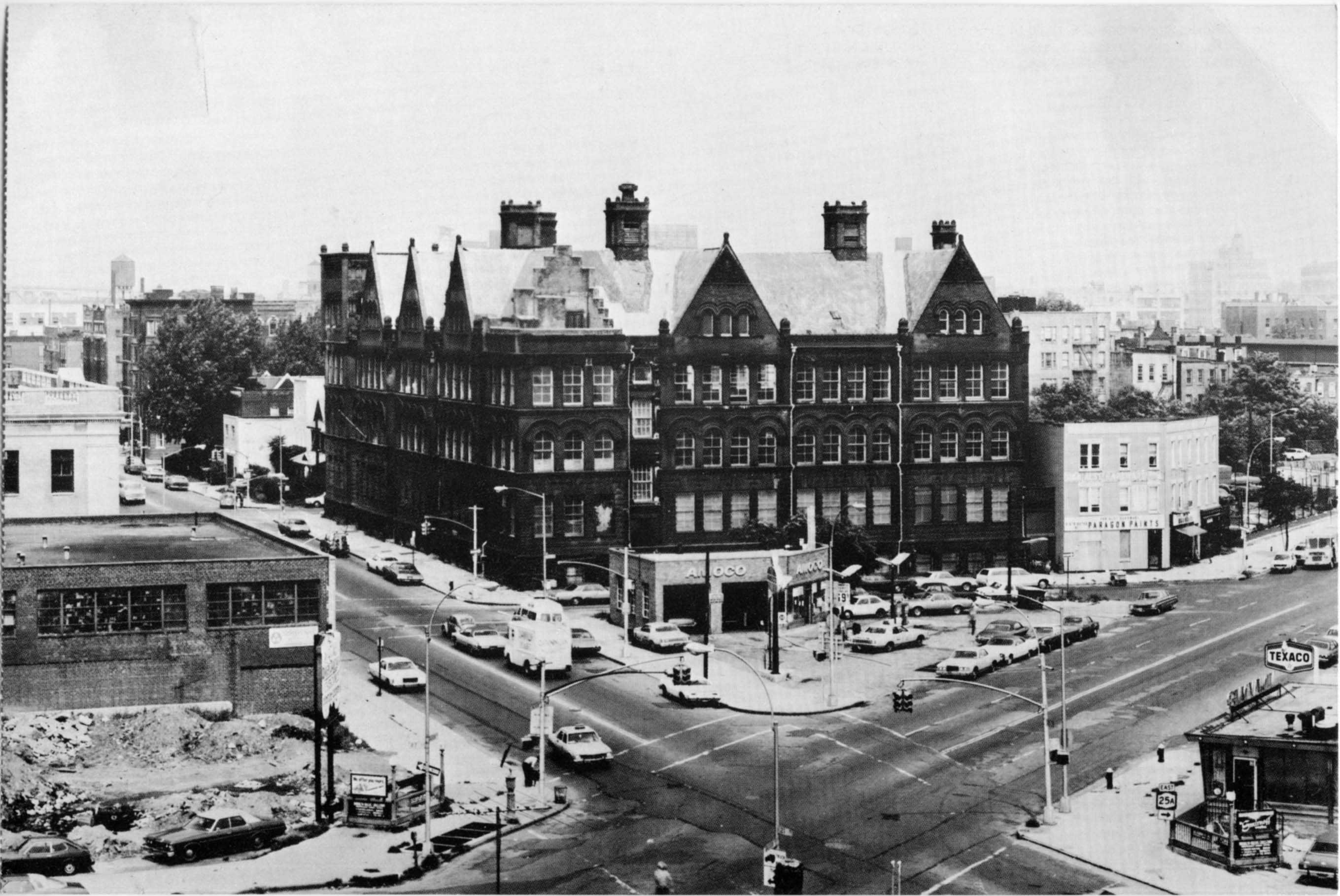
In Gowanus, a commanding red-brick building dating to 1904 once powered the borough’s streetcars and elevated railways. Later abandoned and nicknamed the “Gowanus Batcave," it now powers the creative community as the home of Powerhouse Arts.
Under the leadership of President Eric Shiner, Powerhouse Arts has assumed both a local and an increasingly international role in the visual and performing arts calendar, while also serving as a hub for art fabrication from ceramics and prints to woodwork and metal fabrication. This emphasis on production recalls Gowanus’s history as a 19th-century industrial center, but also precedents such as the Bauhaus in Dessau and the Omega Workshops in London, where the on-site relationship between manufacture and exhibition helped erode distinctions between fine and applied art and created new structures for artists to experiment across media and access new commercial outlets.
Powerhouse Arts echoes this lineage with a seemingly expansionist outlook: three years in, the nonprofit has hosted two art fairs—CONDUCTOR and the Brooklyn Fine Art Print Fair—staged the three-month performance festival Powerhouse: International and, in June, opened its first major exhibition. The Ark expands upon an exhibition initially curated by Eric Fischl at The Church, the nonprofit Sag Harbor arts space founded by Fischl and April Gornik but now expanded to fit the cavernous space of Powerhouse’s turbine hall.
At the same time, a conversation with Shiner reveals how the nonprofit’s ambition expands concentrically, with artists and the local community at its center. That commitment can be seen in the decision to locally source new additions for The Ark, as well as in initiatives such as offering free booths to academic printmaking departments at the Brooklyn Fine Art Print Fair.
A week after the opening of The Ark, Shiner spoke with IMPULSE about his path to Powerhouse Arts, the institution’s place within an increasingly crowded arts calendar, its relationships with artists and the surrounding community, and even the graffiti that remains across the Turbine Hall.
.jpeg)
J. Cabelle Ahn: Could you start with how you would describe Powerhouse Arts to someone encountering it for the first time?
Eric Shiner: I always start by saying that we center artists first and foremost. Powerhouse is primarily an organization that supports creative expression writ large. We’re building a new kind of cultural institution where art is made, experienced, lived, and shared. Museums are generally focused on viewing art, while our production facilities and six active workshops are about making it. Very rarely do those functions exist under one roof.
The way I boil that down is to look at my old life [as the director of The Andy Warhol Museum] and think of Powerhouse as a neo-Silver Factory because for Andy, his Factory was not only a site of physical art production, but also a site where art was consumed and culture produced.
JCA: Speaking of Warhol, I’d love to hear about your own path through the arts. In addition to leading The Andy Warhol Museum, you’ve worked at commercial stalwarts including Sotheby’s and White Cube New York, as well as nonprofits such as Pioneer Works. What draws you to one kind of art organization over another?
ES: I started as an art historian focused on medieval Japanese art and later contemporary Japanese art. I lived in Japan for six years, first as a graduate student and then as a curator.
What always drew me to the art world was spending time with artists: being in the studio, learning, absorbing, and seeing what motivates them and how they turn those ideas into physical, or often nonphysical, forms of production. I’ve always made time for at least one studio visit a week, and I maintain that practice to this day. Being in constant dialogue with artists about their needs in the here and now has informed many of the decisions I’ve made at a museum, a commercial gallery, an auction house, and now at Powerhouse Arts.

JCA: Earlier, you compared Powerhouse to the Silver Factory, and Powerhouse is itself a constellation of small factories, with several fabrication spaces. Could you speak about the production side and its business model?
ES: In terms of fabrication, we inhabit a kind of strange, neutral place in the art world. We work not only with artists directly, but also with galleries and museums, and we make many public art projects with nonprofits and regional organizations.
Everything in our shops is contractually based, from ceramics, printmaking, and public art to our wood, metal, and textile programs. We also have a physical store where we do a 70/30 split, with the artist receiving 70 percent, because our priority is to put as much money as humanly possible into artists’ hands. We also have a Print Publishing Program, where we split proceeds evenly with artists. It is currently centered on the print department, but we will soon be producing ceramic and sculptural editions as well.
JCA: From the outside, it seems like this artist-centric focus extends to the two art fairs you have hosted on site: the Brooklyn Fine Art Print Fair and CONDUCTOR. How do you see them as operating within, or as an alternative to, the fair circuit?
ES: We started by asking, “How can we create art fairs that artists actually want to attend and feel they should be part of?” I’ve always said that most art fairs are not made for artists to be there. We want ours to be places where artists are welcome and feel that they are part of the vibe.
We also want the fairs to be affordable. Most art fairs are expensive because they have to rent a venue, and they pass those high costs on to participating galleries. Booths at most big fairs can start around $14,000 and rise into six figures, while ours [for CONDUCTOR] start at $2,500 for nonprofits, $3,500 for artist-run spaces and collectives, and go up to $12,500 for our largest gallery exhibitor booth.
Because we own our building, we were able to drastically reduce the prices; by extension, younger, smaller, and emerging galleries, as well as galleries from around the world that normally don’t have access to the New York art ecosystem, can participate.
We also decided to open the fairs directly to artists. Many people assume that most artists don’t want to sell their work directly, but that’s actually not true. I know it isn’t for everybody, but many artists love meeting collectors and having that immediate dialogue. It has been really exciting to see entrepreneurial artists thrive in these environments. They have given us strong feedback about how much they enjoy talking about their work—and, yes, selling it.

JCA: You’ve underscored the fact that Powerhouse puts artists first. I’m struck that the first exhibition on view is The Ark, curated by Eric Fischl and first shown at The Church. Can you talk about the genesis of the exhibition and the curatorial choices that shaped this version?
ES: Eric and I have known each other for years. He called [last year] and asked me to come out to The Church and see the exhibition and, as a bit of an animal nut and dog owner, I immediately fell in love with it. I’ve collected artworks centered on animals for a long time, and I was immediately engaged by the show’s range of materials.
At that moment, the Powerhouse Arts team was discussing what our first exhibition would be, and The Ark hit on everything right out of the gate. It was curated by an artist, and it was about how artists take a common subject and go off in their own wild directions to bring it to life.
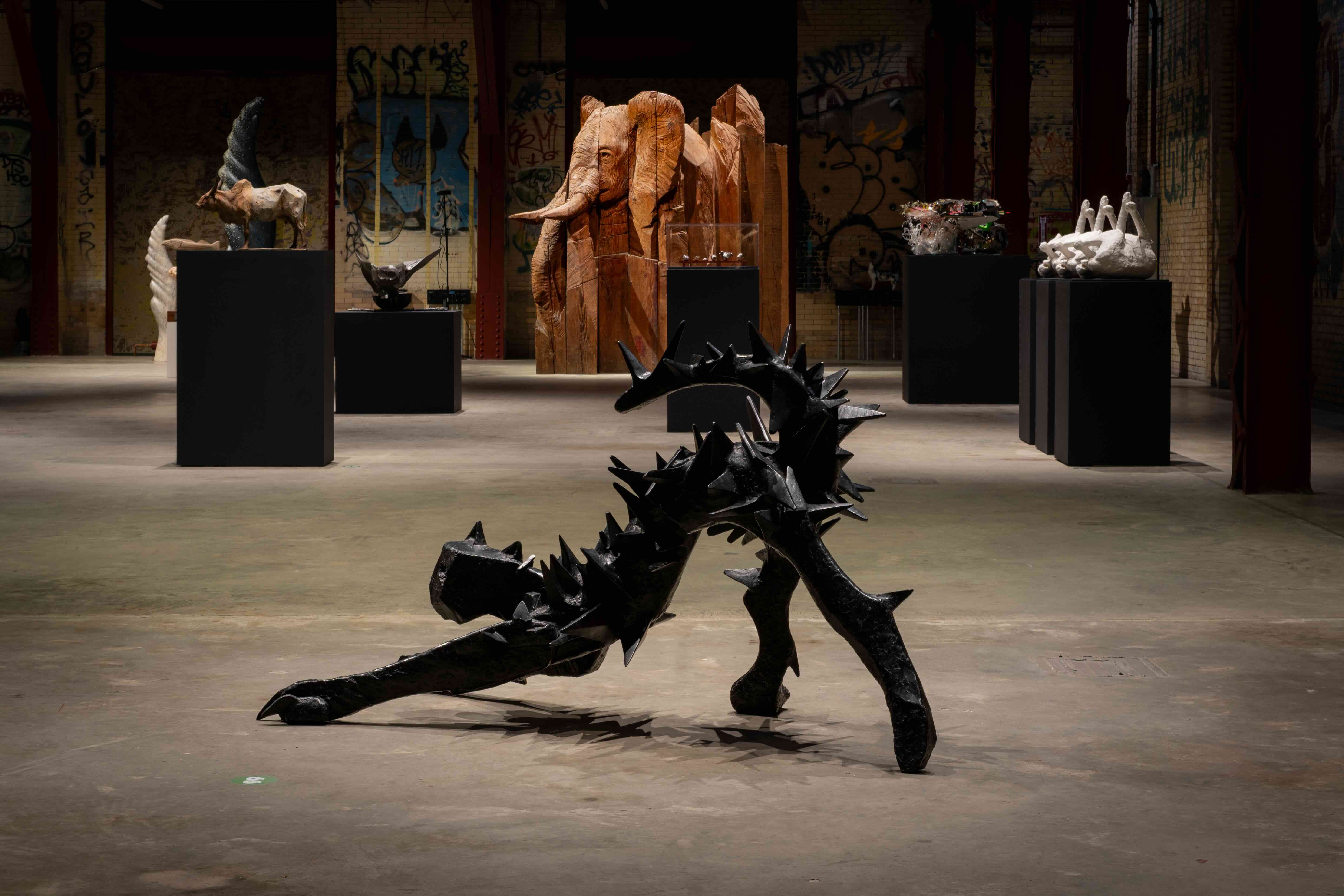
Our space is basically twice the size of The Church, so we realized that we needed to add at least 40 more sculptures. It was important, however, not to busy the space with wall text, labels, and typical museum language. The show ranges in scale from a ceramic fly all the way up to a life-size 3D-printed elephant, with everything in between. We wanted people to walk through and interact with it, as though they were in an animal sanctuary or refuge, and to convene with the materiality up close.
JCA: The installation also takes advantage of the historic graffiti in the Grand Hall as well.
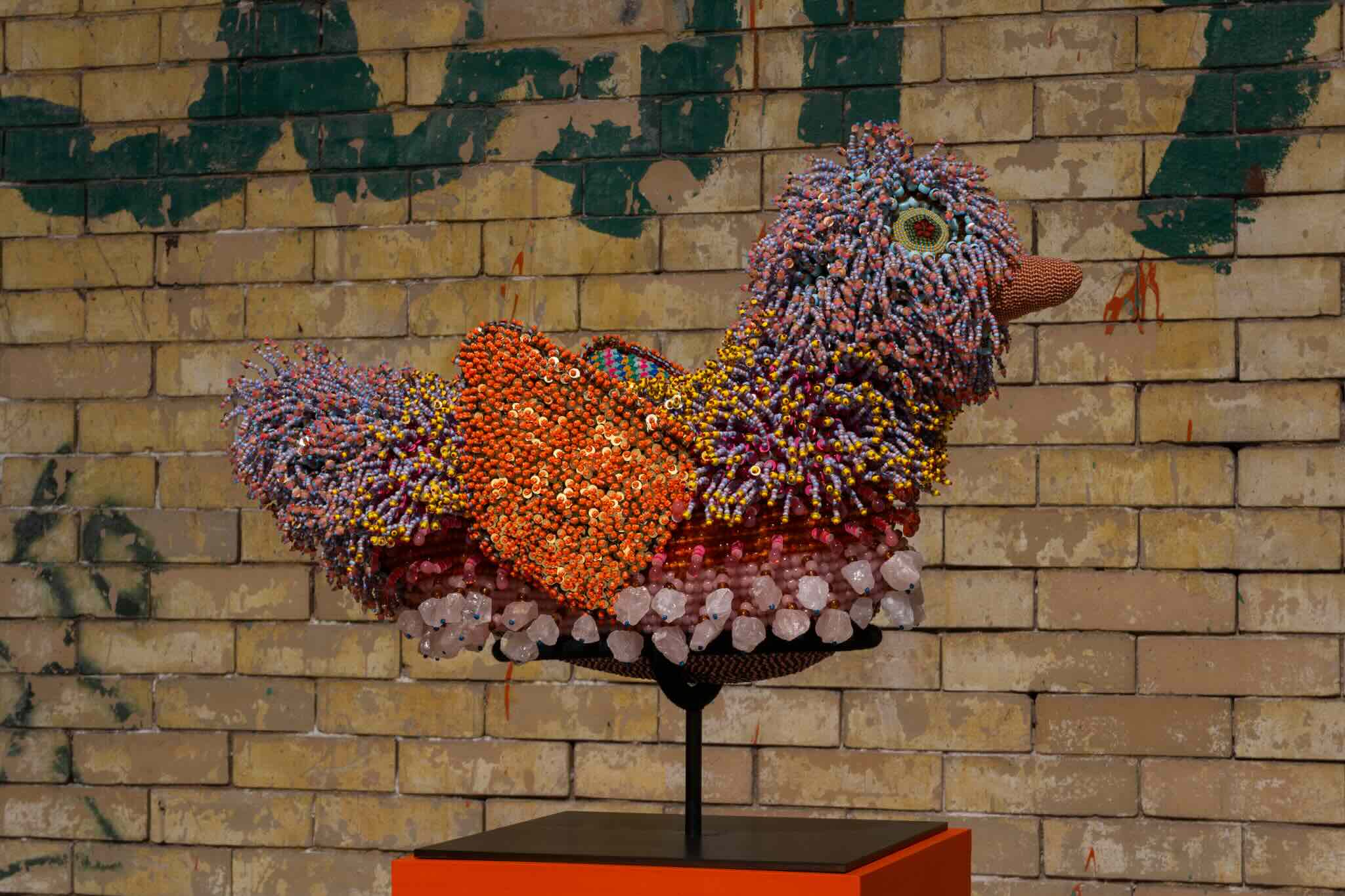
ES: The graffiti is another important part of the building’s history. I had a lot of fun determining which works would sit in front of certain sections. Jeffrey Gibson’s sculpture is a great example. We knew Jeffrey was going to make a new work with an orange base for the show, so I walked around the Grand Hall looking for an orange moment in the graffiti. We found an area with several green marks and a burst of orange. It’s been fun to see how well the animals work against the graffiti.
JCA: Were any of the works sourced directly from the surrounding neighborhoods?
ES: Because of my time in Japan, we’re close with NOWHERE Gallery, a Manhattan gallery that supports Japanese artists in New York. They reached out a couple of months ago and told me that Toshio Sasaki’s widow lives in Park Slope and asked whether I would visit the studio. As soon as I walked in, there was a massive [wooden] elephant standing in front of me [Moving Earth, 1989], and I realized that we needed it for The Ark. Sasaki was a well-known public artist in New York, and the elephant had been shown in Central Park in the 1980s. He was also one of the finalists for the 9/11 memorial, which I had not known.
Once I learned more about him and his sculptural sensibility, bringing the elephant into the show was a no-brainer. The extraordinary thing is that it had been living only three blocks away for more than 20 years. I really loved the neighborhood aspect of it: the sense that the elephant simply migrated down from Park Slope to join us.
JCA: You also host performances, and one of my favorite productions in Powerhouse International last fall was William Kentridge’s Waiting for the Sibyl. Can you talk about Powerhouse’s relationship to projects that sit outside the conventional gallery or museum model, and how you decide which productions to support?
ES: The festival came about through David Binder, who served as its artistic director. I gave David a tour [of the facilities] and said, “Dream big. Think about what you would want to do in our space.” He came back a couple of weeks later and said that he would love to organize a performance art festival, and we began looking at the gaps in New York’s performance landscape.
We really wanted radicality and globalism to be the festival’s two driving forces. For several reasons, work that might be considered more radical was not receiving as much airtime in New York, and neither was work from overseas, largely because of budget constraints. Given where we are in the world, I wanted the festival to lean into both—being as radical and as international as we could.
David then traveled the world and brought several projects to New York as premieres. We were very lucky to be able to present Kentridge’s work, and I still get goosebumps thinking about it.
It was also important to make the festival as accessible as possible and keep ticket prices low. More than half of the 22,000 tickets we sold over its run were $30.

JCA: Powerhouse is in a particular part of Brooklyn, with its own histories of industry, labor, and cultural production. Since outreach is also part and parcel of accessibility, how do you think about activating the local community?
ES: We want to be a resource for the community at large, from the 400+ artists who are members of Arts Gowanus to our community stakeholders and other neighborhood nonprofits. We also have strong, longstanding relationships with all of the local NYCHA residences.
For example, we run a program called Art Where You Are, where we offer art-making classes at NYCHA residences, other nonprofits, and schools. There is always room for more community engagement, and I would be remiss not to say that. While we cannot be everywhere at once, we want to put art in front of as many people in our immediate community as possible and make Powerhouse feel like a third space that is open to everyone.
JCA: Finally, what is new and upcoming at Powerhouse?
ES: We’re excited about the exhibition program and our new curatorial team. Constanza Valenzuela, our associate curator, just joined us from the High Line and has been revamping the artist residency and artist subsidy programs.
Liz Munsell [the Vice President of Curatorial Arts and Programs] is also working on our exhibitions. Beginning in 2028, we will launch an in-house exhibition program that takes full advantage of our fabrication facilities and our space in ways that other institutions may not be able to. Between now and then, we will host traveling exhibitions from around the world, and we’ll soon announce our fall exhibition, a tech-based experience coming from a prominent institution in Europe. We’re additionally planning the second Powerhouse: International for fall 2027.
So, we're continuing with the idea of centering artists first and foremost to develop Powerhouse as a place where people can pull back the curtain and see how art is made in new and exciting ways.
This interview has been edited for clarity and length.
The Ark is on view at Powerhouse Arts from June 11 through August 30, 2026. Powerhouse Arts is located at 322 3rd Ave, Brooklyn.