.webp)
“Are you lonely tonight?” at the Australian Centre for Contemporary Art
Review
Botanist and writer Robin Wall Kimmerer observes that the English language treats water as an object: an "it" that can be owned, diverted, metered, and sold. This quiet, everyday grammar of dispossession strips water of the standing otherwise afforded to living beings. It is this tension, between water as commodity and water as kin, that animates Yehwan Song’s The Other Internet at Subtitled NYC.
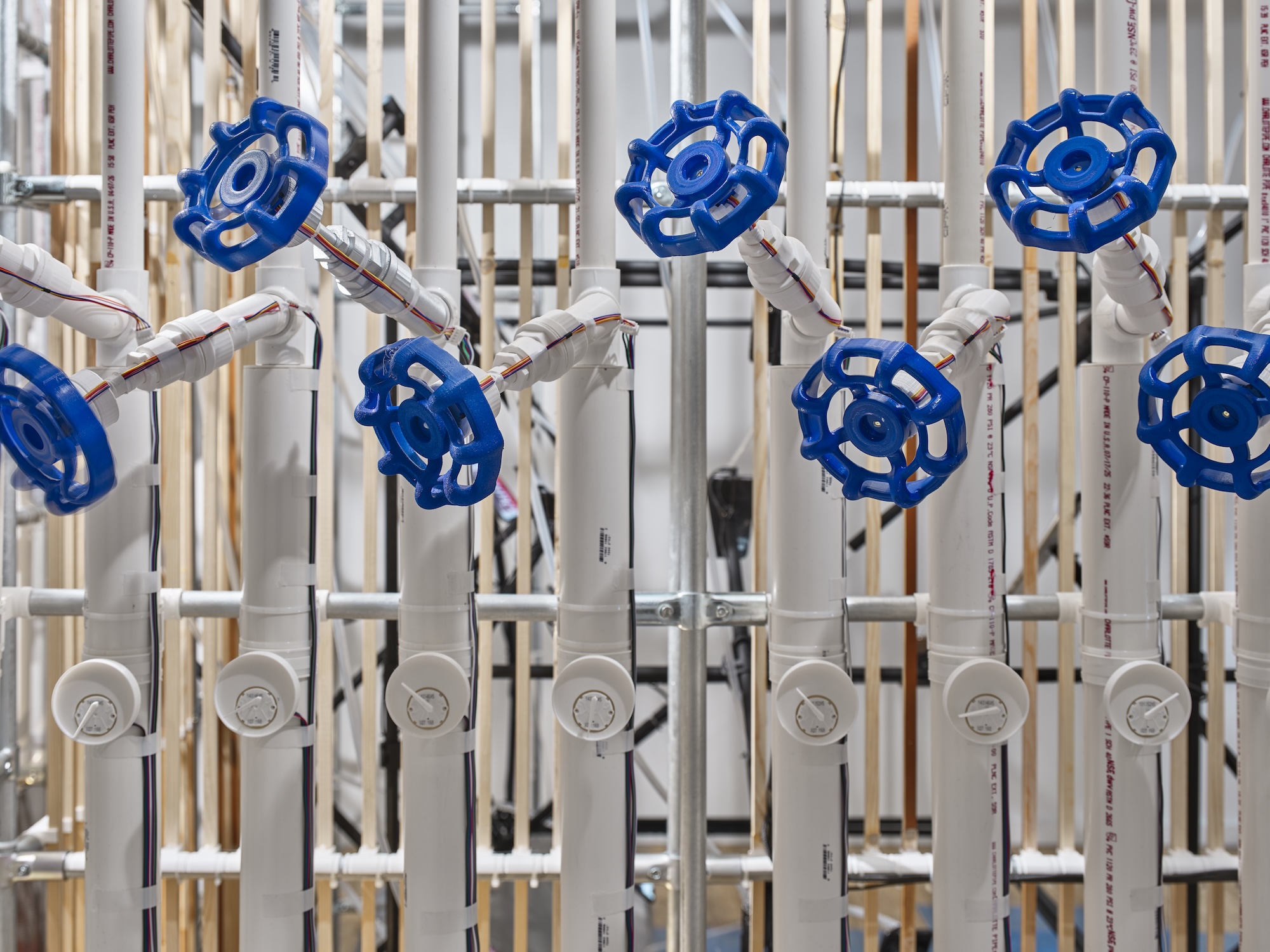
Song’s installation materializes as a vast plumbing ecosystem. Water pipes snake overhead and underfoot in the confined space. Struts cross and lock. Valves open and close. Pumps churn and pulse. The artist’s kinetic sculpture, curated by Brian Droitcour, complicates the digital screen's smooth, frictionless surface by activating omnipresent building structures rarely perceived or acknowledged by passersby. And out of that mechanical choreography, language stutters into being: sentences assembling themselves on smartphone screens, line by line, as fast as the rationed water allows.
The internet has always been described using aquatic terms. Content flows through streams. Data pools into clouds. Song has spent years tracking this vocabulary through her artistic practice, and she's arrived at an uncomfortable diagnosis: that this relational metaphor between water and information isn't neutral nor coincidental, but ideological—a testament to how seamlessly the extractive, commodifying logic applied to water has been absorbed into the way online information is imagined, transferred, and governed.
Indeed, this rhetoric on digital unease is a familiar one, warned to us by thinkers as early as Walter Benjamin and solidified by recent scholars like Shoshana Zuboff and T.J. Demos. We know that artificial intelligence is violative, that digital surveillance is discriminatory, that the promise of a borderless network is always shadowed by the profit margins and oppressive regimes it not-so-quietly serves. Yet, while most art on the internet centers on cyberpunk dystopia or glitch aesthetics, Song pointedly goes the other way—backward, almost, into pre-digital industrial plumbing, garden architecture, and the literal physics of H₂O. By committing to the internal workings of its own metaphor, The Other Internet, through its amalgamation of natural and artificial mediums (wood that swells and contracts with humidity, PVC that blemishes and corrodes, and cardboard that wicks and softens), makes an explicitly material argument about a system we now habitually experience as immaterial.
The artist builds a fountain mirroring those historical ones seen in many European metropolises: cascading garden-like structures where the architecture of water is intimately tied to the architecture of colonial power and conquest. That history is the real subject here, transposed onto fiber and code. Song isn't interested in the internet as a metaphorical ocean so much as the internet as a managed hydraulic system, incepted and enforced by corporate and political entities with their own engineered agendas. Still, by exposing the valves, pressure, and visible mechanics of flow, The Other Internet refuses the trick. In forcing language to behave like water under real mechanical constraint, Song restores a kind of honesty to a system that has spent considerable effort resisting transparency. We are not meant to forget that there is an extensive system of labor and chaos behind the spectacle. Instead, we are forced to watch it as it works, pools, pushes, and leaks.

Even so, the work does not pretend to operate on a self-correcting, naturally democratic process. The pressure valves that release and restrict the water are still being controlled by Song and the program she has meticulously designed. In this case, competing lines of water directly streams against multiple phone screens set to different languages, their collision acting as a catalyst for text output. However, just as one language starts to flood with sentences, we hear and then see the lessening pressure as the previously strong and steady flow gets reduced while another begins to spew in its wake. What is produced is a striking model of linguistic and cultural hegemony not as a fixed hierarchy, but a constant ebb and flow held in dynamic, unstable tension. Our attention is scattered across the different languages, ranging from Latin to Arabic: do we devote it to one in pursuit of full legibility, or do we let it drift, surrendering to an indecipherable whole made up of incomplete parts? The work also poses a quieter question about complicity and familiarity, whether we inadvertently censor ourselves from content we encounter online, skimming past what resists easy translation rather than sitting with its difficulty. The enduring, political charge of the sculpture lies in its sense of speed, or, more specifically, its refusal thereof. Perhaps, the best way to counter the algorithmic current is to reclaim slowness and randomness as forms of agency in their own right.

We were told we were surfing the internet. Song, Droitcour, and The Other Internet remind us, however, that we have been following a predetermined route all along. When parsing through Song’s installation, I was struck by the generative gravity of its maximalist expanse. Ironically, I could not help but also think of a softer, older Daoist wisdom—water that yields to every obstacle yet wears down stone.
Yehwan Song: The Other Internet, curated by Brian Droitcour, is on view at Subtitled NYC through August 23, 2026.