.webp)

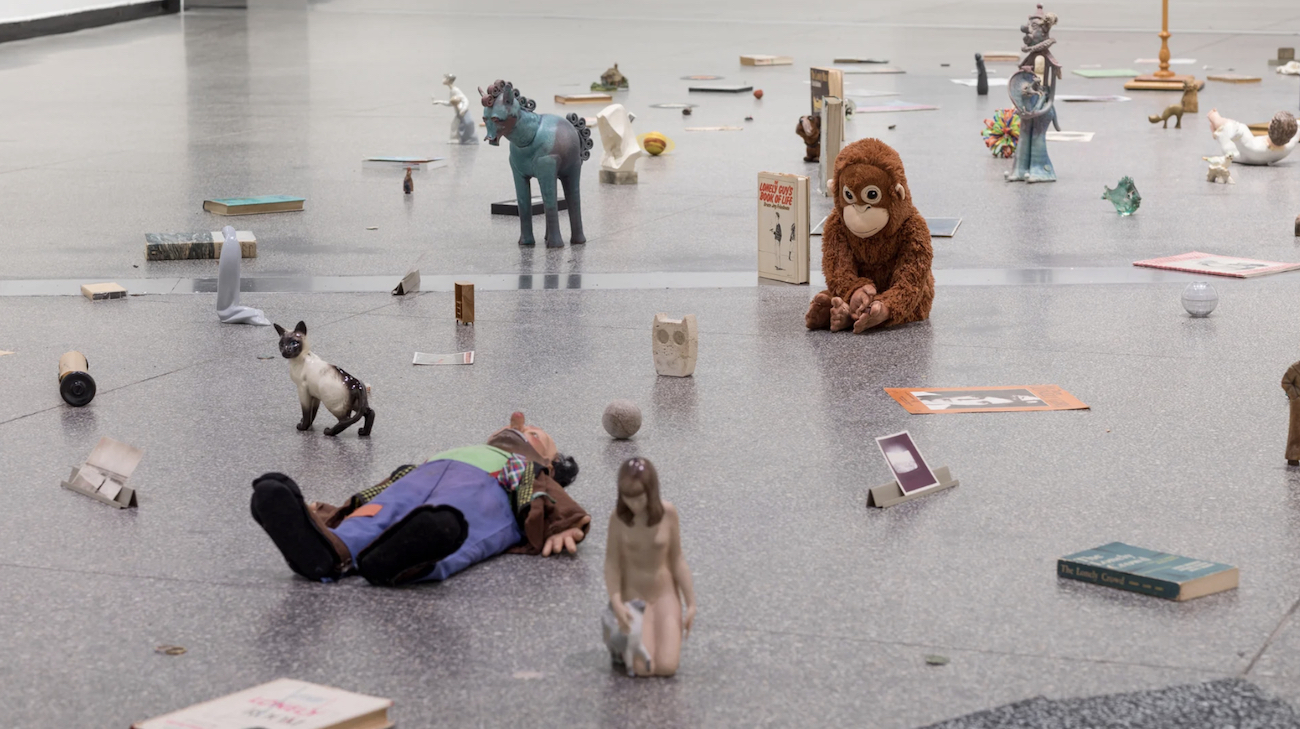
“Are you lonely tonight?” at the Australian Centre for Contemporary Art
Review

Marcin Dudek was ten years old when the Berlin Wall fell, and the Polish People's Republic collapsed. Growing up in a social housing estate on the outskirts of Kraków, his childhood unfolded within the turbulence of Poland's transition to capitalism: the dismantling of state industries and support systems, severe shortages, skyrocketing inflation, and the scarcity and instability that shaped daily life for working-class families.
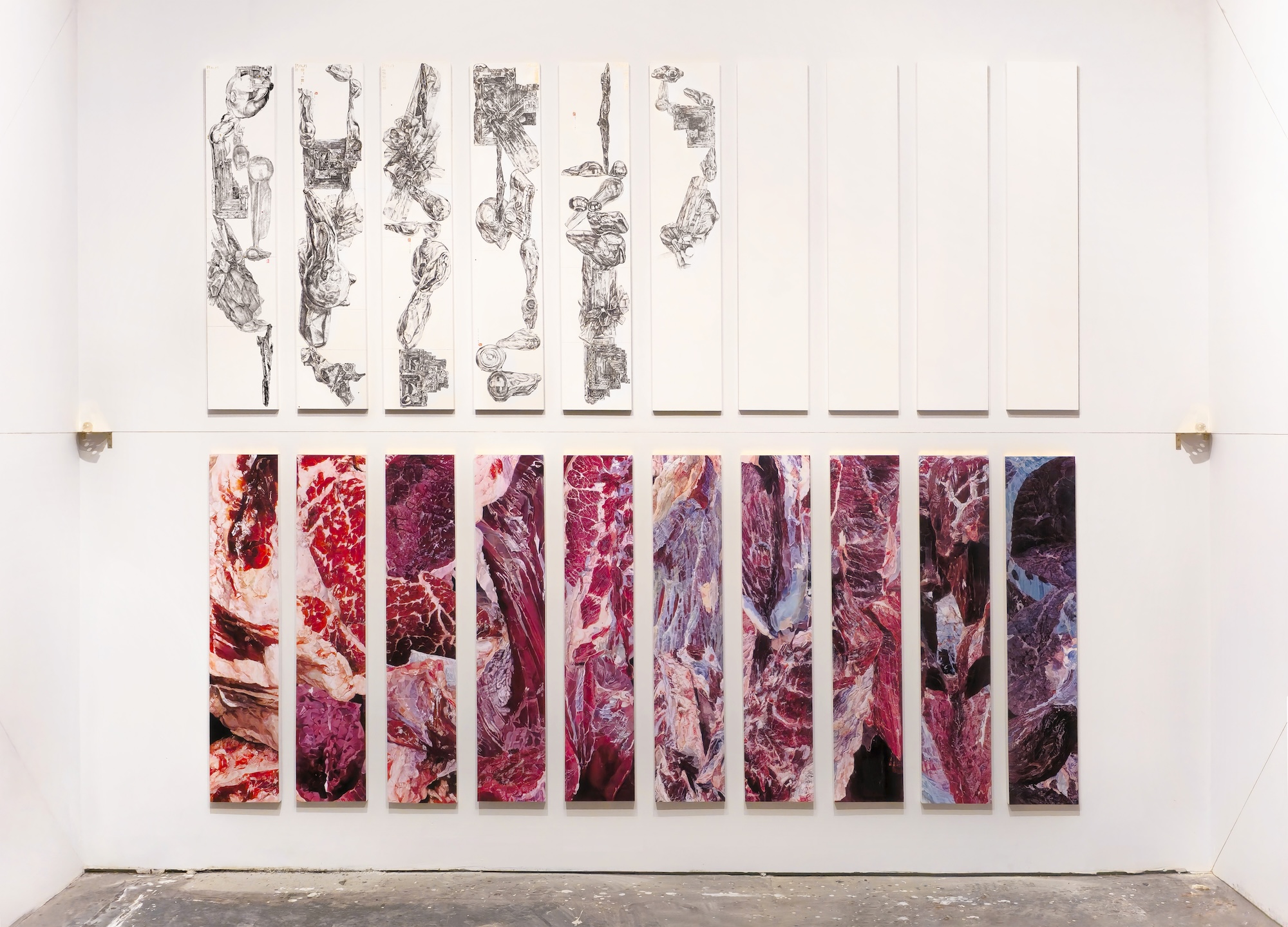
For Dudek, Kraków remains the irreplaceable point of origin. His studio, located in Brussels, becomes a space devoted to the reconfiguration and materialization of a mnemonic complex: the chosen land of untiring prosthetic maneuvers, of incessant and meticulous material processes, executed to construct a sort of hauntological historiography. Drawing from disparate biographical traces largely characterized by experiences of violence and brutality, as attested by his past as a supporting member of a violent Krakow football team Fanclub, Dudek unpacks these fragments as socio-historical uncanny abstractions.

Memory is a permeable membrane, perpetually interrogated and reconstructed as it becomes the point of origin of an autobiographical archaeology that incessantly revisits constitutive moments of subjectivity. Liquid and fragmented as it may be, memory is first synthesized and subsequently encapsulated in what the artist calls “Memory Boxes”: installations that archive lost spaces specific to his own experiences. Radiators, walls, screens, old bus seats, gym appliances, beauty salon furniture, bar interiors and even entire domestic ones become semiotic ghosts, remnants of a cultural imagination that, separated from their source, have acquired a living autonomy. By overlaying, gluing, eradicating, and grafting, the apparently neutral, indifferent inanimacy of the object-environment he selects is effectively eroded by the injection of his personal mythology.
From a specific, regionally situated perspective—as his recent solo show Flipery's reception symptomatically revealed—Dudek’s work may look like aloof representation—a sort of ingenious exercise in conformism. But then, Giorgio Agamben’s seminal essay “What is the Contemporary?” comes to mind, in which he observes that he who truly belongs to one’s time, who truly is contemporary, is he who doesn’t perfectly align with it, nor adapts to its demands. As such, he is out of time; yet, for this very reason, through this anachronism, he is more effective than others in perceiving and grasping his own time. It is within this tension—between biographical memory and formal reinvention, between belonging and dislocation, between proximity and remoteness—that the work exercises its performative capacity. Anachronism, far from constituting a limitation or a deficiency, emerges here as the very condition of the critical gaze: it is distance that makes vision possible, and fracture that produces meaning.
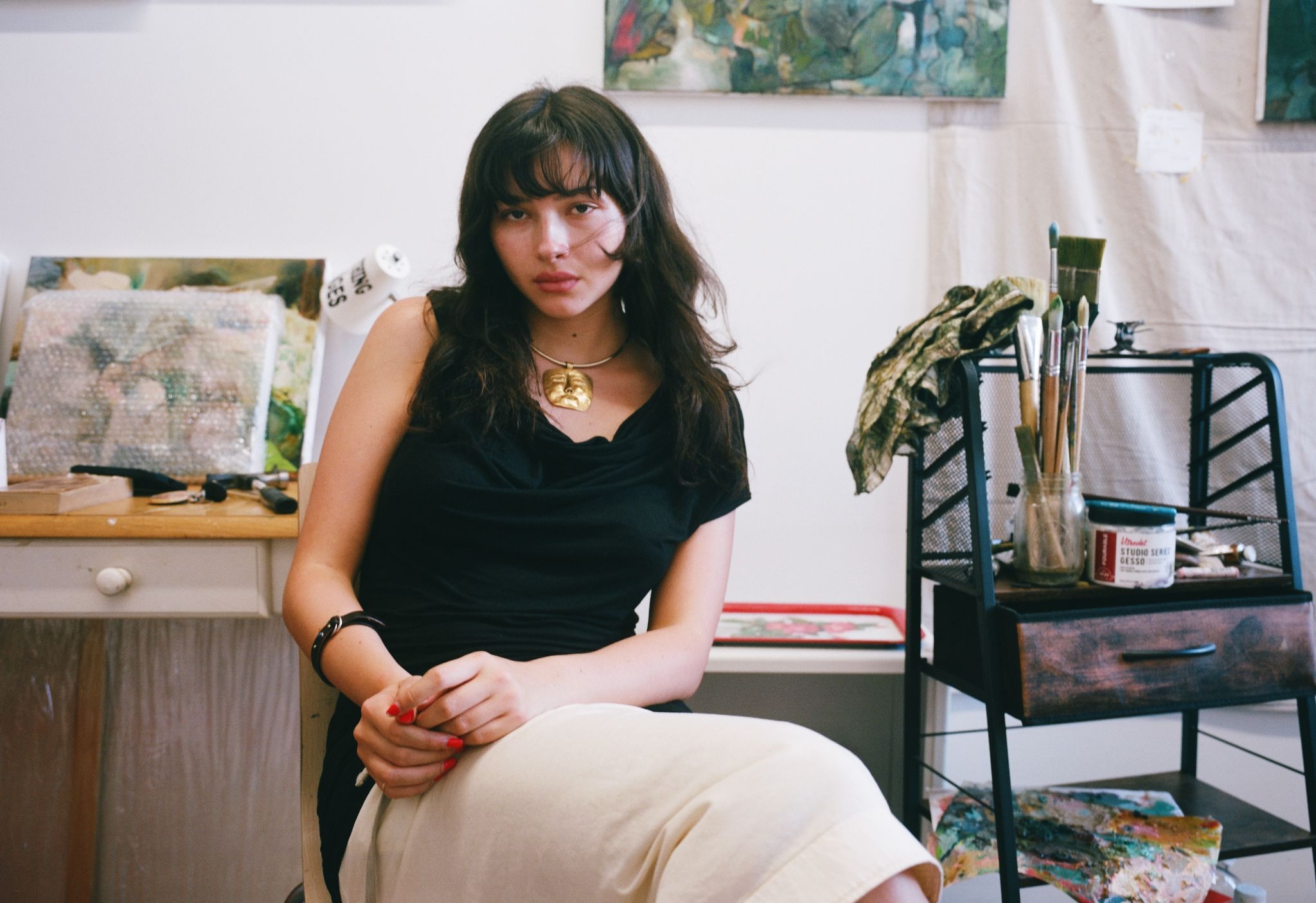
Amber Wynne-Jones’s studio is filled with canvases that slowly accumulate layers like sedimentary rock. Her paintings are bathed in translucent swaths of color that shift between earthly and ephemeral tones and back again. Some have more recognizable figurative content while others delve further into an atmospheric haze. What may appear abstract at first reveals hidden outlines of forms, bodily substrates. She thinks of this as the “‘mud”—paint as a primordial substance—out of which imagery emerges almost of its own volition.
Mud plays an essential role in the ontology of Amber’s practice. Mirroring the biblical story of man’s creation, figures are pulled out of muddy paint and have life breathed into them. The figures are de-individualized, mostly unidentifiable except for occasional “mud children”—as Wynne-Jones describes them—whose youth signals a fragile emergence. These fragmentary scenes lend themselves towards allegorical interpretation rather than literal narrative. They conjure a libidinal plane where desire is a fluid material that engulfs people and their surroundings, obscuring clear representation. Wynne-Jones's own desire has been to lean further into this obfuscation; stripping the content further down to opalescent, rippling mud.
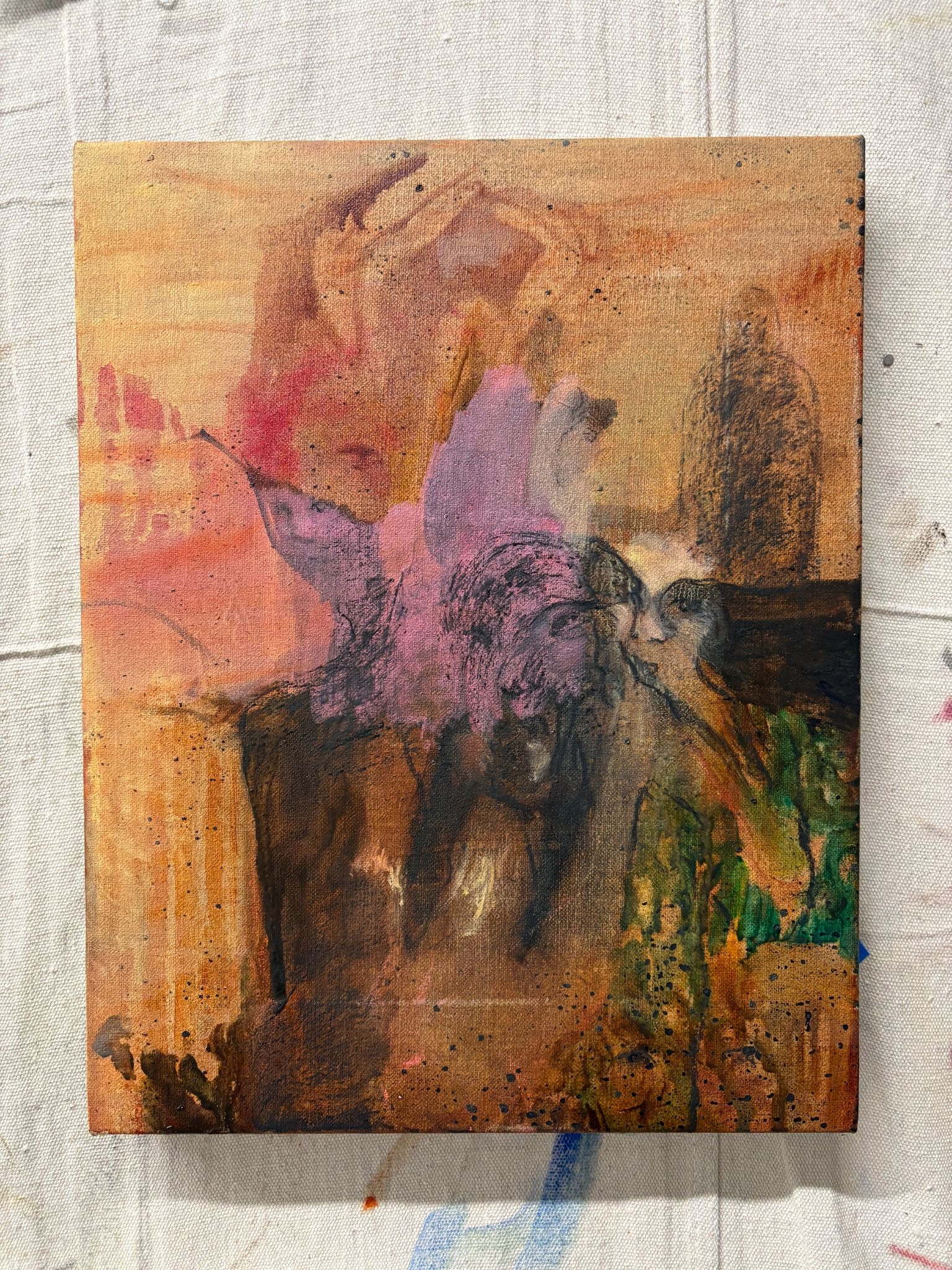
Amber has an evolving dance and performance practice which has a symbiotic relationship with her work in the studio. Painting allows her to work through the same ideas that ground her interest in dance, with a slower pace and without the pressure of an audience. The spirit of a movement-based practice is very alive in her canvases, as paint moves in dancerly gestures and figures are contorted in acrobatic poses. Her recent interests have orbited around modern dance, costuming, and theories of prehistoric dance rituals. In early sacred practices, she explained, dance was the conduit for collective ritual and spiritual awakening. Joseph Campbell’s The Ecstasy of Being (2017), which examines the relationship between modern dance, mythology, and psychology, has been an important reference for Wynne-Jones. Collective movement has been a form of merging and accessing higher powers from prehistoric times and Dionysian traditions. Her paintings capture these rapturous moments of communal movement, where it can feel like boundaries dissolve, bodies merge, and spirit is evoked.
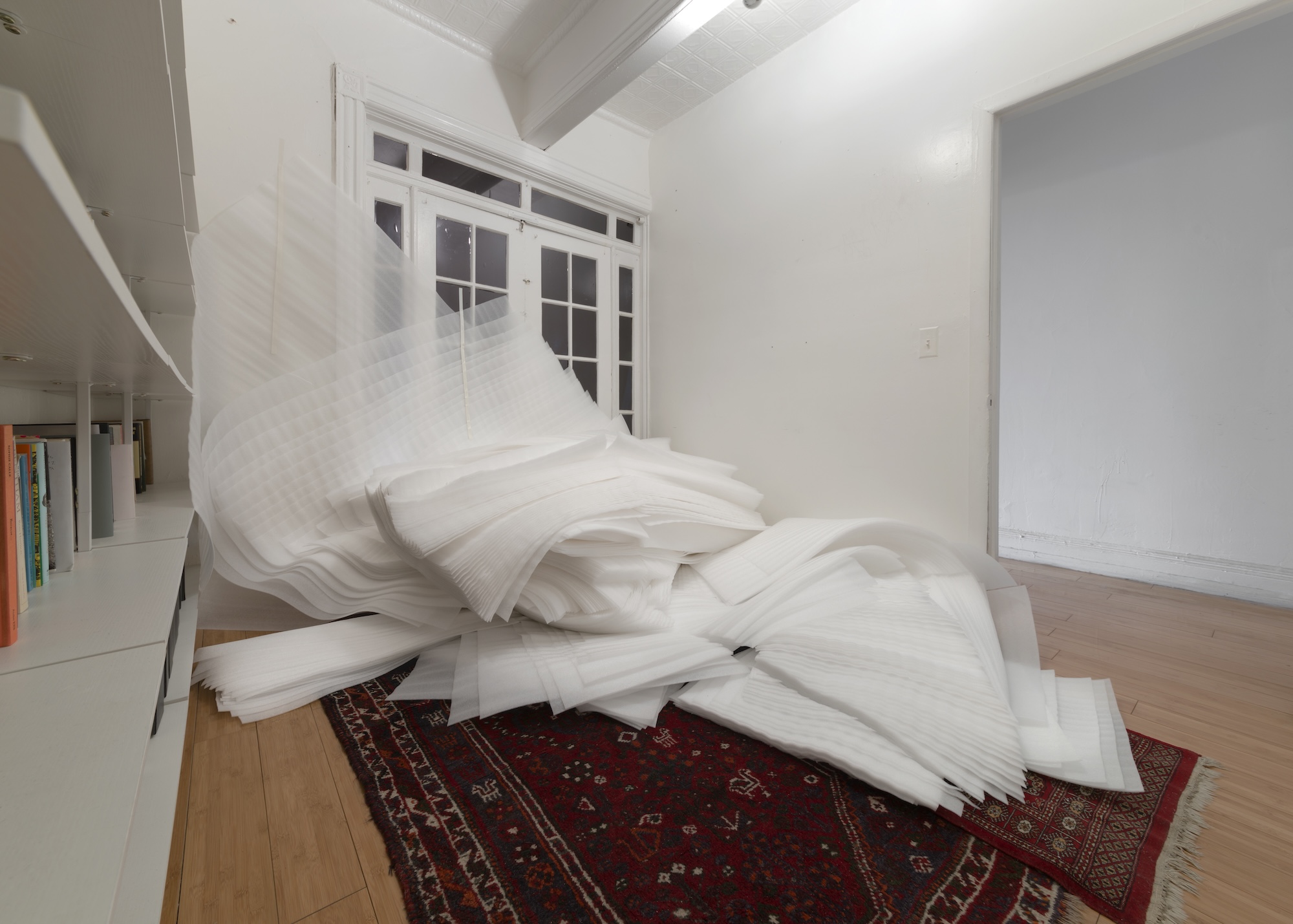
I arrived outside Jacksun Bein’s studio at around 9:15 in the morning. I thought I was prepared for this. Bein was out of town, and we had agreed it might be interesting to attempt a studio visit without the artist present. Conceptually, I liked the idea. In practice, I realized very quickly that I was not prepared at all. A studio visit without the artist is far more intimidating—suddenly it’s just you and the work.
The first thing I notice are various piles of readymade objects and improvised assemblages composed of an enormous range of materials. Some are undoubtedly sculptures in progress, while others appear to simply be materials—or is it really that simple? Rolls of colored tape are stacked one atop another. Is this a sculpture or merely a personalized way to organize studio supplies? There is no one to ask but myself. Either way, it’s compelling. The uncertainty forces me to focus more intensely on the shapes, colors, and formal relationships between objects. There’s an elevation and democratization of material happening here. Everything becomes form, line, and texture. The space transforms into an exercise in looking and feeling. Readymades stripped of the icy detachment that often accompanies this kind of work in galleries around town these days.
There are heaps of individual tubes wrapped in colored thread. Industrial tubes, tiny tubes, plastic tubes, metal tubes—a compulsive accumulation of hollow forms. Bein described tubes to me as “the most distilled version of a body: an entry point and an exit point. Eating, expelling, penetrating, being penetrated.” It’s a reduction almost to the point of oblivion. The sheer number of them, hundreds, maybe more, suggests something being worked through over time: winding and unwinding, threading and unthreading.
Nearby, I encounter a bicycle tire, a step stool, ratchet straps, and metal rods all painted the same muted tone. It reads as a Rauschenberg filtered through Duchamp, interrupted by the painterly residue of Katharina Grosse. On a nearby wall, faint painted shadows of earlier arrangements linger like the afterimage of a nuclear blast. Scrawled on the adjacent wall are the words: these are my cave paintings. Later, I learned this is part of the testing phase for a project Bein will present at Dia Chelsea this June through a fellowship program.
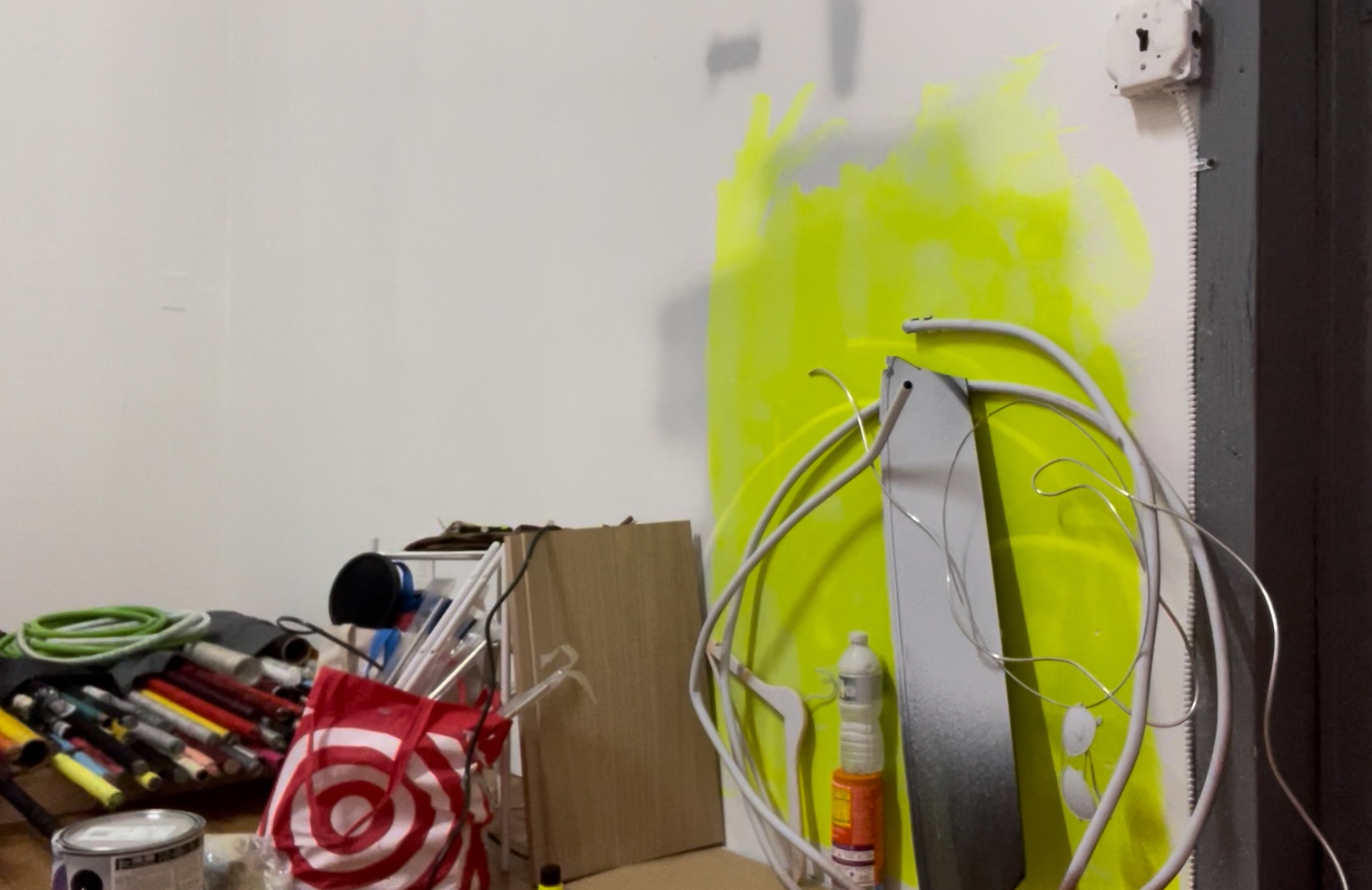
Despite the artist’s absence, this is unmistakably the studio of an artist—not because it contained finished artworks, but precisely because it didn’t. Refreshingly, nothing in the room felt fully resolved or stubbornly complete, creating a buzz of potential all around. Bein’s studio operates as a site of process, rather than production: a space for tinkering, testing, poking, prodding, and patiently accumulating gestures until the pressure of exhibition transforms them into something stable, excited, and alive for a time.
As I prepare to leave after nearly an hour alone in the studio, I glance down and notice a simple 2x4 lying on the floor. Striated cuts run across its surface. The grooves have been filled with glitter, transforming the wounds into something shimmering and metallic—a scar made ornamental. It doesn’t feel finished, but it makes clear that something is actively being worked through.
I walk out the door, and I realize the discomfort has lingered. A studio visit without the artist means there is no mediator between viewer and object. No buffer. It’s slightly frightening—as though the work had been watching me look at it the entire time. Did I do it justice? I wonder. This is precisely how Bein’s work functions best: asking for presence from the viewer while giving room for the art to do its work.
As I walk toward the train, I think again about that tired question people always ask artists: What does it mean? In Bein’s studio, meaning is not really an answer, but an activity.
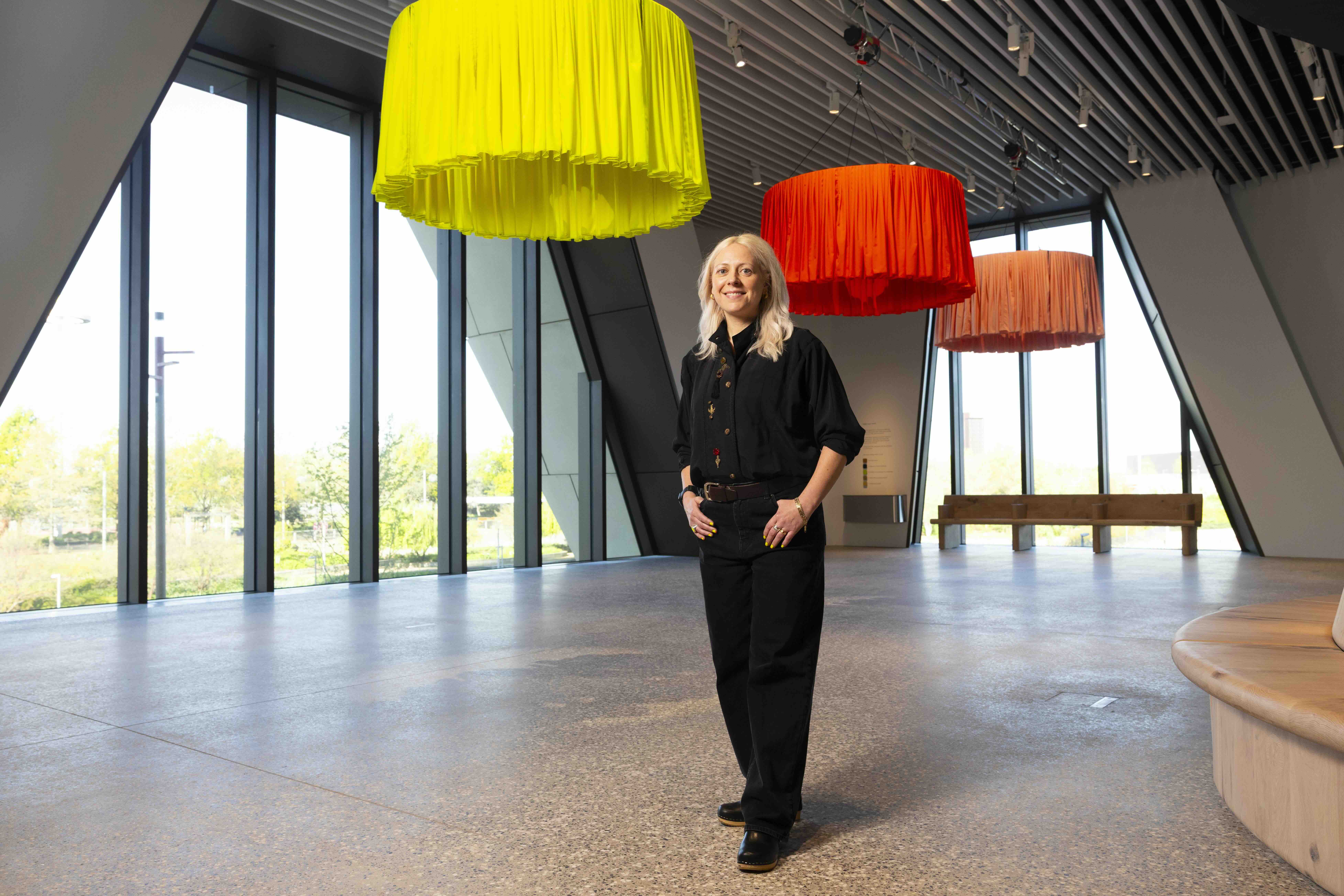
In her striking new public commission for V&A East, Heads! Look to the Workers, London-based artist Laura Wilson constructs a moving monument to the overlooked histories of manual labor in East London. Wilson often investigates history and how particular actions can be relayed and shared between people. “Historically, theatres employed dock workers because they were really good at handling loads; a lot of theatre terminology comes from the dock industry,” she explains. Drawing on extensive research into East London's factories, docks, and historic theaters, Wilson brilliantly combines 3mm-thick stainless steel disks and neon-bright fire-retardant theater fabrics she sourced from a supplier that’s been doing so for 150-odd years, J.D. McDoughall (who also did the pattern cutting). The colors, too, have meaning: “The whole time I was on site, in the months leading up to the opening, it was a construction site. So I was excited to use a hi-vis orange and hi-vis yellow.” The pink is a nod to the naturally dyed Overalls (2024), made with avocado pit dye—a work that emerged from research into women’s workwear and how people move within workwear. This, too, is now on show in the V&A storehouse, along with objects Wilson hand-selected from the V&A collection as part of her research.
Mirroring the collective effort of a factory floor, Wilson collaborated with local specialists and artisans—including text-etchers, stage technicians, pattern cutters, tailor Anthony Golbourne and womenswear designer Georgia Gough, who helped design Overalls and the distinctive cuffs that now drape the discs. The sculpture has a living lineage of specialized trades. Scaled to the diameter of Wilson's outstretched arms, each disc connects large-scale industrial production with individual contribution. When activated by the V&A East team with the traditional cry of “Heads!”, the three sculptures are raised and lowered via an authentic theatrical fly system, giving the viewers an intimate opportunity to see the stitching up close—and the poem etched in Wilson’s own handwriting.
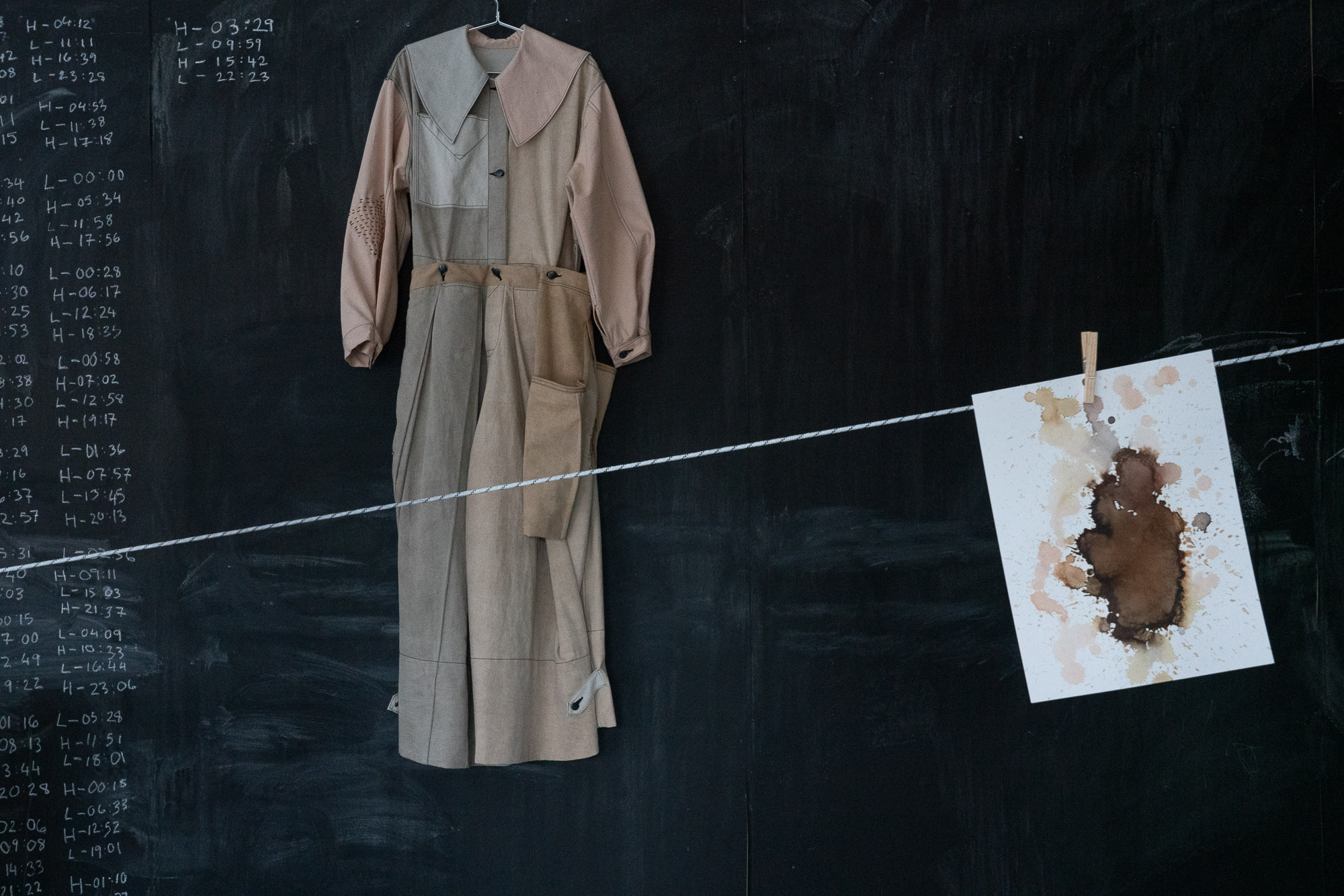
Through melodic text and the fluttering fabric of her sculptures, Wilson infuses the repetitive movements of factory labor with a collective lyrical rhythm. This first manifests in a list of roles: the lumper, the lurker, the baker, the weaver, the spinner, the sampler, the spark, where percussive consonants click and pull against the tongue like mechanical gears. This rhythmic framework knits together the themes of shifting tides, shift work, and backstage labor that occupied Wilson’s studio practice. Delightful wordplay like over all our overalls and sensory imagery abounds: And, the tide comes in, and the tide goes out, clocking in, out, in, out. Wilson mined two years of writing for the poem inscribed: “I’m always writing in my sketchbook; writing for me has always been a part of my work. I’ve written scripts, done spoken word performances, and written poems. Each disc has a verse of the poem.” Wilson expertly mixes past and present, song and steel, presenting the history of the working class as an ongoing lyrical conversation about value, visibility, and community.
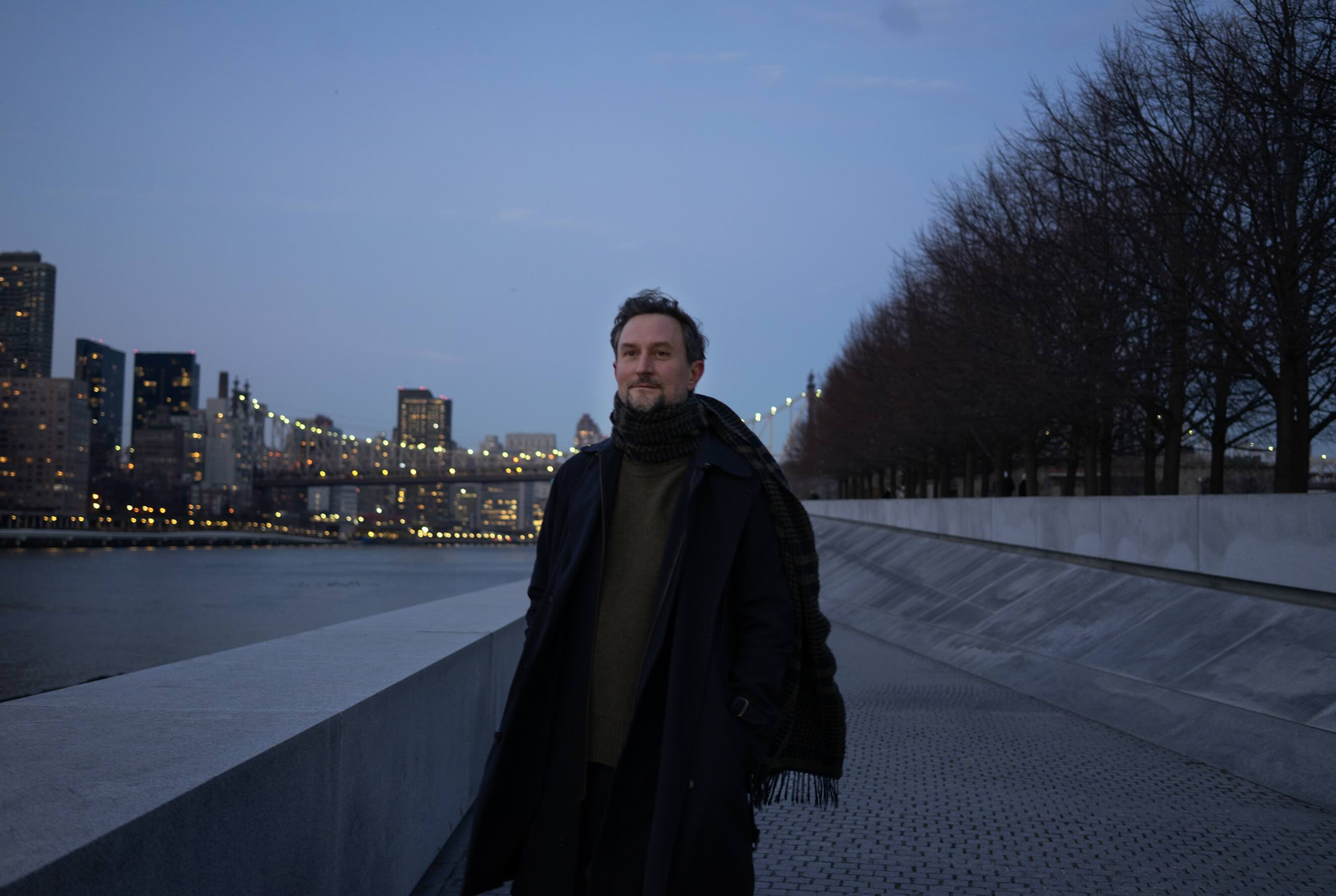
A monument is a machine for permanence. Louis Kahn’s Four Freedoms Park, designed in 1974 and only completed in 2012, narrows into an austere granite platform above the East River. The strictly rectangular stone architecture and the larger-than-life President Roosevelt bust, calibrated to outlast everyone who stands in it, invite a sense of awe that wraps over, instead of embracing, its populace. Hans Rosenström’s Out of Silence, installed into that apparatus, is its precise negation. A dozen speakers, hidden in the canopy, release a fifteen-minute composition recorded in Estonia with the vocal ensemble Vox Clamantis and set to a text by Rosenström. The voices are built to vanish.
The composition is polyphonic in the strict sense, with independent lines that overlap and fall out of phase without resolving into unison. What they articulate, a refrain on being formed by one another, is a sentiment close to what Jean-Luc Nancy termed being-singular-plural, in which existence is from the outset co-existence and the singular is never before the plural that constitutes it. Tuned to Arvo Pärt’s suspended harmonic time, the piece doubles as an argument about duration. Its text cycles between the elapsed present, the timeless, and a future held open; the fifteen minutes register as time withheld.
The work is anti-monumental by design. Kahn fixes meaning in granite; Rosenström supplies the same site with sound decaying on contact, each voice reduced to a trace that lodges briefly in whoever is present, before gone with the wind. The gesture exposes the premise it depends on—that permanence is the precondition of meaning—and inverts it: what persists is the act of attention, not its object. Rosenström undoes Kahn’s architectural logic, which projects outward into the landscape. The sound performs a different operation, fixing the listener at a center continuously displaced by everything beyond it.
The procedure recurs this summer, reconceived. Conspirare, Rosenström’s first solo exhibition at ISCP, the East Williamsburg institution where he spent six months as a resident in 2024, opens June 30 and is on view through October 9, opts for the factory floor. The exhibition responds to ISCP’s own building and the surrounding district, one of the last manufacturing zones in Brooklyn, and above all to the nearby Newtown Creek: a tidal waterway so reworked by a century of industry that its sediment has become horrifyingly unrecognizable as such. Rosenström mounts transducer speakers onto locally sourced industrial glass, steel, and reclaimed wood, conscripting the materials of the site as instruments, and sets the resulting sound against a series of photographs of the Creek and its residue.
What he records there is almost nothing: ribbed mussels fastened along the Creek’s steel and concrete piers, pulling poisoned water through themselves to clean it, breathing, in effect, in a medium engineered to be unbreathable. Paired with the human voice, these recordings of filtration and vibration become an environment in which species that share no language share a respiration. Here the title turns. Conspirare, to breathe together, to sound in unison, is also the root of conspire, with its overtones of secrecy and shared disquiet; the installation holds both senses at once. The oscillation it stages binds body to body and body to land in one rhythm poised between breath and suffocation, persistence and collapse. Where Out of Silence rendered co-existence as consolation, Conspirare insists on its cost: interdependence as a precarious, unfinished negotiation.
Both works proceed from one unsentimental proposition: that the voice, or the breath beneath it, is less the expression of an interior self than the medium through which bodies are rendered reciprocally available, and reciprocally exposed. Rosenström builds the conditions under which that exchange becomes perceptible and declines to resolve it. What breathes together, the work proposes, is also what is exposed together.