.webp)

Tim Kent: “Sojourn” at Hollis Taggart
Review
New York-based artist Eliza Douglas’s GHOSTS at Gagosian’s Park & 75 space, the artist’s solo debut in New York, sets spectral stakes. Upon entering the slick outpost, Douglas’s saturated, mixed-media paintings demand close inspection, each grounded by a dark night sky and the same woman-apparition. In each of her appearances, the figure is both obscured and magnified by fuzzy plumes, which resemble aura-reading polaroids or billowing smoke.
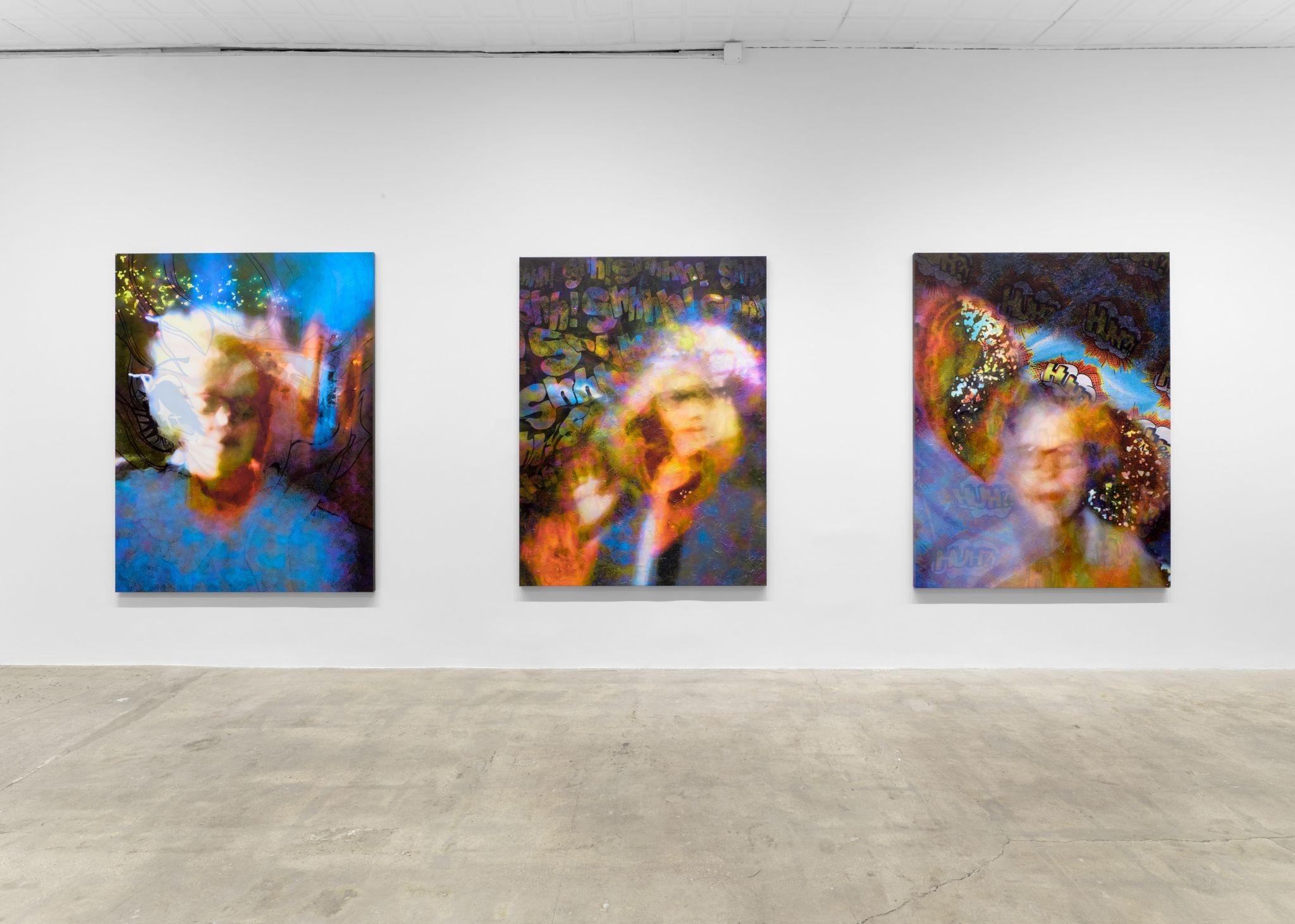
In chorus, the eight works arrest the senses by way of explosive palette and information overload, images veiled atop one another. Among sheets of information, here is this woman’s face, sometimes stately and still, others, seemingly in motion. Some call to mind an over-exposed photo in a family album, others an eerie 21st-century answer to the foggy mystery of a Julia Margaret Cameron portrait.
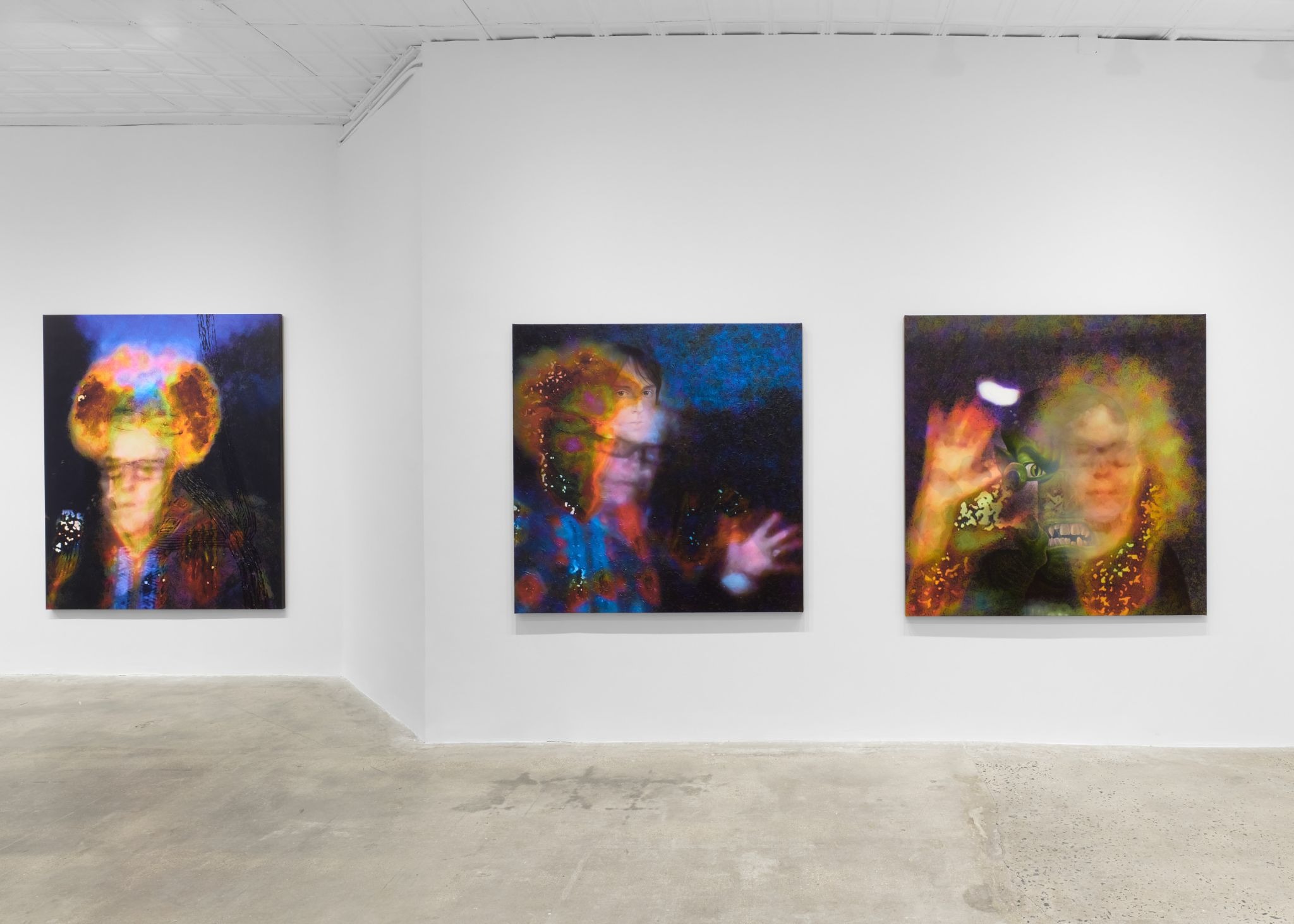
Douglas has superimposed each painting, some of which were shown as earlier iterations at the recently closed Air de Paris, with gauzy selfies of her aunt, investigative journalist and UFO researcher Leslie Kean. Appearing as a constant across each untitled work, Kean’s likeness surfaces among layers of thermal map gesture, a combination of oil painting and UV printing radiating in swathes of Cheeto orange and aquamarine blue. Haunted by their former lives, they buzz with far-reaching associations: halos of flaming edge among faint outlines of floating feet; crackles of bright white that resemble presyncope and also popcorn; sprawling messages from the beyond that also feel like telegrams from shopping bags or targeted ads.
Douglas’s past works have long called on intermediaries to take apart the commercial, sacred, and subliminal, whether capturing posed, rippling renderings of crumbled t-shirts first through an iPhone before translation or using AI to generate gift-wrapped super-real likenesses of Jesus Christ and cackling/crying faces, both of which were then translated to canvas. The fact of their production feels present: Douglas frequently works with assistants and other artists to complete portions of her works, and has ordered wholesale compositions from Dafen, a village in China famed for exporting high volumes of reproduced oil paintings. Remixing cultural signifiers of commerce, consumption, and clickhole, Douglas’s newest suite of works focuses on pushing the churn of circulation further and on the ways in which images are continuously estranged, recycled, and resurrected.
The exhibition text references philosopher Jacques Derrida’s concept of hauntology, which describes how flashes of an unrealized past lurk within the present, and later quotes the cultural theorist Mark Fisher, who applied the term to the commodification of art in late-stage capitalism. For Fisher, a stasis in cultural production has left us stuck with an oversaturation of nostalgia media and a zombie parade of reboots. However, Douglas has rebooted her own work, though in the process has broken it apart. Rather than reading as listless or totally bleak, the renderings of her aunt’s self-portraits combined with the abstracted crackles of light and sooty contours introduce an expansive intervention on the surface of the artist’s obliterated former content.
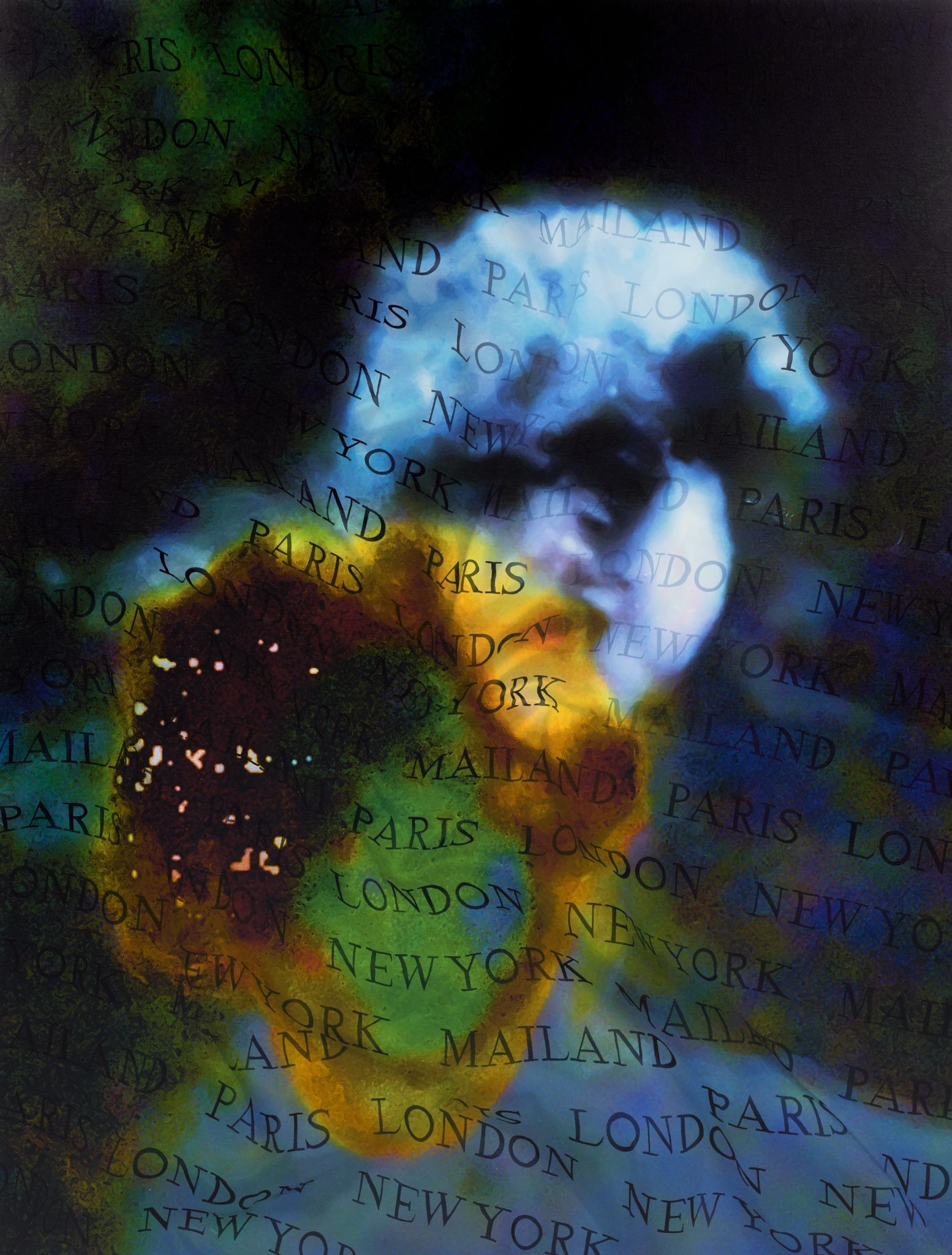
The remnants of running text from a painting with a past life in the artist’s T-shirt series appear among the GHOSTS: warped serif letters announcing “PARIS LONDON NEW YORK MAILAND” in crumbled ribbons, while Kean looks on just below the surface in X-ray blue. It’s something like peering into the well. Another frames Kean in groovy rounded letters spelling “Shhh!” The next features crowded clusters of “Huh?” in comic-inflected speech bubbles exploding with Ben Day dots, peak Pop-goth paired with Kean’s head-on stare and a swirling overcast of blue-orange-dark. A green monster, kind of Nosferatu meets Jolly Green Giant, seeps through one canvas with graphic clarity, while a blurred horror-movie hand seems to tap on the glass, reaching from the vacuous ground.
By reworking these paintings with Kean, whose work centers on paranormal phenomena and is well-known for co-authoring a landmark 2017 The New York Times article on a secret Pentagon study of UFOs, as the common subject, the associations with the afterlife and the unknown are explicit. Douglas’s fixation on Kean as her reigning subject finds synergies with the latter’s rigorous study of UFO documentation, and the tension between the real and manipulated, material and metaphysical.
In an interview with Aperture in 2024, the artist Trevor Paglen remarked, “I often think about UFO photography as the paradigm of photography. Something like, all photos are UFO photos.” A piece of Paglen’s premise is the UFO photo promise to not only point, capture, and document, but to compel belief. Douglas’s paintings do use a form of UFO photos as source images, and seem similarly interested in how we construct reality, the furniture of memory: the witness and event, proof and truth, faith and doubt.
These tensions find easy form with the ominous and estranged hand of AI, which Paglen also characterizes in this same interview as something of a hollow, yet malleable, phrase that “doesn’t really mean anything . . . a term that lends itself to mystification.” In this way, just as Douglas conjures swathes of embedded proxies to make and break apart her selected signifiers, from there, they give over to charged fields of meaning rather than fixed heuristics. Through coats of content and slippage, buzzing associations are summoned forth, both familiar and phantom. Here, Douglas finds apt conduits to drive words and signs to supernatural ends.
Eliza Douglas: GHOSTS is on view at Gagosian Park & 75 from May 12 through July 31, 2026.






%20.jpeg)