.webp)
Tim Kent: “Sojourn” at Hollis Taggart
Review
The difference between a dinner and a picnic lies in the discipline of boundaries. Administered on a standard-shaped, raised surface (the dining table), dinner is a privileged establishment that screens everything that is allowed, from its ingredients and participants to the start time and course rules. A picnic, on the other hand, plays with the dismantling of these boundaries and, fittingly, carries itself out directly on the floor, with its perimeters loosely defined and subject to change. A dastarkhwaan occupies a topology between dinner and picnic. A traditional Persian floor-spread used across Central and South Asia, the dastarkhwaan refers to both the cloth itself and to the social act of gathering around food. Using dastarkhwaan simultaneously as a subject matter, medium, and methodology, Hafsa Nouman’s solo show, Facsimile at Palo gallery, teases a picnic at a dining table by resolving propositions of installation, sculpture, and relational art in the form of painting. The exhibition goes against many tautologies of contemporary art, and American contemporary ideologies in particular, to propose that the resolution of conflicts in the form of painting is neither apolitical nor acultural. To Nouman, painting is not dead precisely because the claim “painting is dead” has been made.
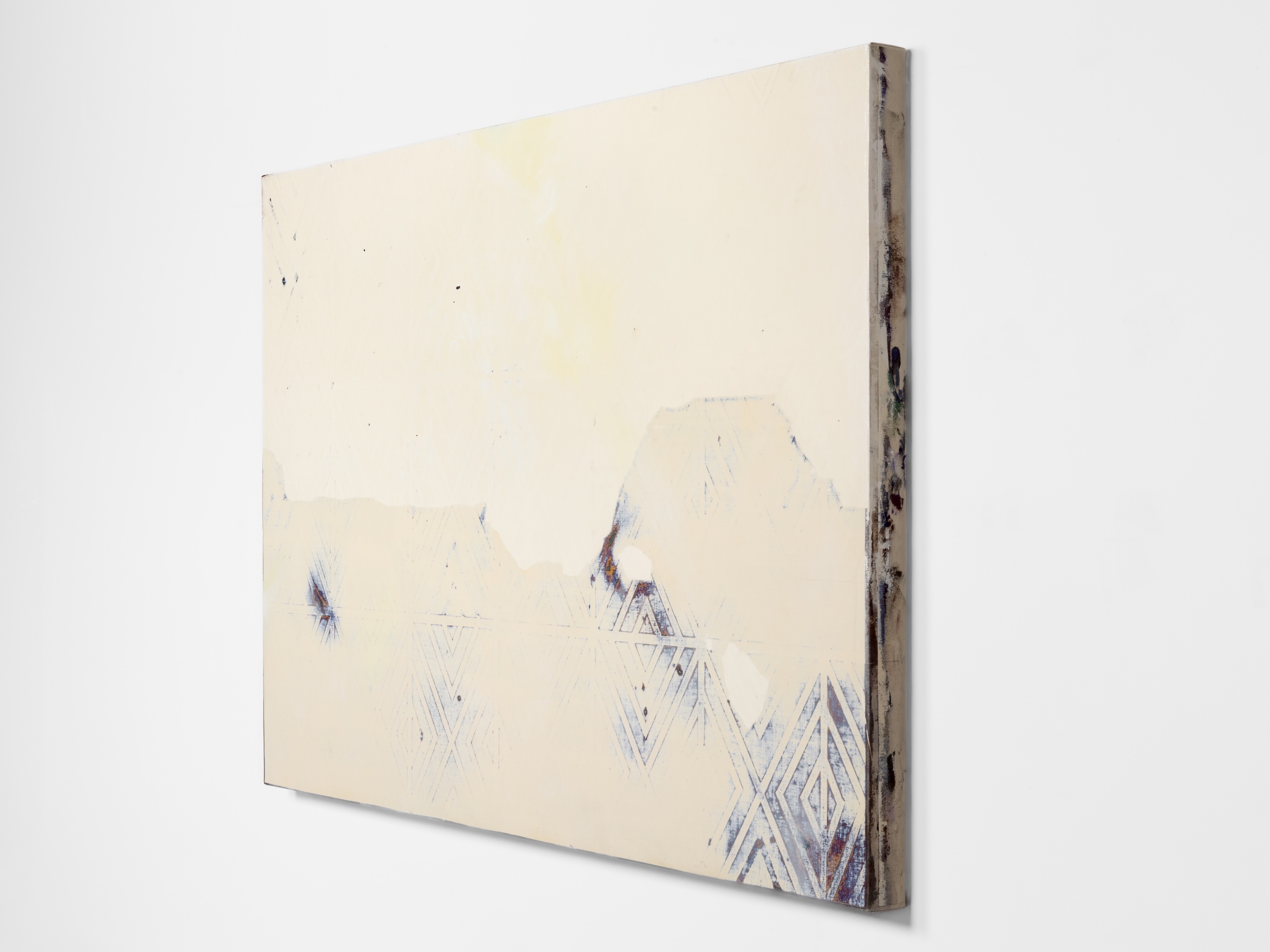
Nouman’s practice centers around her original painting technique. Each canvas involves a subterranean foundation of various layers of paint stacked on top of one another. The surface is then repeatedly coated with a mixture of poppy oil and white paint, resulting in a semi-reflective finish. With each pass, Nouman strictly ensures that the bristles of the brush never touch the surface of the canvas or previous layers; only the paint itself is gently applied, over and over again. At the conclusion of this labor-intensive process, Nouman further deviates in two directions beyond the establishment of these “mirror paintings.”
In some of the works, the gesture of scraping is applied only minimally, revealing the “flesh” in the underlying paint layers and allowing significance to be discovered by means of deduction, in an archaeological fashion. Through the process of addition-then-deduction, the artist enacts how culture works: when the meaning presented is already rich and sophisticated, what one unearths is often not the truth itself but the perceived truth of those who came before. Nouman explores motifs such as walls and Islamic patterns in this body of work, revealing how the artist’s childhood memories are intertwined with Pakistan's rich history. The accumulation of paint through layering is hardly a new proposition. In Wayne Thiebaud’s bakeries, for instance, accumulated paint becomes both marketable texture and visible labor. Nouman’s embedded labor works differently: it remains a quiet condition that precedes exposure.
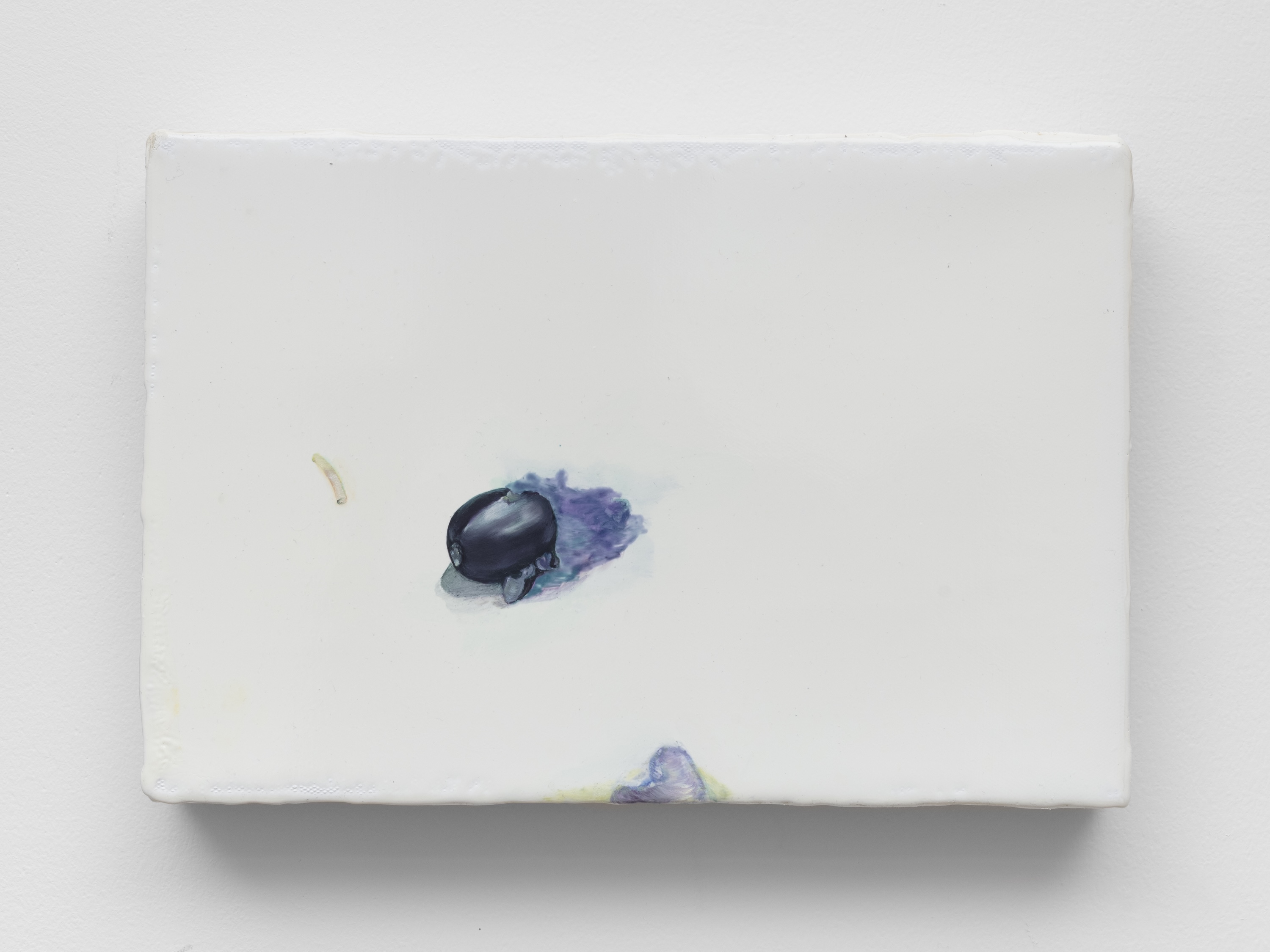
Another body of work is created using a completely different approach: a flat, centralized figure is meticulously painted onto the reflective white surface. These works depict plants or fruit species native to the artist’s hometown, whose symbologies have been shaped by colonial occupation, including olive, pomegranate, and sugarcane. The juxtaposition of reflectiveness and flatness is reminiscent of Michelangelo Pistoletto’s mirror paintings, but the epistemology varies ever so slightly. Nouman’s reflective surface does not primarily return the viewer to the present; it consumes the reflection into a cultural field of memory, offering, and inheritance.
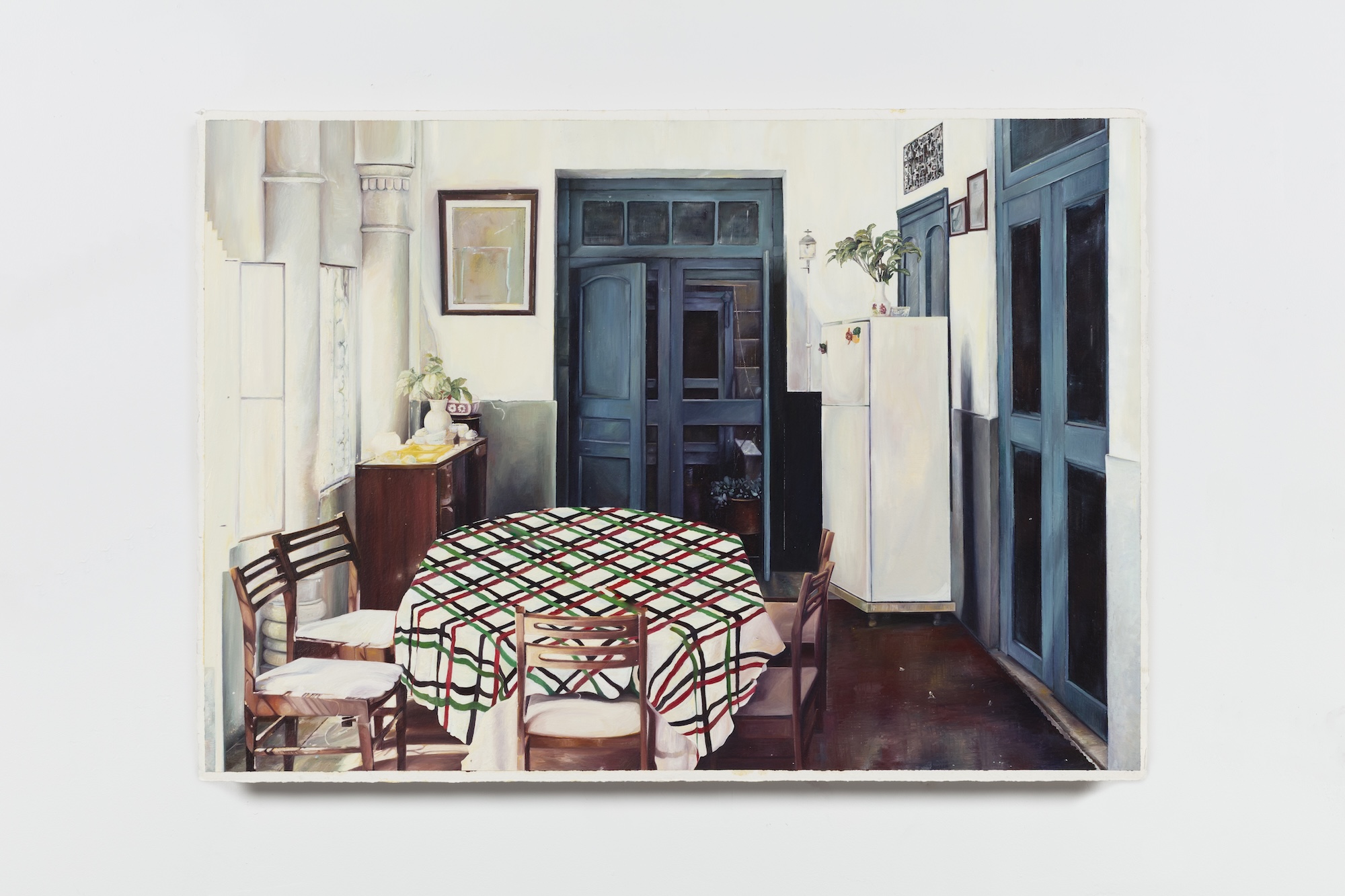
The installation, carefully orchestrated by the artist herself, doesn’t present a specific dining scenario. It summons one possible scenario that might have occurred in the artist's memory with plenty of blanks left to fill. The anchoring piece at the center is the only work in which the dastarkhwaan is directly present as the motif. Snapshotting the interior of the artist’s living room in Pakistan, the painting zooms in on a tablecloth that feels like a landscape with its half-distorted perspective. Ironically, as the lone work in this show that is fully descriptive and figurative, this painting is fully empty—no one present, no food presented, no overt narrative. Flanked by the “mirror paintings,” which are reflective and discreet, this central work seems abrupt at first glance. But this disintegration is actually deliberate. It calls for infinite possible substitutes and gives way to empty spaces, both spatial and conceptual. The offerings at a food party are only welcoming when they are open-sourced and rotational.
How food transformed from a mere subject matter to a sculptural and performative medium central to social practices epitomizes contemporary art’s “installation turn” over the past one hundred years. The Smart Museum surveyed this phenomenon in 2012 with a seminal exhibition, Feast: Radical Hospitality in Contemporary Art. The exhibition was accompanied by a number of participatory feast projects on and off-site, among which the Iraqi American artist Michael Rakowitz’s project Enemy Kitchen stood out. It was a food truck that traveled around Chicago serving a menu of Iraqi dishes. What is worth noting is that under the dome of food as a novel principle that trans-internationalizes cultural perspectives, Rakowitz’s sculptural logic depends on an American grammar of conflict: the staging of opposition, the sharpening of national symbols, and the deliberate placement of viewers between sides. American veterans of the Iraq War were hired to work as servers and sous-chefs. The stainless steel hand sanitizer dispenser on the facade of the vending window was engraved with the symbol that often appeared on Saddam’s silverware. Rakowitz’s Americanized radical hospitality never failed to remind its participants where the conflict lay and to place them in the limbo between the two sides deliberately torn apart by the artist.
If Enemy Kitchen depends on the precision of national borders and political opposition, Nouman’s dastarkhwaan reminds us that cultures are gradient and accepting. Instead of weaponizing food, she argues that its sheer presence bears witness to a history that may or may not immediately relate. The confident worldview of food as historical companionship might seem passive in the contemporary art world, but it offers a rare opportunity to reflect on social issues and cultural dynamics grounded in something seemingly constant. On the table of establishment in today’s art landscape, what we ought to seek is not the permission of “you can sit with me,” but simply to pull a chair.
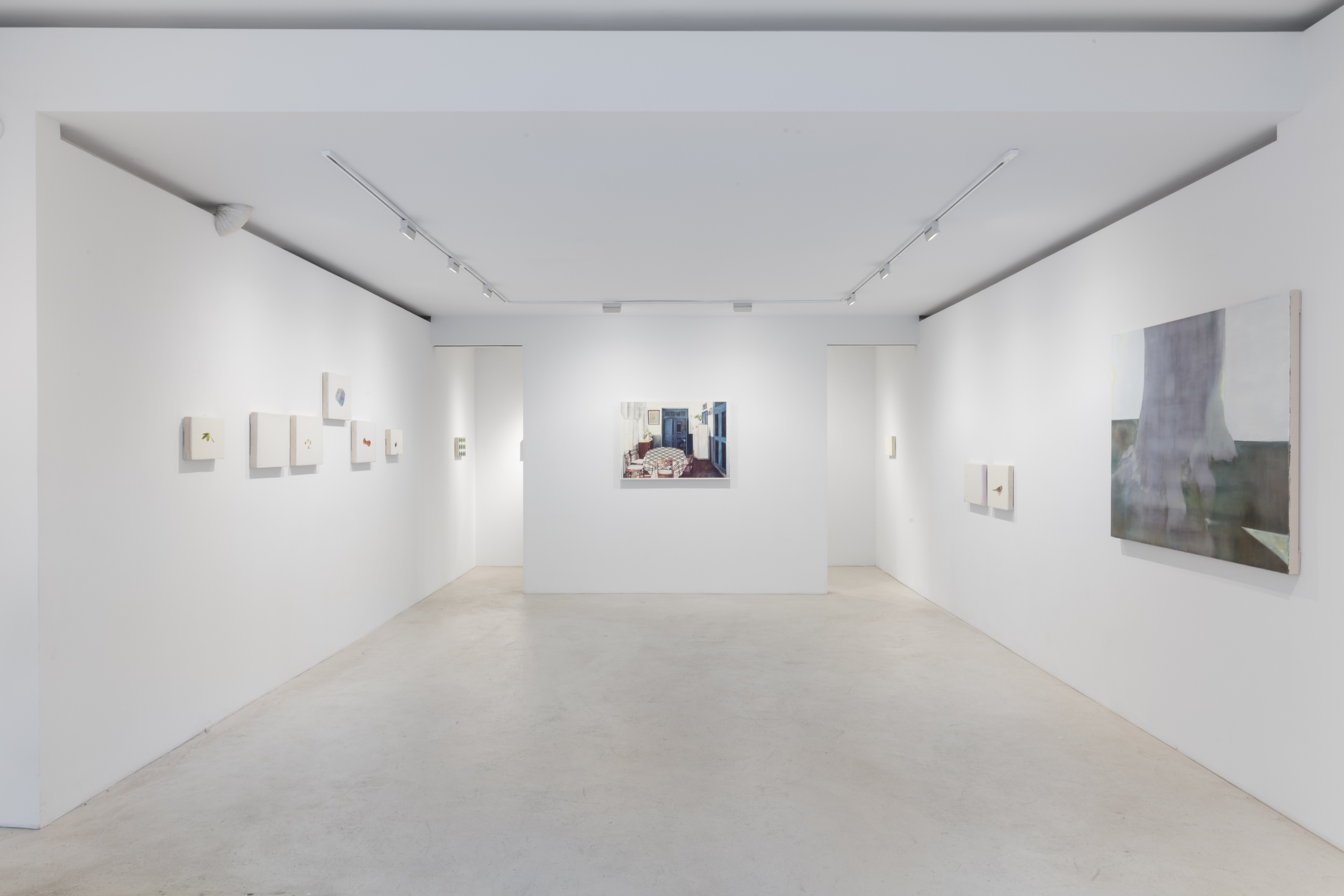
Hafsa Nouman: Facsimile is on view at Palo Gallery from June 18 to June 30, 2026.