
.webp)
Tim Kent: “Sojourn” at Hollis Taggart
Review
At Bulgari’s Bond Street boutique in London, diamonds, rubies, and sapphires glitter through glass and call out to the wandering eyes of passersby, enrapturing them like moths to a flame. If they were to break the spell of platinum, silver, and gold, they would find themselves surrounded by the dream-like oil paintings of Jordanian-American artist Tiyana Mitchell’s latest exhibition, What Light Remains, organized by MeSo Ventures. Mitchell’s paintings depict Rolls-Royces, tailored suits, and designer shoes; yet obstructed faces disturb what at first appears to be a complementary pairing with Bulgari jewels. Amidst the boutique’s opulent milieu, What Light Remains renders visible what wealth remembers and buries.
Mitchell’s process begins in the archive of her own photography, images of her father, and her grandfather’s collection, spanning five decades of Middle Eastern diplomacy shaped by the West’s deepening economic and cultural control. She begins her titles with either “roll,” “contact sheet,” or “album,” each denoting a painting’s respective archival origin. After selecting a photograph, the artist enlarges it to focus on the periphery. She then frames her subjects through scale, ranging from a few inches to several feet, and strategic cropping, such as the partial figures in Album 4: London: 1984: 2 (2026) and Album 2: Amman: 1972: 1 (2026). In effect, Mitchell effaces any indicators of location and identity, positing the half-remembered faces as a mirror of memory’s mechanisms.
Throughout What Light Remains, Mitchell develops a satinlike texture, a leitmotif synonymous with luxury. In the large-scale Roll 11: London 2025: 12 (2026), which features an outstretched leg with stilettos over bedsheets, the artist’s brush captures the sinuous folds of the sheets and pants; the motif recurs in the contours of the skin. Since Mitchell’s palette never uses black, she softens all contrasts and accentuates the presence of white, enveloping her canvases in an aged patina. Together, these stylistic choices invoke the image of old Polaroids, the haze of forgotten memories conjured in dreams.
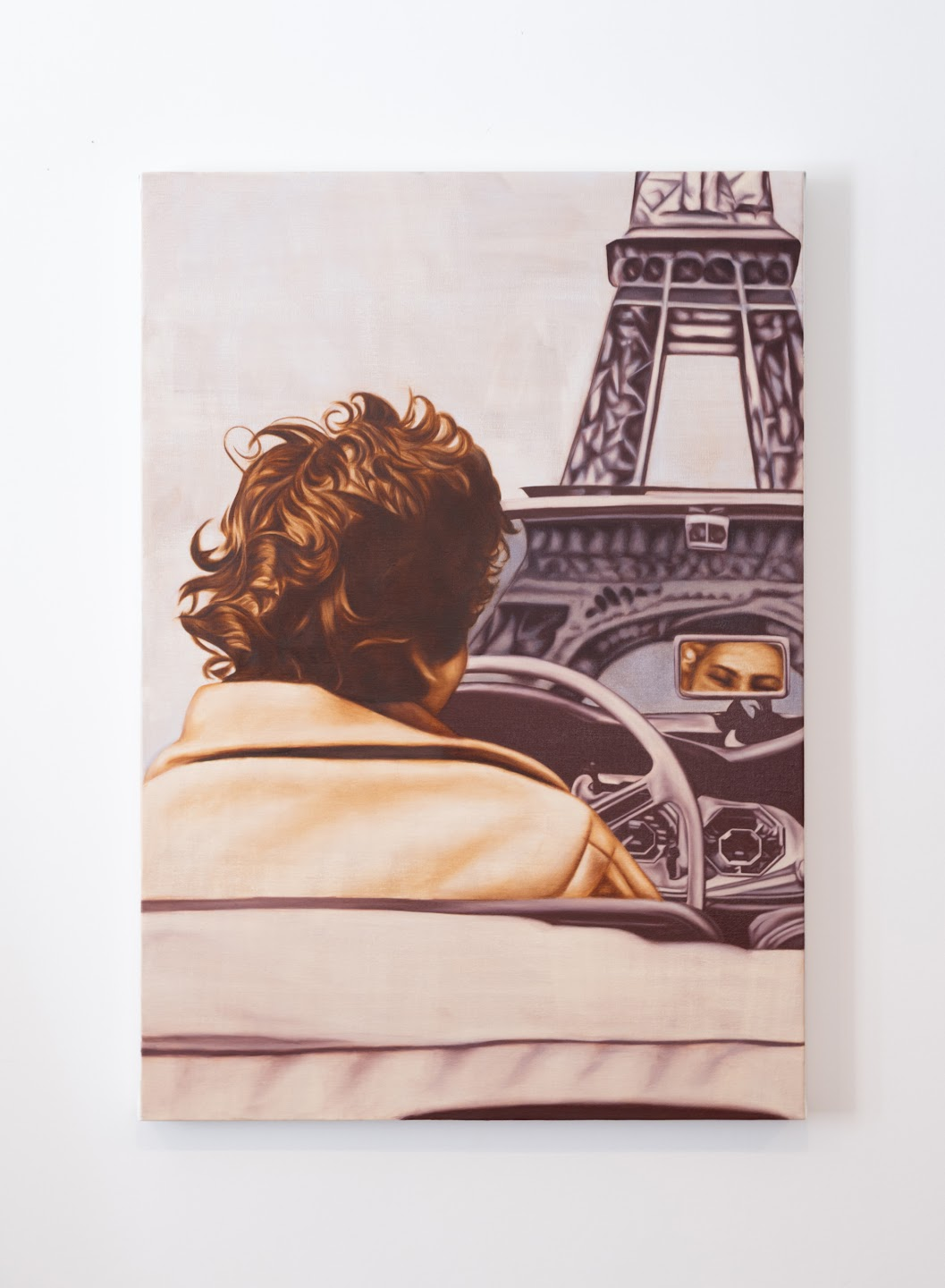
Album 8: Paris: 1950s: 1 (2026), a painting of a figure driving by the Eiffel Tower and looking at a face in the rearview mirror—another person’s, or perhaps their own—blurs any distinguishable features of the reflected face and shows only the back of the driver’s head. The artist portrays the individual(s) in warm tones against the composition’s cool palette to isolate the subject’s stolen look with a lens-like focus. Yet Mitchell’s brushstrokes depict the driver’s hair with the same undulating forms as the Eiffel Tower’s lattice—this visual rhyme collapses foreground and background and ultimately further effaces identity. By simultaneously emphasizing this encounter and burying its content, Paris: 1950s signals the limits of memory. Like the question of the subject(s), this ambiguity makes the audience aware of their distance from the scene, an experience Emily Dickinson artfully characterizes as the dissatisfaction of the silent spectator: “Nor was I hungry—so I found/That Hunger—was a way/ Of Persons outside Windows—/The Entering—takes away—.” In prosaic terms, Mitchell’s exclusions reveal that the viewer’s longing for the image’s hidden content stems from its denial; the context, once lost, can never be recovered without dissolving what made it.
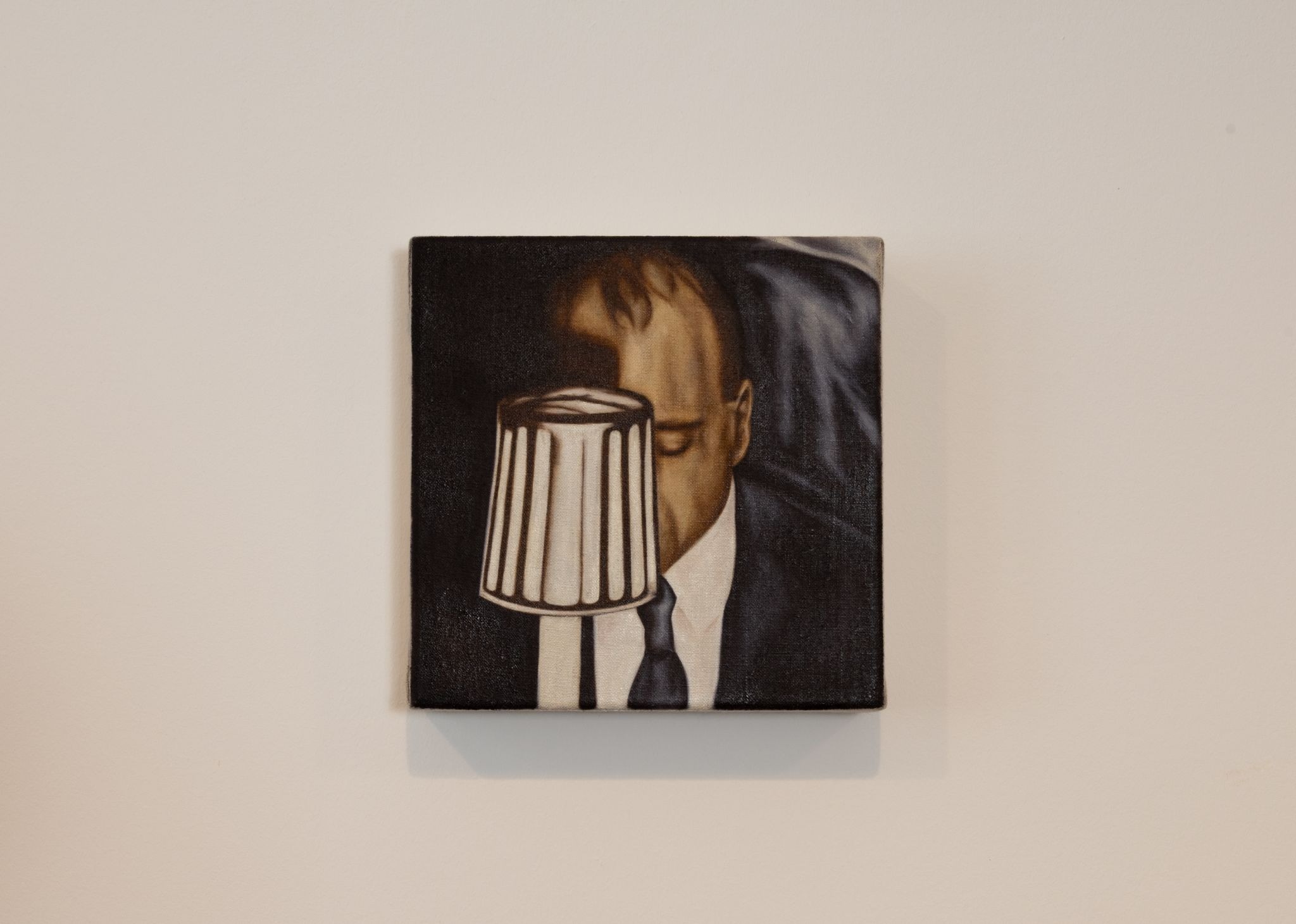
Album 6: Marrakesh: 1976: 5 (2026) presents a man concealed by a lamp. Stripped of any signifier of location, the composition carries an inherent liminality. Brightness concentrates on the highlights of the satin of the man’s suit, the ridges of his face, and the white of the light. Analogous to Mitchell’s deployment of color and texture in Paris: 1950s, the lamp's pure-white diagonals correspond to their sole echo in the man’s button-down, and the light’s verticals align with his tie and the contours of his head. In optically relating the man, his suit, and the lamp, Marrakesh: 1976 prompts the viewer’s perception to further displace the subject’s identity with that of the lamp and suit.
While Mitchell’s process, palette, and composition all obfuscate identity in What Light Remains, the paintings instead focus on emblems of wealth: the emphasis on the lamp and suit in Marrakesh: 1976 or, in London: 1984, where the canvas’s edge bifurcates a woman’s head to place the Rolls Royce’s Spirit of Ecstasy in center view. Similarly, Album 1: Bethlehem: 1950s: 3 (2026), a canvas of people gathered around a car, fades the crumbling architecture and faces, rerouting attention towards the group’s outfits and car. As the car, an epitome of Western modernity, contrasts with the ruins, Mitchell depicts the capital’s replacement of local history and human connections.
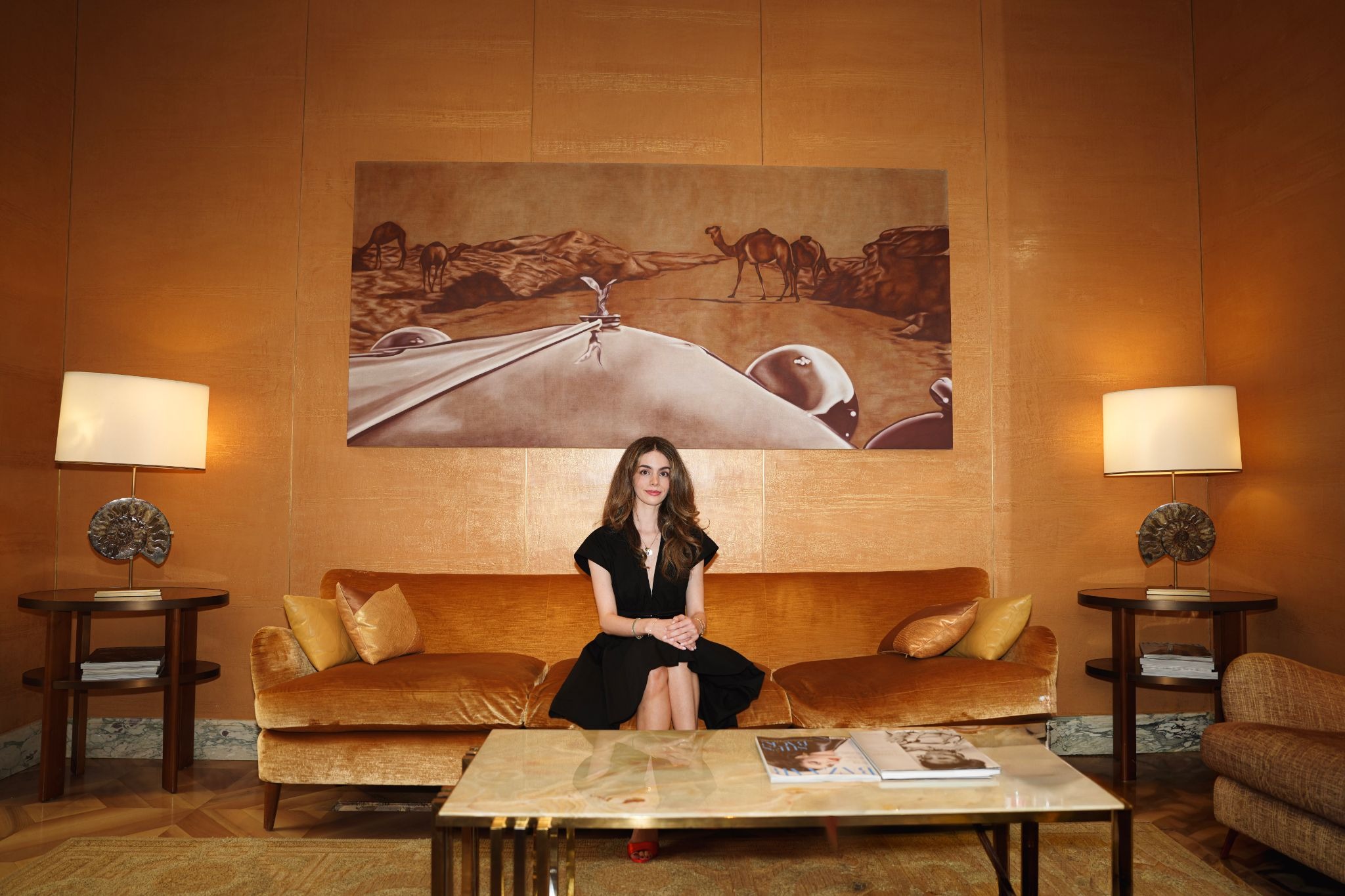
Notably, Album 1: Dead Sea: 1955: 2 (2026), a panorama of a Rolls-Royce’s hood against a vista of camels crossing the desert, situates the viewer’s vantage behind the wheel through the car’s depiction in pure white. The color creates two registers, with the Rolls-Royce highlighted by its brightness and location in the lower half, stark against the landscape on exposed linen. The camel caravan, framed via the Rolls-Royce, denotes a traditional form of desert travel that becomes a hallmark of culture sublimated to modernity’s car. In a similar thematic move, Contact sheet 2: Milan: 1990s: 21 (2026) presents a black—technically dark purple—Oxford shoe against the white background of an intersection. The only other black details are a bicycle wheel and a car tire. This deliberate use of black creates a vague triangle between the shoe, car tire, and bicycle wheel—all forms of urban movement. Like the juxtaposition of the Rolls-Royce to camels in Dead Sea: 1955, Mitchell unearths unconscious cultural hierarchies and makes visible the absence of the traditions it effaces. While Mitchell purposely avoids any actual trace of the politics of the images, they haunt her paintings’ milieu: the adoption of Western cultural exports, the Rolls-Royces, and the Italian-cut suits in distinctly Arab settings, express America’s cultural and economic colonization of the region and erosion of its indigenous culture and communities—the vanished faces and interactions.
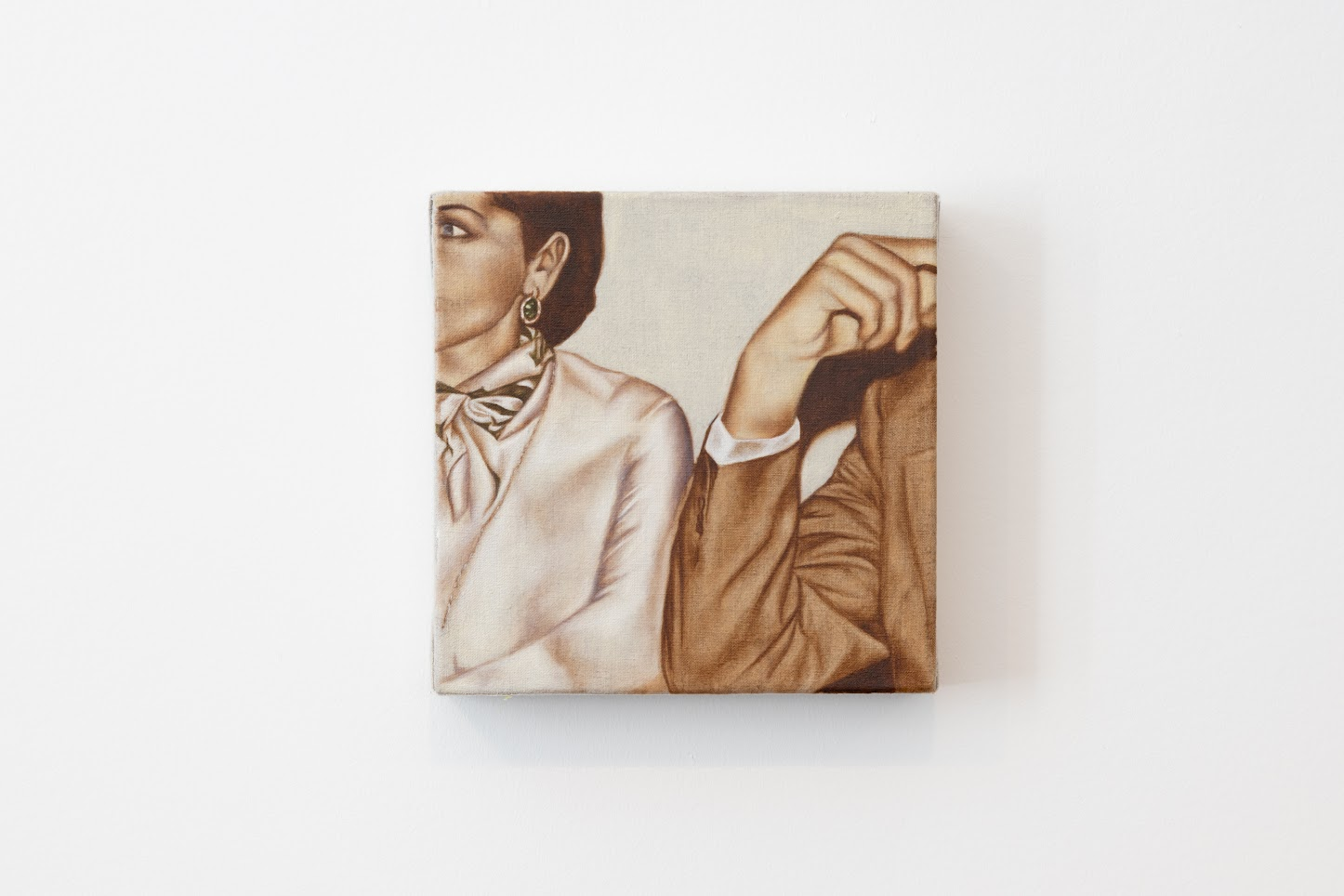
In the commercialized, resplendent environment of Bulgari, What Light Remains may at first appear to be a promotion for buying jewelry, clothing, and even art, given its subject matter. Though the exhibition often teeters between excavating the problems of luxury and reinforcing them, the glaring absences expose the cultural and human cost of materiality. Album 2: Madrid: 1976: 1 (2026), a conversation cropped to spotlight the woman’s diamond earring and the satin sheen of her clothes, and the many images of lonely designer shoes and suits make us aware of how immediately eyes divert to diamonds from faces. While De Beers famously advertised “a diamond is forever,” What Light Remains sings it in the subversive cadence of Shirley Bassey’s Bond theme song and Kanye’s “Diamonds from Sierra Leone.”
Tiyana Mitchell: What Light Remains is on view at Bulgari's flagship boutique in London from June 12 through July 10, 2026.






%20.jpeg)