
.webp)
.jpg)
Tim Kent: “Sojourn” at Hollis Taggart
Review
There seems to be a rise amongst artists in recent years to assume the role of an excavator—that non-human terraformer so powerfully capable. Identity transformations such as these, however momentary or project-oriented, are exciting developments. The intention behind these constructional timelines isn’t a material rummaging for needless deconstruction, nor are they a demolition for purposeful construction and consequently erasure, far more detrimental a variation than the former. No, the actions transpiring instead are something else entirely. This digging-up, a labor driven by the material as much as by the political world, seeks not to forget the cultural heritage of sites, but rather to purposefully draw out the underlying social nature of environments, rendering histories that might not otherwise be transparent, visible once again.
Uncovering the historical terrain of a place might prove difficult for an uninvolved figure, but Jeff Carter is not that. His show, The Singer Pavilion Project, at Hyde Park Art Center, signals an individual who has completely dedicated himself to a singular location. For over six years, Carter has investigated and re-investigated the Singer Pavilion, the last standing architectural unit of the Michael Reese Hospital complex in Chicago’s Bronzeville neighborhood. Famed for being designed in part by Walter Gropius, originator of the Bauhaus School and former professor at Harvard Graduate School of Design, the building now rests in modernist ruin, without use or function since the hospital’s closure in 2009.
But the show isn’t about Gropius, Carter, or even his many returns. It is about the nature of a site, about its social architecture, and about how places continue to persist and evolve despite being abandoned by local authorities. To make this all the more poignant, Carter has rather thoughtfully, at every turn, tried to take himself out of this auto-ethnographically driven endeavor. Largely absent of an extended authorial touch, Carter’s creations center the Singer Pavilion in absolute terms and with little chance of distraction. The pieces in the exhibition, however, do not simply recreate the facility or the role it played as a former psychiatric institute; instead, the 12 works of art tell persuasive narratives, each piece serving as one part of a jigsawed reconstruction of what a site meant and means today.
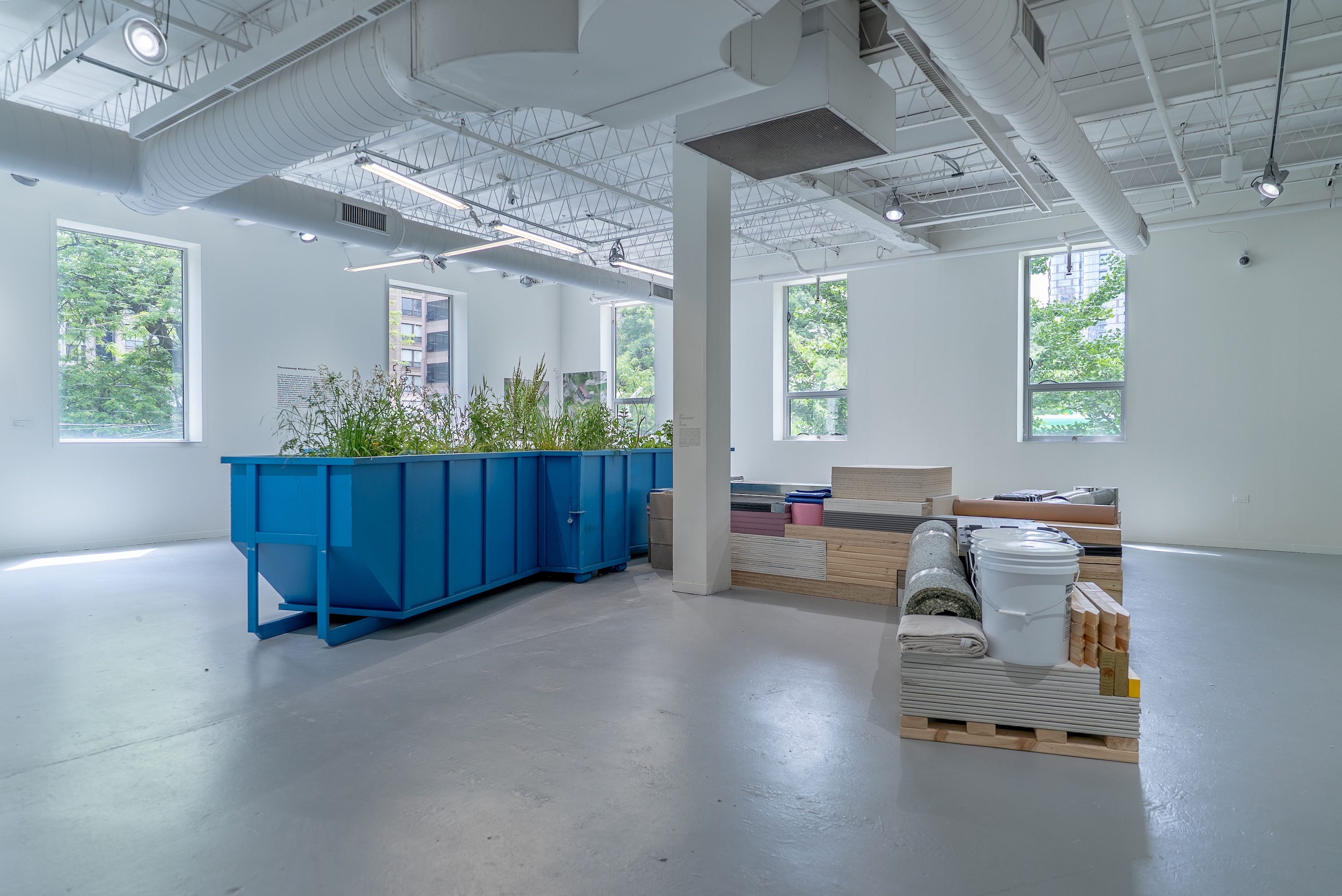
Take, for instance, Urban (re)Fill (2026) and Rehab (2026), the two most physically dominating works, located right in the show’s largest open area. Shaped to mirror the geometry of the Singer Pavilion (which most closely resembles the T-shape form found in the game Tetris), the two works, side-by-side, are structurally distinct yet formally similar. Rehab is a collection of items, composed in short stacked layers, as the nearby label indicates, from an assortment of “construction materials.” Alongside this creation, the exterior of Urban (re)Fill, a ½-scale roll-off dumpster, pops with a distinct blue coat. Carter has filled it with soil and flora taken from the site, a rehoming that directly references the less-than-subpar state of the land’s current vegetative growth. In the ensuing years after Singer Pavilion’s closure, the landscape, originally organized by the modernist designer Hideo Sasaki, has flattened as well as faltered; here too, modernist design and all its accompanying social promises wilt.
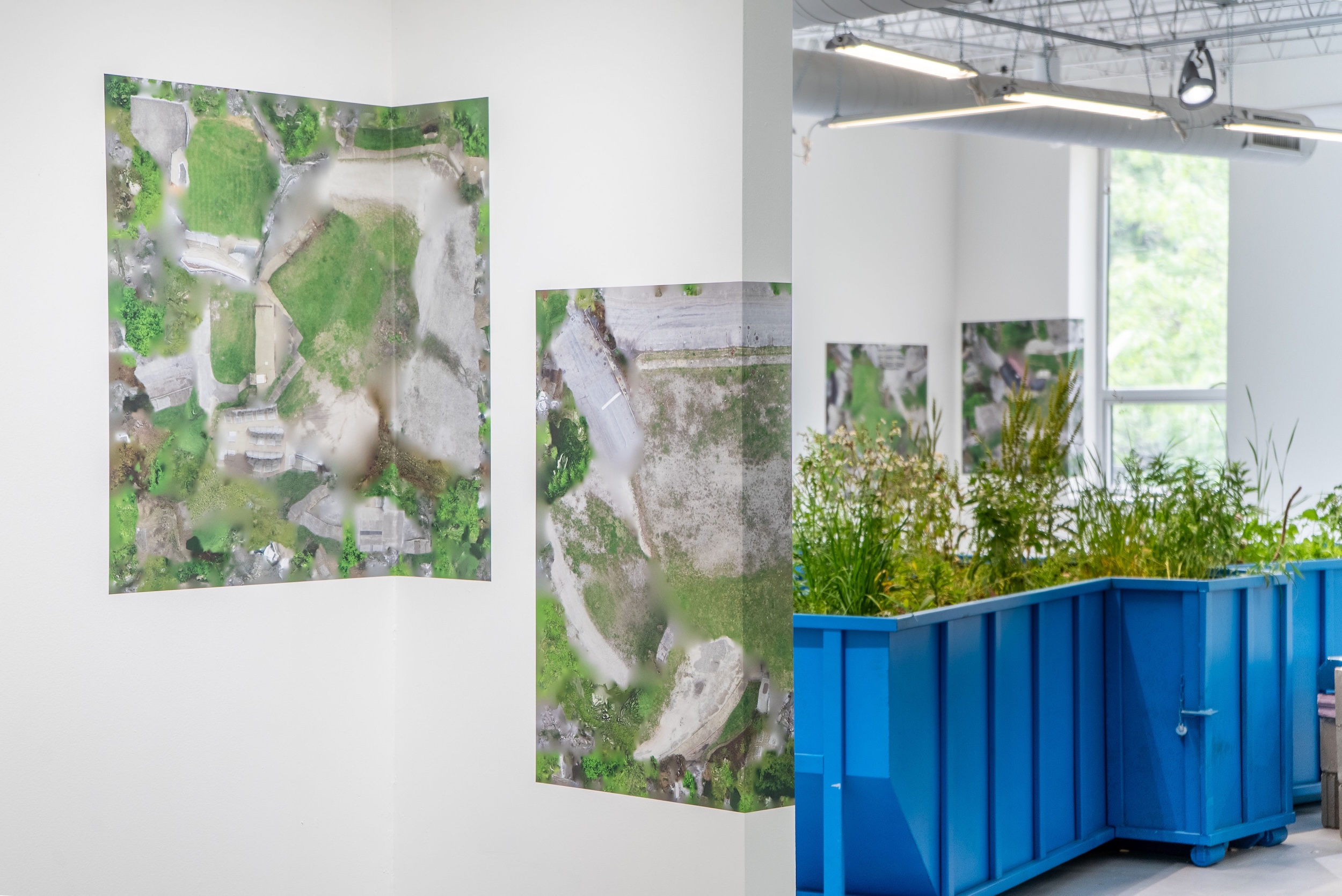
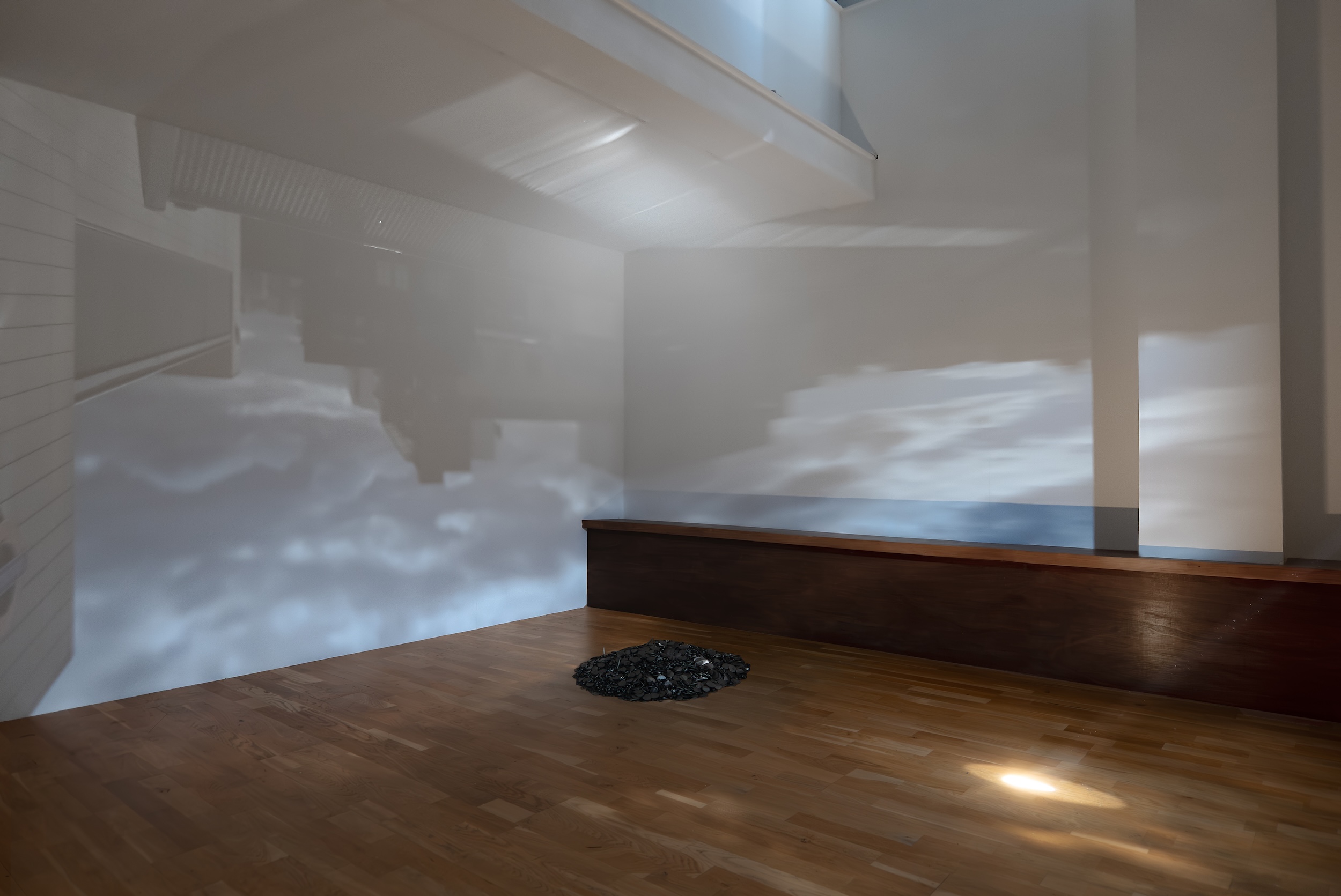
Much of the exhibition functions through interpretative recreations of the site. From every perspective, Carter has extracted micro-histories that deliver a rather robust introduction to the Singer Pavilion. The exhibition’s entrance displays a series of photogrammetry scans, collectively titled Psychosomatic Texture Maps (2021)—images derived from a process that separates spatial data and visible surface readings into unique file types. Such generations produce woozy cartographies that feel apropos for a show that is all about the close detail one gets from being on the ground. Much like our own memory, layered by event after event, these pictures are textured with distortion, years and even decades of change subtly present, only noticeable through repeated encounters with both memory and place. Carter invites us to return, intentionally and consciously, to notice all that has transpired.
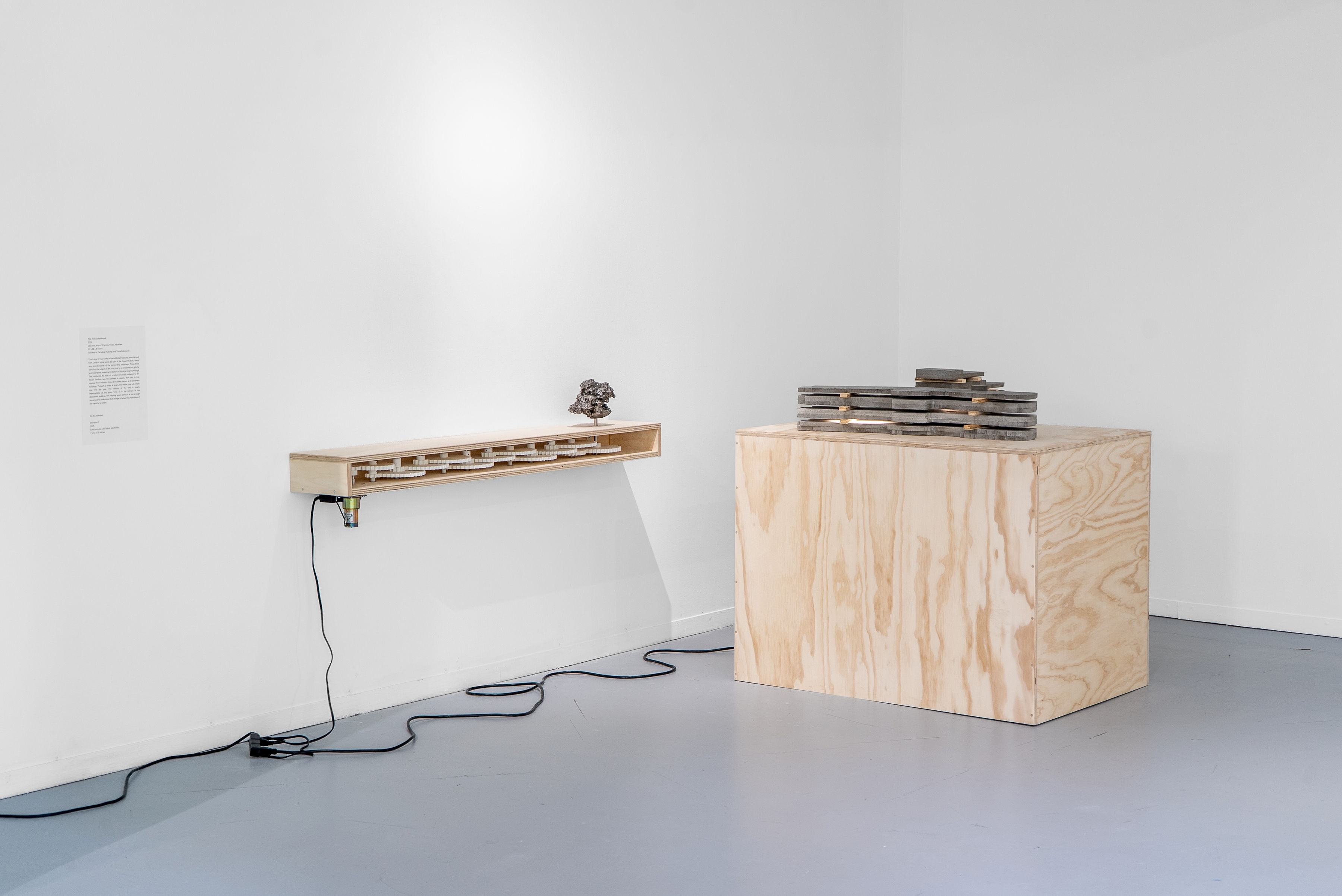
Tree Test (Cottonwood) (2025) is just about the perfect example of this. Taken from the very same 3D scans, Carter this time has selected one of the peripheral components, a tree, on the outskirts of the image as his case study. The result is a complicated interpretation because the focus of the scans has left only a partially rendered object. But the artist has leaned into this warped quality, first producing a plastic model and then casting it in iron. Placed on the right-most edge of a wooden platform, this small tree sculpture connects to a geared system that fully rotates once a year. As the gears whirl and hum, the tree stands practically motionless. The incremental pace is imperceptible to the human eye. Close by, Elevation 2 (2025), a miniature of the Singer Pavilion, cast in concrete and glowing with LED lights, forces only a closer inspection of the heart of the site. How do we recognize differences over time?
During a pristine day, the exhibition space is flooded with an extraordinary amount of natural light. Reconstitution and reconstruction have a particular shine in this setting, and Carter’s observations are most impressive for their ability to never dilute lived experiences. At the very end of the day, almost everything here is about the communities impacted by the Singer Pavilion, with Carter now included. That all of the artworks contour the environment with different angled interpretations or responses displays how one can dissect all the ways a site might be understood. Were the show to falter at any point, it would simply be for its constant re-critique of the very same cultural, political, social, and environmental issues it raises again and again. But sometimes to deliver an essential message you need to come across as a broken record, and even broken records make tunes, as Carter has demonstrated with Recovered Files (2025).
There is something to be said for the historical X-ray vision that artists like Carter can achieve. Opening up the world to the successes and failures of our public spaces through visual and non-visual channels alike is an exacting reminder of what and who is harmed by opaque histories. When accessible once again, these histories carry forth vital livelihoods. In Carter’s version, this is achieved through a panorama of material history. This is how we clear away the hazy mirage cast by erosion, decay, and neglect.
Jeff Carter: The Singer Pavilion Project is on view at Hyde Park Art Center’s Kanter Family Foundation Gallery from June 6 - September 20, 2026.