Alix Vernet: “LANDMARKS” at Chapter NY
Review
Danh Võ
White Cube | 1002 Madison Avenue, New York
10 September – 16 October, 2026
Referentiality in historically inflected art is a strange and perilous craft. Aim too broadly or obviously and one will inevitably land oneself in the playground of juvenile kitsch. Conversely, aim toward the all-too-eager-recent-MFA-graduate-style historicism, where obscurity is law, then one might land in the prison of solipsistic self–referentiality–gaudiness, and God forbid, equally boring. What a delight it is that Danh Võ’s latest self-titled solo show (sans tilde) at White Cube is neither of those things. This collection of works is an exemplary demonstration of the artist’s contemplative sensibilities toward the interconnectedness of contrasting textures, coded historical traditions, and subtle appreciation for well-calibrated repetition.
Born in Bà Rịa, Vietnam, and later raised in Germany, Võ lives and works in the rural town of Güldenhof, where he has his farm and studio. Those familiar with the artist’s last major show at the Guggenheim, Take My Breath Away, might recognize his playful juxtaposition of scale and materiality that is evident in this collection’s rare mix of objects ranging from prized Vietnamese ceramics from shipwrecks to first-century Roman marble sculptures.
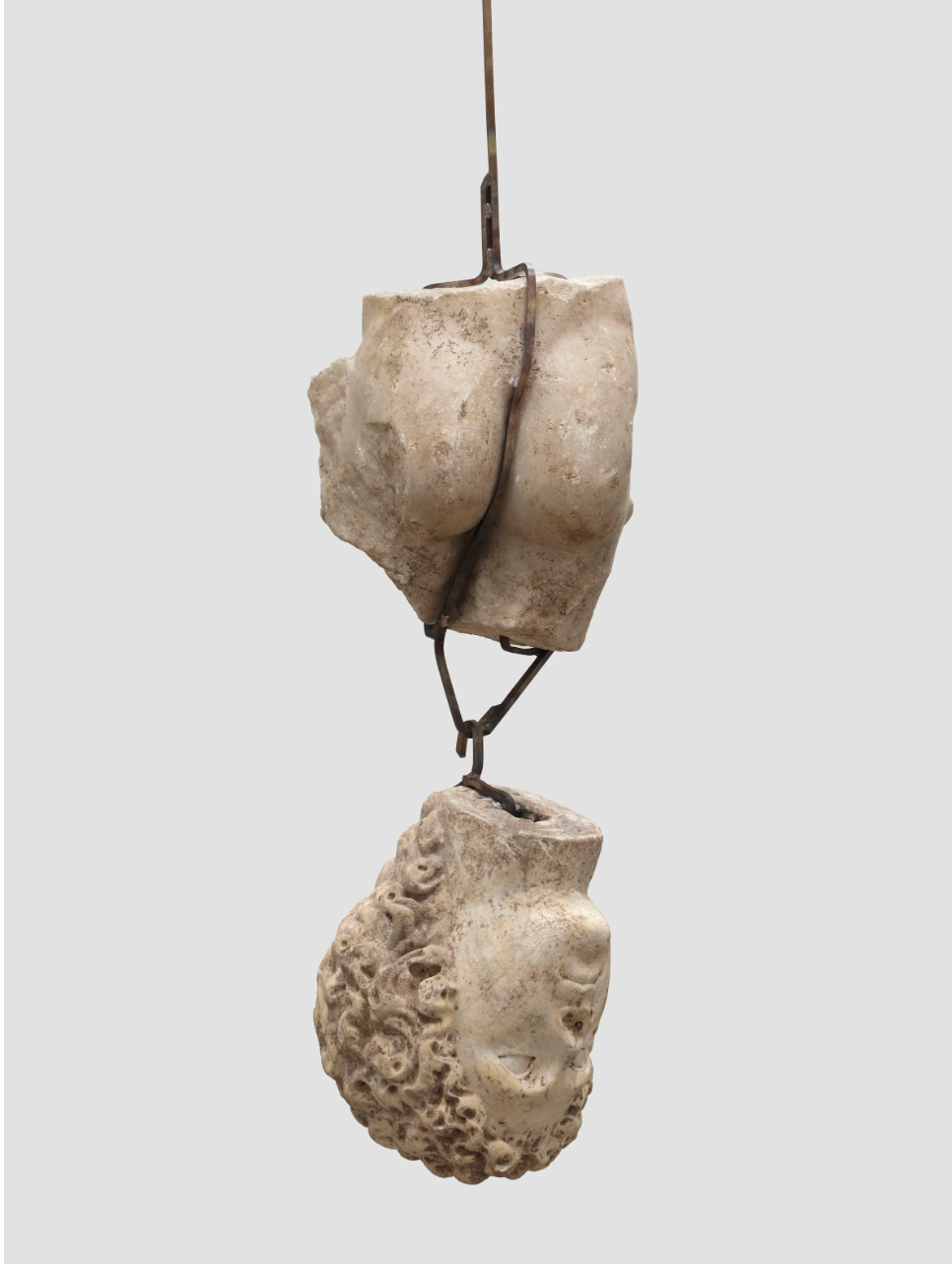
Sprawling across two floors, the show features several standouts like Shove it up your ass, you faggot! (2025), which integrates fragments of Roman-era marble sculptures hung suggestively from the ceiling. Cited as a line from William Friedkin’s 1973 film, The Exorcist, the piece’s cheeky (get it?) title also echoes Võ’s own emphatic words in a 2015 letter addressed to Dutch collector Bert Kreuk, who sued the artist for failure to deliver a large commission work. Here, the work lends itself to referential humor as much as it evokes historical structures of exposure, as indicated by the youth’s nude torso, and constraint, which are anchored by the mutilation of the same body under subsequent religious conservatism.
In line with Võ’s affinities for repurposing and recontextualizing treasured objects, displayed about the show are also a number of precious fifteenth-century rescued Vietnamese ceramics, vying perhaps toward the discourses of transnational movements or materials and displaced traditions.
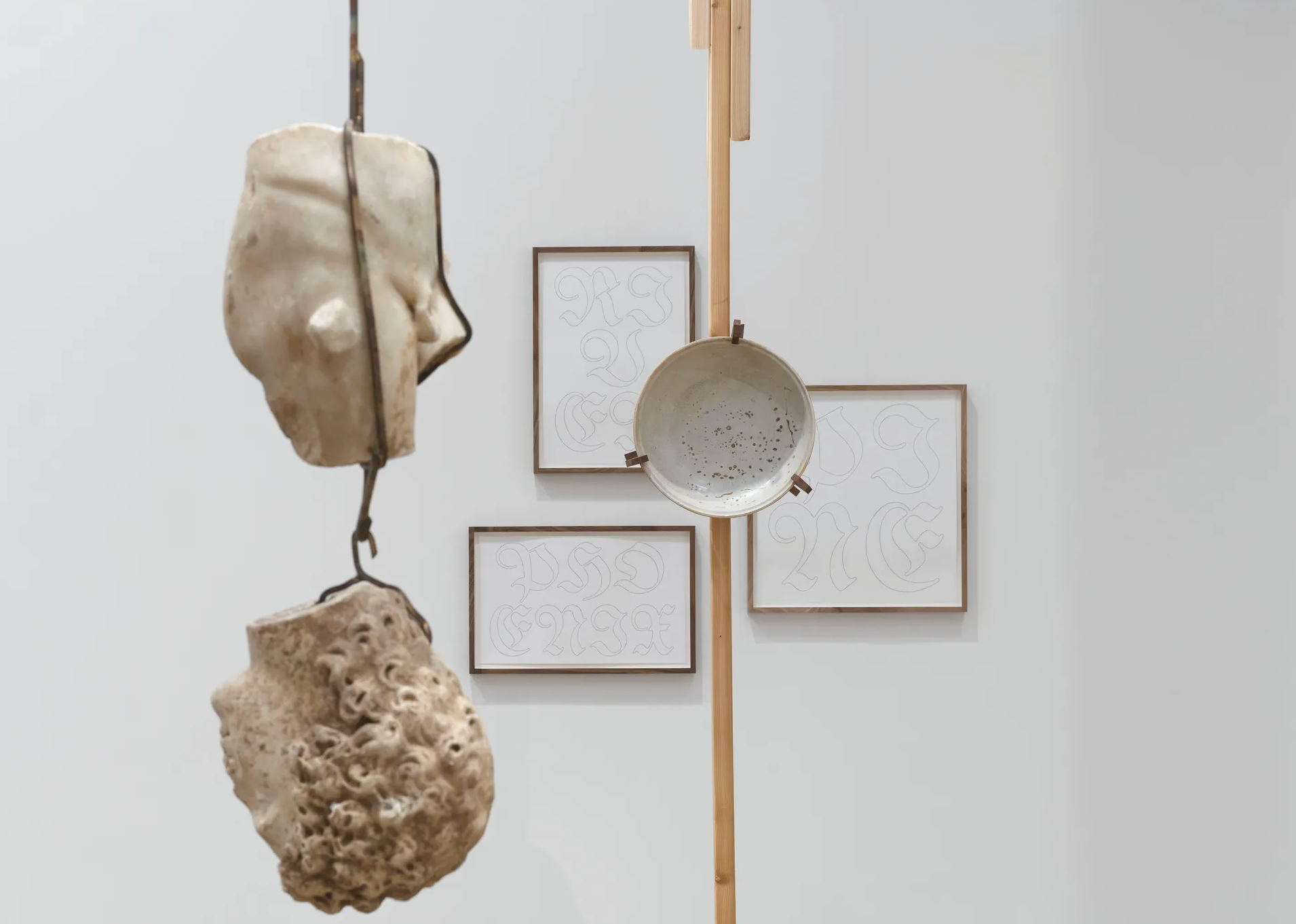
Elsewhere in the gallery, the plants and animals shown on the ceramic plates are written out by hand in English by Võ’s father, Phung Vu, signaling a seamless process of continuity and translation. Yet perhaps the most enigmatic element of the display for viewers may not be perceptible at all: the wooden displays themselves, which have been gifted to the artist by Craig McNamara, the son of Robert McNamara, the former Secretary of Defense under John F. Kennedy and Lyndon B. Johnson, whose legacy was defined by his orchestration of the escalation of the Vietnam War. From father to son, inheritance to found treasure, history is indeed a complicated beauty, and Võ’s intentionality from material provenance to visual levity requires viewers more contemplation than what is immediately apparent.
For a veteran like Võ, the show is an unsurprising measure of the artist’s maturity, and those who have appreciated his prior work will be pleased that Võ’s reputation as one of Germany's most visually daunting, conceptually appealing Vietnamese sculptors remains.
Sonia Rosa Kahn: Hereditaments
The Boiler | 191 N 14th St, Brooklyn
September 11 – 26, 2026
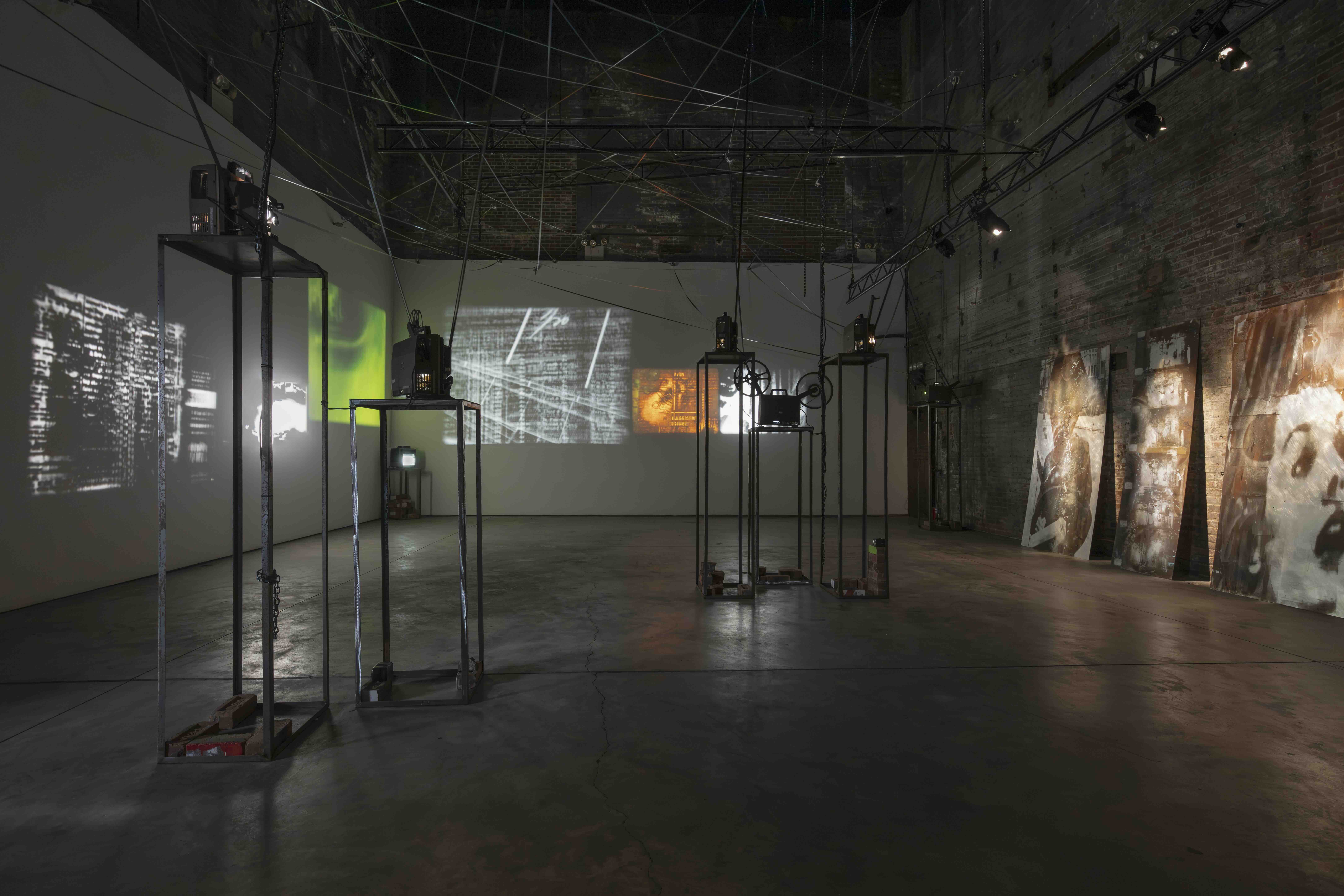
In Hereditaments, Sonia Rosa Kahn’s solo presentation at The Boiler in Williamsburg, Kahn zooms in on the microscopic history of the exhibition space itself to consider how place is constantly renegotiated through forces of industrialization, gentrification, and displacement.
True to its name, the gallery houses a large industrial boiler, the towering remnant of a bygone 19th- and 20th-century age of manufacturing in Williamsburg. Embracing this historical and architectural feature as the core of the exhibition, Khan projects a looped 16mm film across two walls in the space, mapping the building’s recorded existence. A complex metal rigging system built high into the lofted ceiling of the room holds a tall web of overlapping film strips, feeding into a small group of analog projectors sitting high on pedestals in the center of the space.
The film weaves together visual fragments of the building’s history collected through a process of close archival research. Snippets of tax documents, maps, photographs, and land surveys flash and fade onto the exhibition’s walls, dissolving into static and double exposures before reaching full legibility. Khan holds tightly to the space’s documented past, reaching into a vast archive of material history to excavate that which risks obsolescence through the passage of time and through the homogenizing powers of development. In a rejection of linearity, Kahn collapses what is and what was, surrounding her viewer with evidence of what she describes as a “fugitive vernacular history”.
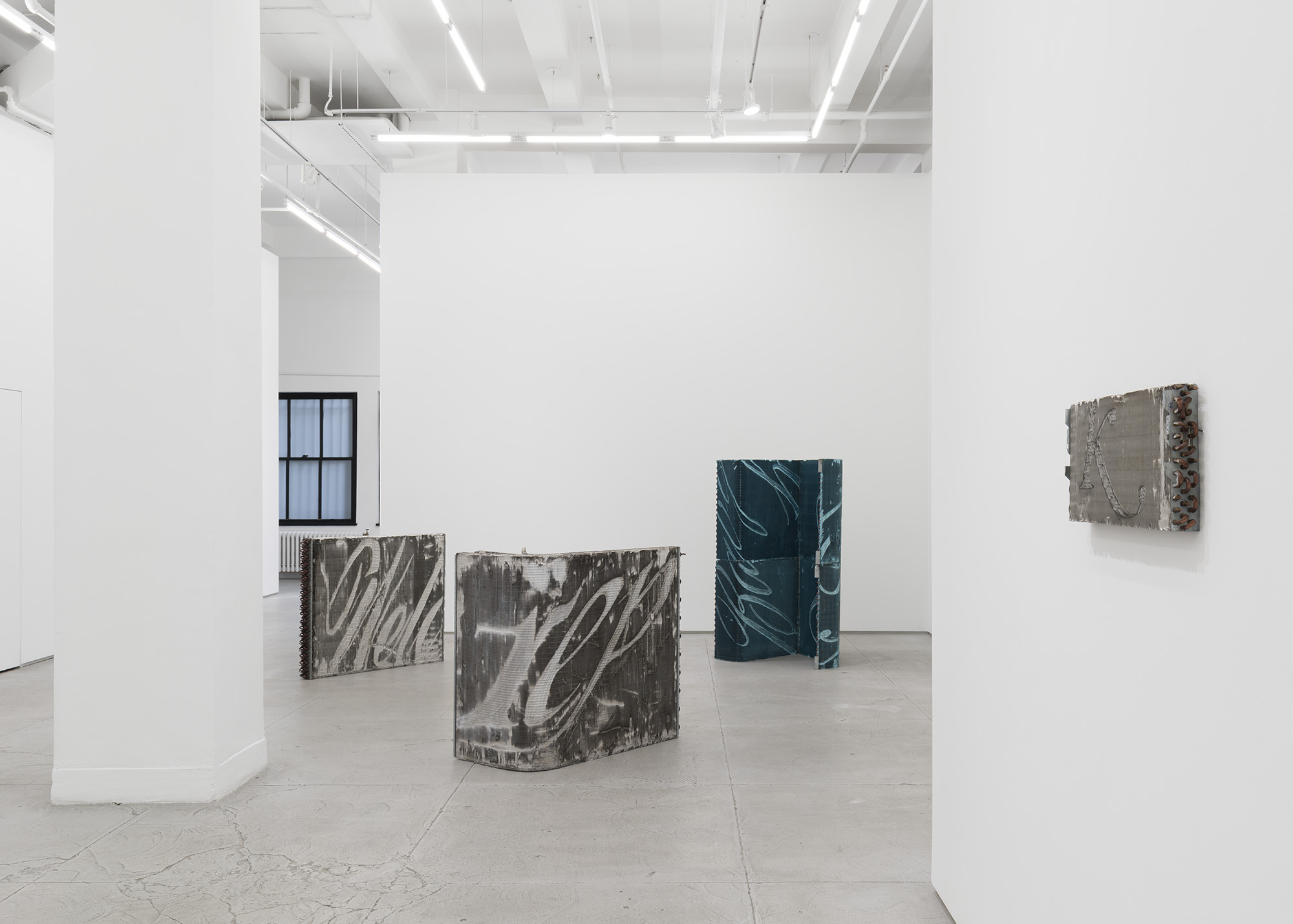
The installation moves between film and sculpture, each speaking the language of their environment. Against one exposed brick wall lies a series of large-scale metal panels printed with imagery pulled from the film. Elongated and split ambiguously into sequential stills, Emoluments 2 and 4 (2026) appear as oversized film strips themselves, distorted with static and chemical interruption. A specialized silkscreen technique produces oxidation on the surface of the aluminum plates, rendering imagery through chemical processes rather than through concentrated ink. Printed with oxidized tones nearly identical to the space’s concrete and brickwork, the panels seem almost born out of the wall behind them, immaculately conceived.
Hereditaments traces the hidden history of a single building, treating the site as inextricable from the work itself. Kahn’s practice of excavation prompts behavior that should more often become habit: questioning what came before us, and refusing the notion that what you see is what you get.
Jutta Koether: Songs of New York
Buchholz | 31 West 54th Street, New York
September 8 – October 31, 2026
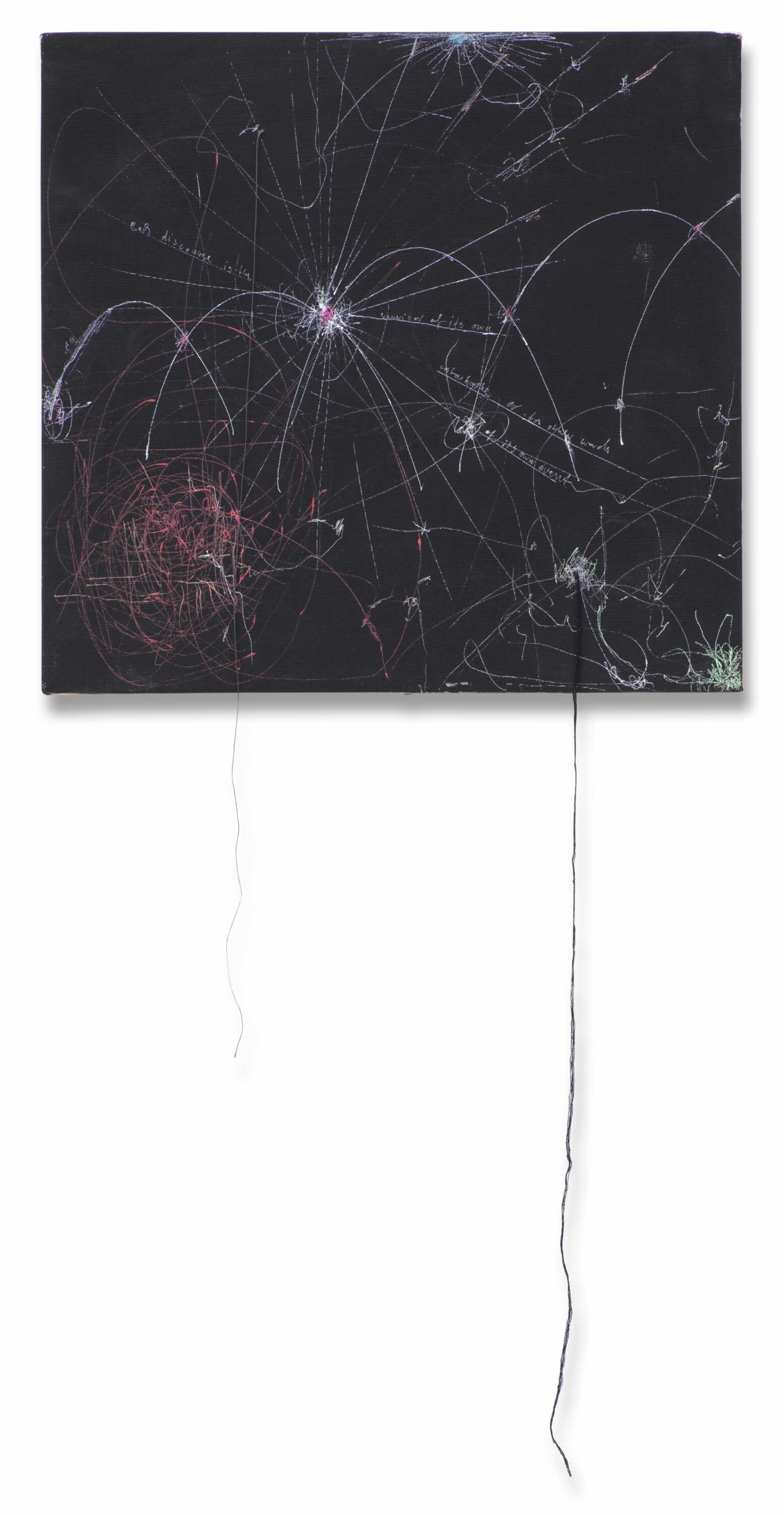
Consider Jutta Koether’s ecstatic practice spanning four decades—a culmination of stochastic gestures that deliriously collide into literature, music, and theory—in the grand scheme, an oeuvre of transcendent visual synthesis. At Buchholz, Koether’s 90s output is exhibited in all its polysemous glory, a fitfully sublime presentation where tangerine and carmine brushstrokes make sharp jabs into infinity. Songs of New York asserts Koether as her own interlocutor, charting the diffuse aesthetic and discursive networks of which she became the floating center.
This web of references, approaches, and relationships expanded as Koether relocated to New York from Cologne in the early 1990s, a move she described as a process of “self-displacement.” Die Erinnerung entwickelt nichts als Bilder und ich bin mir selber selbst schon nichts mehr als das vernichtende Nichts der Gedanken (1995), roughly translating to "a memory develops nothing but images, and I am to myself nothing more than the annihilating nothingness of thoughts," captures this transition from art student and experimental music writer in Cologne to New York polymathic rock star. Surrounding a whorl of erratic white marks is a fey, masklike countenance, a stereobox and a record, dark blue smudges pushing in from the sides, iridescent scraps of holographic plastic, and soft multicolored gridlines. Koether liquidates these allusions, injecting them with her spiky painterly presence to enact an allegorical deconstruction of symbols and systems. Like so many of Koether’s unrelaxed works, one must gaze at this painting restlessly, forcing one’s eyes to move across the canvas with such concerted effort that one's brain has to walk outside, smoke a cigarette, and wobble back in.
Given such immensity, gallerists could easily phone it in by staging Koether with a sense of formality, reifying her works while depleting their eternal flux—however, this is not the case at Buchholz. Instead, viewers engage with an era of listless curiosity, evinced in jet-black 8-foot-tall canvases which she marks with thin metallic lines, connecting tiny grids to bits of text. Here and elsewhere in Songs of New York, a shaggy lattice of caprice and intent entangles the viewers. On the third floor, Koether’s self-reflexive impulse becomes more pronounced. She affixes scratched reflective foil onto silver cardboard, distorting the mirror’s image. Down the hall, a 1943 painting by Fay Ruffo depicts a ball held at Madison Square Garden next to Koether’s more voluminous reproduction.
In a way, this pairing feels like the show’s centerpiece, though there are several brilliant works that could plausibly act as focal points. Accentuating Ruffo’s purple, yellow, and green spotlights while eliminating the original painting’s depth, Koether floods her copy with light, bringing the original’s subtle emotion to the fore. According to the press release, Koether purchased the Ruffo at the Chelsea Flea Market with Tom Verlaine in 1995; this single anecdote sparks off its own set of dense, rhizomatic associations. Like the best of Koether’s work, Songs of New York manages to be richly extratextual without occluding the artist’s genius—achieved through a nimble curation that deftly maps Koether’s creative interests during her first years in New York.
Michael Corner: CLICHÉ
Ryan Green Gallery x CREA Cantieri del Contemporaneo | Giudecca 211/C30133 Venice
May 8 – November 15, 2026
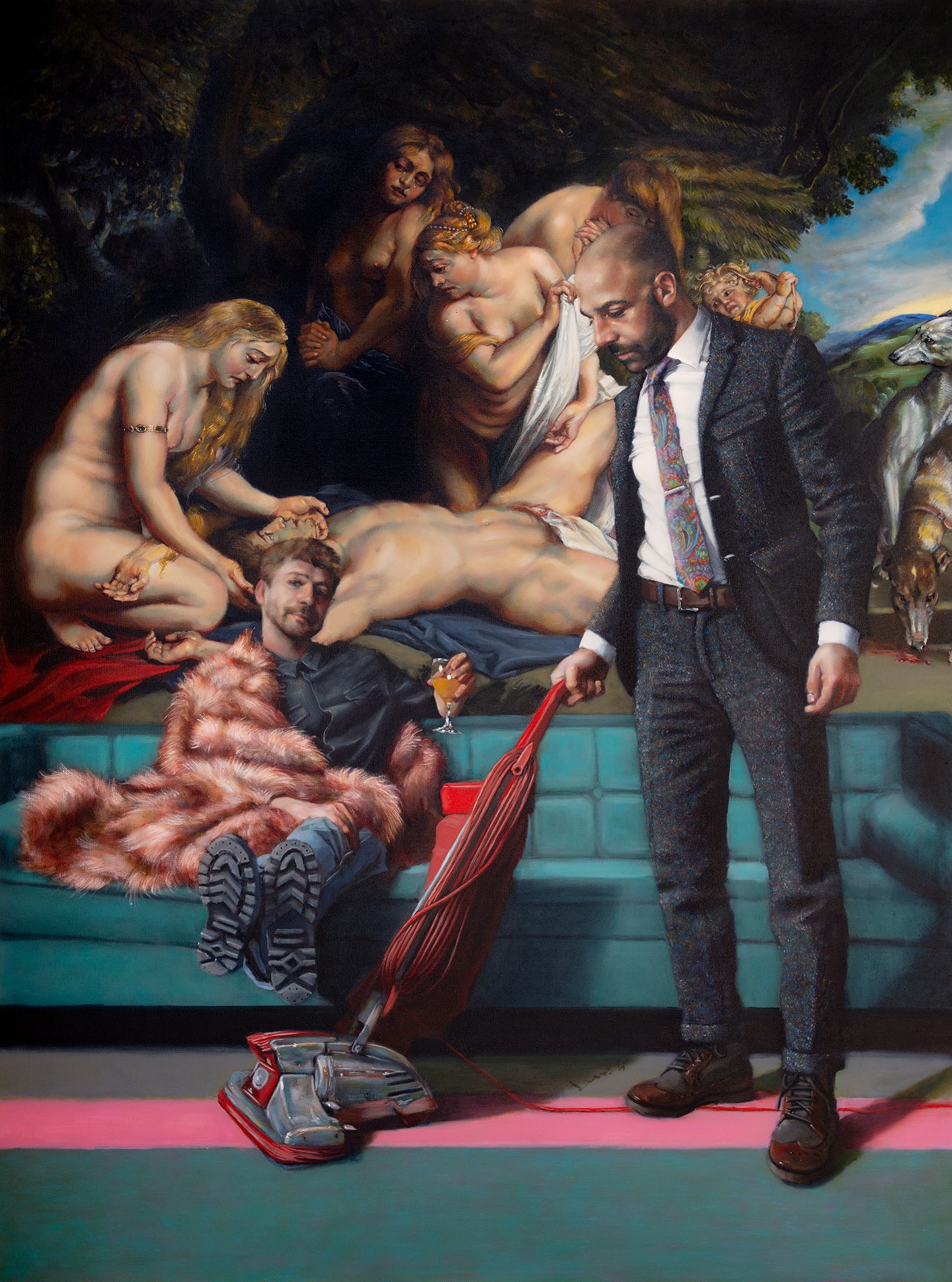
The word "cowboy" likely conjures up the image of silver-screen celluloid of John Wayne and Clint Eastwood or the rugged, romanticized iconography plastered across global advertising. The iconic cowboy has long stood as an archetype of individualism, justice, the cinematic cliché of absolute good triumphing over evil, and naturally, getting the girl before the final curtain falls. We presume to understand the cultural shorthand of the Western hero, so we stop looking deeper. CLICHÉ, Michael Corner’s debut European exhibition presented by Ryan Green Gallery and installed at CREA Venice, is counting on it.
Based in the Canadian Rockies, the so-called “Texas of Canada” in the artist’s esteem, Corner leans into the theatricality of Western mythos, casting figures in unmistakable accouterments with genuine swagger and setting the scene for a familiar cinematic trope. Upon approach, the subjects of these paintings might feel comfortable, but the artist quickly shatters that complacency with unexpected formal choices, rendered through a striking command of light, juxtaposition, and composition.
Corner’s technical skill as a painter shines through his exquisitely executed chiaroscuro and use of symbolism. Past and present collapse into one another within frames that blur the line between domestic space and open Arcadian field. Background and foreground swap places. Across the compositions, hidden trompe-l’oeil citations from canonical paintings serve as both actors and stage sets. The artist demonstrates a mastery of oil paint that evokes the old masters while also sprinkling in delightful moments of kitsch, making the paintings read as distinctly modern.
The canvases play out continuously disorienting performances before our eyes. Amidst classical framing, subtly arresting disruptions occur, most notably a recurring streak of bubblegum pink carpeting. Then, a velvet couch comes into focus, or a stainless steel pot, or a wine glass, or a paisley-printed tie, or a kitchen knife. Time is simultaneously suspended and conflated. A character is captured mid-vacuum, as if in a paused film frame. A knife lingers, a paw is outstretched, a rueful smile goes unanswered. The viewer is left holding their breath, anticipating what may play out next, participating in the drama; in this way, Corner’s paintings remain active sites of performance.
Echoing the old Shakespearean truth that “all the world's a stage and all the men and women merely players,” Corner’s paintings seemingly treat their subjects as costumed actors caught mid-act, playing their part, complicit in the cliché. How fitting that the artist’s European debut would be in the city of Venice, with all of its own theatricality, functioning as a grand, floating stage set, and where we, too, play our parts.
Susy Bielak: Camas de Ceniza / Ash Beds
Pueblo Unido Gallery | 6212 North Clark Street, Chicago
June 1 – October 1, 2026
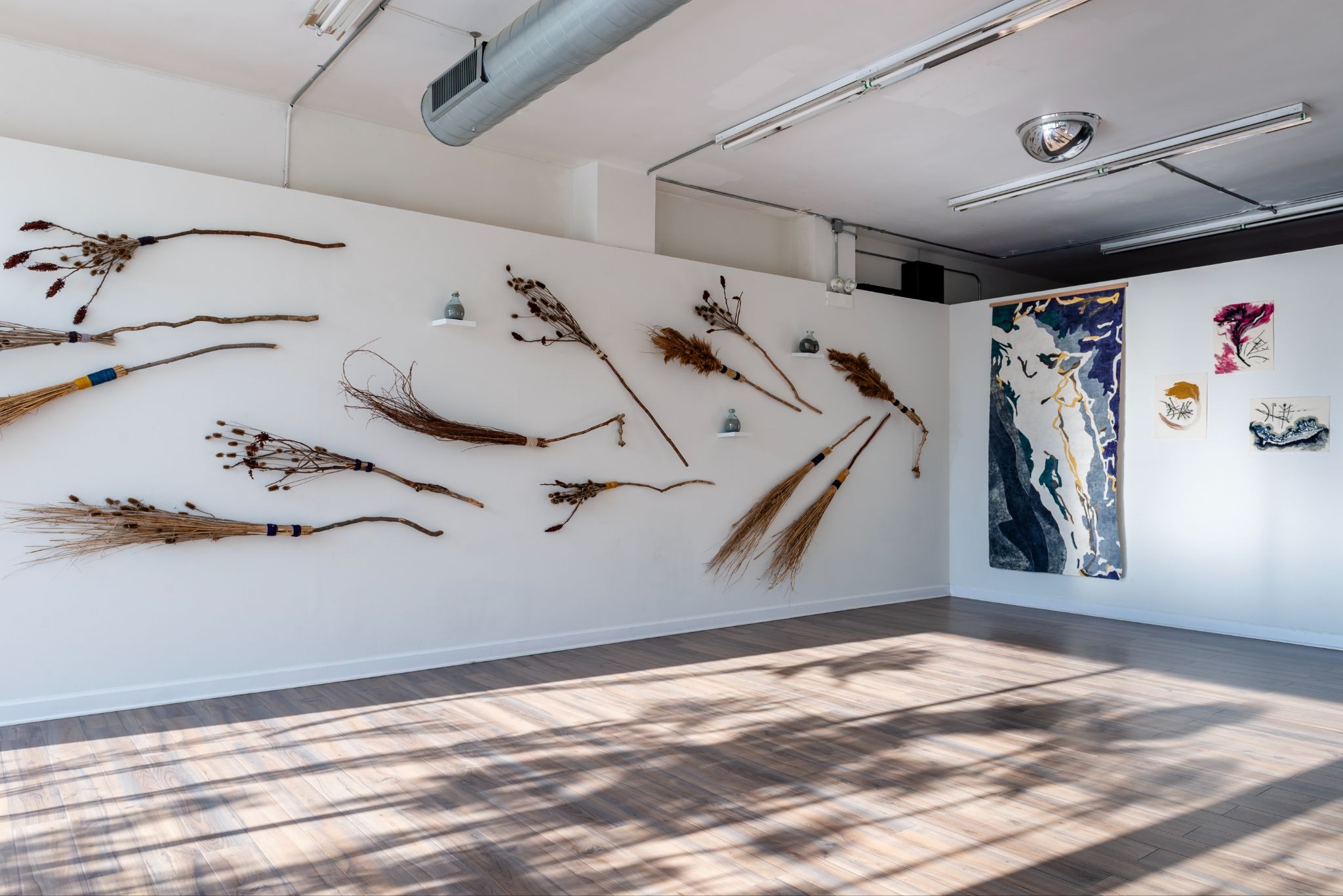
Rhizomatic structures, alongside other circuitous spider-webbed alternatives, make for easy labels of artworks. Connections, after all, teeter on the precipice of being mysterious enough to demand certainty. So, caverns of ambiguity fill with descriptions until they are replete with some form of knowledge. At times, it isn’t the artworks but the artists who are system-oriented.
Amongst undulating hills and alongside bodies of water, Susy Bielak has witnessed how people as well as places seep into one another like falling rain onto soil. In much of the artist’s practice, differentiating between matter, material, and memory is futile. Where some creators might carve out a space to identify what each of these individual components articulates in a given work of art, Bielak stresses the overlap of each element, one upon the other. Here, art becomes a Venn diagram of experience, and at the intersection are Bielak’s interests.
This configuration, one not merely of how things coexist but of how they nurture one another, is the essential, if not definitive, tether to her worldly alignment. Imagine if you could inhale and exhale everything from the clouds to the crumbling terrain around you. That’s Bielak’s art: a process of not only living, but of life.
Camas de Ceniza / Ash Beds at Pueblo Unido Gallery demonstrates this very environmental cycle. In a quiet and sun-filled room, Bielak puts Lake Michigan, a sight she has known for the last 13 years since moving to Chicago, in conversation with the volcanic terrain of Popocatéptel and Paso de Cortés in Mexico. The show surveys how geographies leave an impression on the body and on the mind, a series of poetic lasting indentations. Certain works in the show draw on bathymetric and hazard maps that quantify the geography of the world and our many encounters with it in precise representation.
Other examples, born out of conversations with two formative interlocutors—Mexico City-based artist Nuria Montiel and longtime collaborator Fred Schmalz—identify navigations into and out of sites far harder to translate. These recreations seize upon experiential sensations that remain not so easily captured by scientific studies. In either presentation, it is clear that there is no one correct way to consume our world.
This site-responsive installation, which includes paintings, visual poems, volcanic ash containments, needlefelt works, and photography, offers a variety of options for sensorial engagement. The sum is a collection of vibrant matter. There is something utterly nostalgic about how Bielak has simultaneously rendered a longing for two places at once. Locations slip into one another, finding commonality in porous distinction. To capture what it is to simultaneously be lost and found in both new and old territory is a wonderful gift. There is a reminder here that belonging can find substance in the subtle patterns left behind in the residual trail of life’s nonsequential sweeping journey. Stop and remember.
Gozié Ojini: Careworn
Silke Lindner | 350 Broadway, New York
September 9 – October 24, 2026
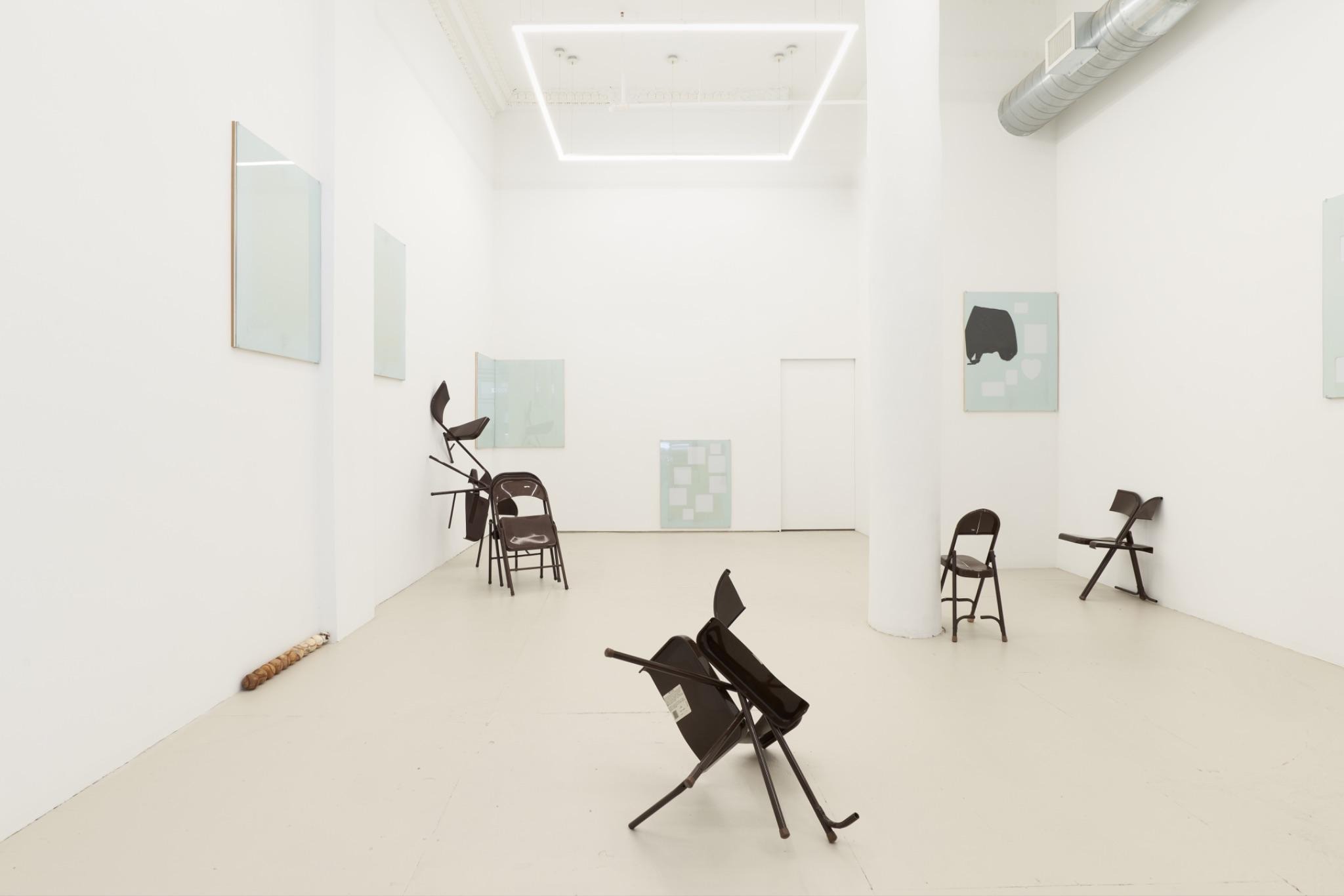
A full house and many familiar faces were at the opening of Gozié Ojini’s exhibition Careworn at Silke Lindner. Despite the September art rush, any sense of fatigue was absent in the gallery, with a presentation that kept revealing surprises in every corner.
With Grounders (2026), altered and unaltered baseballs are placed on the floor in corners, sitting on the periphery yet inviting a closer look. The manipulated baseballs are cut and reassembled, collaged into a new object; familiar to us yet different. On the other hand, the whole baseballs, showing rough use, are placed next to each other, composing a gradient of color and usage.
Untitled 4 (2026), a diptych divided by a raised wall panel, splits similarly to Untitled 2 (2026), a metal folding chair that has been cut in half and reassembled. Both works balance two similar parts of a former whole, reconfigured into something entirely new, their use cases obfuscated.
The flat wall sculptures, or what one might call not-not-paintings, tell a similar but distinct story. Altered matboards whose soiled surfaces show traces of labor that was put into making the piece. Precise, asymmetrical cutouts on Untitled 1 (2026), Untitled 2 (2026), Untitled 3 (2026), and Untitled 6 (2026) leave us wondering whether they were used for maquettes, giving them a second life and a double purpose.
The hanging of the matboard-and-glass panels distances itself from the traditional white-cube installation style. Untitled 1 (2026) and Untitled 2 (2026), hanging unexpectedly low, give the visitor a better chance to inspect the layers of the works, held between the glass and a strainer. Untitled 5 (2026), its two parts hung in a 90-degree corner, calls to mind Julije Knifer’s Meandar u kut (Meander in Angle) (1961) right away. The work acts almost as an icon of the show, drawing attention to the east corner, a part of the gallery space often overlooked. It becomes sacred, lending the exhibition spiritual significance.
Next to Untitled 5 sits Untitled 4 (2026), an installation of assembled folding chairs that acts as both the show’s climax and the first thing visitors notice upon entering the gallery. The work defies gravity, making one wonder how it stands on its feet without falling, almost like a plant climbing onto the façade of a building. The installation ties the exhibition together; Ojini once again reconfigures known objects into something unrecognizable, suppressing their initial use and giving them a new life.