“Are you lonely tonight?” at the Australian Centre for Contemporary Art
Review
Tim Breuer’s paintings pull in two directions at once: toward nostalgia and toward something closer to distraction. His palette is soft, rendering urban dwellers as mottled silhouettes—present but withheld—drifting across the canvas with a heightened anonymity that produces an uncanny feeling of familiarity. The mood is one Walter Benjamin would have recognized. The flâneurs who wandered in and out of the arcades of nineteenth-century Paris knew this particular brand of ennui: the sensation that the world had been turned down a few notches, muffled by an inescapable weariness. Verbal description seems always to arrive a moment too late, as though the right words retreat just as they come within reach. Breuer’s paintings don’t depict that condition so much as reproduce it.
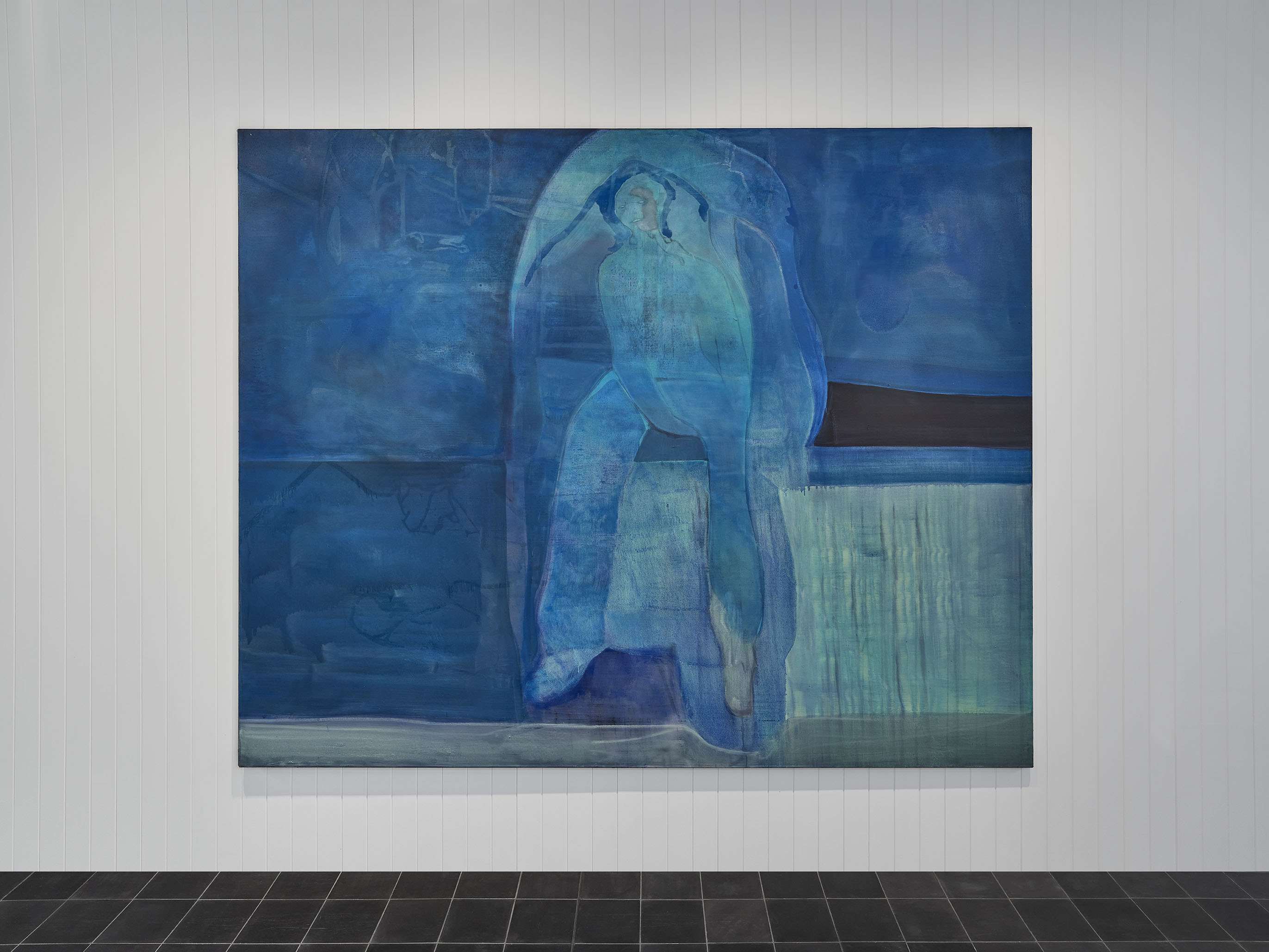
Across three London galleries, Tim Breuer’s solo exhibition, co-hosted by TRAMPS and Champ Lacombe, captures fleeting metropolitan moments. These compositions differ from those of artists like Peter Doig, Breuer’s former peer at Kunstakademie Düsseldorf, who tends to hold the viewer in a cinematic stillness, evoking the painting as a screen, the story assembled by the gaze of the beholder. Breuer complicates the direct connection between the viewer and the scene, often exaggerating perspective to generate hallucinatory, hyper-fluid spaces. In Untitled (2026), the seatbacks in a train car loom, swelling to consume nearly two-thirds of the canvas. The passengers, rendered in a washed-out mauve, appear to float midair, more spectral than solid. Similarly, In Transit (Arrivals) (2026) depicts an escalator tilted at such a precarious angle that it seems moments from buckling. Breuer’s paintings maintain an aqueous quality, as though suspended in solution, lines submerging and forms diffusing into one another. Each cityscape becomes a living organism that absorbs what enters and expels it in altered form.
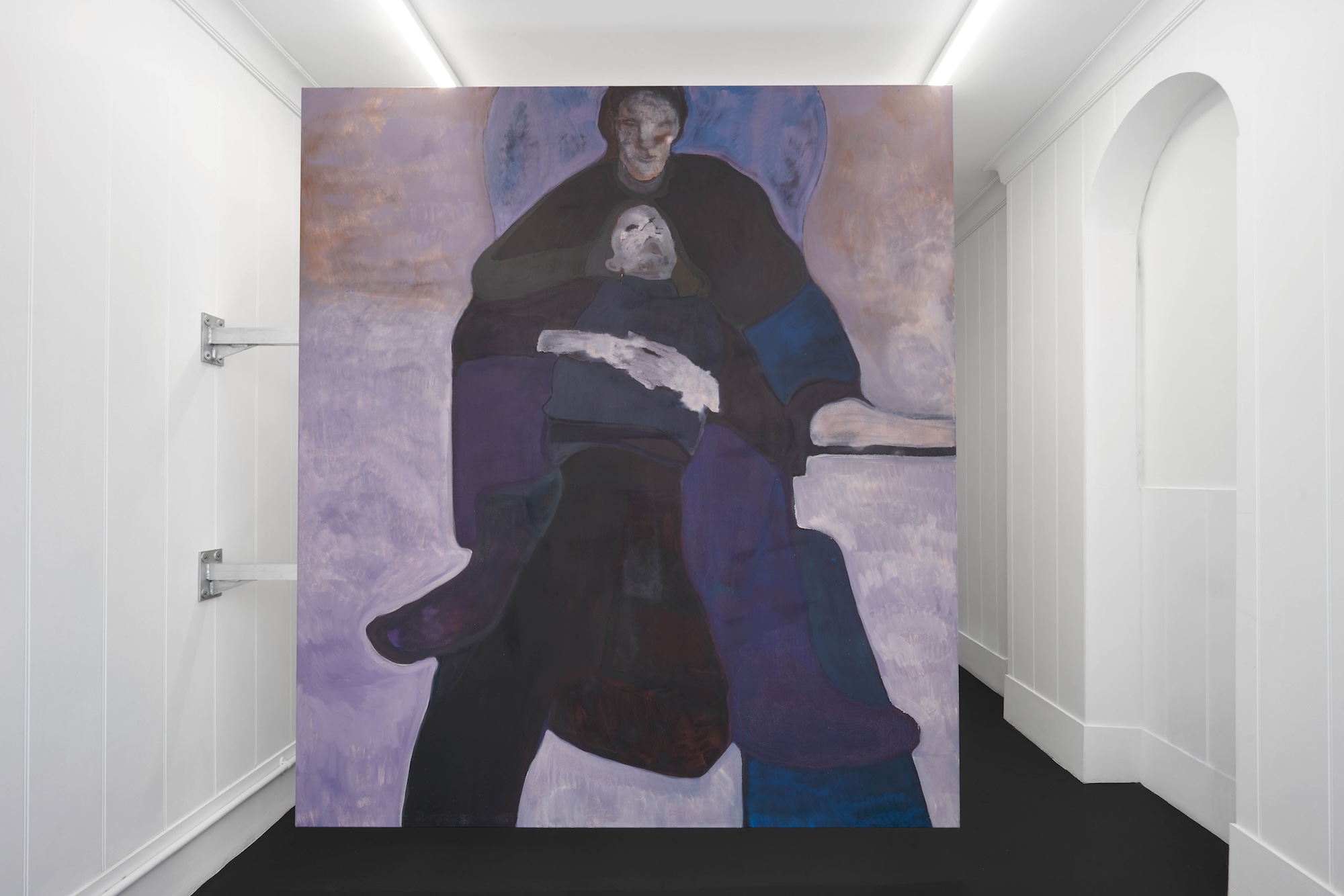
The configuration of the exhibition across three white-box galleries reinforces the works’ preoccupation with the urban condition, as do the architectural features of each site. At Champ Lacombe’s space in the Bloomsbury neighborhood, viewers are greeted by a canvas mounted on a steel frame that functions as a screen partially occluding the gallery interior. Two shadowy, raven-toned figures sit against a somber dark purple field, one held in the other’s arms. The fused bodies recall the disturbing intimacy of Francis Bacon’s famed portraits. But Breuer is not painting Bacon’s world. Where Bacon enclosed psychological turmoil within architectural frames, Breuer imagines no such contained interiority, his figures seemingly denied inner worlds distinguished from the surrounding city. Breuer reminds viewers that individuals are the product of their surroundings.
A fifteen-minute walk away in King’s Cross, the next gallery is thoroughly suffused with natural light beneath the wooden joists of its cottage-style ceiling. Suspended from a beam or affixed to the seemingly provisional wood walls, the paintings invite viewing from multiple directions. In the adjacent room, the variegated brickwork and worn floor tiles pick up the paintings’ saturated palette, as though the colors have leaked beyond the stretcher bars into the architecture itself—or, conversely, as though the building itself has bled into the art. Either way, the works must be apprehended not only optically but through the embodied experience of moving in relation to the architecture. Here, the brushstroke is the foundational element of the physical environment, each one extending across layers until distinctions between forms collapse and liquefy.
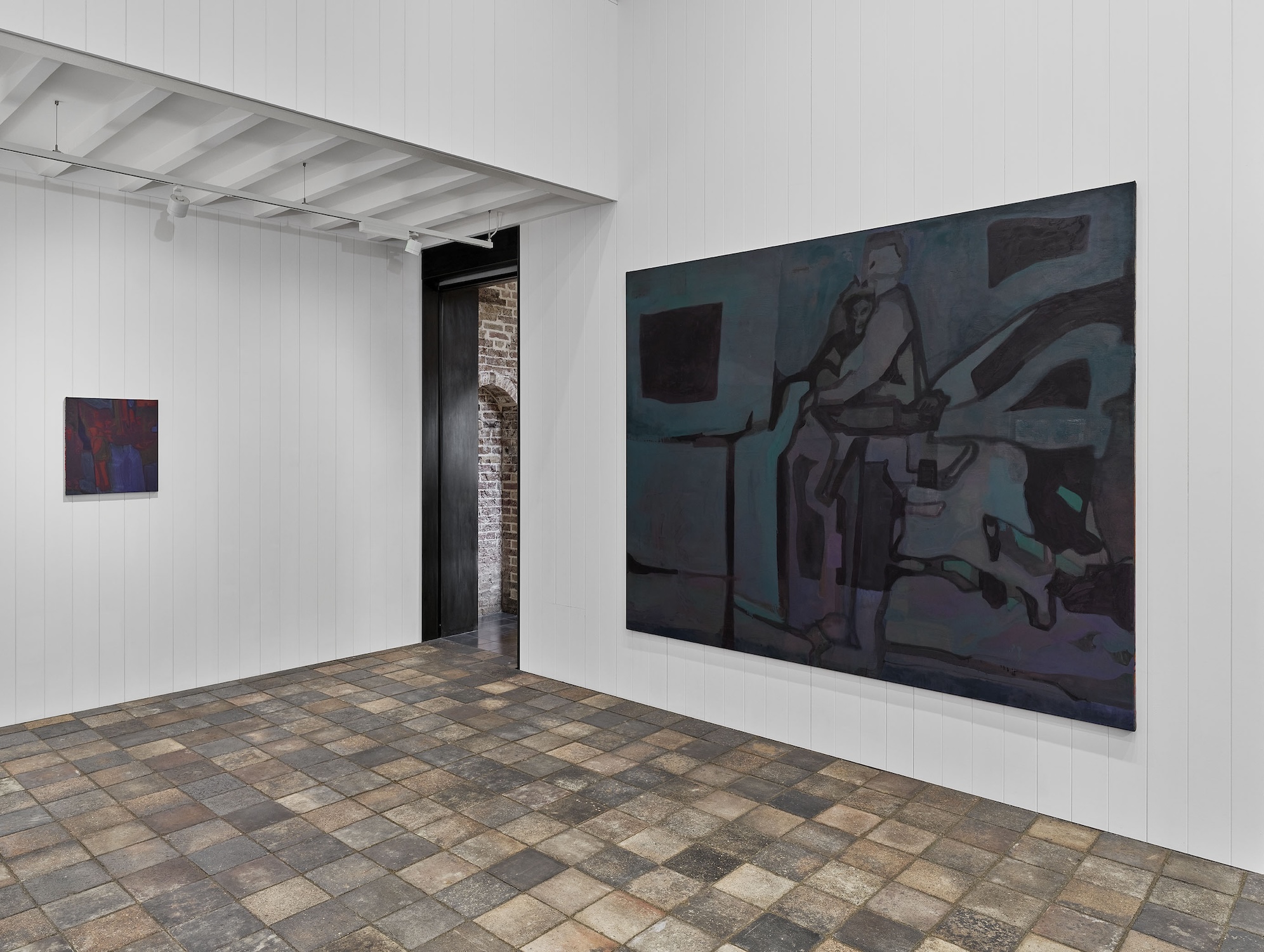
Across the locations—the third in Camden—the paintings ask to be experienced as a city is experienced: in motion, on foot, always in a state of flux. Scale is registered in relation to the body, as the built environment prompts ongoing recalibration. Under natural light, the works’ water-washed, bleeding palette recalls the view from beneath a glassy lake, where blocks of color break into prismatic facets as light refracts through the surface. Benjamin’s arcades promised a world under glass. Breuer’s city offers no glass at all, the art enmeshed in the urban substrate.
Tim Breuer’s three-part solo exhibition was on view from June 5 to July 25, 2026.