
.webp)

Santiago Gómez: “Cabalgando Entrañas / Riding Entrails” at Plaga
Review
Architecture and infrastructure are traditionally constructed as monuments to Enlightenment rationality: standardized grids, load-bearing calculations, and ergonomic predictability designed to eliminate surprise. We build clean, linear systems to pretend we are masters of our environment. Yet beneath the orderly geometry of the contemporary metropolis lies the messy, biological, and psychological reality of the bodies that must inhabit it. When our engineered infrastructures fail, fracture, or decay, they reveal what psychoanalysis recognizes as the inevitable return of the repressed. What happens when sculpture strips away the comforting illusion of frictionless utility, applying the rigorous, oxymoronic mechanics of the unconscious to industrial building materials instead?
Based in New York City, Bradley Marshall constructs intricate sculptures that strip away this illusion of frictionless utility. Adopting the vernacular of urban survival through ventilation hoods, cantilevered arms, overhead piping, and modular brackets, his objects decisively refuse linear teleologies. Instead of illustrating conventional design principles, Marshall deploys what can best be described as dream logic. Marshall replaces standard engineering with the psychic apparatuses Sigmund Freud identified in The Interpretation of Dreams: specifically, condensation (Verdichtung) and displacement (Verschiebung).
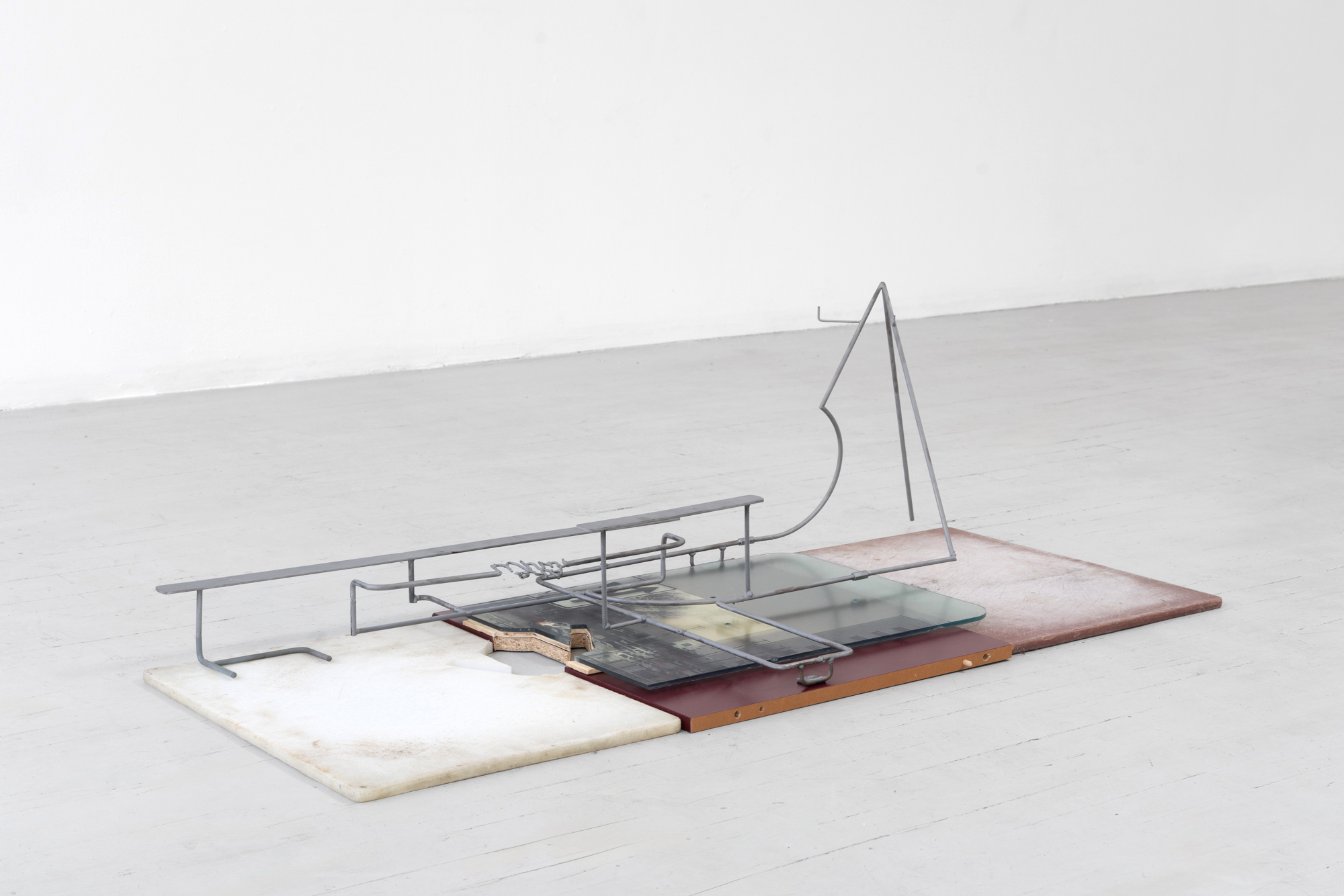
In his seminal 1900 text, Freud demystified the dream, framing it not as a supernatural vision but as a complex mechanical architecture designed to bypass the conscious mind's censorship. Among the primary mechanisms of this "dream-work" is Verdichtung. Freud observed that “[d]reams are brief, meagre, and laconic in comparison with the range and wealth of the dream-thoughts,”1 detailing how vast networks of waking memory and material residue are compressed into a single, highly charged image. This exact architecture of condensation anchors Marshall’s visual syntax. Consider Carbon Copy, Palatial Mirror, AHAMHM (2025), a low-slung floor sculpture that arranges discarded urban detritus into a stratified horizontal mosaic. On the gallery floor, Marshall juxtaposes a stained white HDPE cutting board, a reddish-brown laminate shelf, and a clear acrylic sheet bearing a UV-printed photograph of a city street and a directional traffic arrow. In this horizontal mosaic, all of the stratified layers have been cut flush into the shape of a typical button-up shirt, maintaining their exact registration within the assemblage. This precise excavation exposes the raw, composite wood core of the laminate shelf, physically slicing into the printed urban landscape beneath it. Hovering above this floor-bound collage is a delicate, sandblasted steel rod armature that rises like an elevation drawing, its grey metal conduits bending into cursive script, spelling out "AHAMHM" in empty space. By compressing the two-dimensional signage of street navigation, domestic food preparation, and structural shelving into a single load-bearing footprint, Marshall manifests Verdichtung in physical space.
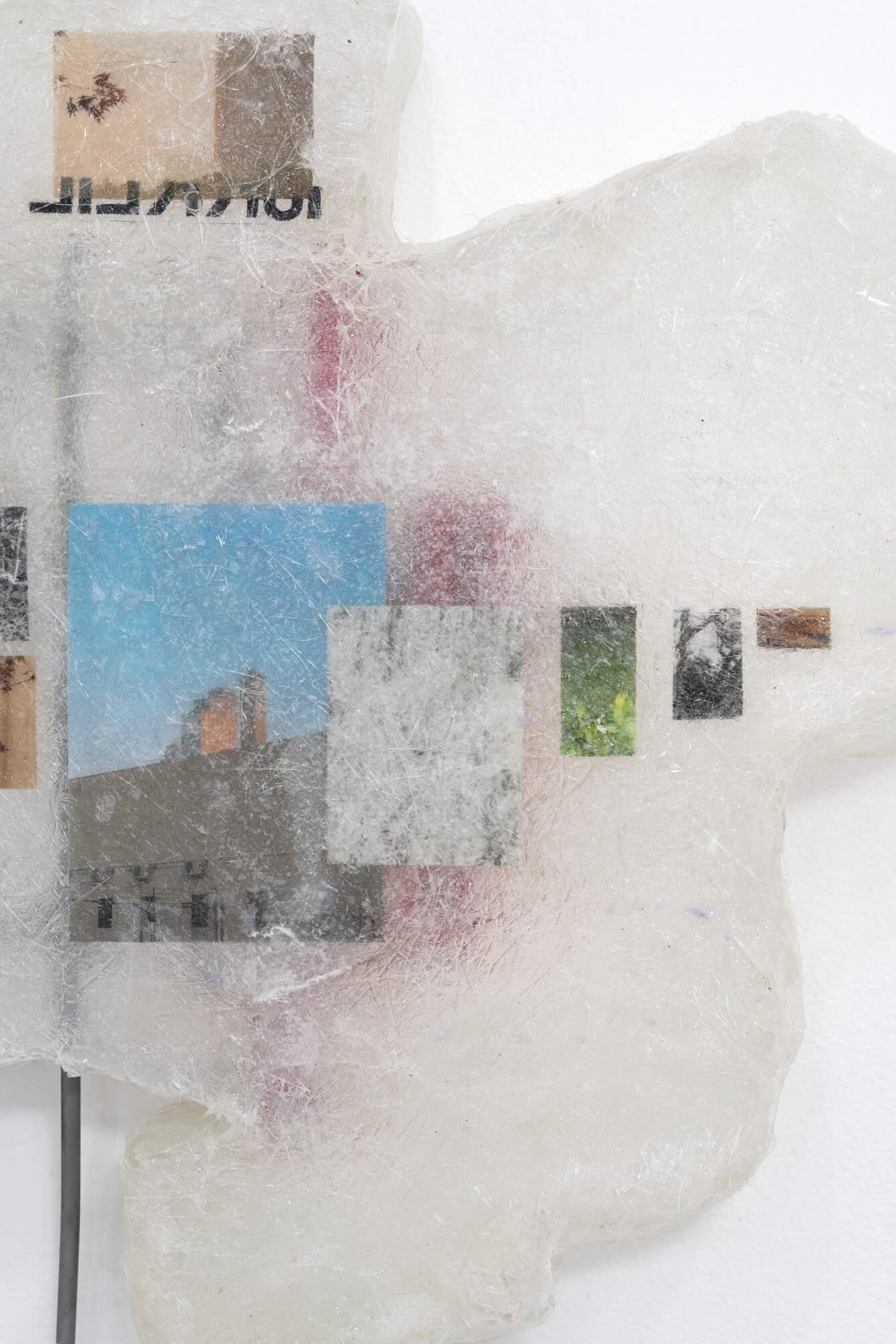
This spatial condensation appears equally potent in 10.5 Years, a wall relief where a translucent, cloud-like hollow fiberglass shell and resin encapsulate fragmented inkjet prints of brick building facades and blue skies. The organic, poured resin body acts as an opaque skin, semi-concealing the architectural imagery within its fibered matrix. Extending downward from this organic body is a right-angled grid of sandblasted steel, thermostatic valves, and piping, fusing exterior building facades, internal circulatory plumbing, and atmospheric memory into an irreducible static relief.
The concept of Verschiebung illuminates the physical tension animating Marshall's structures. In the dream-work, affective intensity is stripped from significant events and transferred onto peripheral objects: “what is clearly the essence of the dream-thoughts need not be represented in the dream at all.”2 Marshall enacts this by shifting psychological stakes onto the technical minutiae of hardware and fasteners. In Waistline and Timeframe (2025), a heavy, black powder-coated steel beam is bolted to the floor at a sharp right angle, cantilevering horizontally into the room. Resting precariously on its far end is what appears to be a disposable plastic bodega cup filled with ice-cold liquid and a bright yellow lemon slice. Yet, this beverage is a synthetic fabrication. Employing plastics and styling techniques borrowed from commercial food advertisement photoshoots, Marshall engineers a hyper-real simulation designed to manufacture artificial thirst. He even applies artificial condensation to the exterior of the plastic, pushing the mimesis further to cement the illusion of a freezing, refreshing drink. The trompe l'oeil is so seamless that during an opening, attendees repeatedly plucked the cup off the beam, assuming a careless gallery-goer had abandoned their drink. By balancing this deceptive emblem of consumer leisure on a load-bearing cantilever, Marshall dissolves the boundary between the artwork and the room. This comedic slippage exposes how effortlessly our built environment conditions us to overlook the constructed nature of our surroundings, as well as the provisional reality of all objects—trash and otherwise—that remain contingent within it.
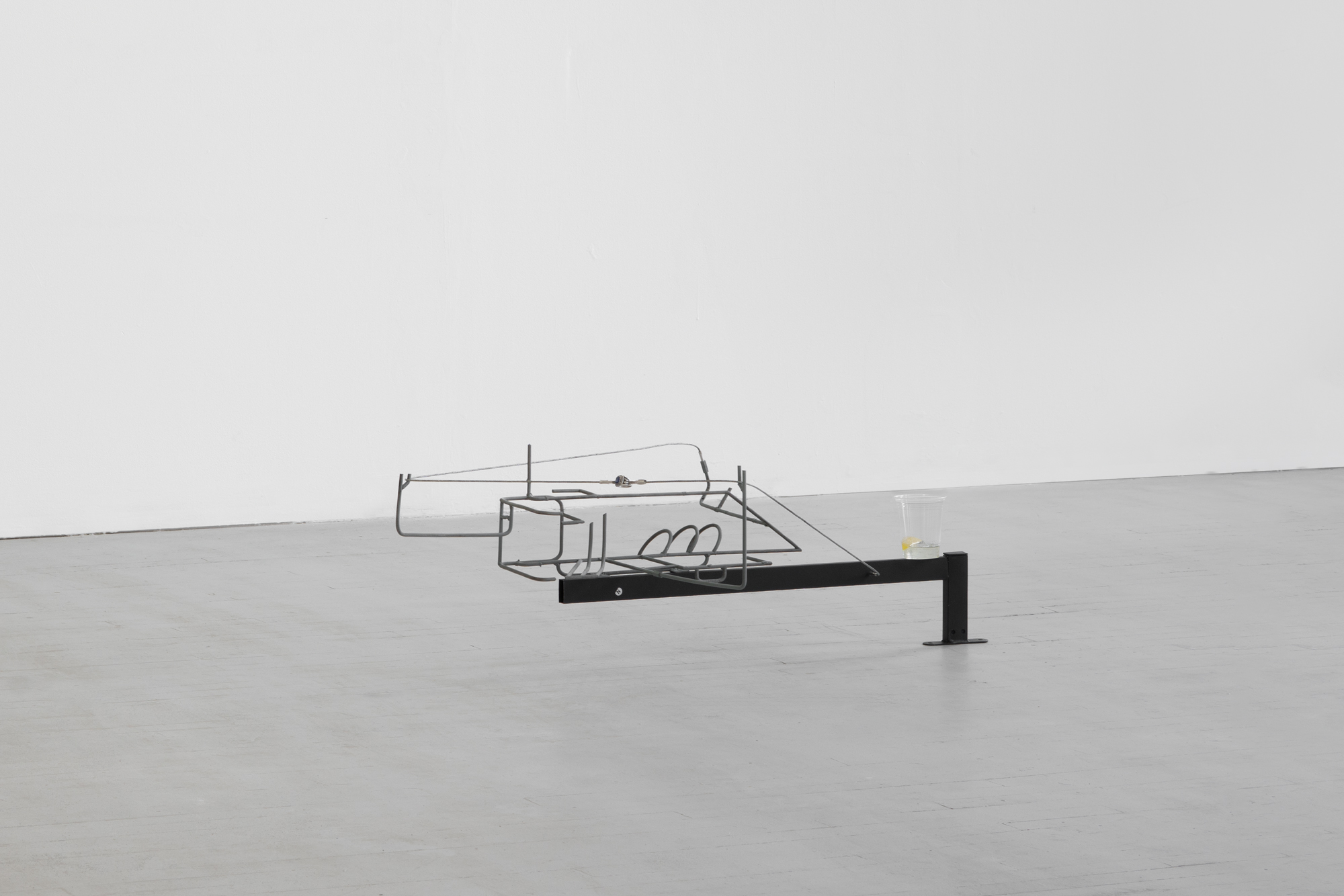
The structural integrity of Waistline and Timeframe relies on a grey sandblasted steel wire rack spanning the length of the beam, guyed and stabilized by a taut stainless steel rigging cable. These ends thread directly into the carefully “tapped” ring itself, where the artist has drilled corresponding threaded holes to allow a neat, structural compatibility. By co-opting the highly specific minutiae and language of industrial machining, Marshall elevates a functional fastening method into a compelling visual experience. Subjected to the rigorous logic of metal fabrication, personal history and institutional memory are stripped of sentimentality and repurposed as load-bearing hardware. This gesture exemplifies Marshall’s rejection of the sterile architectural blueprint in favor of a provisional encounter with material friction. When an initial engineering plan collapses in his studio, that failure leaves behind a sculptural palimpsest where previous physical gestures transform ruined components into unexpected structural solutions. The artist allows materials to re-route the work’s trajectory, echoing Freud’s observation that "the dream-work is doing nothing original … it merely follows the paths which it finds already laid down in the unconscious."3
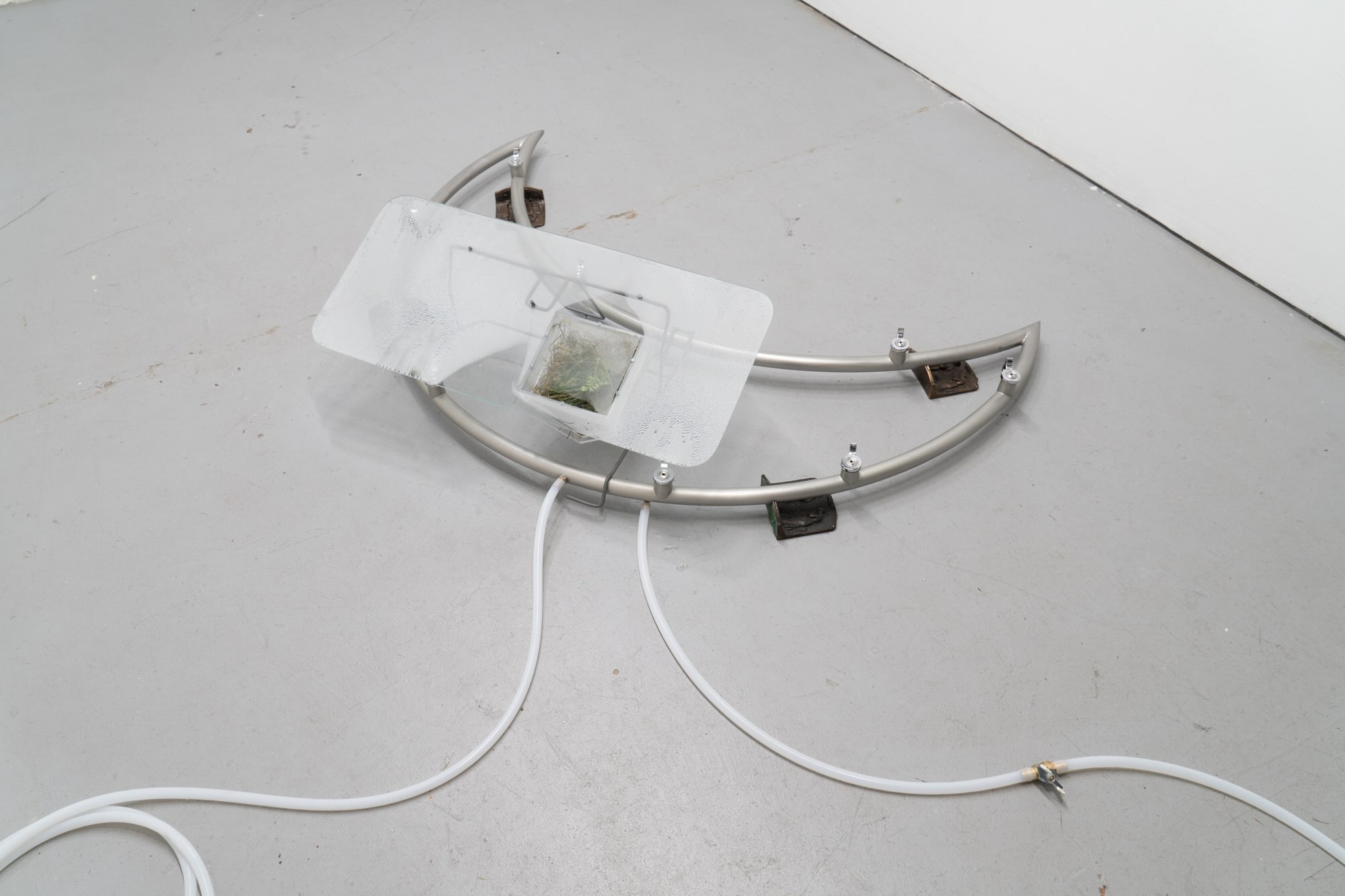
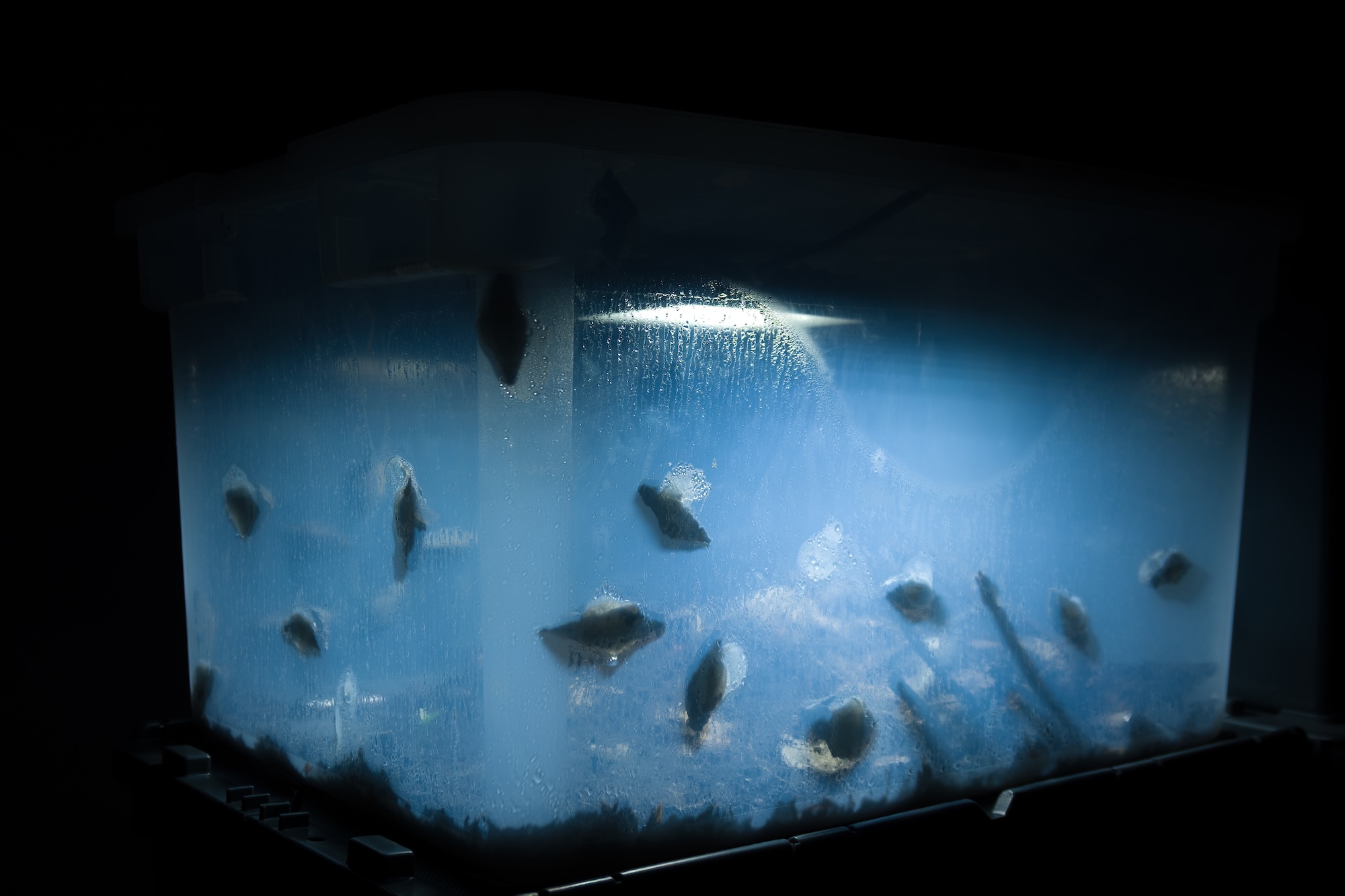
Bodily vulnerability and infrastructural mechanics become explicitly tangible and entangled in Marshall’s kinetic and acoustic installations. In Grandfather of Information (2026), a flat, crescent moon in stainless steel tubing rests on the gallery floor, supported at its tips by heavy bronze bookends. Spanning these curved metal rails is a clear acrylic enclosure housing a dry, tangled nest of fake and natural green grasses. Along the rails sit polished stainless steel tea kettle whistles, while white silicone hoses snake across the concrete floor to connect a remote steam generator directly into the piping system. When active, the sculpture breathes, fogs the viewing chamber, and emits steady, pulsing acoustic whistles. By injecting vapor and organic decay into an engineered conduit, Marshall converts an industrial plumbing grid into an unpredictable, respiring organism. He extends this anatomical mapping in Rolltop Adherent (2024–25), a wall-mounted assembly merging agricultural storage with the human body. Beneath a frosted acrylic awning held by cylindrical standoffs, a transparent hopper dispenses a vertical column of raw sunflower seeds. Suspending this feeding apparatus from below is a vintage aluminum Brannock foot-measuring device, acting as a heavy bracket for a cast bronze relief slab. In the joinery, sandblasted steel rods bend at 90-degree angles to form a parallel wiring harness terminating in five protruding cylindrical steel pins, mirroring the five toes of the human foot or the electrical prongs of a junction box. Human anatomy, agricultural yield, and industrial fasteners are bound into an irreducible psychic apparatus. By forcing a structural dependency between discarded found objects and meticulously handmade interventions, Marshall mirrors the conglomerated architecture of the dream space itself, where disparate waking fragments coalesce into a unified, functioning mechanism.
Marshall’s sculptures refuse the contemporary demand for immediate edutainment or easily digestible wall didactics. His art offers neither comforting maps nor prescriptive solutions to the political and structural crises of our built environment. By filtering the standardized lexicon of industrial fabrication through the logic of the dream, he sensitizes us to the codified nature of the spaces we inhabit. Standing before his cantilevered beams, tension-rigged class rings, and steam-breathing conduits, we confront the hidden tensions and precarious assemblages holding our reality together. In an era that prioritizes seamless, algorithmic predictability, Marshall’s dream-work exposes the fissures in our infrastructure, inviting us to linger in the unsettled space between structure and collapse.
1 Sigmund Freud, The Interpretation of Dreams, trans. James Strachey (Basic Books, 2010), 296.
2 Freud, Interpretation of Dreams, 322.
3 Freud, Interpretation of Dreams, 360.