

.webp)

Marc Kokopeli: “M.Kokopeli CURSED/01” at Gladstone
Review
A Bag of Tricks opens with a bow. We’ve stepped below ground into Ortega y Gasset Projects in Gowanus, and we begin with a small grey drawing depicting a performer who’s crossed his legs and bent at the waist. Two solid spotlights, one from each corner of the page, intersect just above his shoulders. The artist, Samuel Alexander Forest, has a style of drawing that is smooth and illustrative; the contours between forms—pants and shoe, top hat and outstretched hand—are blurred. An act worthy of applause has ended as we’ve set foot in the gallery.
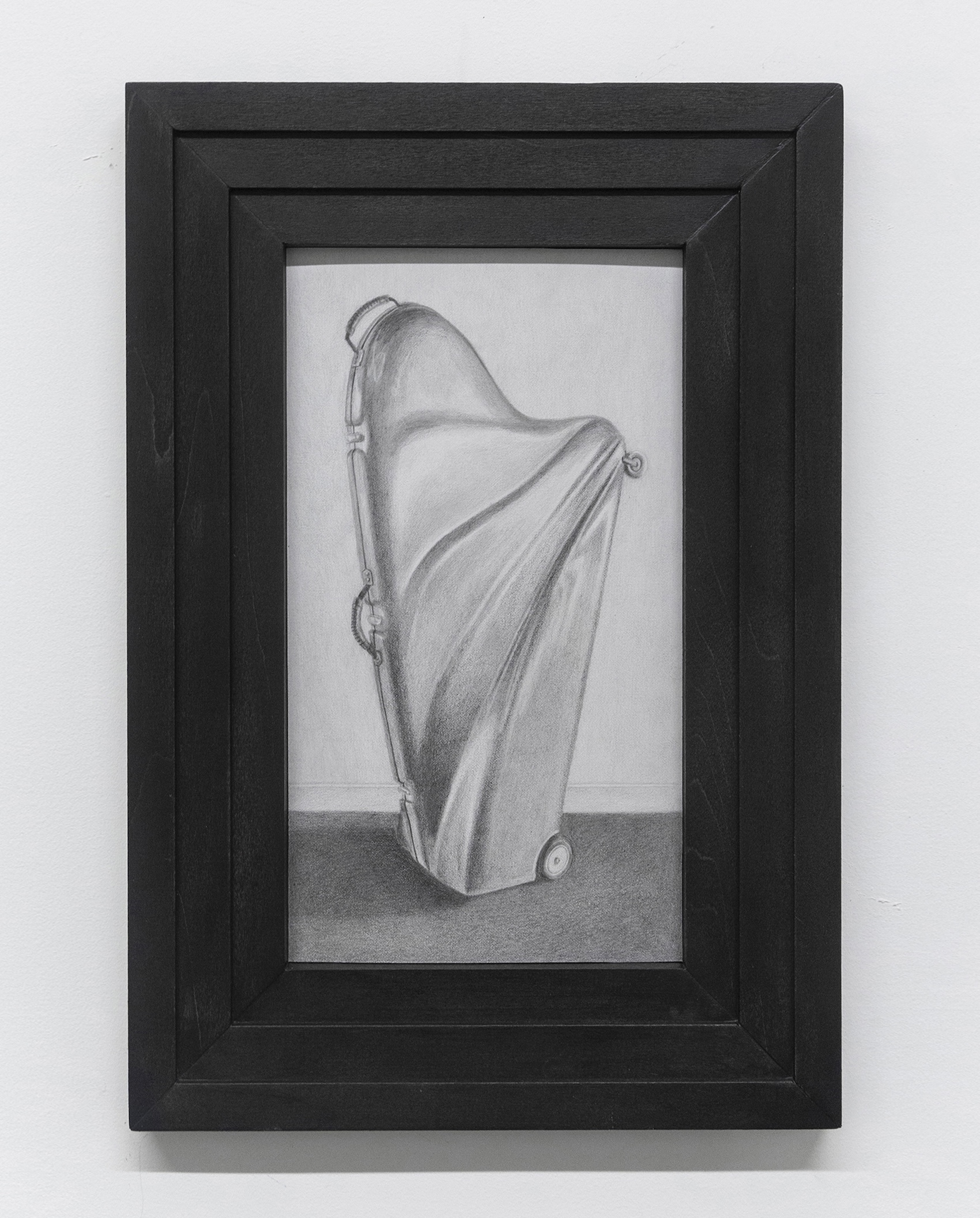
We’ve missed a moment, but Magician starts off a pattern of muted greys on the gallery walls. These are twelve drawings, small and rectangular. On the left are depictions of instrument cases for transportation and safekeeping: a case for a French horn, a case for a harp, and a case folksinger Gillian Welch uses for small tools, like guitar picks and capos. Again, Forest’s hand is precise without flourish. A magician’s case has seven intricate buckles, each rendered with a modest amount of pressure from the graphite. These clear representations read as portraits. The harp case is particularly curvy, and the magician’s case wears a top hat. While performers commute, instruments rest, waiting to emerge and take melodious breaths.
The drawing series continues on the right wall. Forest’s style is now familiar. His hand is an efficient case for an idea. A jester, a one-man band, and Barbette are depicted on the edges of the stage. Spotlights illuminate them, providing contrast that distinguishes these acts from the dwarfing, grey stage. The jester makes eye contact and gestures emphatically, but his face is expressionless.
A one-man band enters the stage from the right side of his picture plane, seemingly having stepped up the stage via the three tiers of the drawing’s frame. The player has all his instruments attached to him, cymbals between his knees, a drum strapped to his back, and shoes that click as he takes a step. He’s self-contained, easily transportable. On his own, he can move from frame to frame.
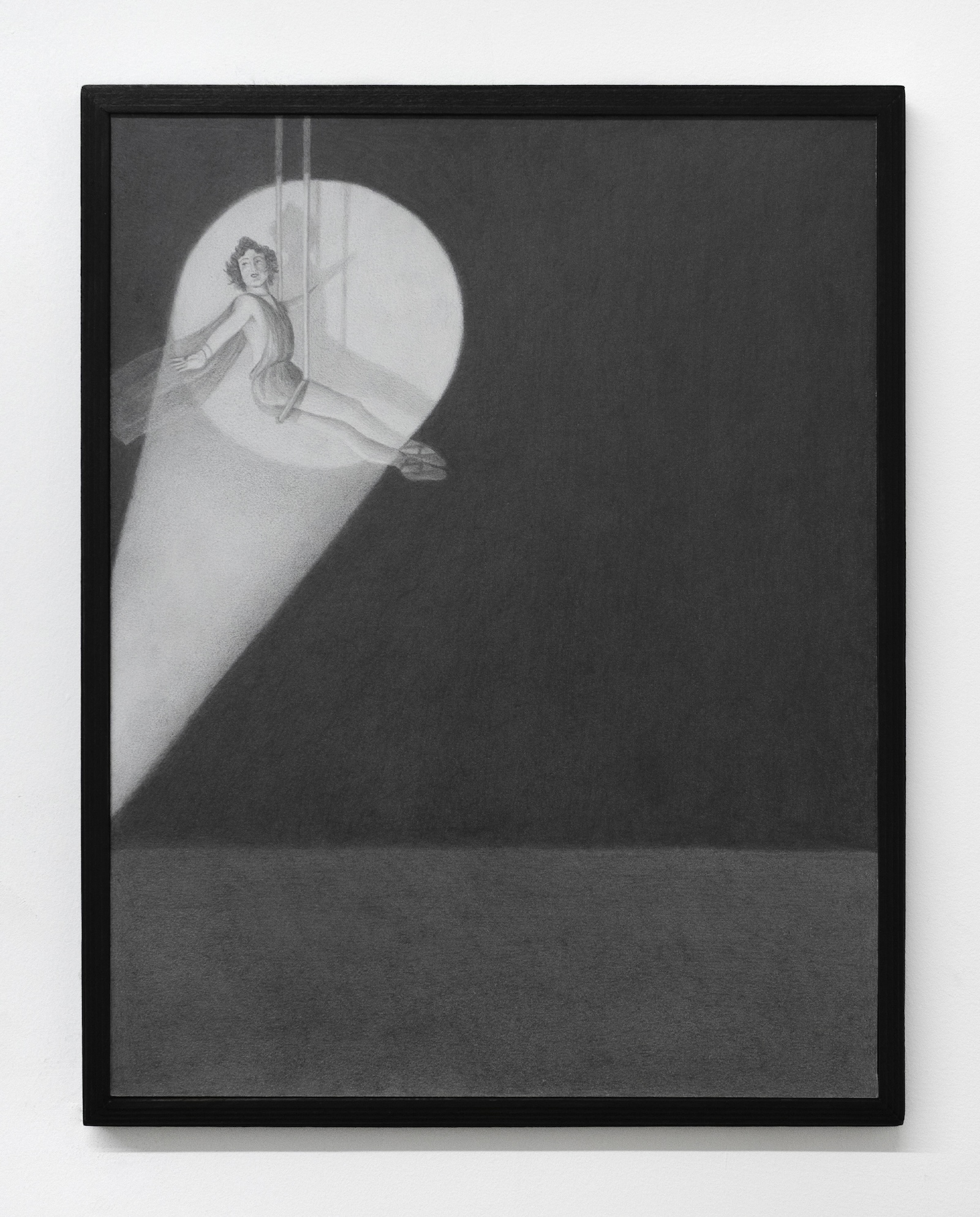
Barbette floats in on a high wire, her legs outstretched and feet pointed, forming an obtuse L-shape around her rope. The historic drag aerialist of the 1920s and ’30s is wrapped in a ribbon-like dress that reveals the side of her torso and arms. A piece of translucent fabric extends behind her, and her eyes gaze offstage. Defying gravity and gender conventions, Barbette created lines and shapes that Jean Cocteau encouraged his fellow artists of the French Avant-Garde to study. After performing a birdlike display of femininity, somersaulting and twisting through the air, Barbette performed man, rolling his shoulders and flexing his muscles, before shapeshifting to human, slumping, shifting weight from foot to foot, and apologizing as he shuffled offstage. Here, she is almost plain, and we peer at her image like an old Polaroid, this lucid portrayal of a miraculous figure.
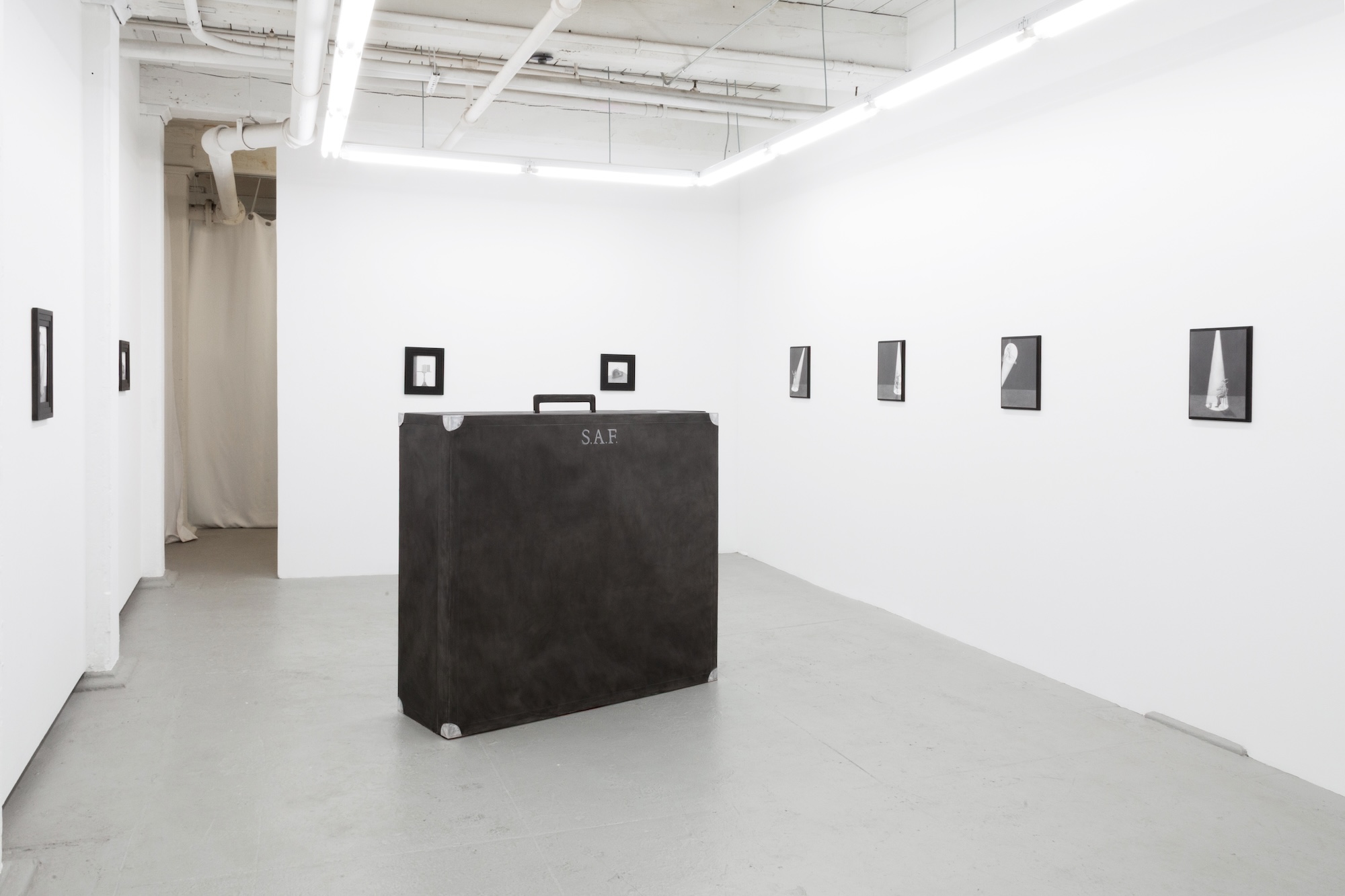
The centerpiece of the show encapsulates these contradictions, which swing like a pendulum from side to side. The largest grey rectangle of all, a jumbo briefcase, stands in the center of the gallery. It’s fantastical, made of paper, graphite, colored pencils, pastels, foam core, and wood, the same graphite of the drawings applied with a round makeup sponge.
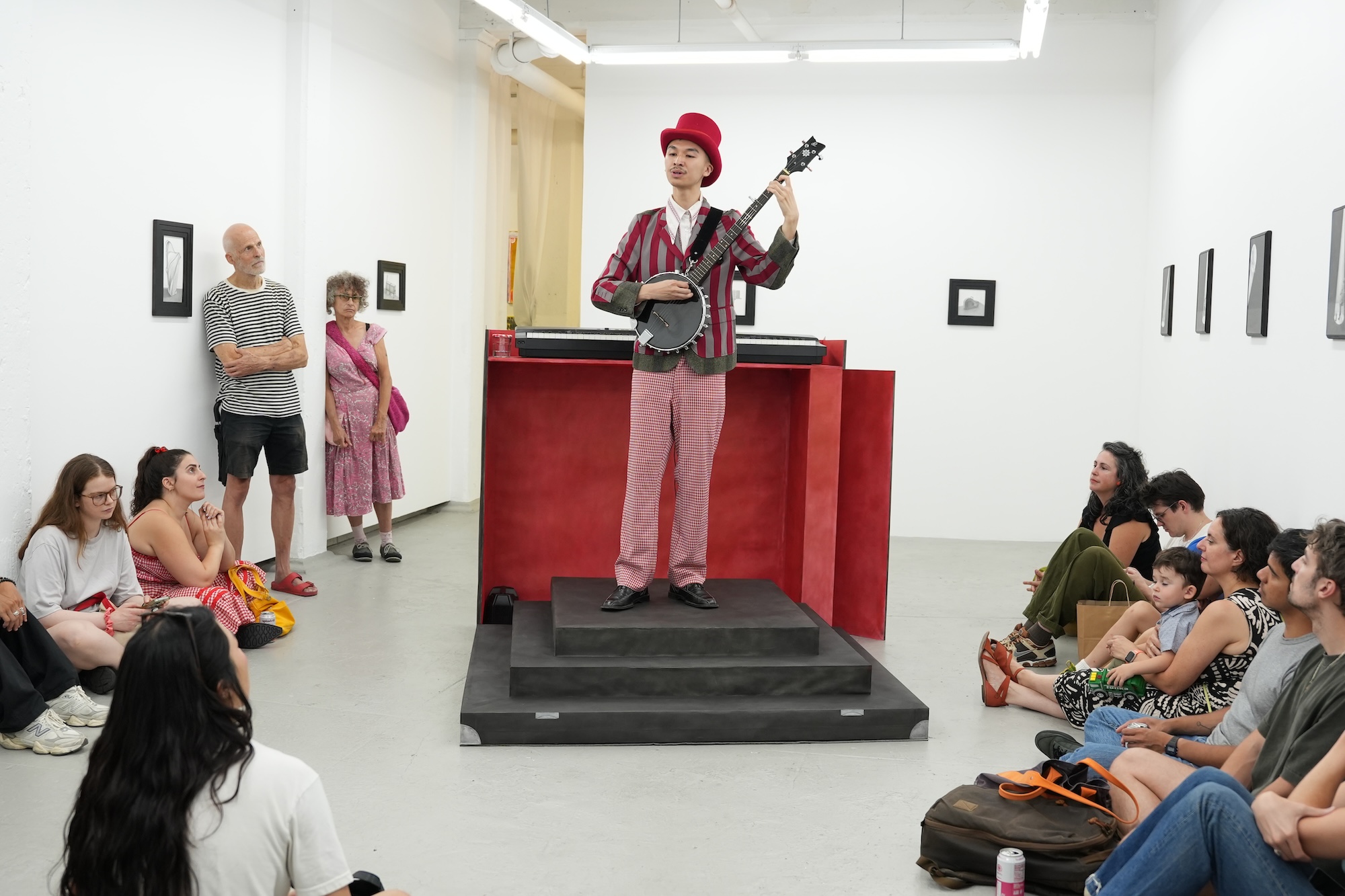
During his performances, Forest unlocks the case, which opens with a soft thump as it hits the gallery floor, forming a stage and a vertical podium. The material transformation continues; the three tiers of the stage a magnification of the frames of the drawings. A red interior compartment—a vibrant interruption—holds a keyboard.
Like his hand, Forest’s voice is clear and direct. Atop his drawing, Sam performs covers. “Song Song Song,” a folksong by Owen Pallett, is catchy and austere, describing everything and nothing, empty stages and empty spaces. Forest sings, the paper billowing beneath his shoe as he taps his toe on the keyboard pedal. Between songs, he retrieves more instruments from places within his sculpture, his Mary Poppins bag: a harmonica from a drawer in the riser of the steps and a banjo from a side compartment in the podium.
The magician, Barbette, Owen Pallett—these acts are made present through the faithful voice and hand of Forest. He is honest, so they remain just out of reach, spectacles made subtle by the process of replication, cases and bows connoting transience.
In the back room, a second paper sculpture creates a whirring sound. A round circus curtain, striped orange and purple, sits atop wooden tripod legs and rotates. Its cinched opening reveals a set of yellow and grey curtains, moving in the opposite direction. There are four sets of these rotating concentric curtains, like Russian dolls and carousels, and their patterns and movement mesmerize. The stage exists in our head, where instruments emerge from cases, magicians trick, and Forest sings. As soon as we see through the curtains’ openings, it's gone again, a perpetual curtain call. We watch in a state of nostalgia.

Samuel Alexander Forest: A Bag of Tricks was on view at Ortega y Gasset Projects from July 25 to Aug 22, 2026.