
Yu Nishimura: "Towards a Sea" at Lafayette Anticipations
Review
How do we distinguish between belief and knowing? The telephone game offers a simple conceptual model for considering this question. Information is passed from person to person verbally, but as the game progresses, the message is interpreted, transformed, distorted, embellished, and sometimes reinvented as it moves through the communication channel. The results can be humorous or frustrating, revealing how language and perception can break down, even as participants remain convinced of what they have heard. If there were an actual telephone involved—an additional medium through which the message traveled—we might also consider the instrument’s perceptual capacities and its mechanical influence on the character of the transmission. At All Street Gallery, Psychic Telephone takes up this familiar game, but in this iteration, questions of belief and knowability become both tangible and generative across a sequence of technical translations via text and images.
The exhibition centers on a collaboration between photographer Danielle Ezzo and writer Marin Sardy, combining psychic testimony, literary nonfiction, computational image-making, and photography to examine what happens when information moves between media and their respective interpretive systems. Rather than attempting to establish the truth or fiction of extraordinary perceptual experiences, the exhibition examines how such experiences are presented to others through the languages, instruments, and representational systems we use to make sense of the world. Each stage in the process involves a transmission and a transformation, raising a key question about where meaning resides. Do we trust the original experience, its telling, or the successive interpretations? In Psychic Telephone, the answer is all of the above.
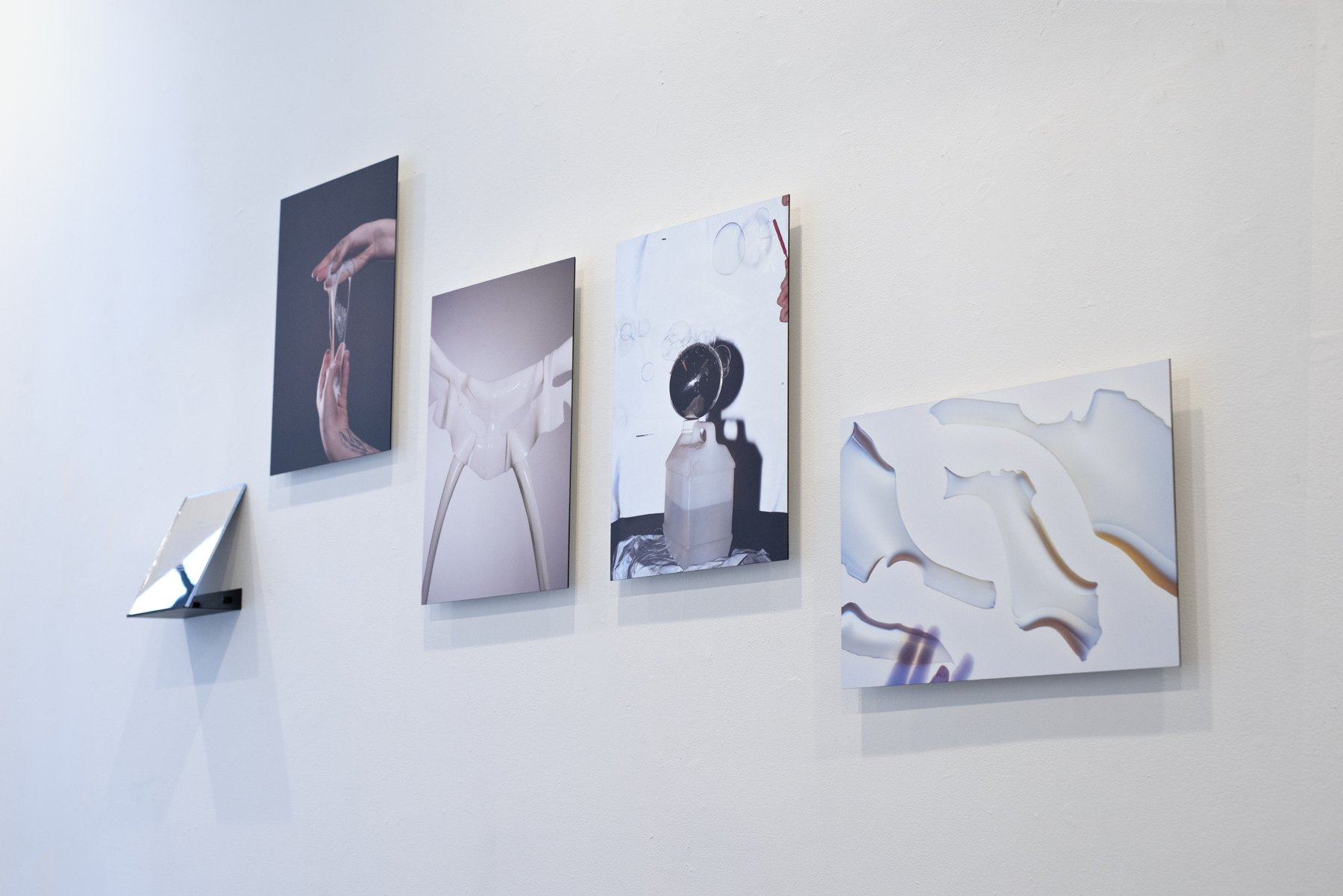
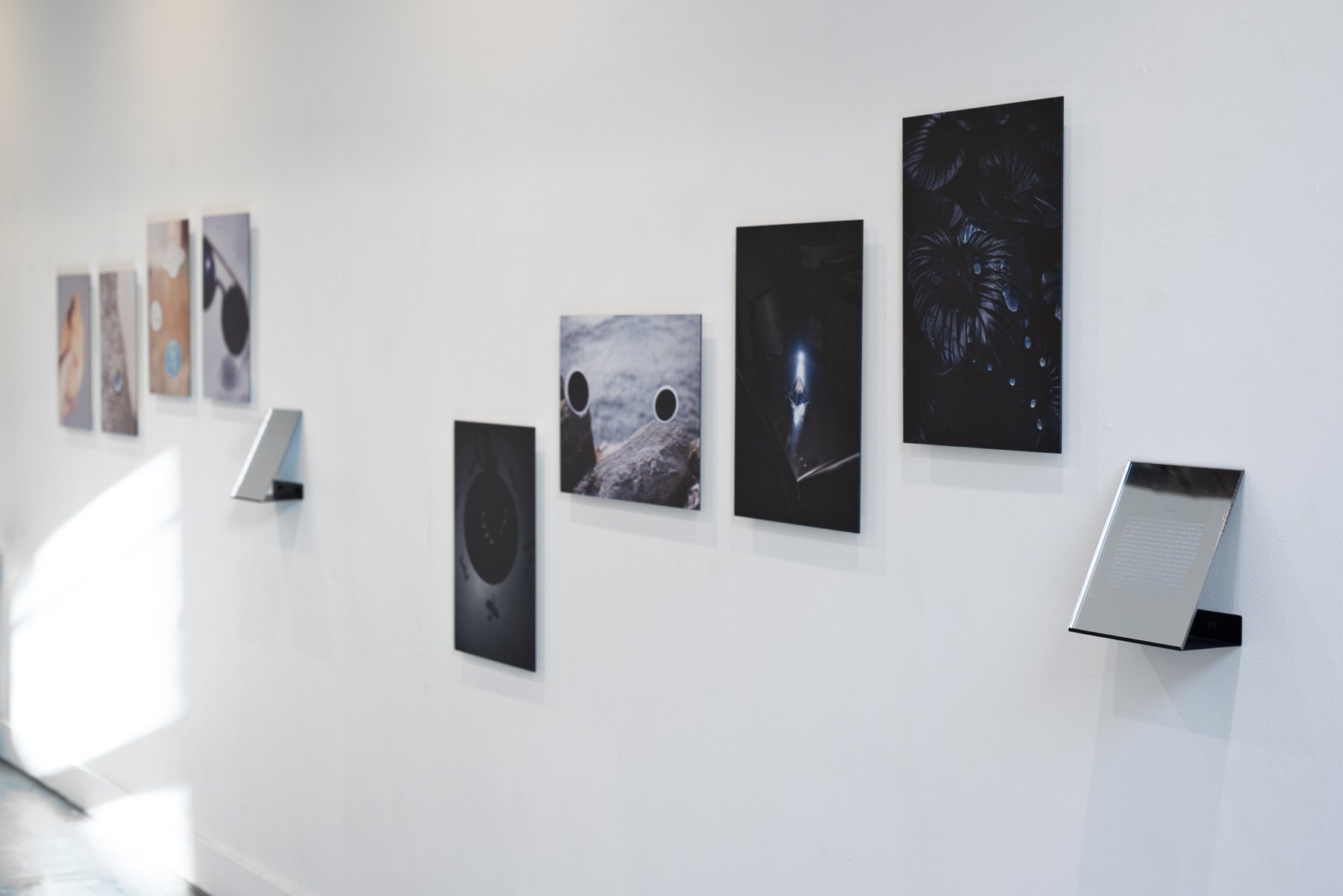
The creative exercise begins with Sardy’s interviews with people who identify as clairvoyants. Psychics, intuitives, channelers, and mediums describe their accounts of having prescient dreams, engaging with spirits, and other unexplained phenomena. Sardy translates these conversations into literary nonfiction by selecting, condensing, and reorganizing speech into written narratives. Ezzo then feeds passages from these texts into early text-to-image AI models, using their often unpredictable visual outputs as prompts for photographic work. In the final stage, Ezzo responds to these results by photographing ordinary objects, body fragments, architectural elements, reflections, shadows, and studio materials. The photographs establish new associations of evidence within an already layered sequence of interpretation. Grouped in clusters alongside Sardy’s transformed testimonials, they inhabit an uncertain territory somewhere between the recognizable and the unfamiliar, echoing the conditions of the source material. Rather than illustrating the interviewees’ experiences or offering visual evidence of psychic phenomena, however, they explore how images might give material form to impressions and ideas that lack direct representation. The camera relinquishes its conventional role as an instrument of verification and becomes a kind of co-witness to the indeterminate. With each step, the work approaches an ever-increasing hyperfictionalization of the original testimonies.
The project draws on Jakob von Uexküll's concept of Umwelt to describe the subjective environment shaped by an organism’s particular sensory capacities. It offers a way of understanding how multiple and often radically different realities can emerge from what appears to be a shared environment. The results of the intricate interplay between technical methods here illustrate how each medium actively shapes the conditions under which something can be perceived, represented, and understood. Sardy and Ezzo’s iteration of the popular game of telephone veers into exquisite corpse territory, with different mediums standing in for other participants. Writing organizes testimonials into narrative; generative AI shapes narrative through statistical associations between existing language and images; and photography makes its own claims of indexicality, registering material presence as evidence. In this arrangement, the artists themselves are also mediators with their own perceptual capacities. Their previous experiences, preferences, aesthetic sensibilities, and biases—their own Umwelten—inevitably shape the decisions made at every stage of this project.

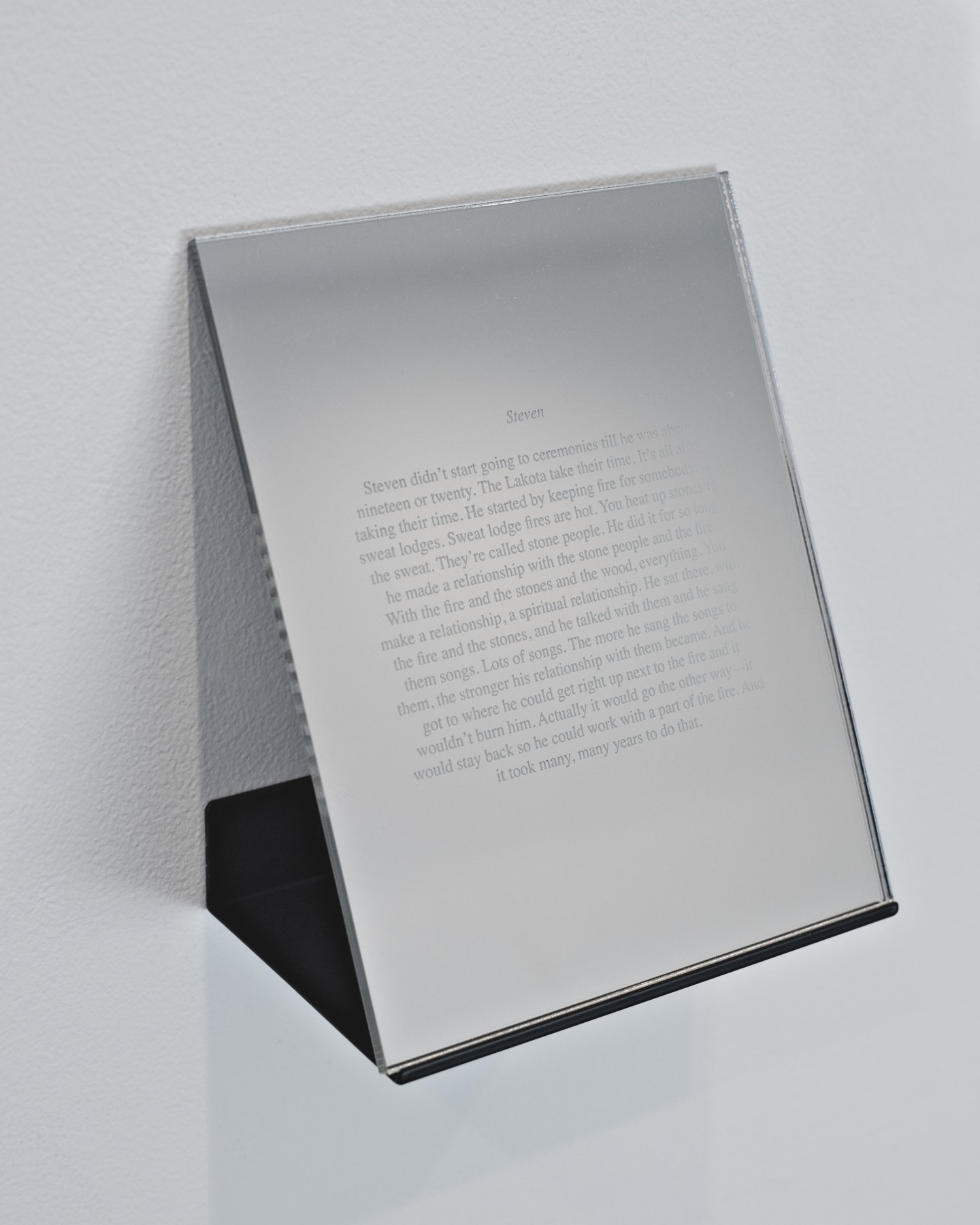
The parts of Psychic Telephone’s collaborative translation that are visible to audiences resist immediate decipherability. An elusive relationship emerges between different modes of perception and the technical systems that mediate them. What initially appears to be evidence grounded in truth can quickly slip into speculation or doubt. The effect gives way to a kind of de-mediation, where the works elicit a more embodied response. Ezzo’s photographs feature strange, ambiguous objects and unexpected juxtapositions that create perceptual uncertainty. Sardy’s text is etched onto mirrored surfaces, bringing the reader’s own reflection into the act of reading, challenging a straightforward transmission of information and implicating the viewer in the very act of making meaning. The exhibition consistently makes certain things available while obscuring others, complicating any familiar distinctions between intuition and knowledge, and evidence and speculation. This strategy also serves as a reminder that there is no such thing as an unrestricted view of the experiences being translated. From the psychics to the camera, each interlocutor contributes a partial account according to their individual particularities. For the audience, meaning emerges from the slippages between them.
These shifts between perceptual truth and material representation are among the exhibition’s greatest strengths. Sardy’s texts and Ezzo’s images serve as material evidence of the inner workings of all manner of perception, expression, and thought, with the specter of generative AI mixed in. Art itself becomes a form of shared knowledge. We can take it or leave it: the exhibition does not insist that we adopt a particular belief about psychic experience or dismiss what cannot be empirically verified. But as it focuses on the systems we use to establish what it means to know, belief in the unexplainable is reified. We are confronted with the fact that various technical instruments, representational conventions, and habitual modes of perception already mediate our understanding of reality. We gather a sense of the project’s psychic lore from objects that bear traces of their source material. The accompanying zine, part archive, part user’s manual, offers another way into this strange ecology of correspondences. Here, Marshall McLuhan’s claim that the medium is the message takes on a literal dimension. Psychic Telephone confirms that meaning does not emerge neatly and intact. It is continually made and remade through the complex conditions of transmission, whether by person, system, or spirit.
Psychic Telephone is on view from November 5 to December 1, 2026, at All Street Gallery.