

Lara Saget: "and the world came apart" at Trotter&Sholer
Review
One of Japanese cinema’s best modern ghost stories about fantasy and reality debuted in the 1950s. Kenji Mizoguchi’s Ugetsu (1953) follows the haunting tale of a family destroyed by greed and desire during Japan’s Azuchi-Momoyama period, the final phase of a century-long civil war. Visually led by the flowing camerawork of the time’s greatest cinematographer Kazuo Miyagawa, Ugetsu elegantly leads the audience between reality and a nightmare, dissolving the visual field almost like a painting of a long-forgotten memory. One of its best-known sequences takes place when the protagonist’s family crosses a lake blanketed in thick mist, which swallows the boats and obscures their path forward. It’s a dreamscape they are unable to escape.
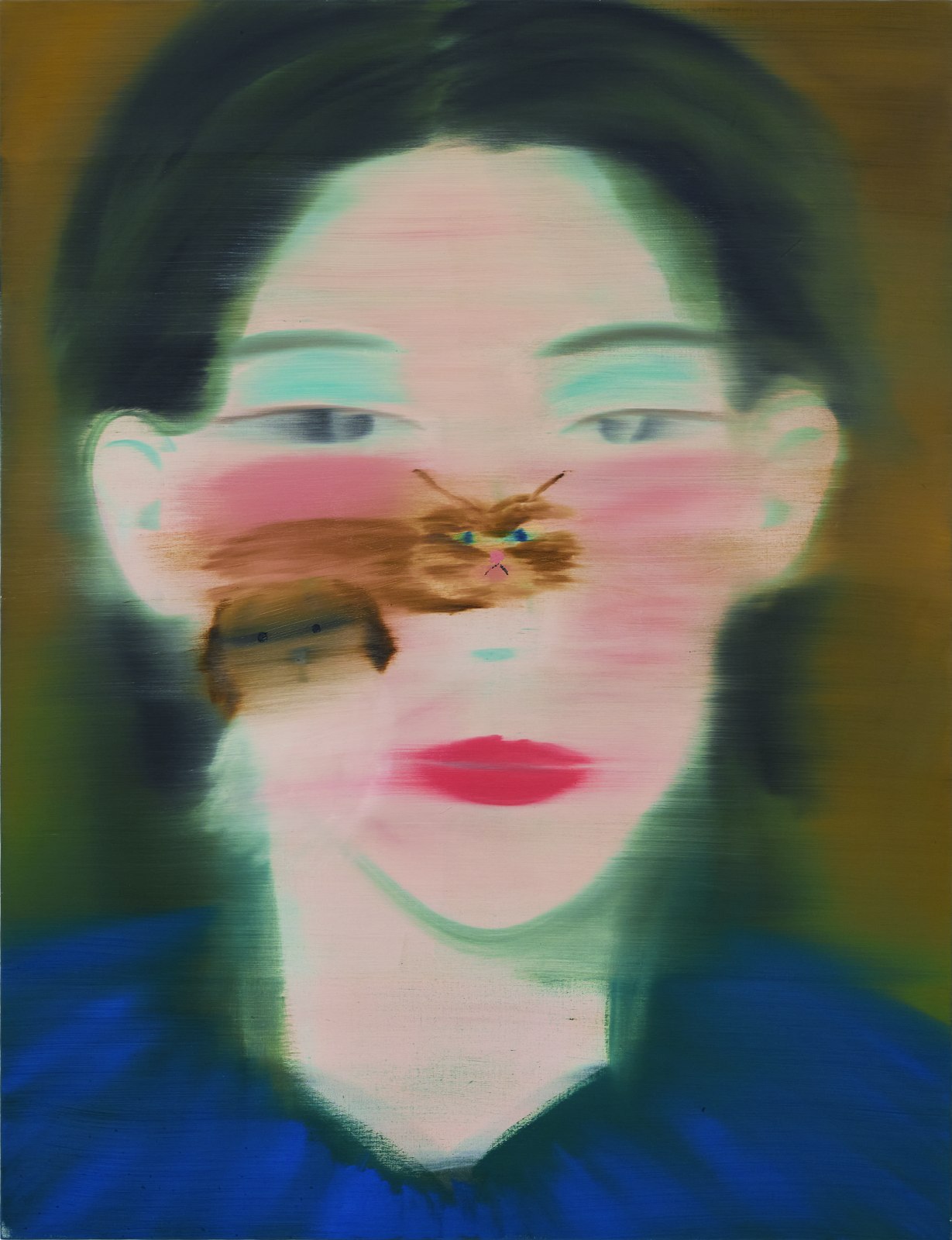
The pervading pathos of Mizoguchi’s cinema feels all too familiar in Yu Nishimura’s first institutional solo exhibition in France, Towards a Sea, which spans three floors at Lafayette Anticipations. In the show, the artist translates photographic and cinematic principles into paint, so that looking becomes a form of remembering. Like drifting through Mizoguchi’s fog on the lake, each painting in the exhibition comes in and out of focus. Upon entering the first gallery, time slows, and a meditation on alternating landscapes, still lifes, and figures slowly unfolds. Opening the show, factory (2018) is a small painting of an inlet surrounded by green mountains and a white field of emptiness where buildings should be, yet their forms are fractured and layered on themselves. Trying to see through the painting is like trying to capture an image with your phone through the double-paned window of a fast-moving train car; the image is too fleeting to be stable. This instability also guides the exhibition’s arrangement, as the fractured landscape of factory gives way to figures whose features seem to dissolve into one another. At the far end of the first room, haze (2023) brings this uncertainty into focus. In the foreground are two floating images of a dog and a cat, the latter oriented so that its eyes are at the center of the canvas. Their forms hover over a blurred portrait of a woman in blue with dark hair, coral red lips, blue eyeshadow, and dusty pink rouge.
In both his landscapes and his portraiture, Nishimura is often inspired by found photography as a method to open up his imagination to the canvas. Like Gerhard Richter’s photo paintings of the 1960s and ’70s, Nishimura’s images arrive flattened and softened, as if the canvases were a print left too long to develop in the sun. But while his canvases may not employ the heavy blur of, say, Richter’s Zwei Fiat (Two Fiat) (1964), they aren’t trying to reproduce the original image accurately, only capturing a hint of the feeling. The painting summer clouds (2024) is juxtaposed in the accompanying exhibition catalog with a photograph of two buildings seen through an early winter thicket. Thick foliage covers the lower photograph, sweeping across from right to left as it progressively grows upward over the bright blue sky. In the resulting painting, the buildings are replaced by one white structure with a low, dark pitched roof under a sapphire blue sky swiped with white clouds, dominating the visual field of the composition. Where Richter’s interpretations hold the reality of the image, Nishimura’s paintings seem to slowly wear down the photographs, until the place is forgotten. By the time it reaches his canvas, it is only a memory.
Other painterly affinities emerge in Nishimura’s handling of surfaces and everyday objects. There’s a touch of early Vija Celmins in the patience of Nishimura’s surfaces. Celmins’s first body of work—paintings of everyday objects close at hand, which she started without the burden of theory and with just her observation—comes to mind. Nishimura’s canvases also carry the temperament of Giorgio Morandi. Paintings like ingredients (2021), composition (2023), and paper cup journey (2019) are defined by a muted palette, holding a quiet intimacy that suspends them outside of linear time.
Somewhat reminiscent of Alex Katz, a flattening, frontal clarity appears in paintings like Sleeping Face (2025), where the figure’s face and hand are rendered in warm orange and rust browns and rest under a pink-and-blue geometric-patterned blanket against a gray surface. The simplicity of the figure’s gesture almost makes you soften, not wanting to wake their slumber. Some canvases also recall John Singer Sargent’s confident, loose handling of paint. In Other Hand (2026), two figures overlap, their forms slightly offset. A dense outline defines the foreground figure, while the one behind remains more loosely delineated. The difference in their expressions gives the painting a psychological tension reminiscent of Sargent’s portraits.
Nishimura’s linework also invites comparisons with earlier Japanese painting. Growing up and now working in Kanagawa, he has previously been discussed in relation to the landscapes of Katsushika Hokusai (1760–1849), whose iconic The Great Wave off Kanagawa (c.1830–32) depicts a scene off the coast of his city. His delicate brushwork, however, evokes still earlier traditions. Just one (2021) reveals linework that recalls the Chōjū-jinbutsu-giga of the Heian-Kamakura Period, the twelfth- and thirteenth-century national treasure of monochromatic frolicking frogs, rabbits, and monkeys across four scrolls, thought to be the oldest work of manga. In his own way, Nishimura modernized these elements of expert brushwork that have existed for centuries. Paintings like Hems (2026) adopt fine lines and a monochromatic palette to express an out-of-body experience for the two subjects, as their full figures hover intertwined above their close-cropped busts locked in a tense gaze. Like the scrolls, what’s left out of the negative space matters as much as what’s there, creating a fantasy landscape where dreams can be felt as real.
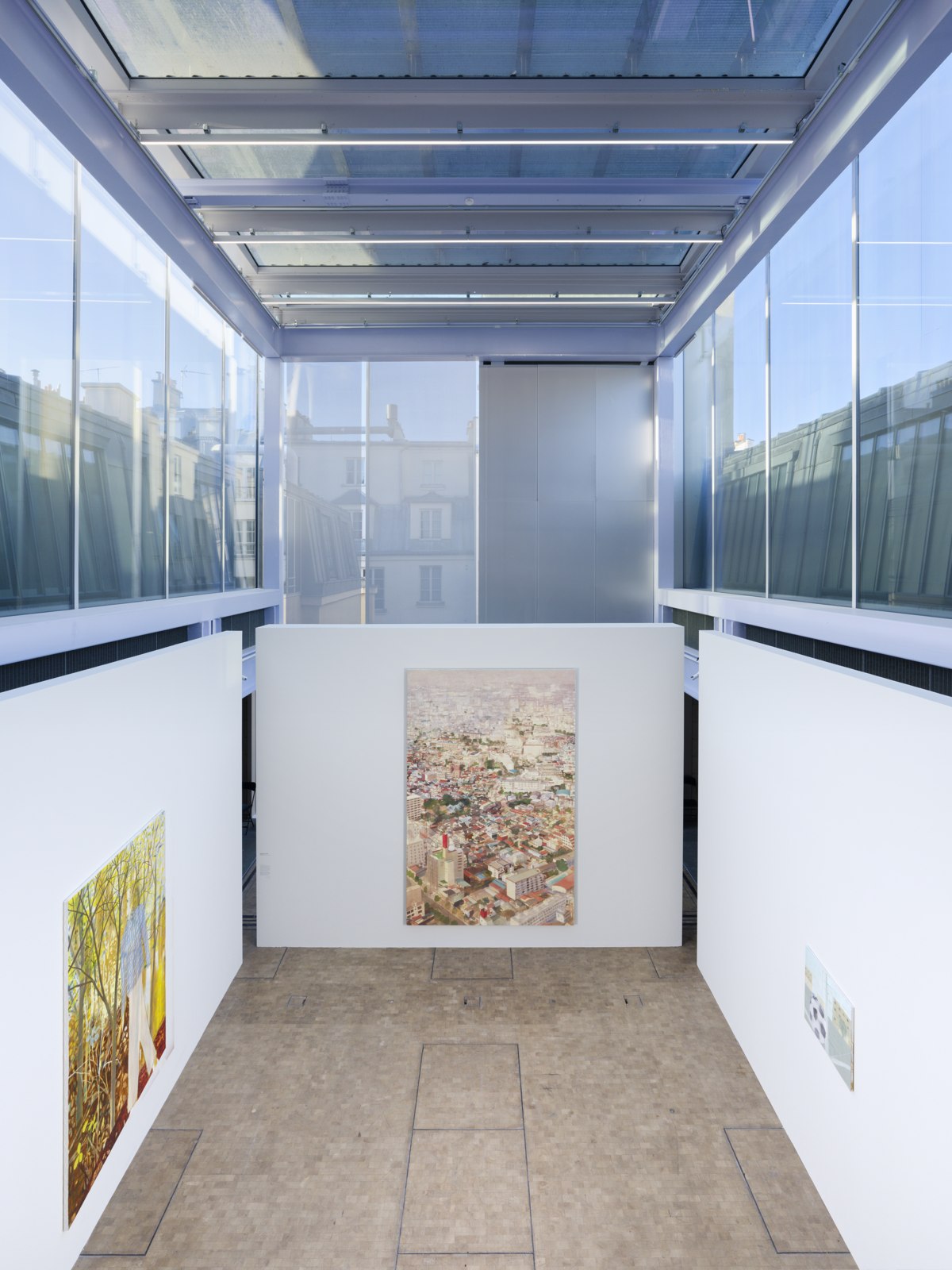
On the third floor of the exhibition is Overground (2026), a painting over three meters tall inspired by a photograph the artist found in his family archive, with no markings for who took it, where, or why. This cityscape is as impactful as Iwasa Matabei’s (1578–1650) seventeenth-century masterpiece Rakuchū-Rakugai-zu [Scenes in and around Kyoto]. Matabei famously depicts bustling streets, temples, and shrines dotted with townspeople, blanketed in a thick gold mist against the backdrop of Kyoto’s landscape. Nishimura, however, works directly from that found photo, capturing a disorienting view of how we’ve come to build life in cities, away from the meditative landscapes that flow through his exhibition.
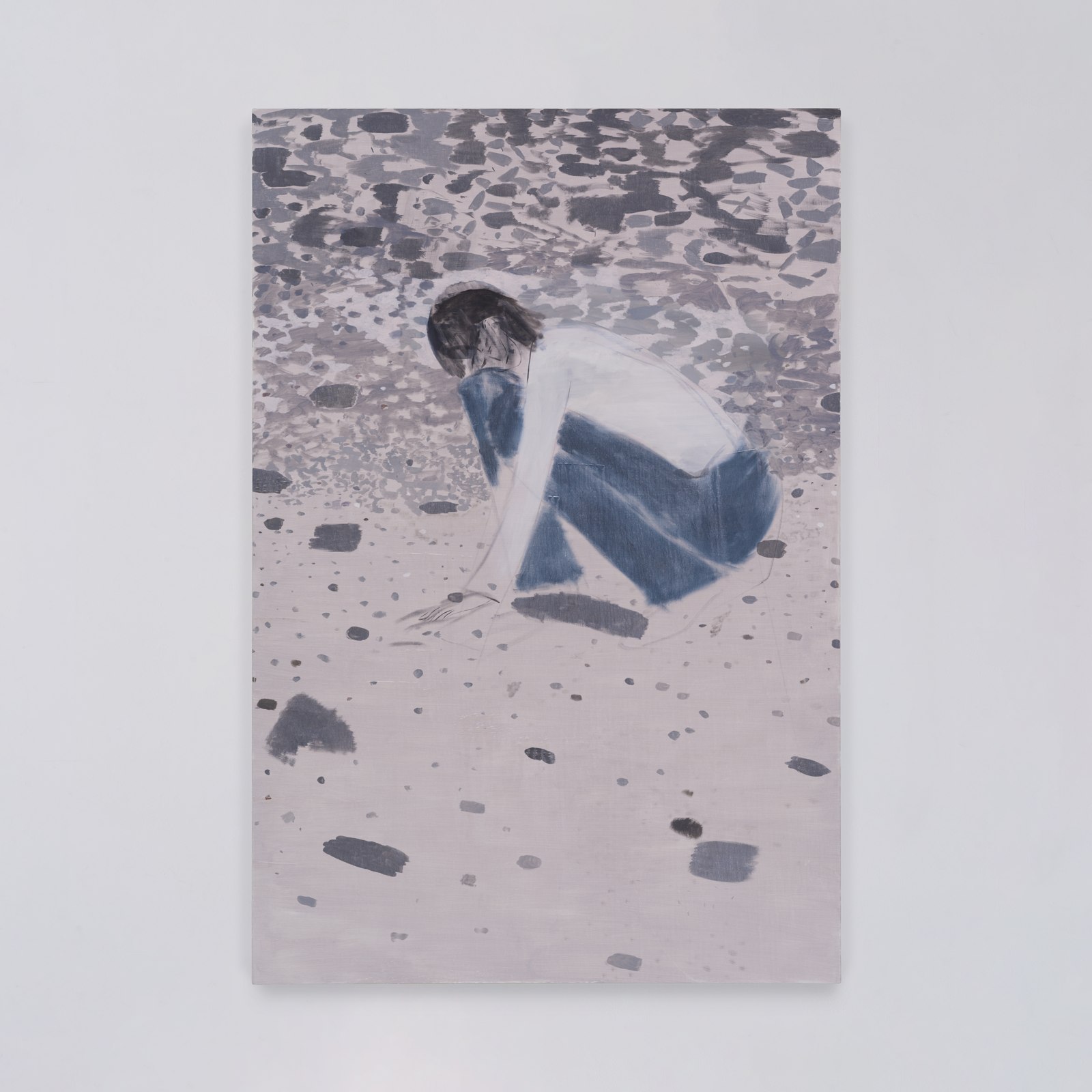
Working from photography, his subjects also often carry the cinematic, recalling films on memory and dreams. Finder (2020) and projection (2022) capture figures in frames, snapshots of time that could easily be sequences of Chris Marker’s La Jetée (1962) as his narrator speaks over: “Nothing sorts out memories from ordinary moments. It is only later that they claim remembrance, when they show their scars.” In distant shore (2023), Nishimura’s subject lies on a beach with his eyes closed, his nose and mouth drawn twice as if they’re twitching back and forth, with a frame in a lighter shade highlighting his interlocked hands. This man echoes the circumstances of Claude Ridder from Alain Resnais’s Je t’aime, je t’aime (1968) as he lies in a time machine, reliving his memories in fragmentary waves. And in the large-scale Filtration (2026), hazy figures are seen through the trees, almost like the spirits of this forest, in a moment that appears private. It feels like we are the young boy from Akira Kurosawa’s first sequence of Dreams (1990), observing Nishimura’s ghostly figures as if they were the sacred foxes' wedding procession.
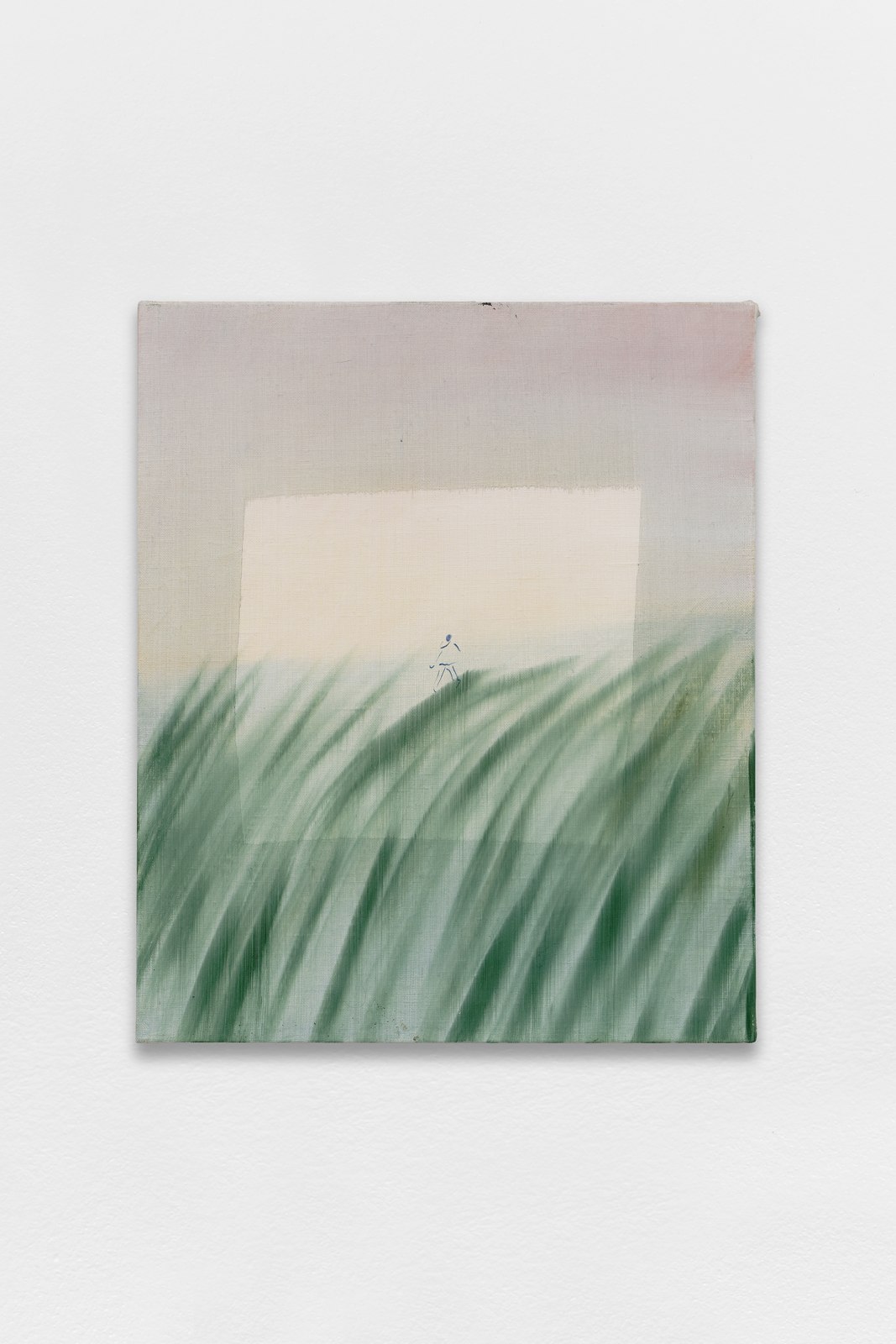
Across Towards a Sea, doubled features, overlapping bodies, and interrupted landscapes make recognition provisional. Photography supplies Nishimura with an image, but painting loosens its claim to a particular person, place, or moment. In all its ambiguity and fluidity, the exhibition is meditative, silent perfection.
Yu Nishimura: Towards a Sea is on view at Lafayette Anticipations through January 3, 2027.