
.webp)
.jpg)
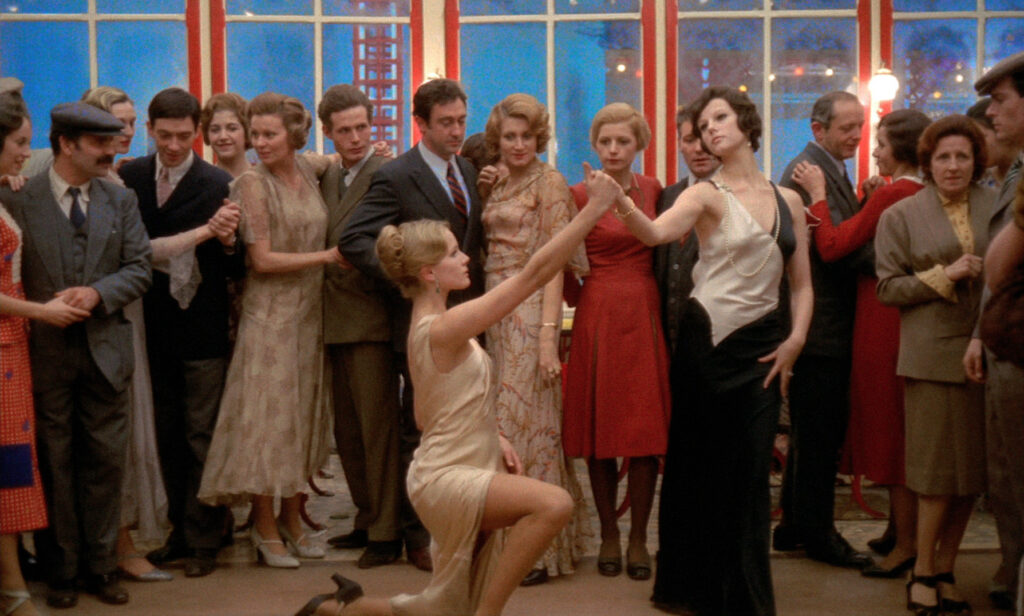
"The Conformist" by Bernardo Bertolucci
Review
This is an essay about nothing, and perhaps that’s for the best. One could argue that at the nexus of the cinematic medium rests the human being in all their expressiveness, pensiveness, and consciousness. One could further argue that when a film focuses on a non-human entity, it is anthropomorphized to allow for affinity in the human spectator. At least, this is the case in most narrative cinema; the experimental is where filmmakers tend to flex this nexus, where the non-human might just be able to exist on its own accord, without the need for humanification.
To varying degrees, the experimental “collage” films Antonio Gaudí (1984), Nothing (2014), and Homo Sapiens (2016) take an approach that alienates the human from their own built environments, acknowledging their irreversible manipulation of the landscapes in frame while largely rendering the beings themselves invisible. Considering a present reality off-frame that plummets more intensely into ecological devastation by the day, these films taken together form an archive of how our creations will autonomize, coexist, or otherwise be subsumed among the natural world in our absence.
According to Indigenous scholar Vanessa Watts, the colonial mindset “act[s] to centre the human and peripherate nature into an exclusionary relationship.”1 Colonized land and its various non-human inhabitants—from insects and animals to plant life, soil, and geological strata—are stripped of their agency when the extractive imperial machine churns its gears, as “[t]he measure of colonial interaction with land has historically been one of violence and bordered individuations where land is to be accessed, not learned from or a part of.”2 Taking this notion forward into our exploration, it’s important to note that neither of the three filmmakers of these works under investigation is Indigenous to the lands they are capturing on film. But their experimental methods may be seen, some to lesser extents than others, as detaching the cinematic gaze from what Watts considers a Euro-Western tendency, one which either subjugates or essentializes the agency of non-human actors.
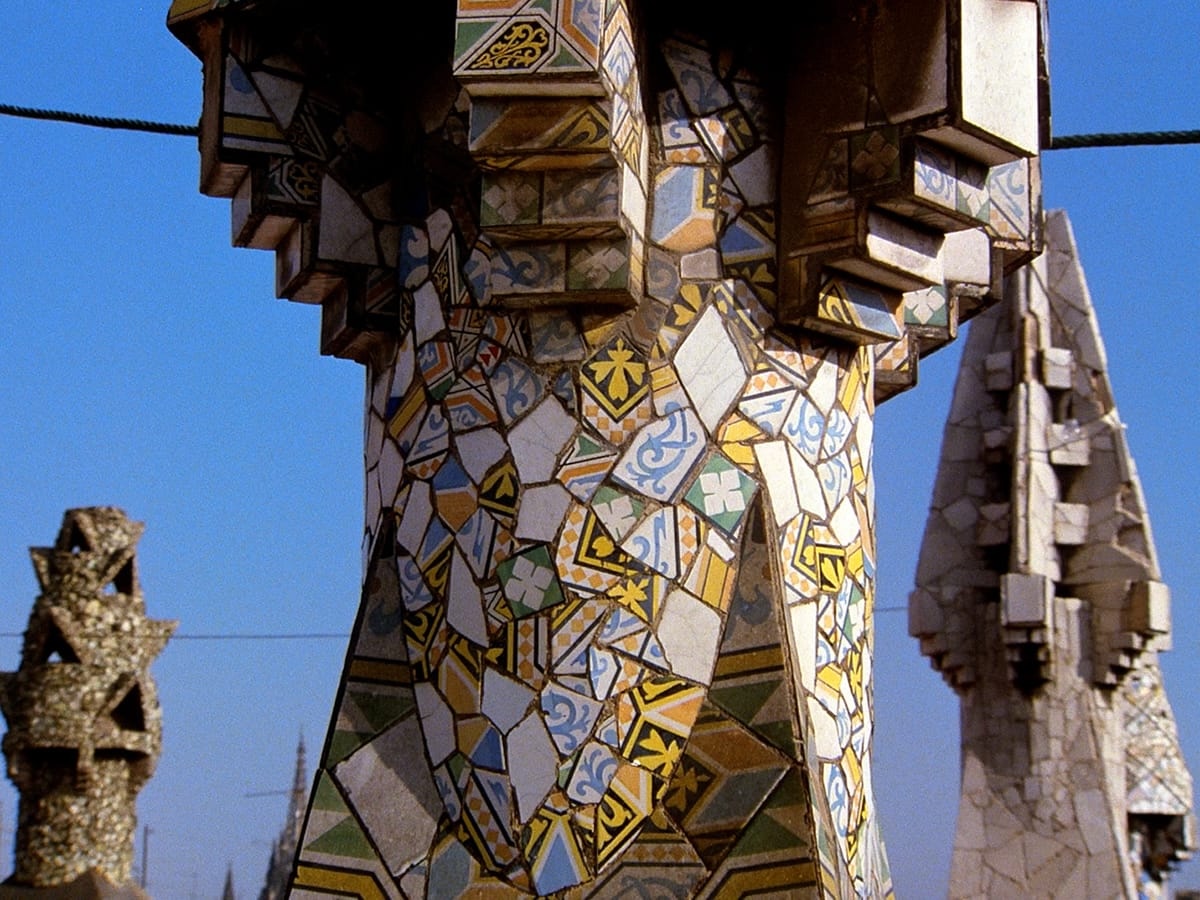
Hiroshi Teshigahara’s Antonio Gaudí is an experiment in exhibition. The titular architect’s whimsically curving, spiraling designs sprinkle throughout the city of Barcelona an air of playfulness and mystery. A sense of folklore. Teshigahara decided to approach these architectural wonders with little biographical context or even human presence. Hyper close-ups are employed; winding tracking shots, pans, and tilts of the camera trace the curvature of the designs and push much of the surrounding human activity to the periphery. From the burgeoning Sagrada Família to smaller residential homes and outdoor sculptures, the architectural detail is almost psychedelically angular and wisp-like. Fractaled tiles form striking mosaics that lend an unforgettable personality to these urban environments. In Teshigahara’s hands, these structures completely usurp the human pedestrian, even in shots where they are visible walking around a corner, passing by in the reflection of a window, or sitting around a table in a study spewing barely-intelligible dialogue about “restorations.” Yes, Antonio Gaudí is the only one of these three experiments that incorporates human dialogue, but it is scant and often drowned out by Tōru Takemitsu’s otherworldly, droning score.
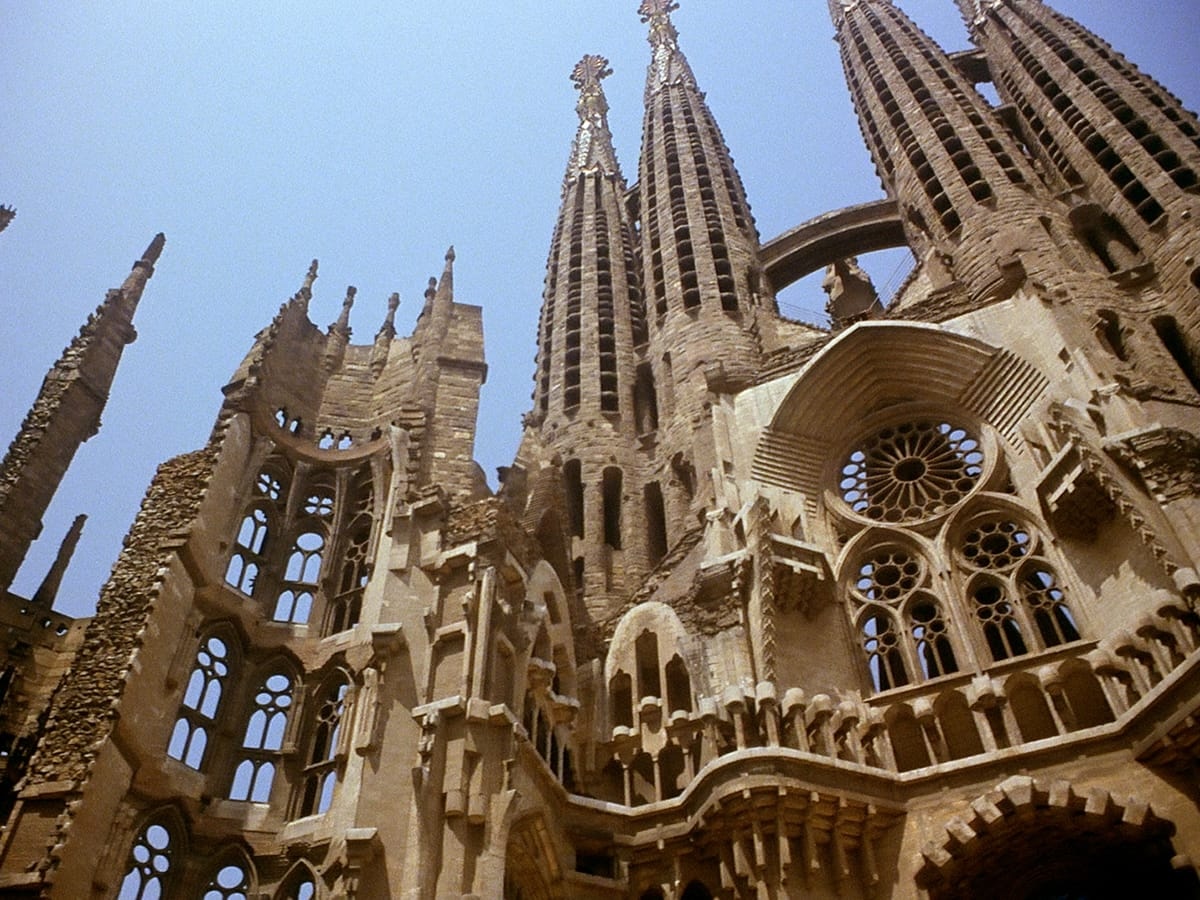
Were Teshigahara’s 1984 film produced in the 21st century, it might have been an experiment at risk of fetishizing architectural prowess while neglecting the pressing reality of Barcelona’s tourism problem. In the past couple of years in particular, this strain on the city has become undeniable, with various local activist groups protesting against “the structural inequalities tied to capitalist accumulation, tourism’s extractive nature, and a sector that funnels community wealth into private hands.”3 But Antonio Gaudí predates the intensification of this issue. Examining it within its own context, it offers a transfixing, if flawed, vision of the energy of non-human elements notwithstanding the humans who occupy it.
Sometimes, even, Teshigahara intentionally places human beings in frame as sentries in service to the structure. For example, there are several shots throughout that show an anonymous, voiceless individual opening the gate to a Gaudí building for the filmmaker to enter. The camera rolls forward carefully, respectfully, to capture the grandiosity of the place while the gate servant quietly recedes from view. This motif is probably the film’s most extensive use of human presence, and it happens to do so with the colonial mindset of place-thought as described by Watts, but invertedly. The human is the one being accessed, tool-ified, used by the land. And the land itself takes center-stage for most of the film, as Teshigahara presents the architecture in a realm of its own, as if it is living, breathing organic material encompassing a world at once among human beings and completely autonomous to them.
This was at a time, however, when the environmental crisis wasn’t as pronounced as it has been in more recent years. Teshigahara’s film proves lighter, more optimistic in its vision of the built environment and its ability to transcend or exist peacefully alongside human activity. In every shot involving a human being, they are either reverential to the architecture or joyfully going about their days in the shadow of its towering artistry. Antonio Gaudí ultimately undercuts its own aesthetic by concluding on outright biographical background, historical pondering, a blasphemous intrusion of human narration to force our focus back onto the man himself. All that poetic collaging of the built environment deflates in these final moments—in hindsight, no longer “a literal and animate extension”4 of place-thought, but a fictional utopia, an abstraction.
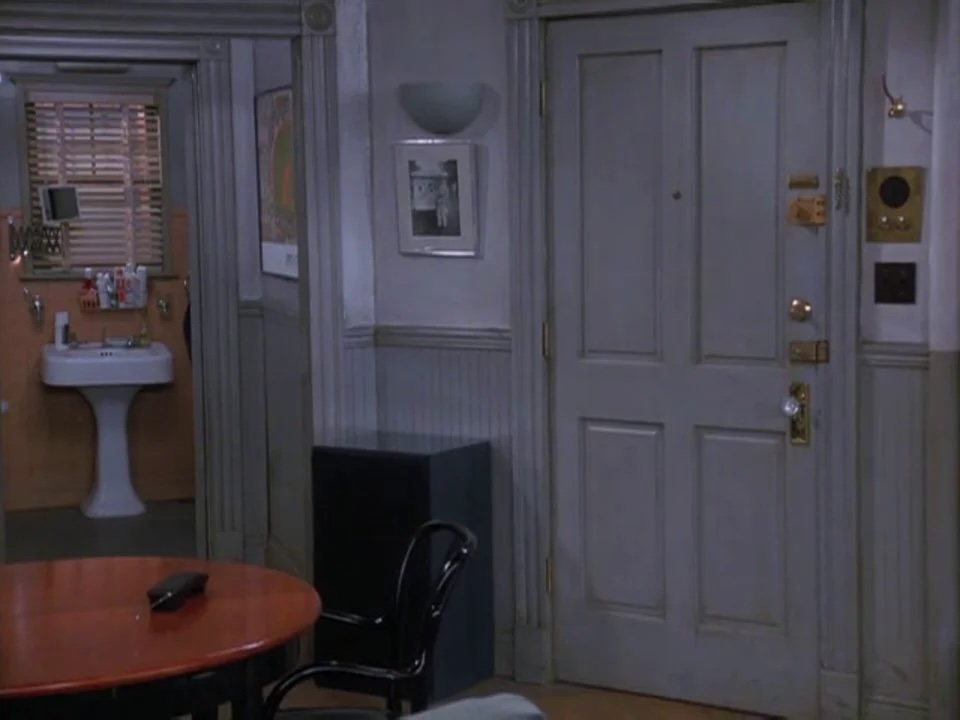
Teshigahara nevertheless established a formidable predecessor to the non-human collage film. LJ Frezza’s Nothing and Nikolaus Geyrhalter’s Homo Sapiens take this methodology down weirder, more complex, and achingly contemporary paths. Frezza’s 2014 short is, upon first glance, a gimmick: nearly 7 minutes of establishing shots extracted from the sitcom Seinfeld (198–98). None of these images contain human beings, but rather the residential and commercial spaces in which they often reside. Every shot is static, some with the slight addition of a slow zoom-in, the non-diegetic theme music (the iconic bass thwap) is fragmented in its sequence depending on the individual excerpt, and the eerily repetitive laugh track fades in and out.
The film is overstimulating, grating even, for its first three minutes. The blaring non-diegetic sound is relentless and still gives the impression of a bustling New York City even though we’re not witnessing any human activity on screen. As noise pollution abounds, we are not yet in the unnerving serenity of the “nothing” part of Nothing. It becomes clear, however, that we might be in the presence of another living, breathing built environment. Quiet amid the commotion, yes, but the ubiquitous presence of empty windows is like a sea of eyes, watching us watch them. On second thought, it’s possible humans aren’t here at all. The built environment may be absorbing the ambiance left behind by human society, channeling it as a way to communicate amongst itself.
This is not an inebriated thought. Halfway through Nothing’s ephemeral runtime, the theme music ceases, the laugh track grows quieter and less frequent. The empty parking garages with unattended cars, office spaces with leftover Chinese takeout on derelict desks, Seinfeld’s central apartment with mise-en-scène left askew—lived-in, but abandoned—all take center-stage. The exterior establishing shots make way for the interior, the ambient noise all but mutes itself, and the peacefully unsettling emptiness of human living/working space seems to breathe with a sigh of relief. One could easily interpret this experimental short as presaging our urban environments during the eventual COVID-19 pandemic, that is, until it reaches its second half and even all the interior abodes are extinguished of human presence.
Critic Katie Rife observes that this supercut in “execution takes what could be an exercise in tedium and raises it to the level of art . . . From nothing we came, and to nothing we must inevitably return.”5 The excess waste, pollution, and other environmental stressors of an industrialized cityscape have and will continue to take their toll, and Frezza’s way of depicting such scenery is twofold, and very much in line with what Rife was alluding to: 1. Human material (as heavily artificial as footage from a sitcom) is primarily purged of human imprint; 2. Human environment (as heavily populated as a cosmopolis like NYC) is primarily purged of human activity.
Emptied of its human inhabitants, Nothing does something wondrous to our spectatorial habits. We view the built environment as an autonomous zone in spite of us, assuming we’ve either abandoned it to colonize the stars or have been wiped out by some unidentified, but certainly self-caused, catastrophe. With nothing to latch onto or to draw affinity from in regard to those of our own species, the dramatized urbanity of Seinfeld is now an ecosystem unto itself. Our left-behind iconography is simply litter, to be ignored, repurposed, or choked on by the non-humans who now reign. We are nothing but haunted echoes to them.
Unlike Teshigahara’s utopic architectural showcase, Frezza takes an unessentialized approach to the material he’s working with. The non-human actors are right there on screen, and they are allowed room to breathe and exude agency in their own right. And yet they are not entirely untethered from or in parallel harmony with the humans who would usually occupy them. Traces of our interference, from noise pollution to undiscarded trash to energy-zapping lights being left fully lit, linger both within and beyond the frame. We are absent, but only in the physical sense, as our metaphysical detriment lives on—the devil in the details.
Where Antonio Gaudí operationalized a framework for centering the non-human within (or, as was determined, away from) the human sphere, Nothing fine-tuned it; Frezza takes what Teshigahara was experimenting with and stamps onto it a metacritical layer, one that more immediately resonates with contemporary audiences. He threads both the lone, persistent built environment and the lingering ghost of human extraction together, producing a result that is undeniably more palpable, significantly more somber and brutalizing than Teshigahara’s structural symphony. In Nothing, this non-human collage framework is energized with a sociopolitical lens and a penchant for discomforting the viewer.
Geyrhalter’s Homo Sapiens is seemingly more hands-off in its filmmaking, which might dupe one into thinking it’s less rigorous. Yet it’s in fact more challenging and spellbinding than Frezza’s and Teshigahara’s films combined—a “healthy expansion” of them is perhaps a softer way of putting it. The experimental documentary begins on close-ups of mosaics depicting human beings, droplets of water tip-tapping in the background, echoing cavernously. We are clearly within some kind of hall, or church, or as it comes to be revealed, a monument. Specifically, it is the Monument House of the Bulgarian Communist Party, a brutalist-futurist, UFO-resembling lookout tower on the Buzludzha Peak in the Balkans. The mosaics inside this structure are the only glimpses of human figures that we will see during Homo Sapiens’ 94-minute runtime.
Humans in Geyrhalter’s film, unlike Frezza’s Nothing, aren’t so much as heard. Not even in the canned-laughter variety. They are present only through semiotics in the environmental surroundings contained within these static shots. They are present in the lopsided bikes left in lockup in a downpour; a ghost-town McDonald’s reclaimed by foliage; a vending machine in the middle of thick overgrowth that conceals a once-developed commercial space; an ornate, dilapidated theater whose only sign of movement is the rhythmic flapping of its forever-closed proscenium curtain in the breeze; a cinema aisle now steeped in shallow water; fishing boats grounded in a vast field that once held a lake; birds making use of the towering concrete silos of a nuclear facility as their personal playground; a hospital’s formaldehyde collections, now mostly overturned, shattered, sharing space with moss; a pile of cattle bones in an empty industrial slaughterhouse.
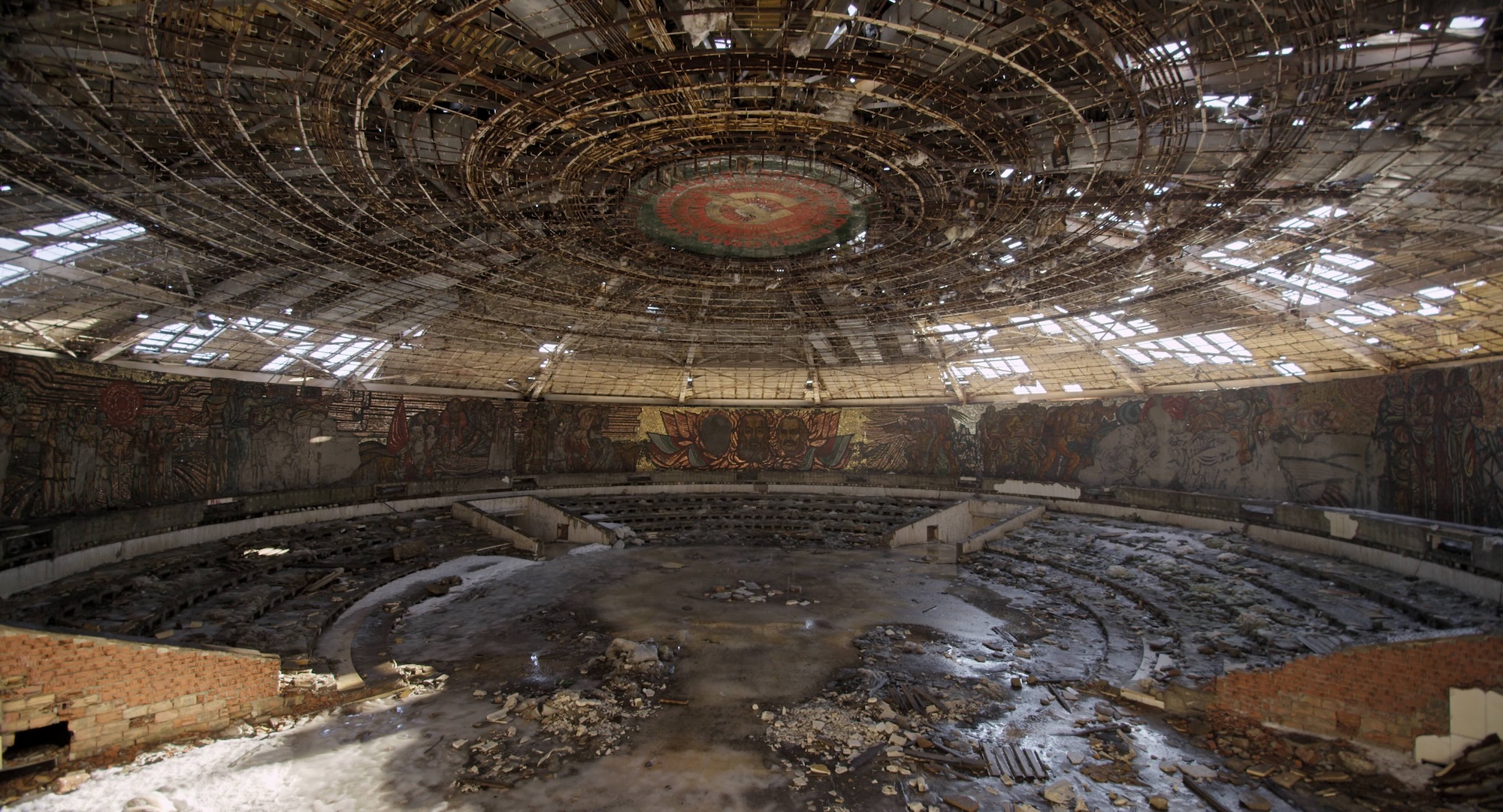
The images in Homo Sapiens are unshakeable, and vibrate within a collagic framework that otherwise slows down and anesthetizes much of the cinematographic/editing flair of the works discussed previously. It is clearly shot on digital cameras, providing for high-def, extended-duration takes of head-on, wide-angled spaces. Geyrhalter, in an interview with The Independent, disclosed some of his own fabrications in the production and postproduction processes: “The focus should be on the natural elements, not the humans anymore. And from that point on we decided to work toward this film. It doesn’t mean we really manipulated any images. All the locations in the film exist in the present. Since it is a film and not a photobook, movement was important.”
He does admit, then, that some aesthetic intervention was necessary in removing the ambient human-generated sound that comes with shooting in any space, no matter how deserted or remote. But this works in his favor, as the detritus of human industry breathes into a life of its own, conjures its own ecosystem, bastardizes the relics and artifacts left behind by human systems in its overgrowth and nesting and weathering away. The non-human elements form a new society out of the collapsed human one, and that’s one of the distinguishing features of Geyrhalter’s film from Frezza and Teshigahara’s: the irreversible terraforming and violence of human infrastructure is more on display than anything else.
The skeletal framework of the colonial is never invisible in Homo Sapiens, which “discloses a spatio-temporal constellation in which things, objects, creations—in short, everything material—pertains to its historical existence by virtue of its transitoriness and decay…”6 In other words, the reality of human-inflicted ecological damage is presented by Geyrhalter as a continuum where all things exist on the same plane, and in this particular document the center of that plane is, without question, the non-human in all its forms. “With these shots, what ‘has been’ becomes actual, and past and present are incessantly indistinguishable,”7 and thus the foreseeable future is able to emerge from the wreckage. A world, irredeemably scarred by extractive industrial practices, learning how to evolve once humans (but not the wounds they’ve left on the land) are removed from the equation.
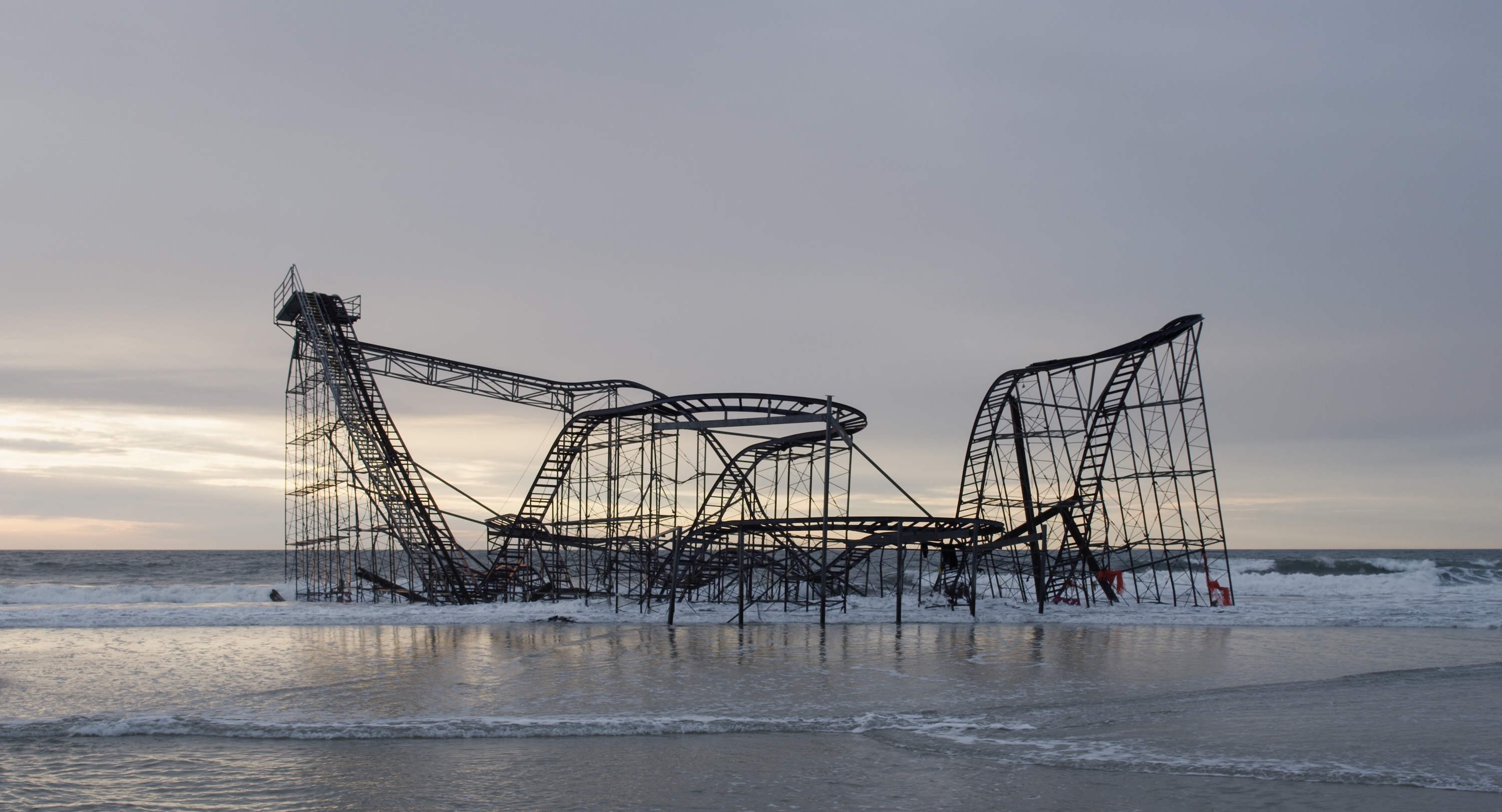
Whether it’s a crate of vintage gas masks or a junkyard of amphibious military vehicles sprouting weeds and tree saplings, a naval battleship left motionless and decaying in anchorage or the Bulgarian monument disappearing in a blizzard, a ghost city hammered away at by thunderous waves or dust storms enveloping abandoned towns in the desert, a roller coaster literally being swallowed by the ocean or vines spindling their way through a derelict club, overtaking the rafter lights and disco ball like a network of veins—the accumulation is the point. The reinsertion or modification by the non-human to survive a world downtrodden by colonial machinery. This is the ultimate form of the non-human cinematic collage, a de-centering of the human corporeally and sonically, but never overlooking their systemic, infrastructural gutting of the land.
More than mere disciples of the long-pondered posthumanist philosophy, these films taken together offer a window into what can only be deemed “dehumanist” aesthetics; they leave traces of the human, just enough to document their abuses, but strip them of agency over their own creations, manipulations, and transformations of the non-human world around them. Essentially, all that was co-opted by the human is re-re-purposed and made non-human once more—and more alive than ever. Teshigahara placed the non-human at a transcendent perch from the human, Frezza made them distant neighbors, and Geyrhalter pulverized them into a single purée. The human de-centered, the non-human re-centered, and history omnipresent. In the end, that Sapporo™ grab-n-go cooler isn’t going to refill itself.
References:
1 Vanessa Watts, “Indigenous place-thought & agency amongst humans and non-humans (First Woman and Sky Woman go on a European world tour!),” Decolonization: Indigeneity, Education & Society 2, no. 1 (2013): 26.
2 Watts, 26.
3 Claudio Milano et al., “From hotspot to flashpoint: how tourism pushed Barcelona to breaking point, and how social movements are fighting back,” The Conversation, 6 June 2025.
4 Watts, 22.
5 Katie Rife, “A Seinfeld remix collects the show’s moments of true nothingness,” A.V. Club, 13 March 2014, https://www.avclub.com/a-seinfeld-remix-collects-the-show-s-moments-of-true-no-1798266899.
6 Anat Messing-Marcus, “(Non-)Moving Images: Nikolaus Geyrhalter’s Homo Sapiens as a Cinema of Natural History,” Transformations, no. 32 (2018): 66.
7 Messing-Marcus, 66.