
.webp)

Santiago Gómez: “Cabalgando Entrañas / Riding Entrails” at Plaga
Review
In a vertical painting between two Neoclassical windows looking out onto the Venetian Grand Canal, a woman carrying a baby appears to float upwards—or perhaps inwards, deeper into a portal where inky blues merge with pale pink in an efflorescence reminiscent of a nucleus or even a womb. The figures appear encircled by concentric waves of slate and indigo, shot with bands of brilliant yellow. In Untitled (2024), a sense of struggle is palpable in this liminal, perhaps oceanic atmosphere, which Helen Molesworth describes in terms of “pictorial liquidity.” Abstract forms seem to drift, suspended in space that feels familiar yet emotionally charged. This fluid ambiguity is a consistent feature of Michael Armitage’s paintings, which quietly address sociopolitical tensions while resisting fixed positions or easy declarations.
The Promise of Change, Armitage’s solo exhibition at the Palazzo Grassi, opened during the 61st Venice Biennale. At a safe distance from the cacophony of the Giardini, over a little bridge and down several small alleyways from Campo Santo Stefano, Palazzo Grassi was the last noble palace constructed on the Grand Canal before the fall of the Venetian Republic. When François Pinault purchased the palace in 2005, he commissioned the Japanese architect Tadao Ando to reimagine the interior. Ando preserved the building’s historic exterior and ornate interior frescoes while inserting smooth, geometric volumes—introducing a duality that dovetails with elements of Armitage’s approach, which blends historical techniques with contemporary subjects.
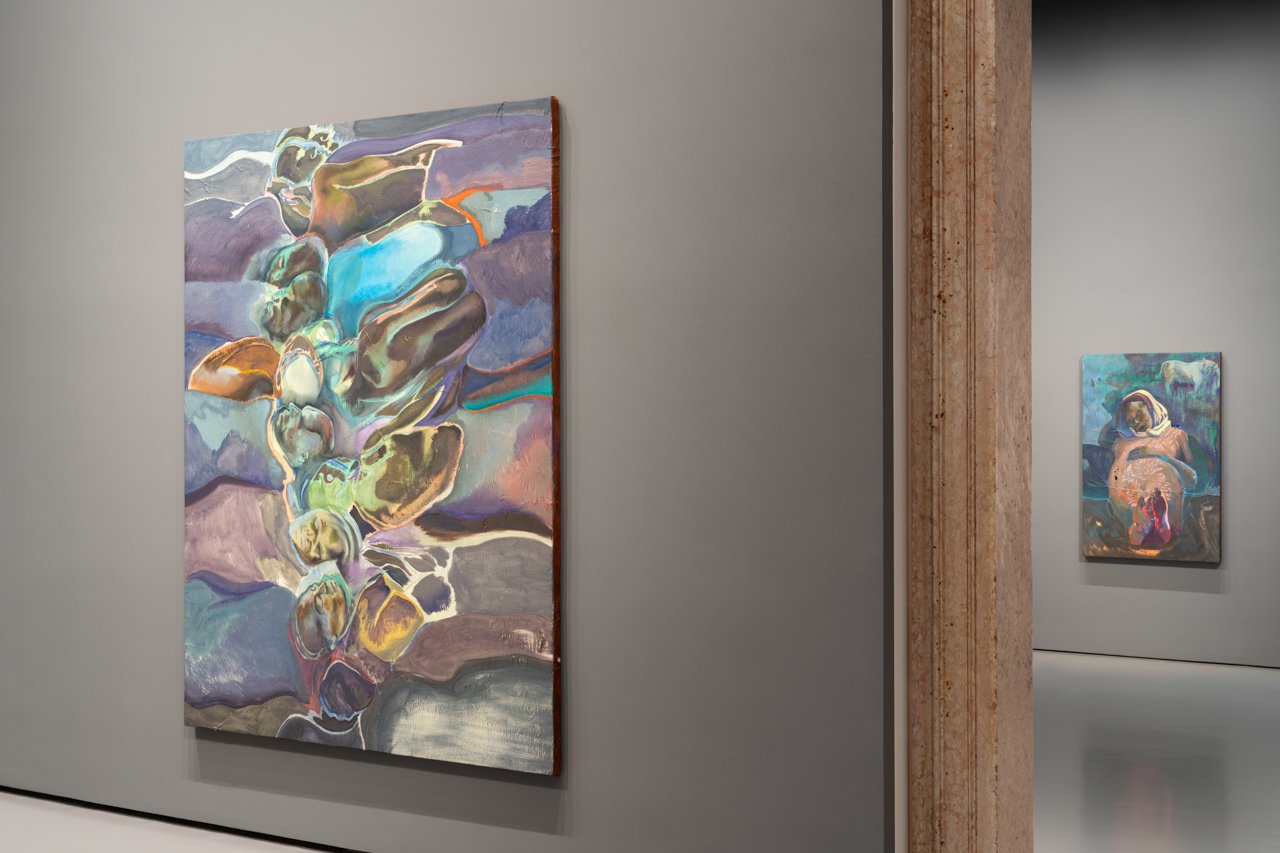
This modest blockbuster curated by Jean-Marie Gallais and Hans-Ulrich Obrist resonates with the late Koyo Kouoh’s call for exhibitions presented “in minor keys.” The exhibition first seduces viewers with color, drawing them into dark histories and complex narratives. In paintings like Baikoko at the mouth of the Mwachema River (2016), Conjestina (2017), and Nyayo (2017), forms emerge slowly from swathes of Prussian blue, mauve, and phthalo green: a body in the frothing sea, a fleeing crowd, unfolding violence. While visually alluring, these charged scenes offer no escape, instead demanding thorough engagement. Armitage asks viewers to stay with the visuals, letting waves of uncertainty wash over before reaching interpretations.
Unlike painters who construct compositions through drawing, Armitage develops paintings through color. “I am generally more interested in how colors play off each other,” he notes in the exhibition text. “Sometimes you can get two colors together that are quite aggressive and that can give you shape, depth, form.” Color does not merely describe a subject; it generates it. Figures emerge through interplay between tones that harmonize or destabilize one another. “I do think that color can change a narrative,” he explains.
This chromatic approach allows Armitage to maintain deliberate ambiguity, occupying uncertain narrative positions. His paintings are not statements so much as investigations that resist clear political messaging in favor of more nuanced resonances. “I’m interested in subjects that are problematic,” he says, “but [that I] also feel implicated in.” His work then becomes a means of thinking through contradiction without resolution. In Nyali Beach Boys (2016)—a composition named after the “beach boys” who labor as sex workers for tourists in Mombasa, Kenya—it is unclear whether the figures on the beach seek refuge, comfort, or pleasure. Bodies cast in seaweed greens and shadowy blues, illuminated by the moon, suggest a certain mythical presence, yet they also appear sickly or otherwise vulnerable.
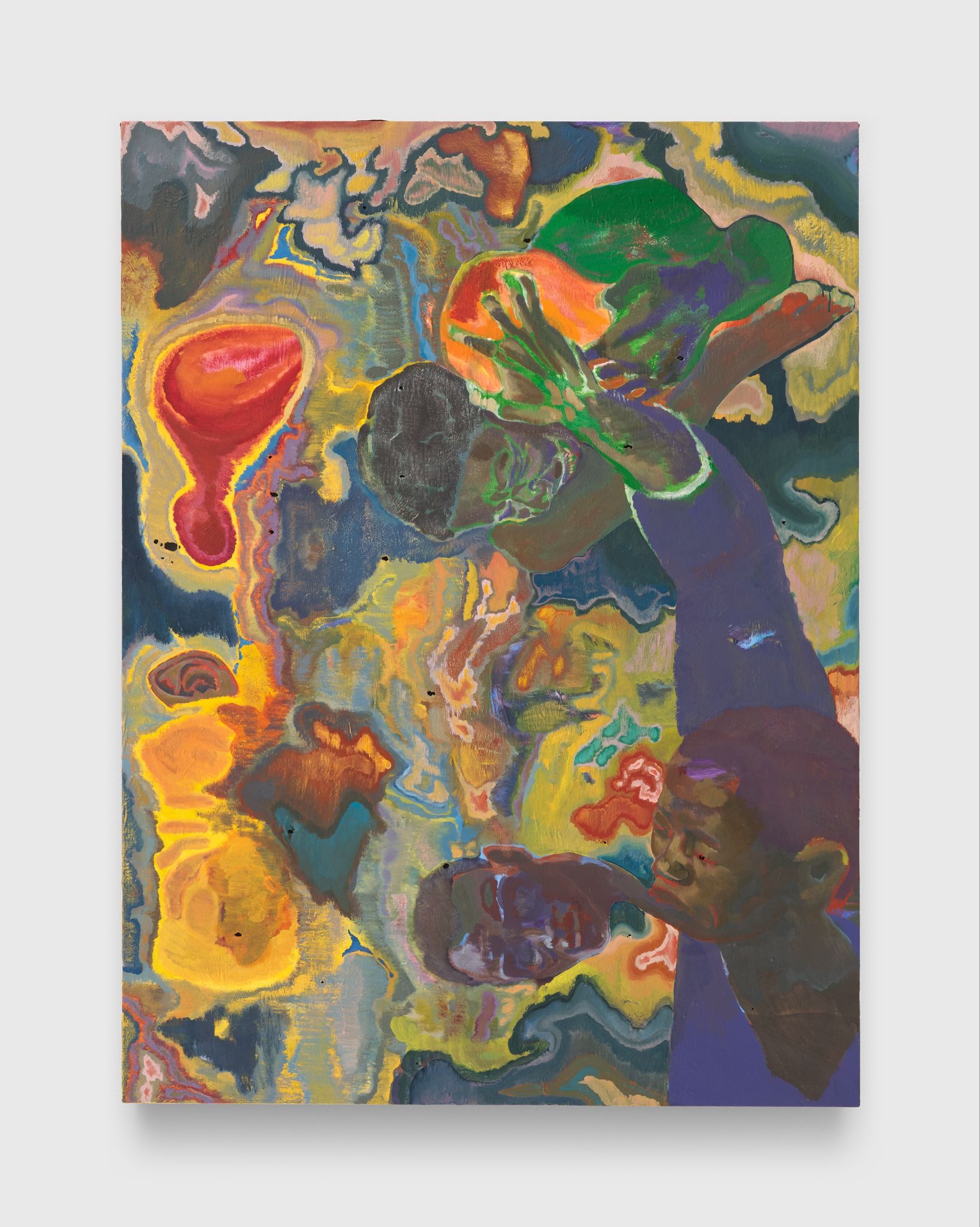
Armitage’s tactful negotiation of charged topics is shaped by his choice of substrate. He paints on Lubugo, a traditional bark cloth made from ficus trees sourced from Uganda and Indonesia. Unlike canvas, its surface is marked by a constellation of imperfections—fissures, creases, and bumps—that both interrupt and guide the composition. Its natural irregularities create the impression that the surface might be actively coming apart, or that it has been repaired. Seeing a hole in a painting is unnerving, especially in a museum. In Bound (2025), for example, a cavity beneath the depiction of twisted rope binding hands and feet together conjures associations with wounded flesh. Retaining proximity to the natural world, lubugo brings with it a sense of vulnerability and contingency. Armitage was drawn to the cultural resonances of this material from East Africa, seeking to distance himself and his work from certain aspects of Western art history, instead engaging with his own heritage.
Lubugo transforms not only the appearance of the paintings, but also shapes his technique. “Where I wanted more fluidity in the mark-making, or a more solid shape or area of color,” Armitage explains in his interview with Molesworth, “I really needed to thin down the paint.” What began as a conceptual decision evolved into a shift in technique.
For Armitage, painting is not a mode of representation so much as a process of inquiry. In conversation with the show’s curator Hans Ulrich Obrist, the artist relates to the Spanish painter Goya, whose rejection of traditional academic linework favored discovery over prescription. This attitude surfaces throughout The Promise of Change, where forms seem found, not predetermined in paintings that reflect on complex topics like postcolonial identity and the consequences of war, corruption, and instability in equatorial regions. Monumental yet intimate, these genre works avoid the polemical by locating history within lived experience: the weight of societal judgment settles over the hunched, moonlit bodies of Nyali Beach Boys (2025); migrants appear enveloped by undulating waves of color in Raft (II) (2024); and the flaming tires in Necklacing (2016) evoke brutal abuses of power. Armitage navigates a world “where things that are really vital are problematic.”
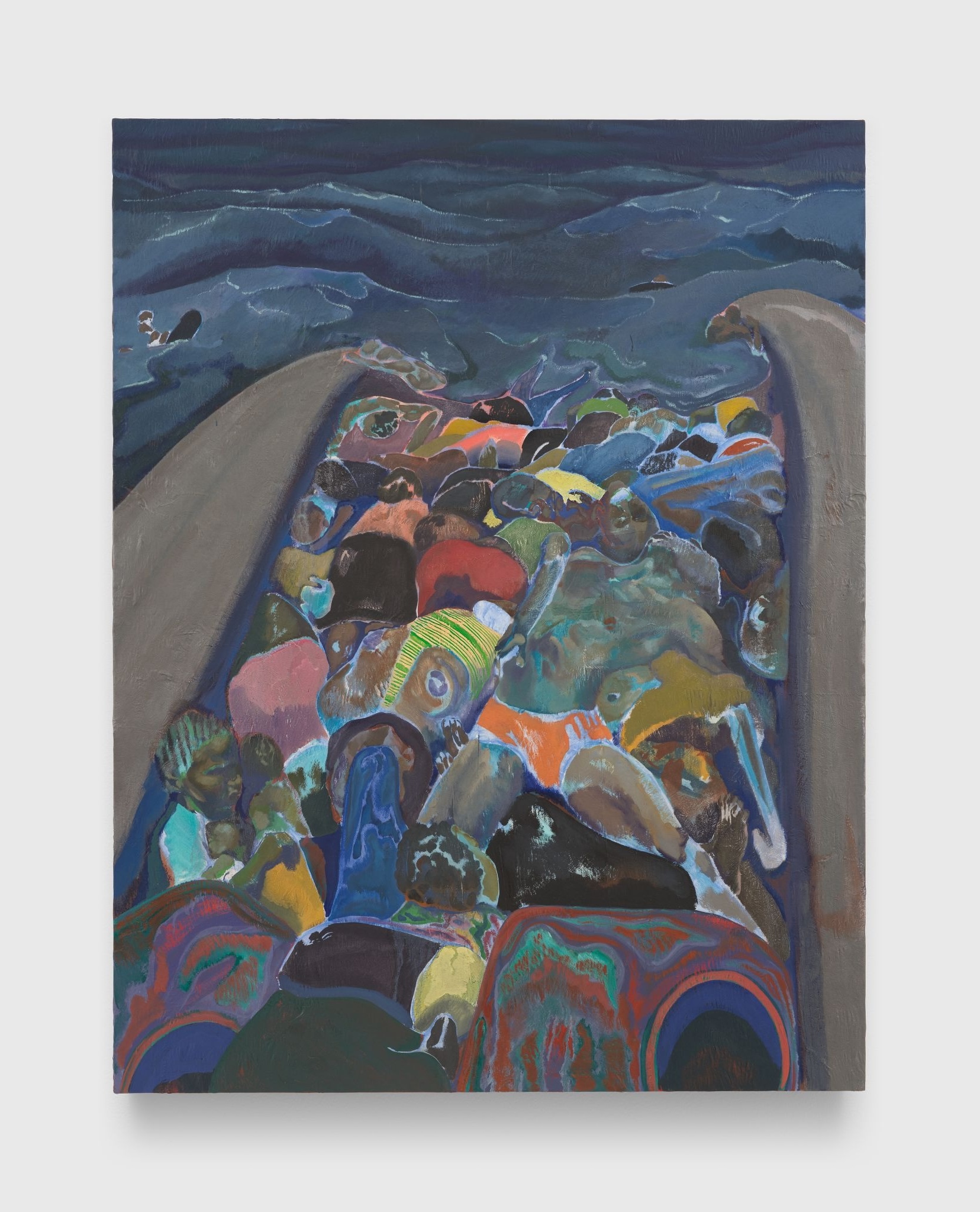
Through “pictorial liquidity,” Armitage maintains formal and conceptual fluidity, drawing viewers into each image. While maintaining ambiguity, however, he explains that “[i]t felt important that those faces were recognizable,” promoting the visibility and individuality of those who are too often turned into statistics and dehumanized by political rhetoric. His sensitive, purposeful handling of issues that flood news feeds today is a welcome balm. Viewers need time to process grief, anger, or sadness while acknowledging their own implication in the systems.
With wars raging across the globe, the expectation that artists should somehow represent, explain, or resolve systemic faults has become increasingly burdensome. How can artists remain true to their own vision while simultaneously navigating the demands of diplomacy or soft power? The Promise of Change offers another possibility—Armitage’s paintings do not aim to occupy a moral high ground, nor do they propose solutions. Instead, they create space for reflection and time to experience difficult emotions amid these uncertain times.
The Promise of Change is on view at Palazzo Grassi through January 10, 2027.