.webp)
Unsympathetic Clock: In Conversation with TJ Shin
Interview
When the Erie Canal opened in 1825, New York governor DeWitt Clinton poured a keg of water from Lake Erie into the Atlantic from a boat named the Seneca Chief—the wedding of the waters, the local lake married to the world atop a dispossession no one named. Two centuries on, the inaugural Medina Triennial, titled All That Sustains Us, co-curated by Kari Conte and Karin Laansoo with major support provided by the New York Power Authority and the New York State Canal Corporation, gathers thirty-nine artists under a rubric of maintenance and repair. Its strongest works ask not whether the local keeps pace with the global, but whether the two can relate without one being poured into the other.
Alice Bucknell’s futuristic video Staring at the Sun (2024–25), a game-engine geoengineering docufiction based on real-life interviews the artist conducted with climate solution startup founders, dissects the digital and political afterlife of planetary modeling, which proposes not to picture the planet but to become it, ruling from the data-rich center while the global majority goes unmodeled. The whiff of fascism around its CEOs is genealogy, rather than simply epithet. Corporationist extractivism is the shared structure, tracked from canal to cloud. Luckily, visitors can find solace of community in Asad Raza’s Reflection (2026), which reroutes canal water into a channel apparatus for leisurely enjoyment, or in Michael Wang’s locally sourced and produced energy drinks, a result of his sugar maple (a more ethical alternative sugar source) farming experiment Future Sugarbush (2026) in the Medina region.

Matt Kenyon gives that apparatus a monument. The TELL (2026) stacks champagne coupes into a glittering tower—an archaeological mound of celebration—but the champagne is gone: each glass cradles a Rose of Jericho revived by water wrung from the gallery air. Is the work a commentary on “trickling down” as an economic model? Or is trickling down a mere myth, just like how Kenyon’s agricultural experiment is a delicate artwork that cannot be mass produced?
Richard Ibghy and Marilou Lemmens expose the valuation beneath how we understand the world through statistics. Tales from the Terranean (2026) rebuilds environmental economics’ diagrams—such as the social cost of carbon emission or the net benefit of a bird’s song—as captionless bamboo-and-gel sculptures that, stripped of the spreadsheet’s authority, revert to colorful and lightweight fictions. Perhaps this is the price we pay for having too much data. Their Community Toolshed for the Birds (2021) literally catalogs the tools birds use. The same bird is priced indoors and credited outdoors.

Aki Inomata pushes the credit further. How to Carve a Sculpture (2018–) hands authorship to a guild of nonhuman makers—beavers named Czech, Genie, Nagi, Maru, and Yuzu, who gnawed at the artist’s wooden sculptural originals. Were the beavers bored or delighted? Their sculptural patterns seem mechanical. The results are a grove of totems in a former classroom. When value no longer rests on illusions of singular authorship, what are the metrics for creativity? In a county built on sandstone and mill labor extracted from the working class, the question becomes a historical one.

The rest answer with situated refusals. Mary Mattingly’s Floating Garden (2026) turns a rusted barge into a free, forageable commons in the canal, which feels like a social gray zone. Tania Candiani’s Two Waters (2026) gathers residents in the abandoned high school’s auditorium to vocalize sounds made by the Medina aqueduct, where the canal crosses above Oak Orchard Creek. The two streams touch without mixing—embodied knowledge arriving through breath and vibration. The aqueduct is the show’s most radical figure: relation without fusion, neither course absorbed into the other.
Futurefarmers’ 48 Collections from the Erie Canal (2026) spins the local legend of a boy’s leap into a cow carcass, creating a sprawling installation of texts, video, and sculptures in response to the story. On a scroll-like wall piece, an un-ranked almanac holds “Tonawanda Seneca Nation,” “Land Loss,” and “Planetary Atmospheres” in one embrace; best are sculptures resembling spirit levels, the surveyor’s instrument refilled with muddy canal water and its invisible life—reason made a vessel for what it disciplined. Perfect un-digging of forgotten knowledge.
.jpg)
Deirdre O’Mahony answers Bucknell’s synthetic documentary with a raw one. The Quickening (2024), by the Irish artist-farmer, draws its sung libretto from three years of transcribed dinners with farmers, scientists, and policymakers on agriculture’s unraveling—while animals’ breathing and pond water make up voices of their own. Knowledge is soil and dispossession, sung by those losing the land and the creatures bound to it.
Jeneen Frei Njootli similarly insists on embodied connections to land. A member of the self-governing Vuntut Gwitchin First Nation in fly-in Old Crow, Yukon, Frei Njootli prints their body as a faint silhouette into hot-rolled steel and smokes it into canvas—images that throw back your reflection and deny your gaze its likeness. Titled from withheld fragments of the artist’s own writing (Dreaming of new futures, greater empires have fallen), the work asserts Indigenous permanence through impermanence: presence by absence, opacity as resistance to erasure and commodification—the inverse of Bucknell’s will to capture.
Lina Lapelytė’s Faithfully Recording (2026) sets builders stacking reclaimed Medina sandstone at the railroad museum, labor as a collective score sung into the town. The song derives from William Carlos Williams’s 1962 poem Children’s Games, after Bruegel’s square swarming with children at play—but here there are no children, only adults performing the work those games once rehearsed, the inheritors gone.
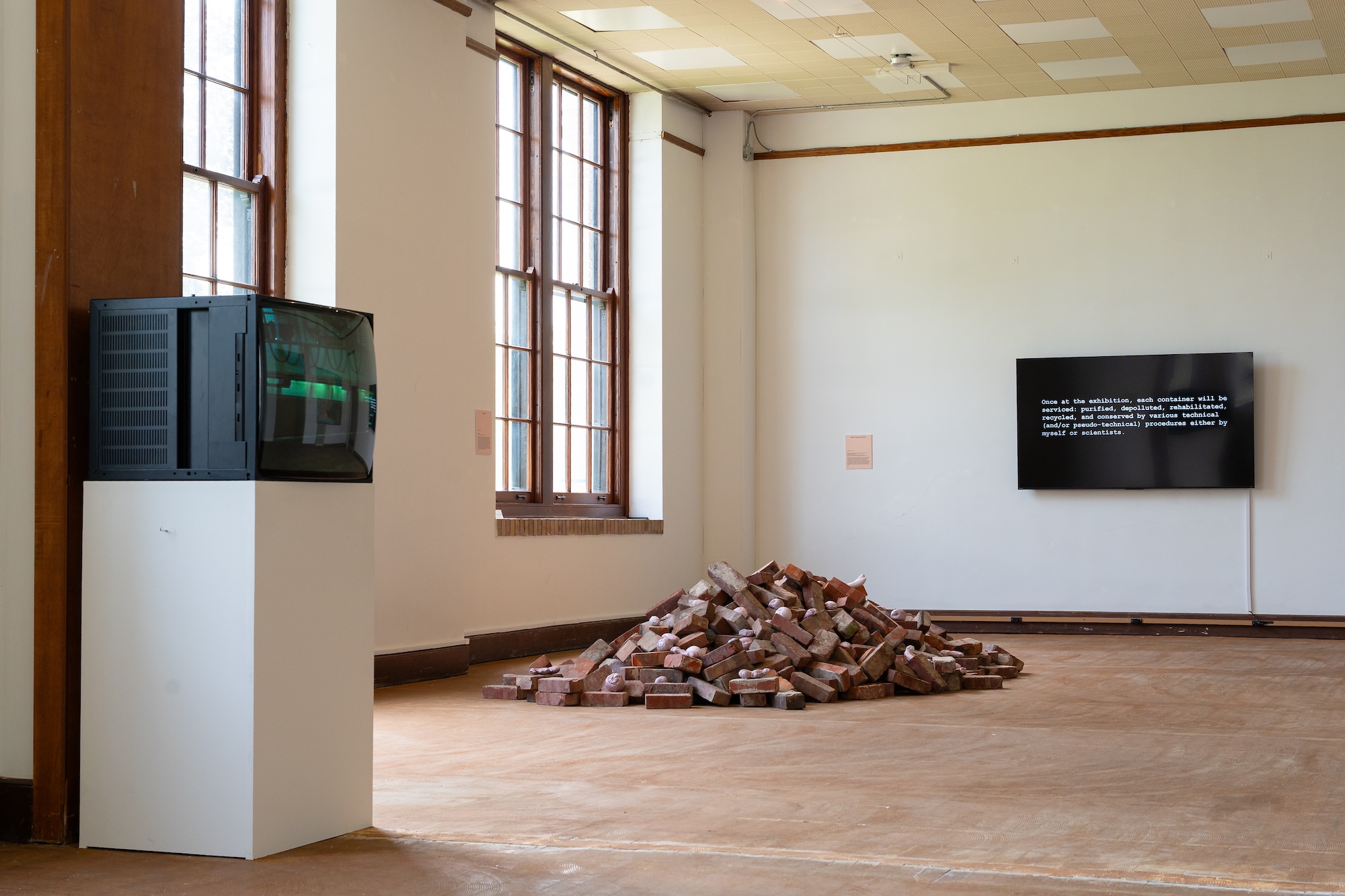
Across them, the triennial resolves into an axis, from the model and the monument that price and govern nature to a decentered company of makers, refusing to be ranked or consumed. Its honest strain is our unresolved desire for sovereignty, land and water as kin, though the body that refuses capture still feels distant from Medina. What does coexistence mean? Will the art world and the town share one dock all summer, never mixing? What the show makes walkable is that difference and question: whose water, whose land, whose labor, and whose “we” that pronoun is finally large enough to hold.
Medina Triennial 2026 is on view from June 6 to Sept 7, 2026.