%20Headshot_Matthew%20McPhillips.jpg)
Alix Vernet: “LANDMARKS” at Chapter NY
Review
“DAI DAI DAI DAI PIANO FORTE PIANO FORTE HELLO HEEEELLO HELLO HEEEELLO,” a young performer screams in desperation as she reads from plaster cast tablets leaned up on the wooden stadium scaffolding of Miet Warlop’s new performance IT NEVER SSST at the Belgian Pavilion of the 61st Venice Biennale. It’s a relentless onslaught of words—coming after nearly thirty minutes of her and her fellow performers tirelessly collecting tablets stacked amongst the audience and pavilion space. Her exhaustion is palpable; she’s the last performer standing amongst her troupe, the others sprawled out on blankets on the stage nearby. Soon, even she succumbs, using her last vigor to cast tablets off the wooden structure, and pulling out her blanket from its skeleton, finally at rest. How did we get here?
Warlop’s living sculpture sits at the bruised heart of this Biennale’s theme, “In Minor Keys,” now a collective score carried forward after the loss of Koyo Kouoh. Daily, performers rebuild and break apart plaster-cast words to loud percussive music, chanting along while they hurry to gather them all for display. “OUI HOLA HEY CIAO SALAM ORA.” In many moments, they work alone, bearing their own burdens of finding, hauling, and displaying the dusty and at times crumbling words. In one sequence, they move the wooden platforms off the stage, creating an assembly line by catching a tablet thrown by a previous performer, hopping two steps, spinning it 180 degrees, then tossing it to the next performer. As they work, they use their hips, chest, and shoulders as support, leaving white powder across their all-black ensembles. At the ritual’s climax, the tension reaches its peak as each scrambles to find the tablets with “sSST” inscribed, smashing them against other words to cover them with silence, desperately trying to quiet the storm. “HA HA HA WHY WHY WHY WHY WHY STOP STOP STOP IT NEVER SSST IT NEVER SSST.”
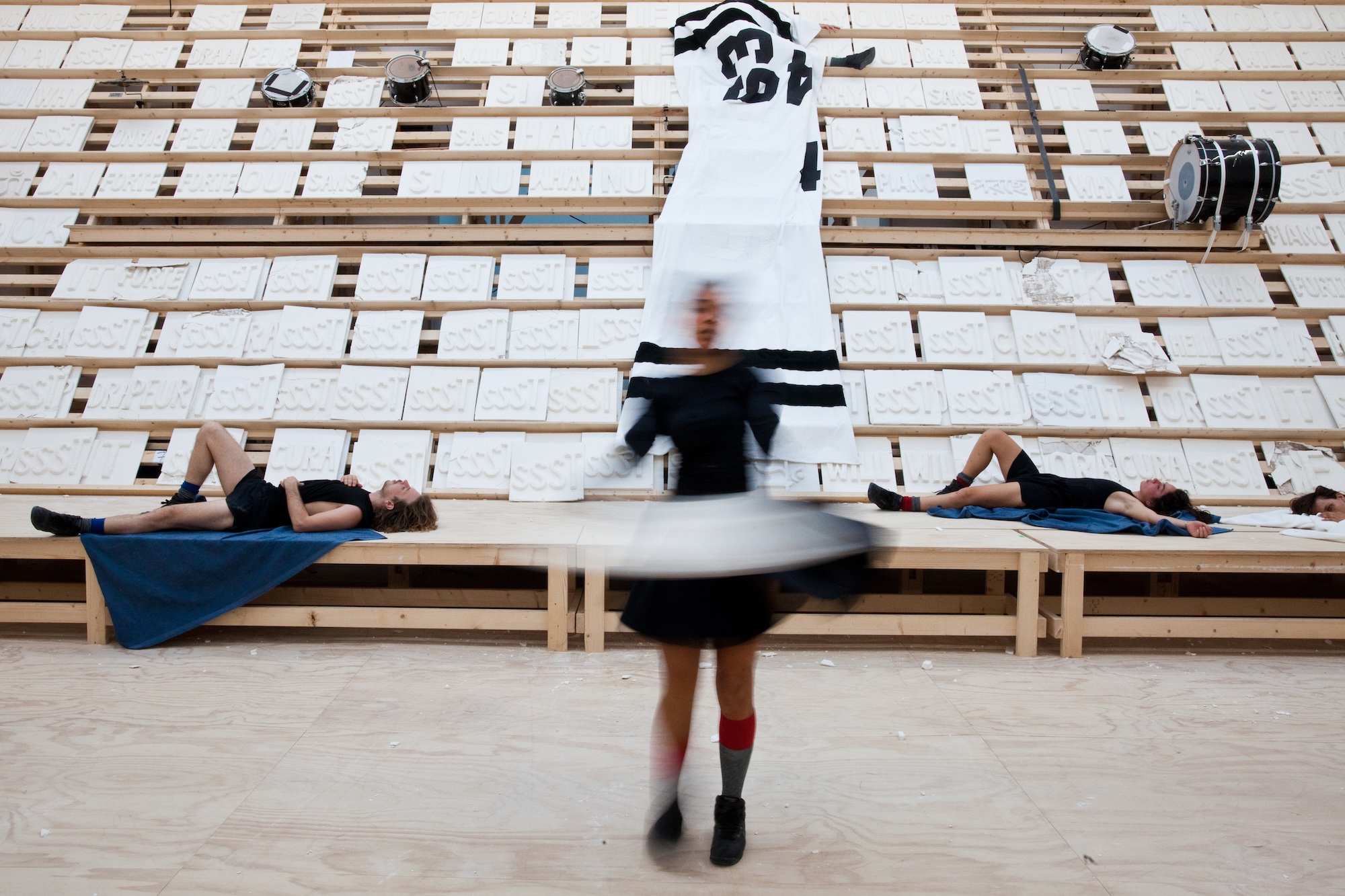
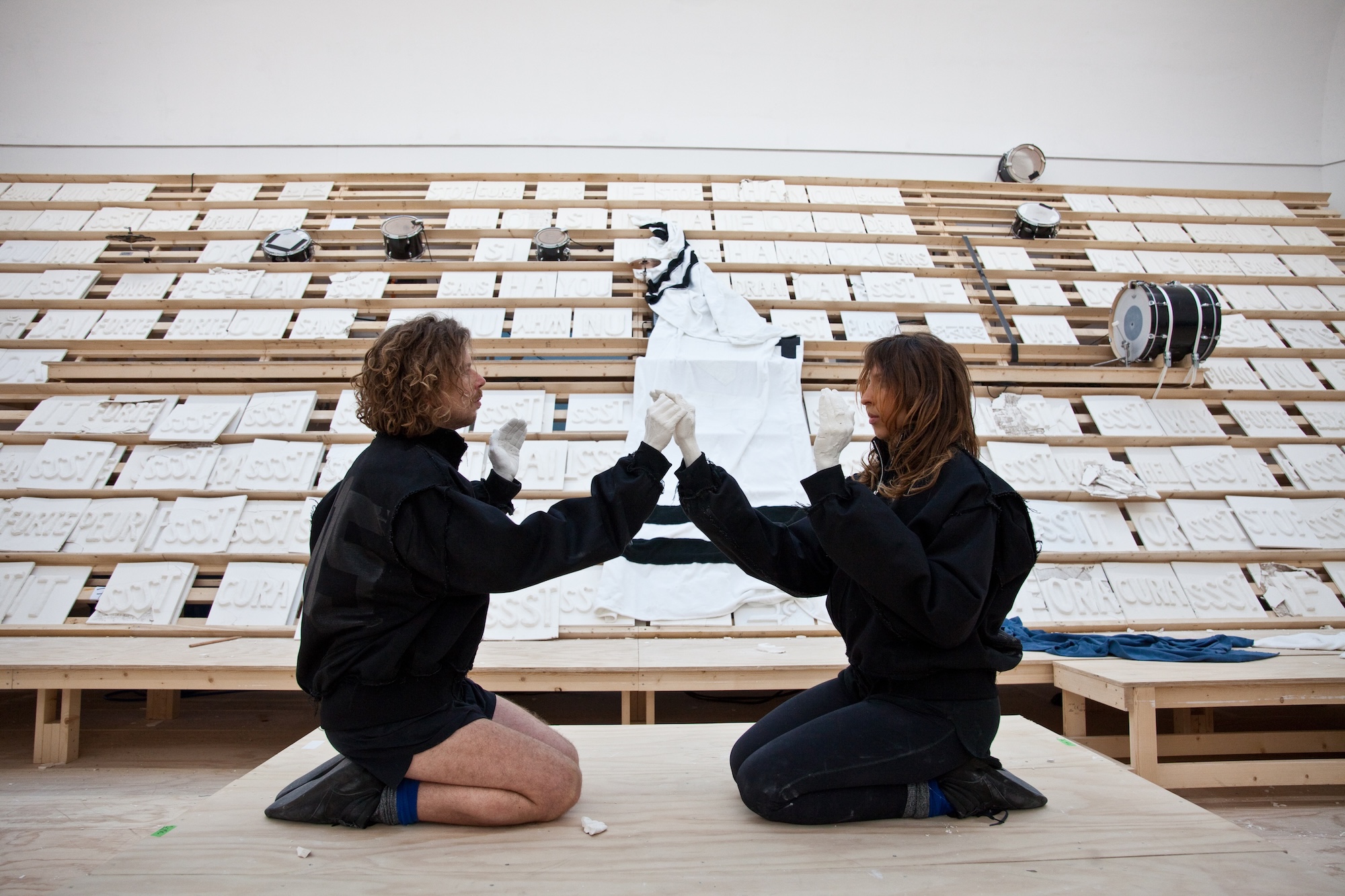
What one witnesses in the Belgian Pavilion is a longing for human connection amidst a world that has refused to quiet down—something the work’s own title names honestly. There is an ancient quality not only to the performance but also in the workshop-like exhibition space—resembling what could be a drying hall for modern Akhmim or Mesopotamian cuneiform tablets. Flanking the main room are two studios for plaster casting, producing everything from replacement words to delicate plaster arms, used for a short interlude performance where two kneel in front of the scaffold, playing silent patty cake until their false hands shatter. The plaster itself is a potent material metaphor—one that is at first fluid and then hardened, cast time and time again. It parallels our own bodies’ repetition, decay, and eventual crumbling and return to dust.
There is a kinship between Warlop’s sculptures and Lauren Halsey’s hieroglyphic Met Museum commission, the eastside of south central los angeles hieroglyph prototype architecture (I) (2023), which combines imagery from Black communal life, funk music, and speculative mythologies into a monumental relief. At the Belgian Pavilion, the architectural interventions use inscribed language to hold what speech cannot sustain—a communal memory etched in forms that can be returned to, carried, and broken. But where Halsey turns to Ancient Egyptian monumentality, Warlop insists on impermanence, welcoming the dissolution of words through the fragility of her medium.
The plaster is almost absorbed by the performers, their bodies bearing the tablets’ weight until the white dust becomes a wound. The durational exhaustion recalls Marina Abramović’s performance in Balkan Baroque, which debuted at the Biennale in 1997 and is having its grand return to Venice in her landmark solo exhibition at the Gallerie dell’Accademia nearby. Abramović’s repetitive labor in scrubbing 1,500 putrid, bloody cow bones while singing Yugoslav folk and funeral songs six hours a day over four days carried the memory and grief of being unable to wash the shame from war. Where Abramović’s theater is solitary, Warlop’s is communal, and as the performers strain, scream, and collapse together, they share in the exhaustion of our lived experience.
Perhaps collectivity is what makes IT NEVER SSST so precisely attuned to our world. Gabrielle Goliath's Elegy, displaced from the South African Pavilion to a church in Castello after political interference, makes similar arguments: mourning is not private but structural, as bodies gather in shared duration, and grief requires witnesses. Whether or not it intends to, this is the company Warlop’s pavilion keeps, and artists across the Giardini and Arsenale are reaching to hold what the news cycle has made unbearably abstract. The wars in Ukraine, Gaza, and Iran; the violence done to women, LGBTQIA+ people, and children; and the slow self-committed violence of emergent technologies that question the very fabric of what gives us purpose and makes us human. Warlop’s assembly line of plaster words won’t solve our pressing issues. However, what remains in the dust is the relief in having tried, in having reached out in the noise towards another person.
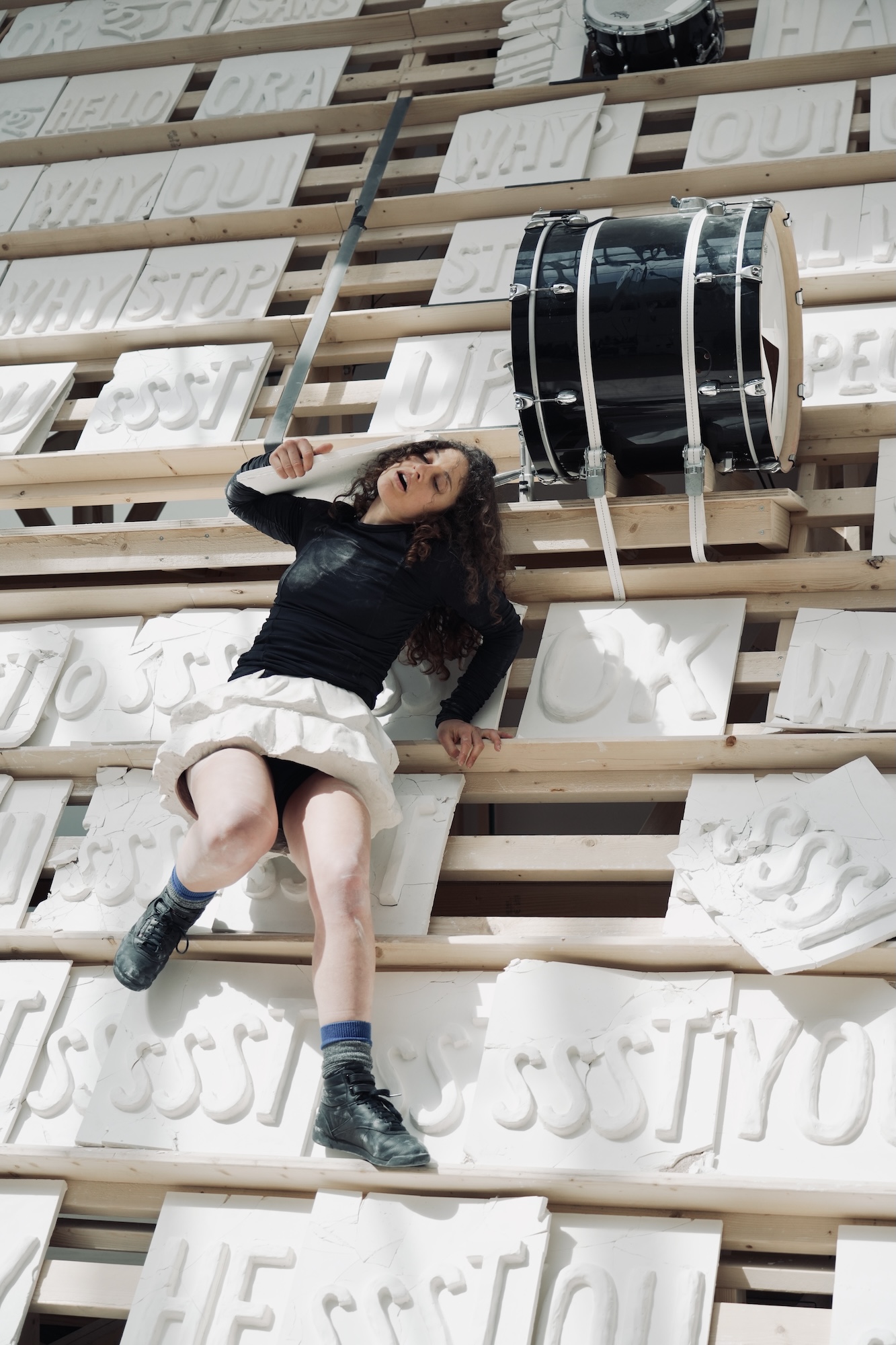
In the wake of a Biennale that convolutes spectacle, noise, dissent, and anxiety, Warlop’s IT NEVER SSST may offer us the only kind of hope still available: not that our world will quiet down, but that we will keep on building structures and community to hold each other up.
Miet Warlop: IT NEVER SSST is on view at the Belgian Pavilion at the 61st International Art Exhibition—La Biennale di Venezia through 22 November 2026. Performance times are available on the official Belgian Pavilion’s website.