Alix Vernet: “LANDMARKS” at Chapter NY
Review
In a tightly focused yet dense selection of works spanning the first three decades of Joseph Kosuth’s practice, And I Shall Offer It To You As A Ready-made Product at Castelli Gallery situates the artist’s hallmark distillation of language and installation as fluidly nimble yet steadfastly viable. Adopted from a sentence pulled from a lecture by Sigmund Freud published in 1933 titled “Anxiety and Instinctual Life” discussing object and ego, the exhibition title more popularly draws references to Marcel Duchamp, a primary influence on Kosuth’s trajectory. Rather than emphasizing Kosuth’s affinity for his conceptual predecessor, the show aptly unpacks the artist’s lesser-cited consideration of Freud.
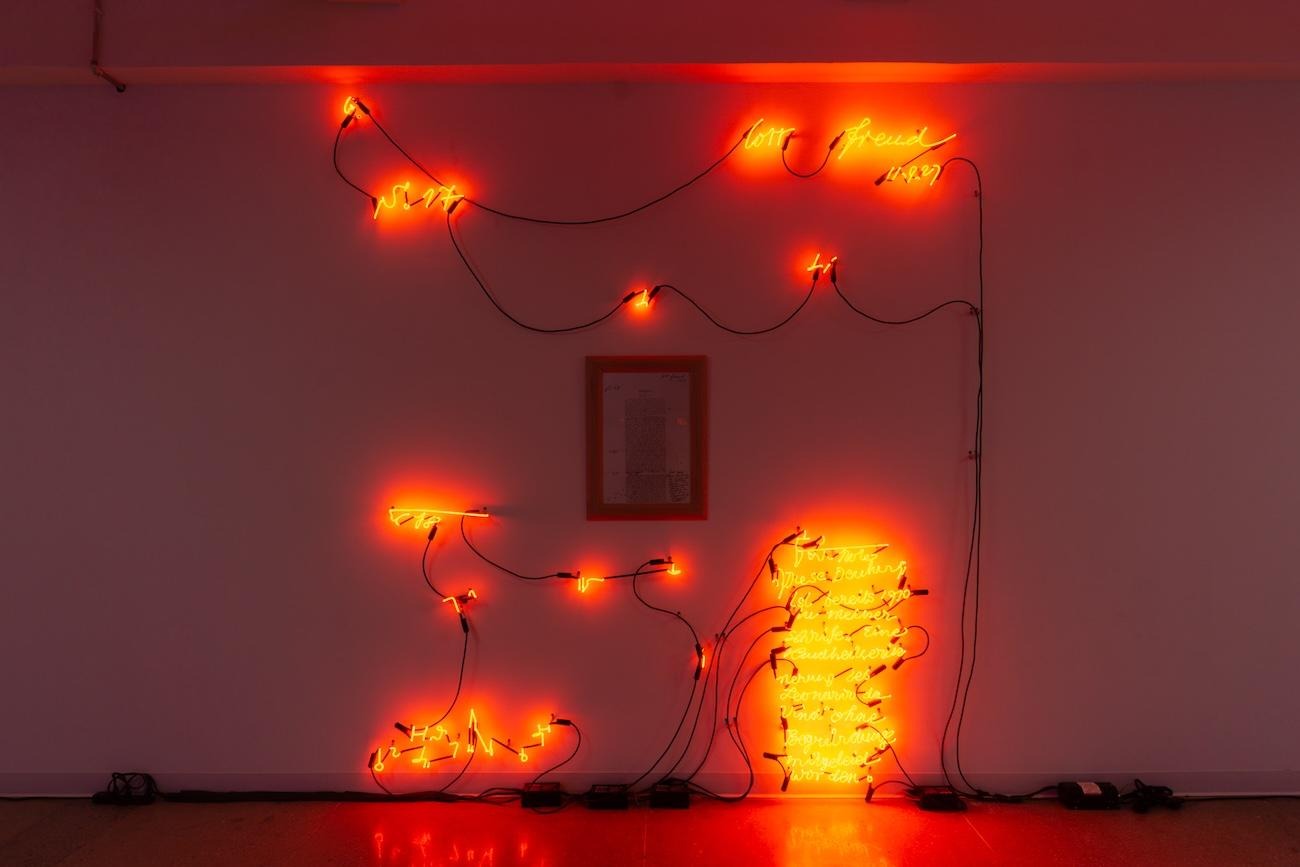
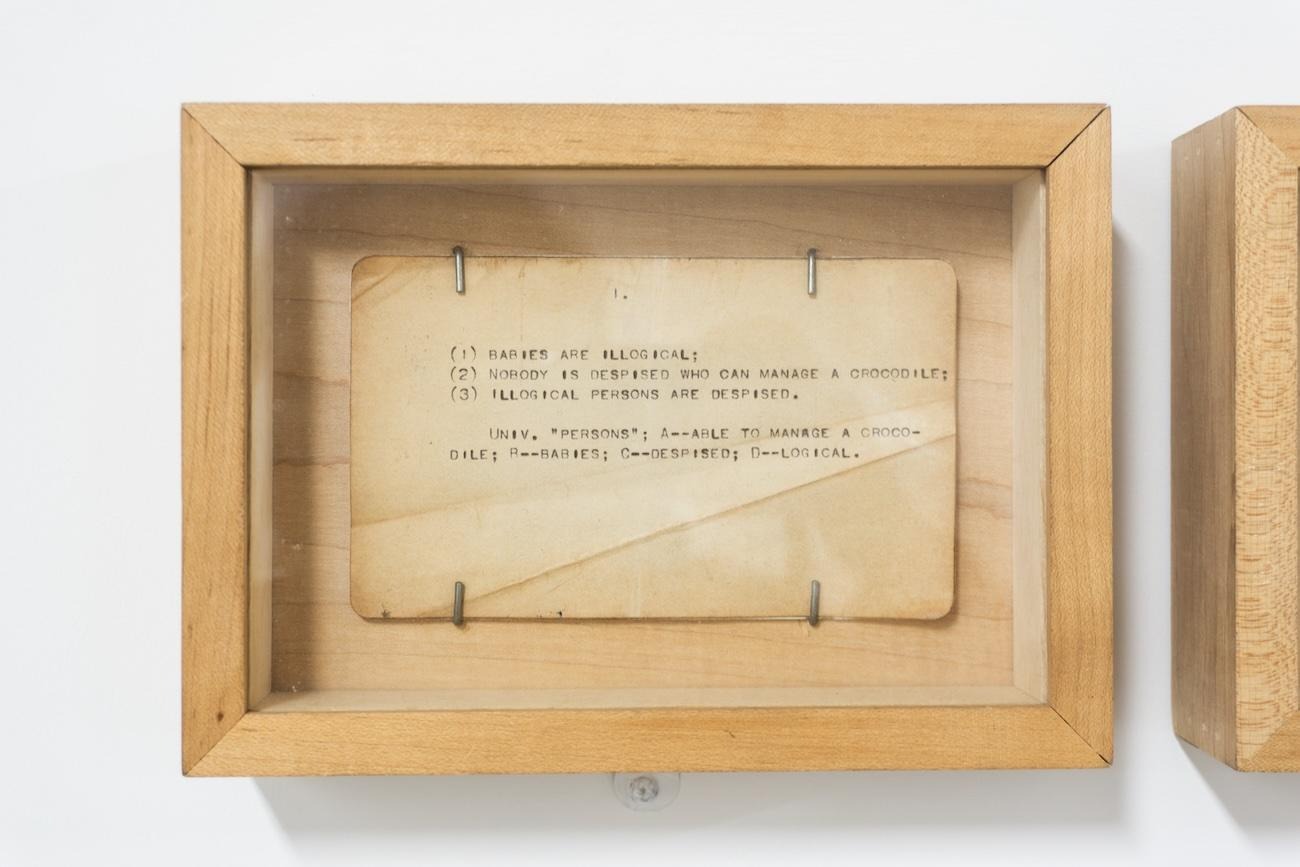
The physical grouping of the works on view reads like an open circuit. A freestanding wall erected at the front of the gallery area creates a sense of containment with openings to either side for viewers to pass through. Installed across one another beyond these pathways, ‘One and Three Labels’ [Eng.-Latin] and One and Three Hammers [Eng.-Latin] (1965), iconic nascent works that borrow the structural format of dictionary entries, buttress Fetishism (Corrected)’ [Red] (1987), an installation comprised of a framed reproduction of Freud’s text “Fetishism” surrounded by notes that Freud annotated in the margins of the text, his handwriting identically reproduced in ruby neon cursive script. Across from this monumental, baroque presentation, The Sixth Investigation (1969), a grouping of 28 individually framed index cards typewritten as adaptations of Lewis Carroll’s logic games, employs the aesthetics of administration of its epoch. Its orderly installation recalls the artist’s solo debut at the gallery in 1969 and the same year that Kosuth pens Art After Philosophy, a text in which he rejects formalist art (painting and sculpture) and emphatically advocates for questioning the nature of art asserting, “the reason that different artists from the past are "brought alive" again is because some aspect of their work becomes "usable" by living artists. That there is no "truth" as to what art is seems quite unrealized.”
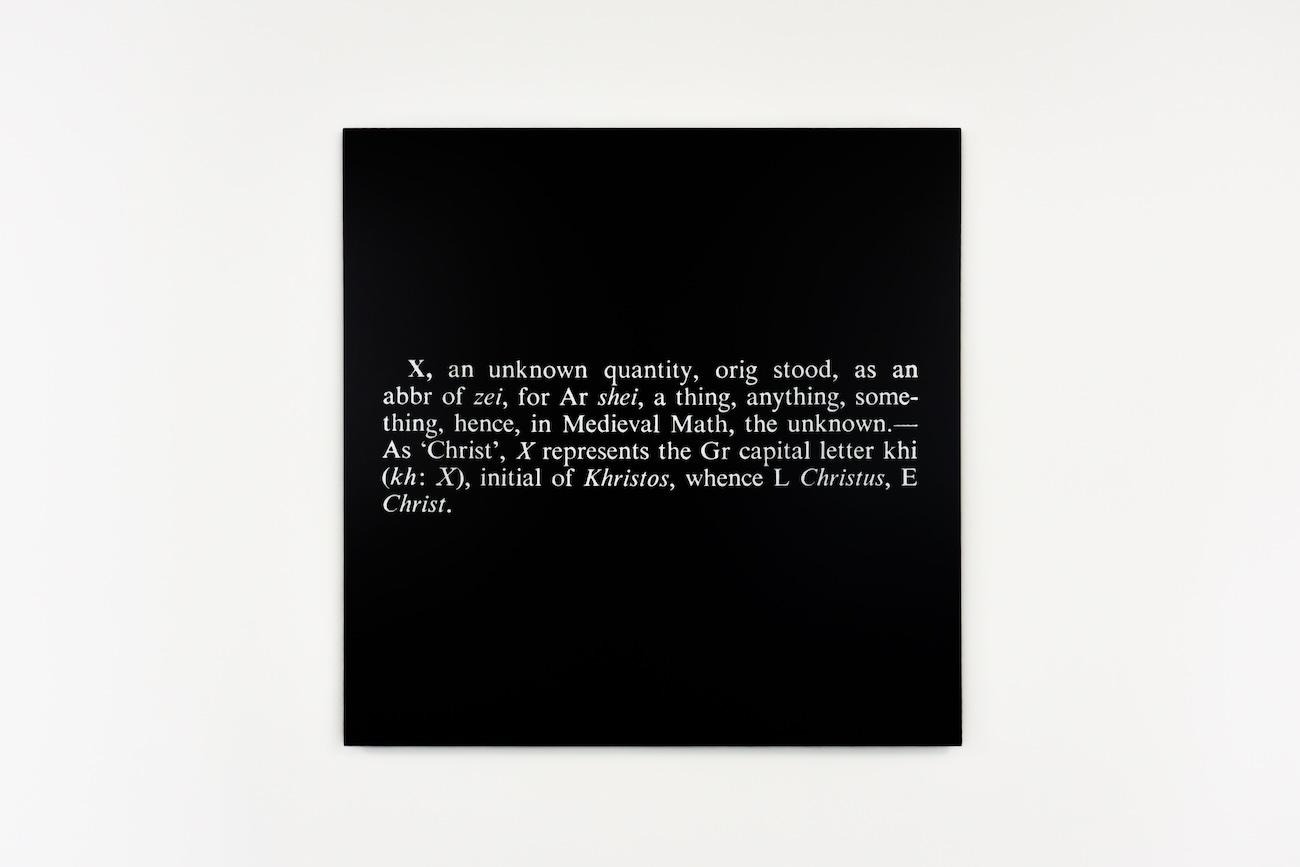
On the opposite side of the freestanding wall where Fetishism (Corrected)’ [Red] blazes, ‘Titled (A.A.I.A.I.)’ [X] (1967) faces out at the viewer, hung separately from the interior grouping. While the placement that would traditionally function as an introductory wall, ‘Titled (A.A.I.A.I.)’ [X] (an abbreviation for Art as Idea as Idea), feels rather like a strange glitch complicating linear certainty rather than dictating it, interrupting both the physical circuit (does one begin left or right) and the reflexive theoretical space. Composed of a working definition of X as an unknown quantity, thing, or as the Greek letter representing Christ rendered in white letters in a Times New Roman style font on a black background, the work evidences Kosuth’s influential adaptation of language as art, the concept as the proposition. Today, the abbreviated title immediately elicits associations with artificial intelligence, particularly imminent ChatGPT large language models. Here, Kosuth’s persistent incorporation of language, revealing the tenuous nature of logic, order, and authority that it invokes, rings with a striking urgency.
While X operates as a mutable vessel in its ability to hold an infinite amount of concepts, the criss-cross symbol also acts as an editing gesture, a cancellation, an x-ing out. Kosuth’s engagement with acts of revision is made more explicit in the line struck through ‘C.S. #31’ [Violet] (1987), a violet neon construction spelling out the titular sentence. The prominence of the neon works in the room stimulates thinking about the historical popularity of neon in the 1930s, with its resurgence in the 1980s, as parallel to Freud’s success in the 1930s and his enduring influence on psychoanalysis, particularly revived with Lacan’s reinterpretations of Freud and Lacan’s students’ own revisions of both Freud and Lacan, including Luce Irigaray and her contributions to French feminism in the 1970s.
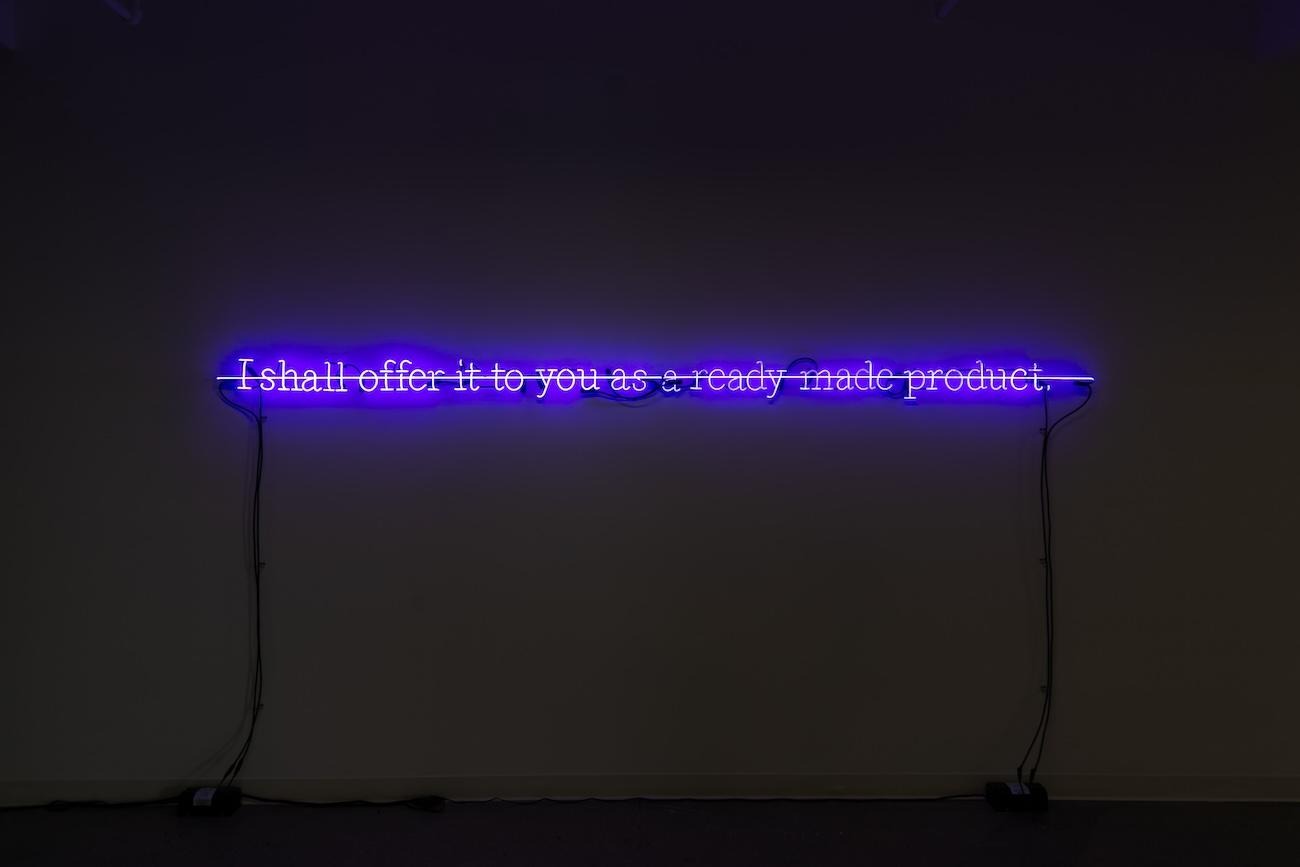
Elaborating on ‘C.S. #31’ [Violet], Kosuth describes the line crossing out Freud’s sentence as a “negated presence and a positive absence” in Art After Philosophy and After: Collected Writings, his 1991 follow-up to the previously mentioned essay. Considering Kosuth’s disdain for the formal aesthetics foundational to painting and sculpture and the intimate relationship between psychoanalysis and art (particularly the parallel developments in Freud and Lacan’s writings and in painting and sculpture from the 1920–40s), his involvement with Freud is intriguing. While Fetishism (Corrected)’ [Red] fetishizes Freud’s handwriting, implicating Freud as the object in an altar-like, even funerary, display, Kosuth strikes out the words of Freud in ‘C.S. #31’ [Violet], refuting the infamous psychoanalyst’s assertion but also the authority of the readymade, Kosuth and Duchamp’s primary material. Through this action, Kosuth folds in his own (now widely popularized) elaborations on and contributions to systems of meaning-making as up for negation, revision, and expansion in the quest to continually investigate the nature of art and ultimately what is being said, re-said, and unsaid. And perhaps in this age of facile prompts paired with mindless, automatic regurgitation of information and imagery, And I Shall Offer it to You as a Ready-made Product underscores for a contemporary viewership the potential found in the instability of language, reason, and authority and the corresponding imperative of absence, gaps, voids, and ineffable unknowns in realizing presence, be it regarding art or wider negotiations of reality.
Joseph Kosuth: And I Shall Offer It To You As A Ready-made Product was on view at Castelli Gallery from May 15 through July 30, 2026.