

.webp)

To Touch the Sky: The Drone in Contemporary Performance
Voice
Museums attempt to maintain a contract: they offer visitors the opportunity to encounter artwork that the institution has deemed valuable enough to acquire and preserve. These encounters can be meaningful experiences as long as they are silent, orderly, and polite. Museum visitors, in turn, foist expectations on the artwork they see; it is imperative that the artwork teach, inspire, or entertain them. Anything less is a failure. Maia Chao’s BEING MOVED (2026) suggests that this dynamic is not serving anyone or anything. Performed at the Whitney as part of the eighty-second edition of the Whitney Biennial, the performance humorously attends to the behaviors and gestures that are produced inside museums. Chao proposes that museums enact disciplinary tactics to reinforce and reward the performance of certain activities by museum visitors. Devising a series of scores, Chao guides a large ensemble of performers to imitate and exaggerate the actions of museum-goers. With choreography by Lena Engelstein, BEING MOVED ridicules everyone who interacts with museums: artists, staff, and audiences alike.
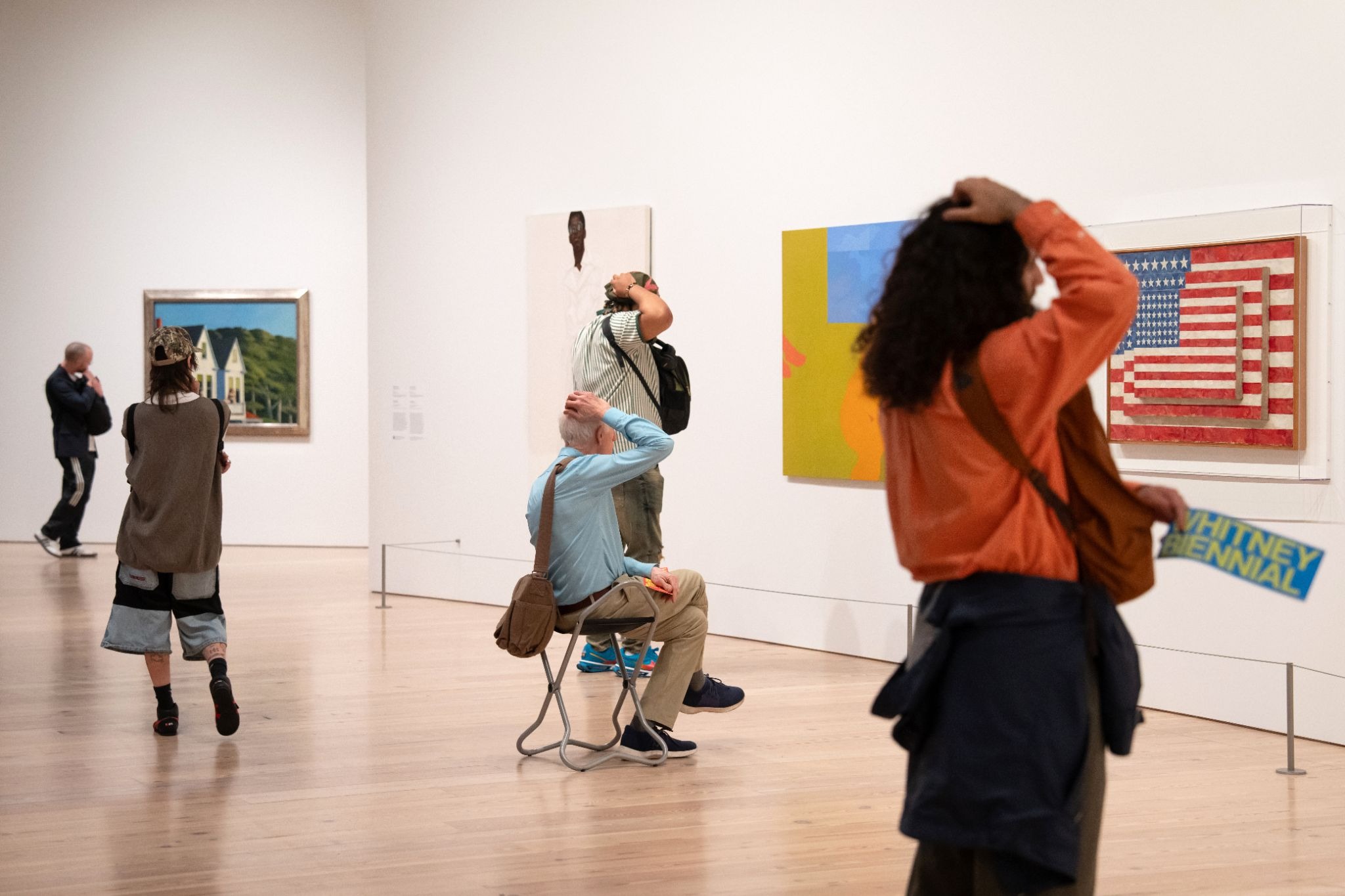
The performance takes place on the museum’s seventh floor, where the exhibition “Untitled” (America) is currently on display, featuring artworks held in the Whitney’s permanent collection. Audiences are directed to sit on the floor or in chairs opposite a wall that features five paintings: Barkley L. Hendricks’s Steve (1976), Kay WalkingStick’s April Contemplating May (1972), Jasper Johns’s Three Flags (1958), Georgia O’Keeffe’s Summer Days (1936), and Alma Thomas’s Mars Dust (1972). Images of these artworks are reproduced across the ensemble’s clothing and accessories. As if to prepare the audience for the evening’s absurd antics, the performance opens with a cacophony. The ensemble, still hidden by gallery walls, produces embarrassing, unwanted noises like throat-clearing, yawning, coughing, sniffling, sneezing, door-slamming, phone-dropping, and wrapper-crinkling. These audible distractions give way to louder sounds: the opening notes of "The Star-Spangled Banner," an evening news theme song, and animalistic shrieks.
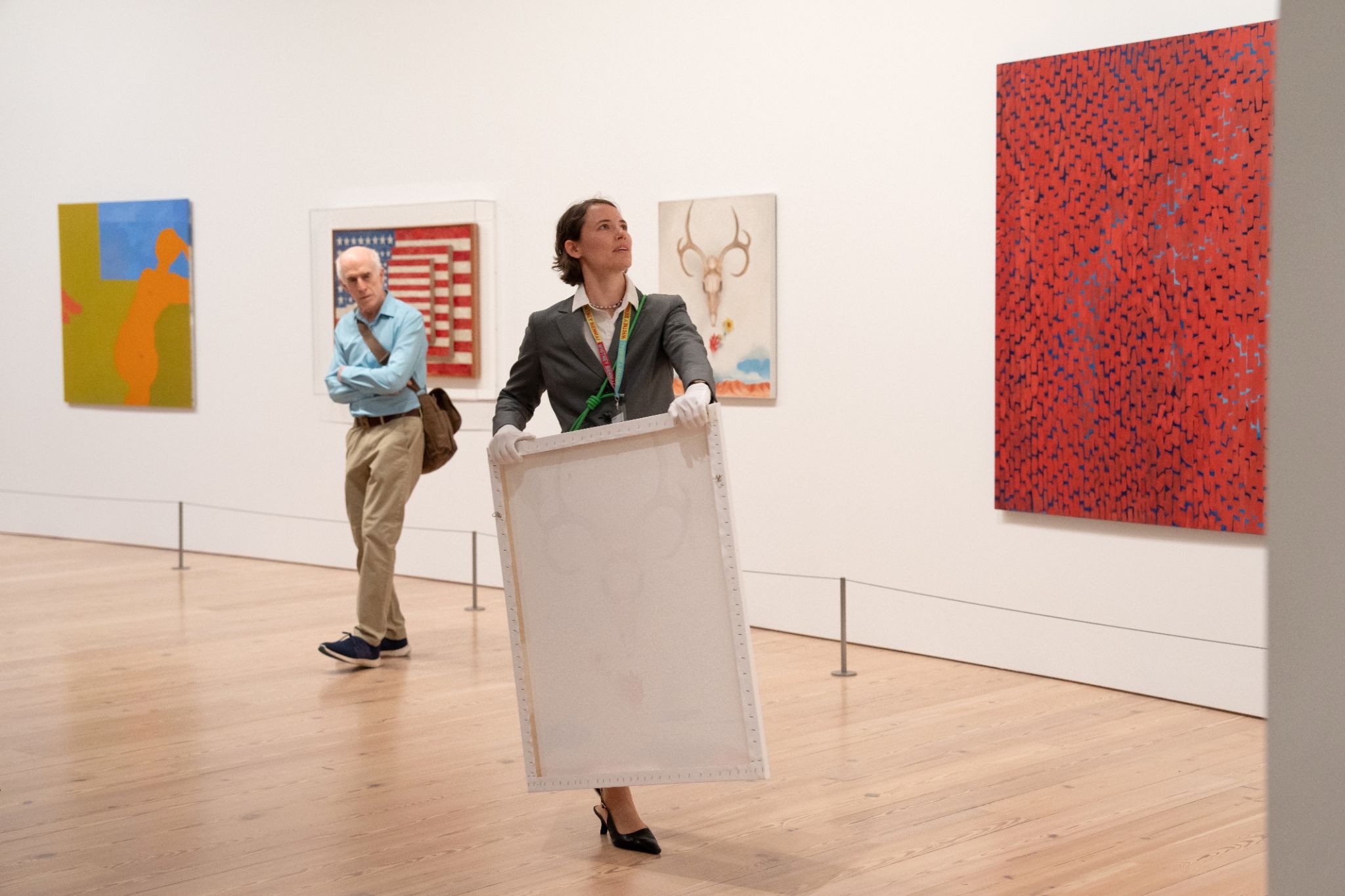
The audience may notice that a styrofoam coffee cup is spilled onto the floor in front of Johns’s Three Flags. Once there is silence, a performer outfitted in a gray, corporate-approved suit and equipped with a walkie-talkie (Hannah Mitchell) approaches the cup in a state of distress. Mitchell delicately tosses a few tissues onto the spill before mashing everything together into her hands, a moment that pokes fun at museum bureaucracy and the administrators who favor the most complex, inefficient operations.
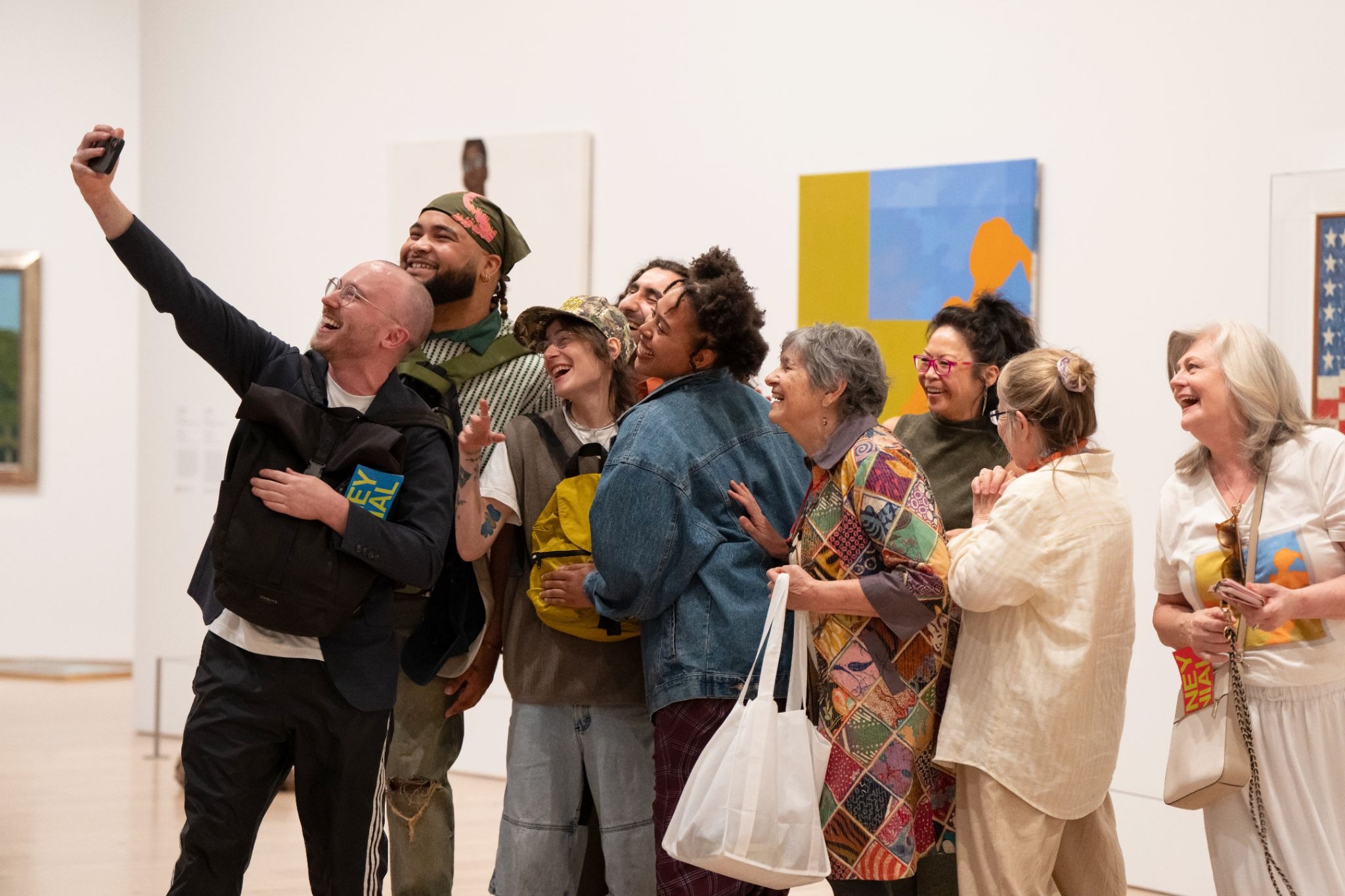
Ensemble members stroll into view with backpacks strapped to their fronts and spill out of the elevators with gift shop bags. At first, the performers strive to be “ideal” museumgoers who engage in forms of quiet study and stare at art with frozen looks of wonder and awe. They sense a need to read the wall text and artwork labels, capture photos, and scan every visible QR code. Some tilt their heads to one side as they inch closer to a particular artwork only to retreat from it a few moments later. Squinting, they retrace their steps for fear of having missed something. Many of the performance’s most engaging moments occur when the movements of the ensemble members are either synchronized or perfectly staggered. Pairs cross their hands behind their backs, touch their heads, rub their necks, scratch their backs, reach into their pockets for tissues, and fan themselves with bright Biennial museum guides—all in sync.
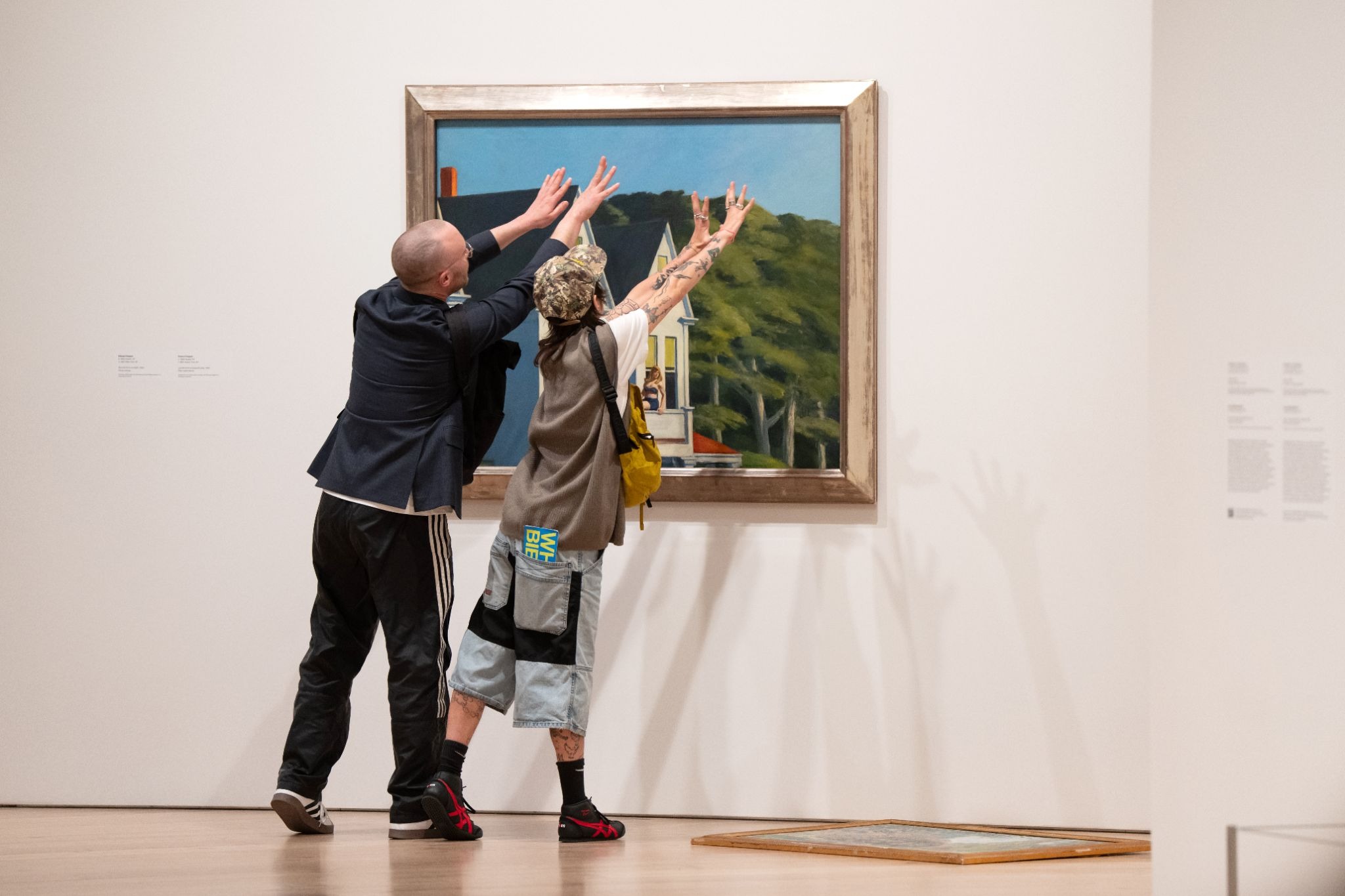
Eventually, it is no longer possible for the ensemble to constrain their bodies. Their unruliness cannot be contained or suppressed. Without warning, a performer (Jo Warren) collapses onto the floor in a fit. Another ensemble member (James Barrett) jumps and lands into splits. These moments bring to mind the opening pages of Ben Lerner’s Leaving the Atocha Station (2011). While on one of his daily trips to Madrid’s Museo del Prado, the novel’s protagonist witnesses another man “having a profound experience of art.” This man bursts into tears at the sight of multiple paintings, his loud wailing startling both the protagonist and the museum’s security team. Alarmed by the man’s sudden display of emotion, everyone wonders whether the crying man will damage the paintings that so dramatically move him. Like Chao’s performance, this scene points to one of the many contradictions of museums: that they cannot tolerate ecstatic, intense reactions to artwork. Laughter, screams, and sobs are unwanted and discouraged, deemed to be threatening to the artwork on display and the overall institutional white cube environment. Brian O'Doherty writes in Inside the White Cube: The Ideology of the Gallery Space (1986) that museums regard visitors as "intrusions" who disturb the sanctity of the gallery space with their human Otherness; as such, in their effort to protect the gallery space, museums surveil and alienate visitors, separating them from the artwork hung on the wall.
Across its choreography, sound design, and costume design, BEING MOVED maintains an interest in repetition to the point of meaninglessness. Still embodying an uptight museum staff member, Mitchell spends much of the performance carrying out multiple imitations of the artwork installed on the seventh floor of the Whitney, including Felix Gonzalez-Torres’s “Untitled” (America) (1994). At one point, she places a larger version of O'Keeffe’s Summer Days against the wall. Two ensemble members (Paul Zimet and Ellen Maddow) are perplexed by the larger painting’s sudden appearance. Carrying a white shopping bag with a print of Summer Days emblazoned on its side, Maddow insists that the false or forged painting must be the one on the floor. “If it’s real, they won’t let us touch it,” she reasons. Eventually, Zimet and Maddow gingerly touch the copy of O'Keeffe’s painting. The illicit act becomes erotic for them, as they run their hands over the painting’s brushstrokes and squeal with pleasure. They express an impulse to, as Mary Simpson writes, “physically consume art.” The pair continue their exploration until they are interrupted by the sound of an alarm, and they scamper away. Zimet and Maddow’s brief debate over the authenticity of artwork is a performance highlight.
BEING MOVED succeeds at being funny, but the moments that are deliberately played for laughs feel less precise, at times. For example, halfway through the performance, the ensemble members begin to take photographs of each other. They form an infinity loop, one person asking another for a photograph with an artwork until the entire group is taking a carefully-framed selfie and exploding in peals of laughter (à la the infamous selfie at the 2014 Oscars with Ellen DeGeneres). This moment feels less effective, because the uncontrollable urge that people have to capture and photograph themselves is present everywhere in this technofuture. The gesture is not contained to museums.
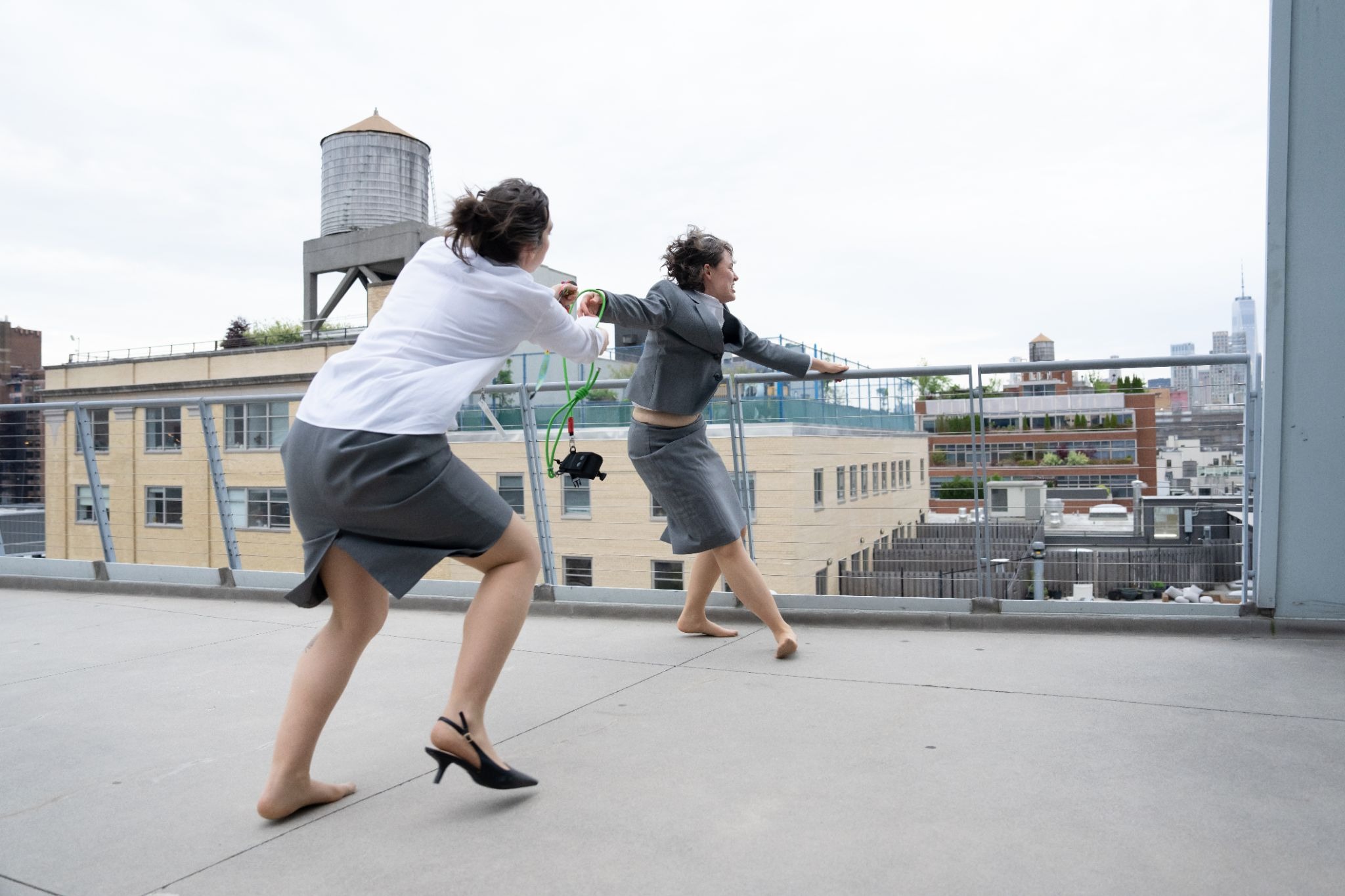
At the end of the performance, two ensemble members transform into museum docents and lead groups of audience members on brief tours that are delivered in foreign languages. The bemused audience can only make out a few words and phrases in English: close reading, permanent collection, censorship, and Palestinian liberation. After the last phrase is uttered, the tour guides are swiftly pulled away by the museum staff members (Hannah Mitchell and Parker Sera), and their lavalier microphones are removed. Mitchell and Sera then race out to the seventh-floor terrace, tussling and crawling over each other in a scuffle. The scene calls to mind the Whitney’s capacity for retaliation; remember the museum’s unilateral cancellation of the performance No Aesthetics Outside My Freedom: Mourning, Militancy, and Performance in 2025 (originally scheduled to be included in the Independent Study Program’s curatorial exhibition that spring), the dismissal of the ISP’s former associate director Sara Nadal-Melsió, and the subsequent suspension of the ISP program. This uncomfortable, abrupt end to the guided tours is followed by two surprising musical numbers. The ensemble comically sings in harmony about their desires to defy the logic and rules of museums. After apologizing for the mess they have made with their willful bodies, the group excuses itself, singing, “I need to pee.” Exiting in a state of fatigue, the ensemble emphasizes that there is a limit to how much control people can bear inside museums.
Chao has spent much of the last decade interrogating and transforming museum dynamics. Alongside artist Josephine Devanbu, Chao created the project Look at Art. Get Paid., or LAAGP (2015–2020), which paid “guest critics,” typically Black and Brown people who had never been to a museum before, to spend two hours exploring a local museum. After the initial pilot took place at the RISD Museum in Providence, Rhode Island, LAAGP and its unique model spread to other institutions. LAAGP acknowledges that, in the United States, art museums are inaccessible, exclusionary spaces that have historically prioritized their white, affluent audiences. By compensating non-white audiences for the labor of visiting and critiquing museums, the project offers museums clear evidence. The public wants these institutions to be alive, capable of evolving their rules, policies, and structures to center and embrace the people who come to experience the art.
Maia Chao: BEING MOVED ran at the Whitney Museum of American Art as part of the 2026 Whitney Biennial from May 14 through 17, 2026.