

In Conversation with Anna Heisterkamp
Interview
“Sick and kinky” is how the British Board of Film Censors described Ken Russell’s dramatization of the Loudun possessions—even after the board had censored most of the film’s sex, torture, and plague. Despite the omissions, including that of its crowning jewel, the nun orgy entitled “The Rape of Christ,” the Vatican denounced The Devils (1971) as “an obscenity as had never been seen before on the screen.” Fifty-five years after the release of the original censored version, the uncut and restored object of such vitriol arrived in theaters on October 16—and, this time, to critical acclaim. Based on Aldous Huxley’s The Devils of Loudun (1952)—a Herodotus-like history of the Loudun Possessions (1632-1637)—and John Whiting’s 1960 theatrical adaptation, The Devils centers on the trial and execution of Urbain Grandier (Oliver Reed), a magnetically dissolute priest whose downfall is engineered by Cardinal Richelieu. Original sets by Derek Jarman, a score by Peter Maxwell Davies, and cinematography by David Watkin drench The Devils in all the sex, sleaze, and hallucinatory excess of the 1970s. Russell’s orgiastic interpretation of the Loudun Possessions functions like a secularized passion play, casting Grandier in the image of a Catholic martyr. By paralleling Grandier’s resistance to state authority with the hagiographic tradition of Catholic sainthood, The Devils recasts his execution as a political martyrdom.
The Devils begins its historical account from the perspective of Grandier, a Jesuit-educated priest and spiritual leader of Loudun. Grandier is a reputed libertine who wrote treatises against celibacy in the priesthood. Eventually, his reputation becomes the fixation of the city’s repressed convent of Ursuline nuns, led by Sister Jeanne des Anges (Vanessa Redgrave). Even more controversially, Grandier tolerates Protestantism and insists that Loudun retain its walls to remain sovereign. In doing so, he defies Richelieu’s Counter-Reformation campaign and his efforts to consolidate provincial authority under the Crown. To remove this obstacle, the Ursulines’ confessor cites the women’s sexual fantasies as evidence of demonic possession. The cardinal’s allies then open an inquest into witchcraft, using torture to derange the women and to secure an indictment against Grandier.
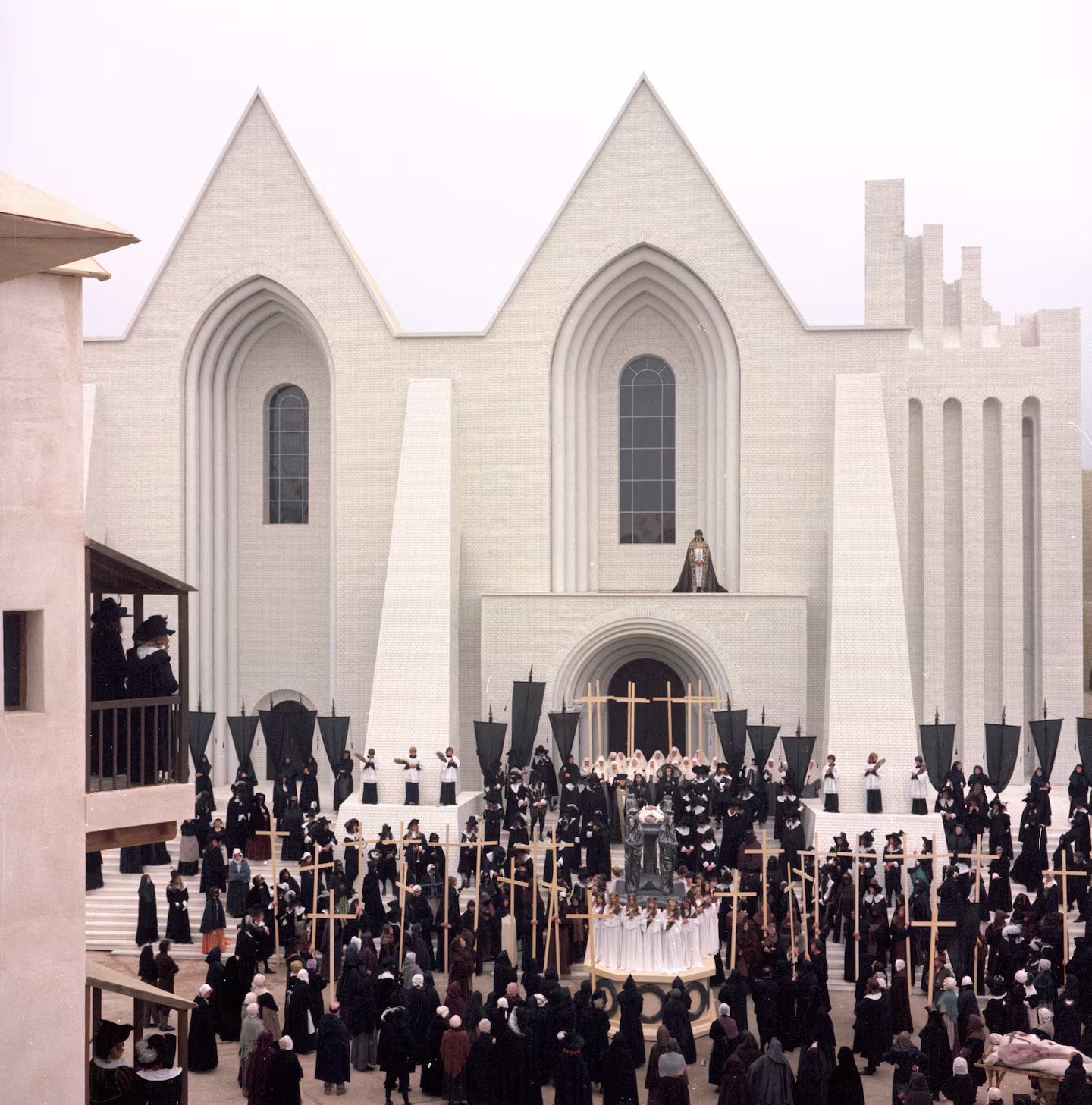
Derek Jarman’s sets construct a milieu haunted by state authority. Jarman drew upon the monumental, painterly sets of German Expressionism and Fritz Lang’s Metropolis (1928) to modernize the history and immediacy of Loudun Possessions. The convent of the Ursuline, built of white subway tiles, exudes the sterility of a sanatorium, incubating the nuns’ boredom and repression. In Richelieu’s library, bookshelves occupy prison cells, and large red crosses adorn caged doors, creating a carceral aesthetic worthy of Foucault. Comparably, the looming black fluted columns in the courtroom of Grandier’s trial evoke the oppressive atmosphere of Kafka’s The Trial (1925) (especially with its visual similarity to Orson Welles’s 1962 adaptation). As Grandier defies these set pieces that signal the state’s pervasive power, The Devils deepens Grandier’s political resistance and claim for martyrdom.
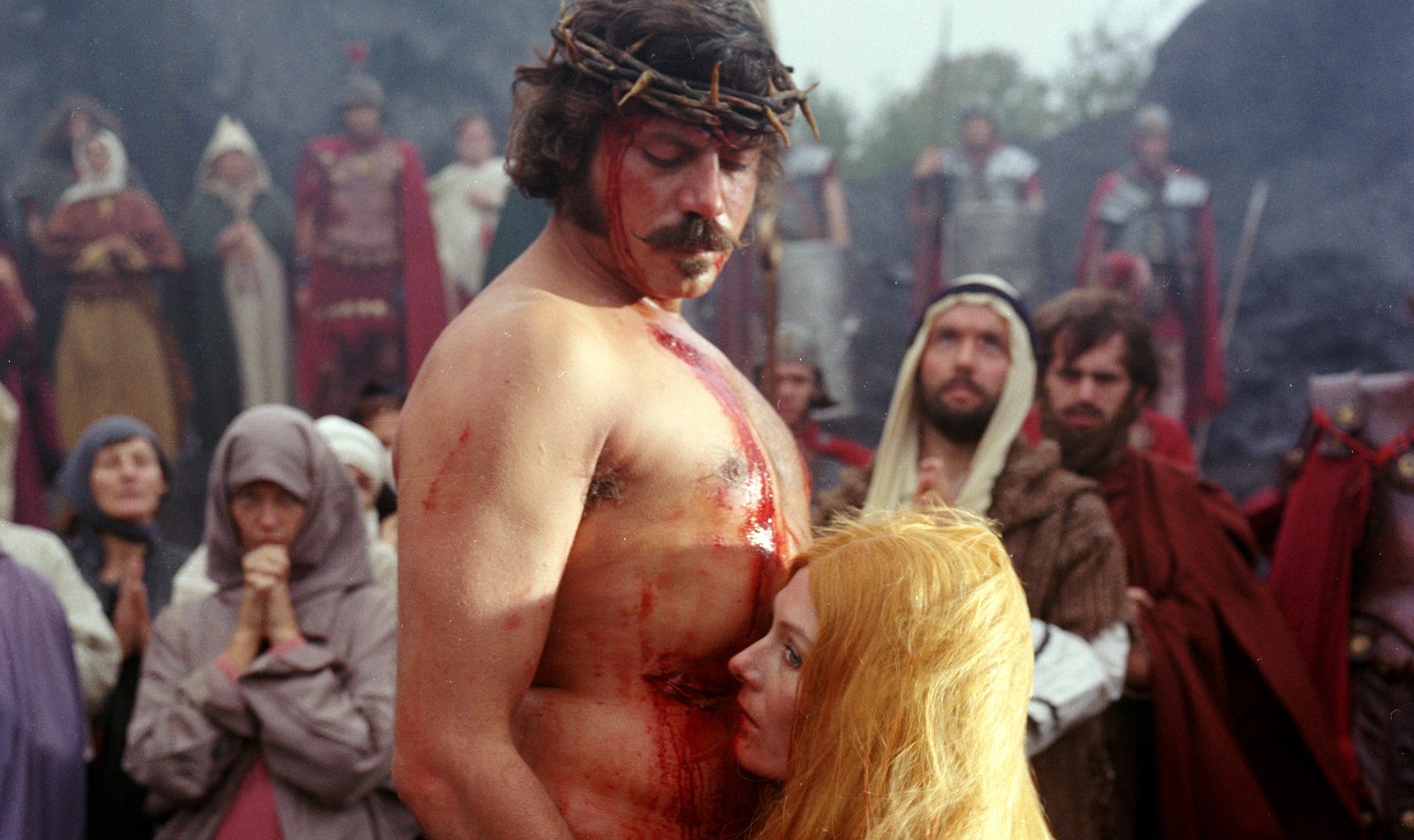
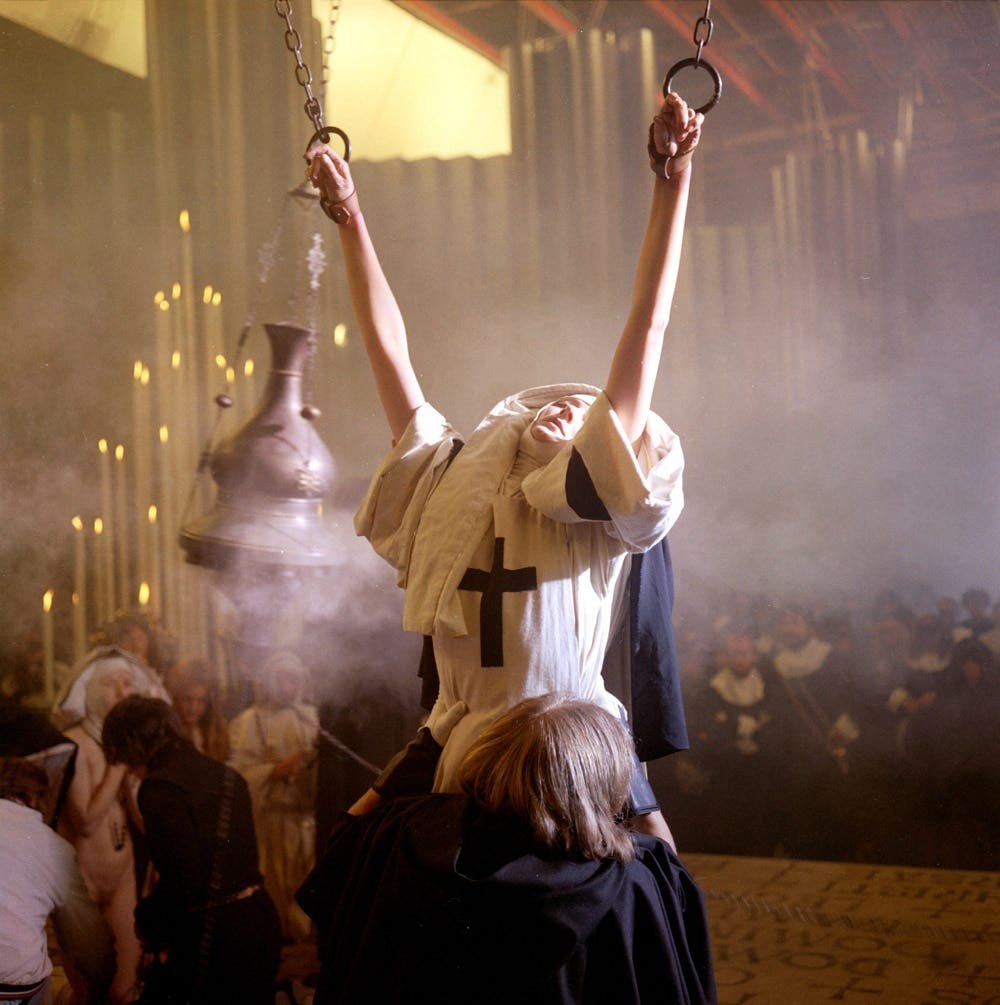
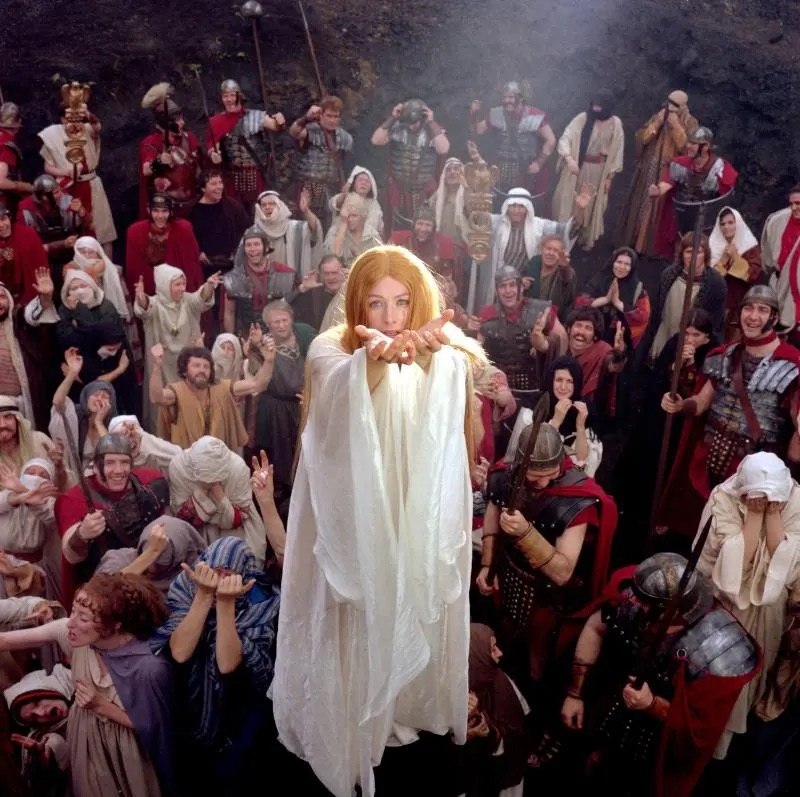
While this repression permeates most of the film, Sister Jean’s dream sequences and the climactic “Rape of Christ” scene tear that composure asunder in a supernova of viscera. In Sister Jean’s erotic fantasies, she portrays the lovelorn Mary Magdalene and Grandier Jesus. When Grandier is about to make love to Jean, her hump appears, and the onlooking crowd ridicules her. Davies’s symphonic composition erupts into a cacophony of screeching horns and violins, and Watkin’s frenzied crash zooms make the camera appear epileptic. In “The Theater of Cruelty” (1938), Artaud theorized that a multisensory force communicating beyond language can collapse the distance between the viewer and the story. Russell’s audiovisual bacchanalia functions this way, arresting passive viewing and simulating the violence for the audience. In “The Rape of Christ,” when the state finally corrupts the nuns, the brides of Christ have an orgy with his crucified body. The motif appears at the moment of absolute sexual transgression, crashing down like an iron fist. Yet, Russell intercuts the scene’s madness with Grandier’s tender delivery of the sacrament. As the director states, “the film has two themes—religious corruption and redemption—the sinner who becomes a saint.” Since the viewer feels this climactic desecration, Grandier’s steadfast faith registers all the greater.
The final act completes the testimony of Grandier’s martyrdom. Condemned for witchcraft, Grandier endures torture that Russell’s camera painstakingly details. Still, the priest maintains his innocence and his faith until his fiery death. The exaggerated violence functions as the passio (the sacred suffering) that asserts Grandier’s sanctification: in Catholicism and texts like Voragine’s Golden Legend (1265), a saint’s endurance of physical pain became evidence of steadfast faith and proximity to God. In Gothic art, depictions of bodily harm measure that passion and, by extension, testify to God’s majesty. The abjection therefore serves a moral function: Grandier’s bodily degradation distinguishes his integrity from the corruption of the state authorities who condemn him. Since the state, not pagans, tortures Grandier under the guise of religion, his refusal to confess makes him a martyr to tyranny.
Yet, with Martin Luther’s 95 Theses, the Protestant Reformation raised suspicions of the visual consumption of suffering as an ersatz spirituality, where the instinctive fascination with death is mistaken for religious rapture. In the case of The Devils, the violence may merely arouse the audience’s attention and trigger a comfortable nihilism that paralyzes political action. The film defuses this through camp and eroticism. Its absurdities, like Grandier shielding himself with a crocodile in a sword fight, and its baroque performances, like Reed’s smoldering declaration, “Satan’s boy I could never be. I haven’t the humility,” place it between excessive realism and surreality. Above all, The Devils feels like a feverish wet dream, incidentally aligning the audience’s pleasure watching such illicit content with Sister Jean’s deluded fantasies. While this distances viewers from the screen and the feeling of disgust, it invites a more imaginative engagement that requires the viewer’s active participation.
As Grandier dies, Loudun’s white walls—the symbol of the city’s independence, which he had defended—are demolished. The camera then leaves his body and follows his wife (Georgina Hale) beyond the ruined walls, along a path lined with wheels, medieval instruments of public torture. As she walks, the image drains from color to black and white. The spectacle reveals its aftermath: like when an angel dies in Sátántangó (1985), the city is left without its moral witness. Loudon will soon fall into decline, and the trials spread to other towns. By withholding catharsis, Russell makes Grandier’s martyrdom something the viewer must carry out of the theater, a reminder that the state’s violence and sham justice did not end with him and echo forward.