.webp)

Rosa Barba: “Drawing Vocabularies” at Centro de Arte Moderna Gulbenkian
Review
TJ Shin’s solo exhibition Counterweights at Final Hot Desert, London, centers on chronopolitics—the politics of time—in their ongoing inquiry into systems of valuation.
The following conversation emerged from a series of discussions with Shin around sympathetic clocks, a contemporary doublespeak for “slave clocks.” The sympathetic clock is a network of ancillary timekeeping devices synchronized by electrical impulses from a central “master clock.”
Beyond critiquing the colonial triangulation of language, Shin engages with the mass standardization of time as an infrastructure upon which British territorial expansion was premised. This synchronized time governs calendars, railways, and trade. Who is the clock sympathetic to? How do we build tactical imaginaries that unsettle a global order of time?
Our conversation takes the speculative device of the “unsympathetic clock” as a framework, positioning asynchronicity—visual, representational, and temporal—as a formal strategy through which to read Shin’s recent exhibition and their broader artistic practice.
Fiona Ye: Let’s start with your most recent solo show Counterweights. Your earlier work has engaged with temporal apparatuses drawn from empirical and historical archives—whether in relation to governance, language, or games. Temporal order has often felt present, but arguably more on the periphery of your work. In this exhibition, however, time and its administration become the central subject of investigation, tethered directly to the site and history of the British Empire. How did you start this research and arrive at this point?
TJ Shin: I’m interested in the contradiction of time and how it inherently raises the issue of form even as we speak about it. Through what medium time is represented or apportioned organizes how that object of time unfolds sequentially and comes to be experienced. Previous projects explore this relationship between legibility and medium of representation through language and moving image—and what their temporal structures might reveal about the disclosure of politics and systems of valuation.
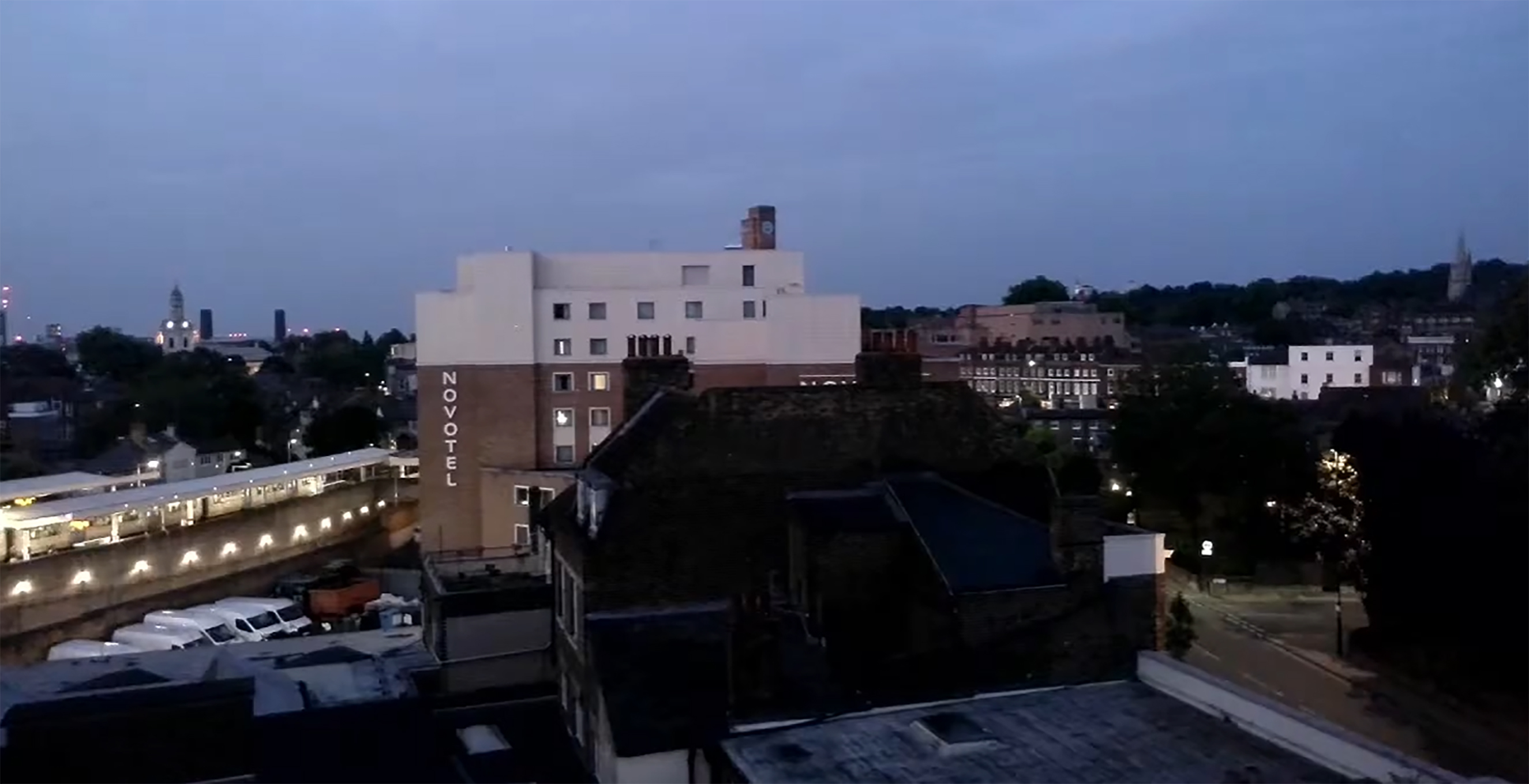
Counterweights takes timekeeping and imperial power as the center point. In 2025, I collaborated with Final Hot Desert in London to set up a remote livestream of the Royal Greenwich Observatory from a Travelodge Hotel room. The resulting video, Gotta Make Time (GMT) (2025), was simultaneously presented on July 25, 2025—at the start of the most recent lunisolar leap month—at Benny’s Video in Brooklyn. I was in Los Angeles coordinating this.
I’ve long been fascinated with the observatory’s role in drawing the world’s zero-degree longitude and how it intersects with Britain’s history of imperialism. I grew up observing the lunar year, and became interested in slippages across different calendrical systems; in this instance, the insertion of a leap month in the lunisolar calendar to close the gap between the lunar year and the solar year, which organizes global timekeeping. How do we qualify this period of time? Is the leap month anticipatory time, spectral time, inexistent time? How does this evaluation change based on which calendar we determine gives the leap month its status?
I wanted to think beyond the paradigm of a universal standard, and how this implicitly already sets up a structure in which a position is cast to the margins if outside the privileged center. Even as a medium that promises immediacy, the GMT lags heavily. The livestream was made possible through remote engagement. It offers an unpicturesque view of the observatory. There are moments of surprise within its duration and frame. I like how GMT offers a different relationship to synchronization, a mark of time unfolding simultaneously through its succession and endurance.
FY: It’s really interesting to see how you tend to this temporal gap formally, thinking about how standardized time can be hacked, delayed, and even multiplied. I wanted to bring the focus to the Prime Meridian here, which defines locales under colonial governance—whether geographical, celestial, or metaphorical. This is related to your ongoing research interest in the spatialization of time. Can you speak about how this idea was translated into the show?
TS: Henri Bergson defines extensivity as a spatial mode of comparison, placing and arranging temporal states alongside one another to form a discrete sequence. Time is literally unfolded and retrospected into an object of evaluation, retracing the trajectory of the motion and length traversed as a line through space.
The Prime Meridian directly follows this logic. The British Empire, as the world’s largest colonial power with its vast network of naval fleets in the 19th to the early 20th century, faced shipwrecks and difficulty finding ports; ships had to leave and return on predictable schedules amid its expanding maritime power. Finding your latitude (North-South position) was relatively easy by measuring the angle of the sun above the horizon line. But finding your longitude (East-West position) depended on establishing a prior starting point in order to compare time at two places simultaneously.
The Royal Greenwich Observatory soon became that fixed reference point. The “master-slave” telegraph railway network automated electric signals, distributing standardized time to recipient clocks and imperial observatories in South Africa, India, and other colonies. In turning multiple local timelines into an imperial coordinate, space is literalized as a temporal distance: a measure of progression that relegates distant subjects and places as lagging behind or catching up, using the logic of developmentalism to cast the “Orient” or the “Global South” as underdeveloped, uncivilized, and backward. Time is conceived as management for the production of modernity.
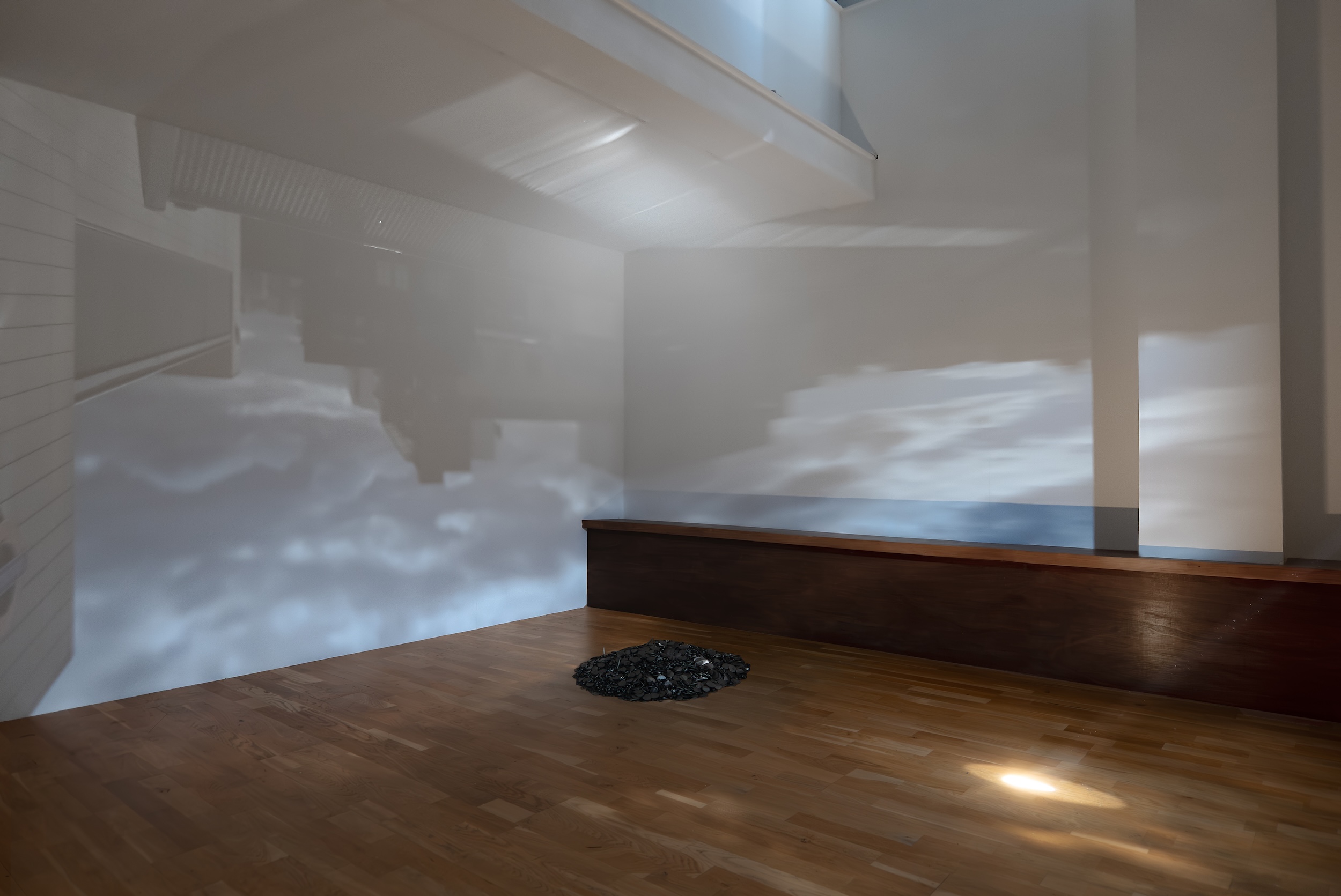
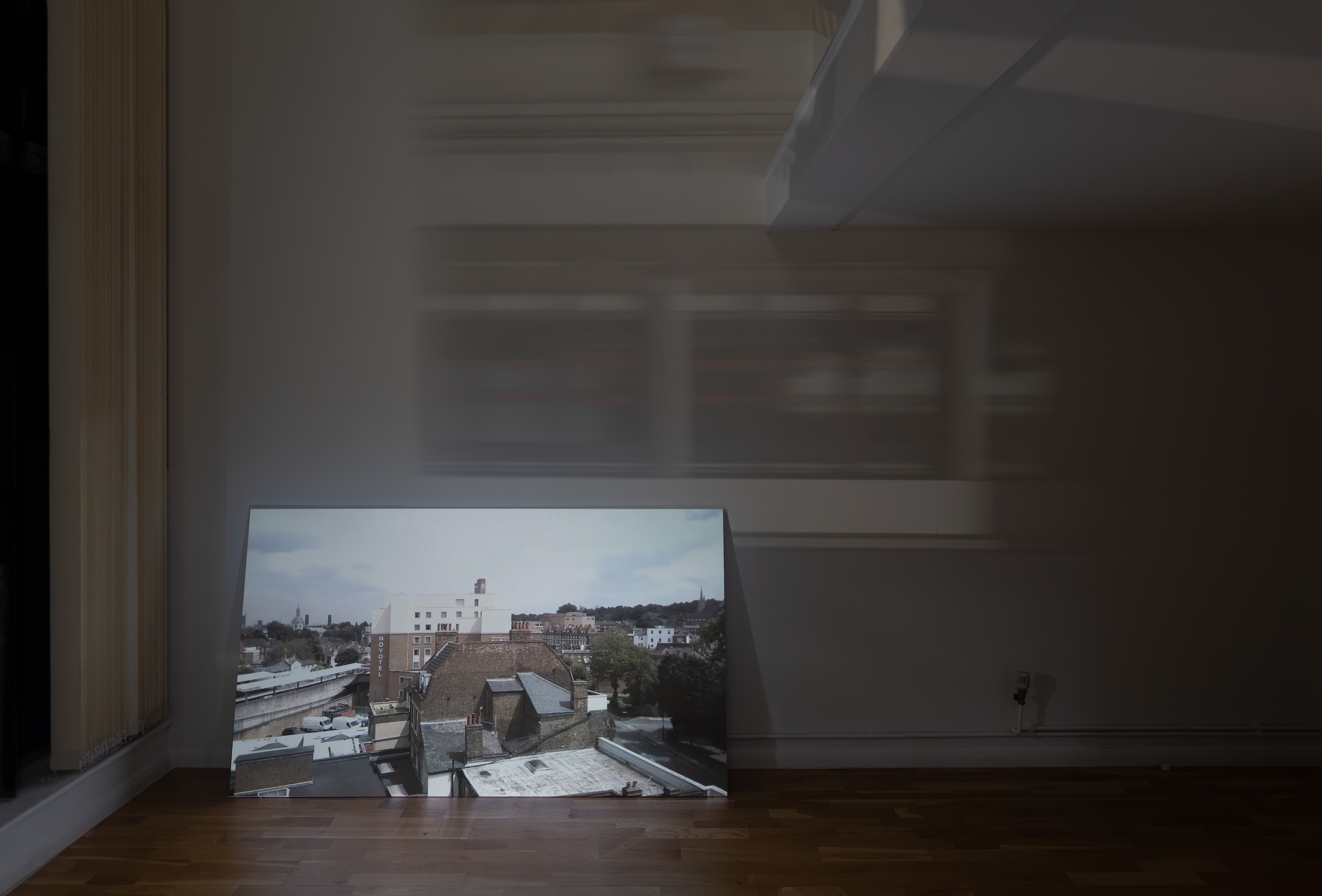
In Counterweights, a camera obscura projects an inverted view of the oncoming overground train and its surrounding landscape. The camera obscura was an early astronomical instrument that extended the observer’s eye to the center dial of the cosmos, whereby vision was mechanized and made repeatable. But in the gallery space, the landscape just spills. Counter to unfolded time, Bergson proposes unfolding time, describing it as drawing an instantaneous mark on a piece of paper. I liked this idea of facing the train in motion, encountering this momentum and directed movement; collision as a mark where contingency strikes.
FY: Right—this spatial hierarchy imposed by the modern notion of time is potent in part because of what Rolando Vázquez has argued: that modernity’s time designates certain places in the present as the “site of the real,” while places cast in the “past” are closed off to live encounters and contemporaneity. Who is granted the legitimacy to articulate their own stories and produce visibility is a deeply temporal concern. This is what drew me to your essay, “Paranoiac Time, Desynchronic Time,” published by Asia Art Archive in 2024. You quoted a passage from Dictée, in which Theresa Hak Kyung Cha reflected on the neutralized production and distribution of a historical record. In the same passage, Cha noted the conceptual homogenization of all “distant lands” under colonial subjugation, which speaks to this colonial impulse to abstract the other. This feels particularly pertinent to how timekeeping operates: there is a center, while others remain indexical to it.
TS: That passage from Dictée by Cha has been deeply influential for me because I think she’s naming a similar contradiction. What is the role of the historical document that simultaneously names a singular event while at the same time being effaced of its transgression through the very register of its diachronic record? How is its legibility as history compromised in the moment of its inscription, made homogeneous and undifferentiated in kind with other past events? How might we name this indeterminate event appearing in a determinate world as a form of multiplicity?
Cha has a collection of poems called Temps Morts, translating to dead time. I think about her writing in relation to her interest in exilic time. I wanted to be in dialogue with her, in a way. My experimental text is titled Crash (Temps Forts) (2026), translating loosely to intensive time.
My text takes Henri Poincaré’s thought experiment at the French Bureau of Longitude as the starting point. At the turn of the 20th century, modernity’s infrastructure, with its transit and railway networks, created the demands and conditions for its expansion and interconnection. Likewise, Poincaré was responsible for refining East-West longitude, determining via telegraph signals whether events across vast distances occurred at a precise, shared instant. Instead of thinking about temporal synchronization as extension—time made divisible and identical, subtending from one interval to another—I wanted to think about synchronization as collision, differences encountering and crossing one another.
The text itself explores different temporal states following a chiastic pattern, reversing and crossing referential frames that oscillate from generality to the particular, from observing subject to the observed. What happens when the deictic structure—“here”, “I”, “now”—becomes permeable? How is something made relative to what? I was interested in how simultaneity might be deposited into language itself—how we fix as relative alters who is speaking, and what comes to mean.
FY: In a way, this linguistic play can act as a stylistic device against an imposition of a dominant language, which is often quite violent. When language is refracted, as is the case with Dictée or Crash (Temps Forts), other times suddenly become possible within this new set of ruptures. You mentioned dead time, exilic time, and intensive time—I’d be curious to talk more about a different kind of time: stolen time, which is suggested in the title of your work, rubato (counterweights) (2026).
TS: Rubato is a musical term that allows a performer to speed up or slow down the tempo while still maintaining a strict metronomic beat. It’s a method of give-and-take. A performer can steal time from one beat by compressing it, as long as they pay it back by slowing down somewhere else. Time is borrowed and returned.
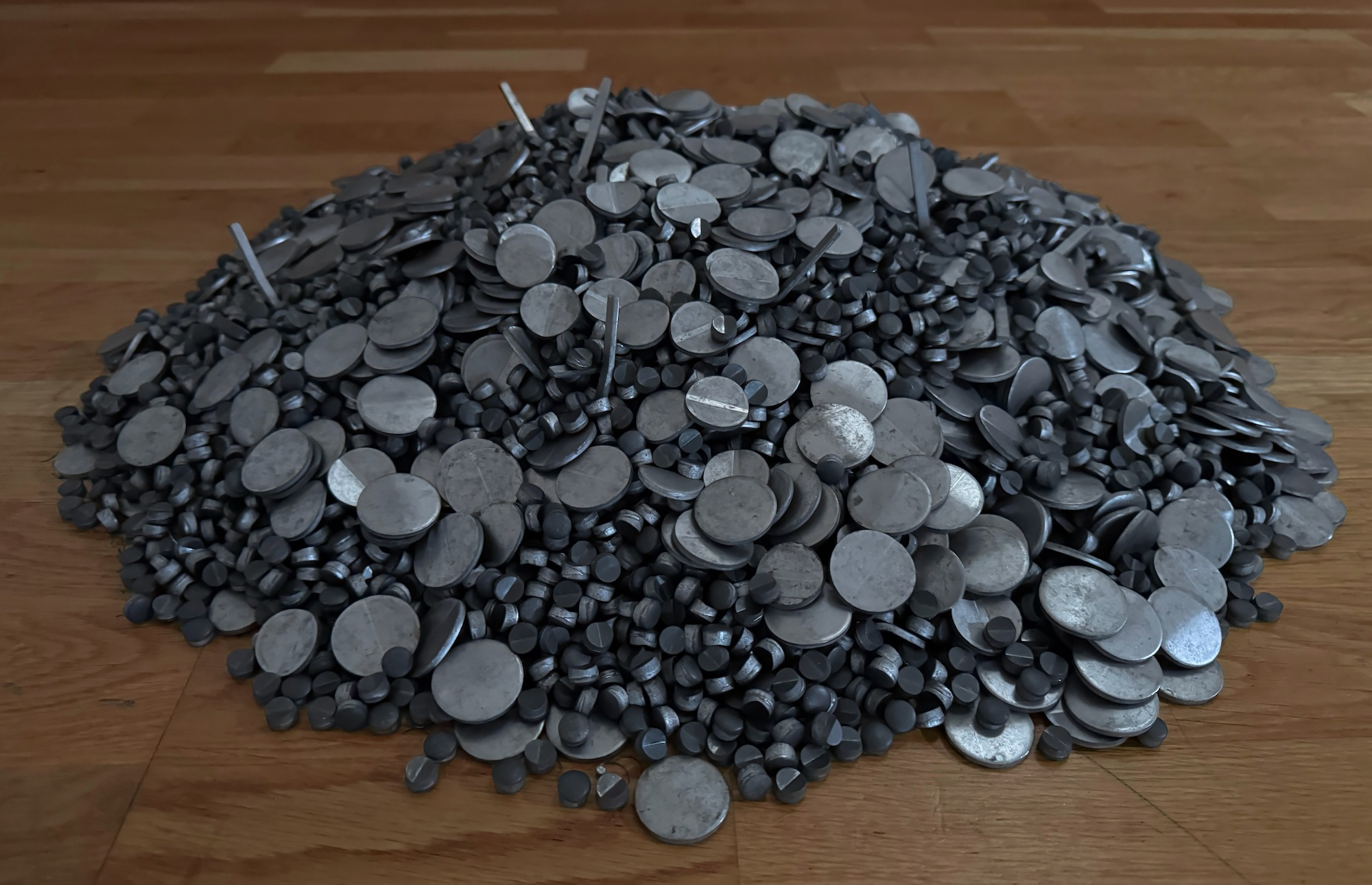
I was interested in how the Big Ben clock uses pre-decimal pennies to weigh its pendulum to calibrate time, since it exists outside the automated railway telegraph network. Legal tender functions as a fixed mass that exchanges weight, time, and value. I was curious to see this directly in front of me, the material displacement that would upend Big Ben’s rate from solar to lunar time. I found an industrial steel manufacturer in Ireland that would sell me 60.8kg. of steel punchings for £26.80—keeping with the value per weight ratio.
There’s slippage in this stack of mass, tethered to its system of calibration yet existing outside its valuation, represented through industrial waste. It borrows the logic of Big Ben’s conversion, paying off this lunar difference. Is this “heap” an object, an event, a score, or material evidence? I’m not sure, but there’s a material resistance in this piece that I really enjoy.
FY: What about material displacement interests you?
TS: I’m interested in using a given system of valuation and upending the logic to expose its structural instability. If imperial discipline functions by stabilizing subjects and places as fixed coordinates, then its power relies on the arrangement of their relations to reproduce itself. It assumes these positions, like the colonial observatories and governed subjects, are fixed, but really they’re mutable. It’s as provisional as our reliance on these rules and rubrics for its operation. The pre-decimal pennies expose the continual calibration necessary to maintain itself. I like to work around the material gaps to understand where power elides in its sequence.
FY: I wanted to go back to your idea of synchronization as collision. In the gallery, you’ve built these parallel temporal pockets, each with its own duration and speed. You did this by using various representational frames: the digital recording of Royal Greenwich Observatory and the live projection of Haggerston Overground Station. Both read as a form of documentation; the former is diachronic while the other is more transitory and mutable, contingent on light and movement, which cannot be captured and therefore archived. Can you speak a bit more about this parallel?
TS: I recently revisited one of Sergei Eisenstein’s texts in Film Form (1949), where he defines montage as collision, a conflict between two shots in opposition to each other, out of which a concept or image arises.
Whereas Eisenstein approaches collision as a dialectical synthesis of oppositions in the production of a moving image, I’m more interested in resistance that produces suspension. Gotta Make Time (GMT) marks the passage of time as it aligns lunar and solar time. Material waste in rubato (counterweights) overturns solar time back to lunar time. The camera obscura inverts its internal chamber into a bending field. Seemingly like a contradiction and effacement, perhaps, it’s another strike for contingency.
FY: What does an unsympathetic clock mean to you?
TS: Multiplicity, on collision.
This interview has been edited for clarity and length.
Counterweights is on view at Final Hot Desert from September 5 to October 24, 2026.